The Battle of the Little Bighorn did not end with George Armstrong Custer’s death. What followed was a scene of such brutality that the U. S. Army deliberately concealed details from the American public for years, including from Custer’s own widow.
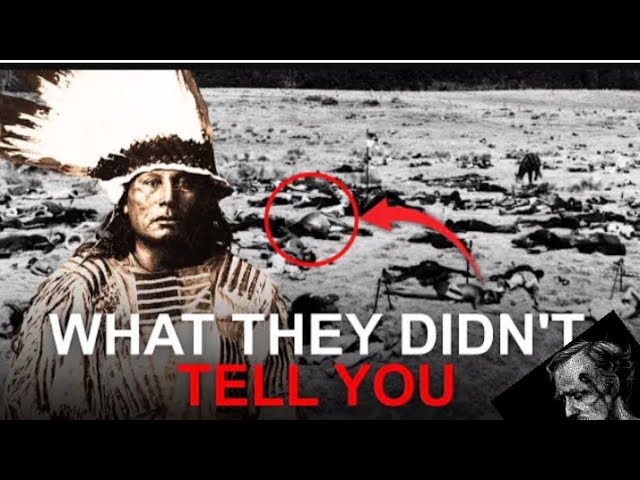
For the victorious Lakota and Cheyenne warriors, looting the fallen soldiers was a natural first step. The dead had weapons, clothing, jewelry, badges, and horses, all considered rightful spoils of war. Lakota warrior Brave Bear described the aftermath: “There was much commotion and disputes over the horses and firearms that were seized. The Indians were telling one another, I have some tobacco.
I have coffee. I have a fine gun. ”
The looting showed little regard for the dead. Nearly all the fallen soldiers were stripped of their garments and left to decompose in the sun.
Feet were severed to remove boots more easily. For hours, warriors removed scalps from the dead as war trophies. Native accounts also describe women from the camp approaching and desecrating the bodies. Two Cheyenne women claimed they had driven an awl into Custer’s ears.
Years later, it was revealed that someone had forced an arrow into an unspeakable location in Custer’s trousers, a detail the army kept secret to spare his widow. Lakota warrior Iron Hawk recalled witnessing two elderly women strip a corpse and begin dismembering him, only for the soldier to suddenly rise and try to fend them off. The soldier was swiftly killed, but Iron Hawk found the sight of a naked man trying to repel two elderly women humorous. Sitting Bull reportedly cautioned that his warriors would incur a curse if they disturbed the dead, though historians note that his interviews occurred years after his defeat, and he may have been distancing himself from actions the public found scandalous.
The battle was not over with Custer’s death. Most of the Seventh Cavalry remained alive under Major Marcus Reno and Captain Frederick Benteen, entrenched at Reno Hill. Sitting Bull’s warriors assaulted them through the night of June 25 and all day on June 26, only stopping on the morning of June 27 when scouts spotted incoming American reinforcements. Reno and Benteen had been too focused on survival to know what happened to Custer.
It was the reinforcements led by General Alfred Terry and Colonel John Gibbon who first understood the magnitude of the catastrophe. Gibbon’s scouts were the first to encounter the bloodied garments of American officers in abandoned camps near the battlefield, plundered from the dead but left behind during Sitting Bull’s retreat. Then a second scout arrived with even more dire news: he had counted 197 dead bodies lying in the hills. When asked if they were white men, the scout confirmed they were.
Terry and Gibbon feared the entire Seventh Cavalry might have been annihilated, but their scouts soon located survivors from Benteen and Reno’s commands on the nearby hills. Benteen and Reno were battered but alive, with most of their men intact. Both were unaware of Custer’s calamity and had presumed he had deserted them. They were swiftly corrected.
Benteen and a portion of his men were sent to locate Custer. What they found was devastation. The naked corpses of their comrades had begun to decompose after two days under the scorching Montana sun. They first found the bodies of L Company, commanded by Custer’s brother-in-law, Lieutenant James Calhoun.
The bodies remained in the defensive formation they had assumed in their final moments at the summit of Calhoun Hill. Most of the other bodies did not show such a formation. It was unclear whether they had been killed in a panic or if the Native Americans had subsequently moved them. Another group of bodies was concentrated on what became known as Last Stand Hill.
Private Jacob Adams was the first to discover the commanding officer of the Seventh. He called Captain Benteen, who rushed over to verify the identity. “By God,” Benteen exclaimed. “That is him.
”
George Custer’s body was found near the summit of Last Stand Hill, 20 feet away from his brother, Tom. Like the other men, he had been stripped of all clothing except his socks. General Custer had not been scalped, although Tom had been. The body was discovered upright, leaning against the corpses of two other soldiers as if at rest, with a facial expression resembling a man who had simply fallen asleep.
Lieutenant James Bradley later noted that the remaining 200 bodies from Custer’s command were strewn between the hills and the river near Sitting Bull’s abandoned camp. In a letter to a newspaper, Bradley told the public that the remains had not been subjected to severe mistreatment, claiming there was minimal mutilation and that the injuries he observed seemed to result from the act of finishing off a wounded individual. He was not truthful. Private Charles Windolph, one of the soldiers who accompanied Benteen to the battlefield, later remarked: “It was considerate of him to protect the feelings of the relatives, but the bodies were indeed severely mutilated.
Some were so badly damaged that it was difficult to discuss. ”
Isaiah Dorman, a Black scout, was extensively mutilated, and the enemy had left a kettle filled with his own blood beside him as an insult. Most bodies had been scalped. Many had been pierced with arrows or had suffered blunt force trauma from axes or hammers after death.
Custer did not escape this treatment. Officially, soldiers documented only two bullet wounds, one in the chest just below the heart and another in the left temple, either of which could have proved fatal, plus a knife wound in the thigh. The soldiers agreed not to disclose that an arrow had been inserted in a humiliating location in his trousers. The detail was kept confidential for many years.
Tom Custer had suffered even more severe injuries. He had been scalped, his skull crushed, and he had been disemboweled. Had it not been for a tattoo on his arm, he would have been unidentifiable. Because two days had passed since the battle, the bodies were already decomposing when discovered.
The summer sun in Montana exacerbated the situation significantly. Colonel Gibbon acknowledged that the bodies had become quite offensive by the time he arrived. The sight and odor left an indelible mark on those who witnessed it. Most people assume everyone on Custer’s Hill was dead by the time Benteen arrived.
This is not entirely accurate. Private Jacob Adams, who claimed to be the first to find Custer, made another astonishing discovery on the same hill. As the soldiers navigated through the devastation, they heard a distressed sound. A lone survivor called out: a 14-year-old bay horse named Comanche, belonging to one of Custer’s officers whose body lay nearby.
Comanche had sustained seven separate wounds from bullets and arrows and had not had water for days. Yet he remained by his master’s side. Despite his injuries, Comanche managed to stand and rejoin the Seventh Cavalry. He recovered and enjoyed a long retirement as the regiment’s mascot before dying in 1891, receiving one of only four military funerals ever given to a horse in U.
S. history. June 27 was spent counting and identifying the dead. Many bodies could not be identified, and even those that were identified often lacked certainty.
Nineteen bodies from the battle were never located. In subsequent years, human remains continued to be discovered in the surrounding hills, indicating that some men may have escaped the initial chaos at Last Stand Hill only to be hunted down later. On the morning of June 28, soldiers began burying the dead. Benteen’s party counted 208 bodies to be interred that day, while Lieutenant Bradley noted 206.
Whatever the actual number, it was a hurried task. They feared Sitting Bull or other hostile Native Americans might appear, so they could not afford the time to dig 200 proper graves. Most of the deceased were interred together in hastily dug mass graves or shallow graves at the locations where they fell. Custer and his brother Tom were laid to rest together.
A grave was excavated at the base of the hill, barely two feet deep, just sufficient to cover the bodies. The brothers were wrapped in canvas and placed side by side. A small sled and a circle of stones were positioned to deter scavengers. Conflicting reports exist regarding who precisely dug the grave, with several men eager to claim the honor.
By 6:30 p. m. , the task was complete. General Terry was eager to depart and begin the long march back to the main Big Horn River.
There were still 50 injured men requiring proper medical attention, and news of the defeat needed to be relayed to authorities. Medics did their best on the journey, performing at least one leg amputation, though several men unfortunately succumbed to their injuries. The aftermath took a significant toll on survivors. Major Reno resorted to alcohol, purchasing 11 gallons of whiskey in the 22 days following his return.
Captain Benteen also turned to drinking, resulting in a drunken altercation with Captain Thomas Weir, who held Benteen responsible for abandoning Custer during the battle. Benteen challenged Weir to a duel, which Weir declined. Weir could not bear the guilt for long and was found dead in his hotel room in New York in December 1876. The steamer Far West sped up the Missouri River carrying news of the defeat and 38 of the wounded.
It broke speed records, completing the 710-mile journey back to Fort Abraham Lincoln in under three days. The sound of the ship’s arrival roused Libbie Custer before dawn on July 6. Shortly after 7 a. m.
, senior officers knocked on her door. Libbie hurried to the door, where the officers insisted on speaking with her privately. By this time, her sister-in-law Maggie was also awake, eager for news about her brothers and her husband, Lieutenant James Calhoun. The officers escorted the women to the parlor and conveyed the heartbreaking news.
Libbie and George had been teenage sweethearts, married for 12 years. Their surviving love letters illustrate the depth of their affection. Lieutenant Gurley, one of the officers, recalled it as one of the most difficult tasks he had ever undertaken. Despite her grief, Libbie insisted on accompanying the officers to inform the other 26 women in the fort who had become widows.
The remainder of Libbie Custer’s life was shaped by her loss. She defended her husband’s legacy and held Reno and Benteen accountable for the disaster until her death in 1933. The news became public on July 7, when Washington received the telegram just three days after celebrating the nation’s 100th birthday. Custer’s defeat shocked the country and dominated newspapers for days as speculation ran rampant.
Many began searching for someone to blame: Custer’s recklessness, Benteen’s and Reno’s shortcomings. The nation mourned one of the most significant defeats it would ever endure at the hands of the Native Americans.