On December 11th, 1964, Sam Cooke, the man whose warm, intimate voice had carried him from gospel churches to the top of the pop charts, was shot and killed at a Los Angeles motel. He was 33 years old. The motel manager, Bertha Franklin, said she fired in self-defense, and a coroner’s jury accepted that account. But his family spent the rest of their lives questioning what truly happened that night.
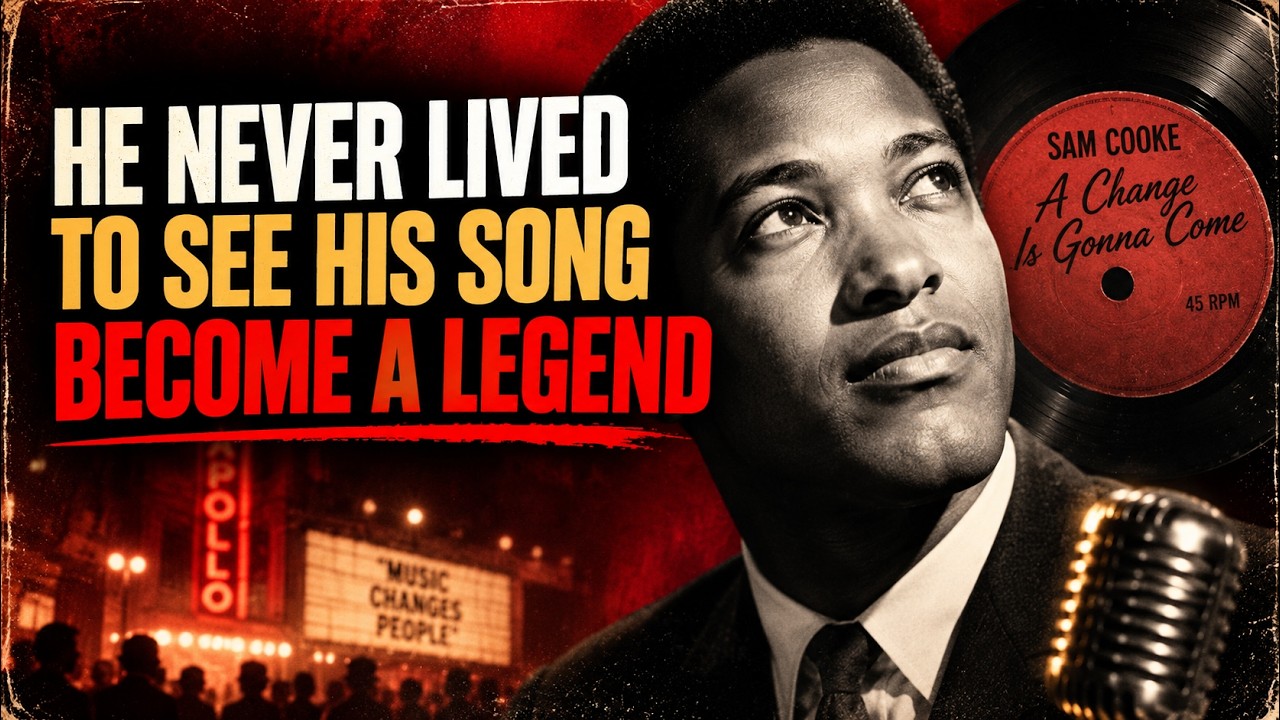
To know Sam Cooke only by his death, however, is to miss the extraordinary life that preceded it. Born on January 22nd, 1931 in Clarksdale, Mississippi, he was the son of Reverend Charles Cook. When Sam was about two, the family moved north to Chicago, part of the Great Migration that carried Black families from the segregated South toward new possibilities. Sam grew up in the Bronzeville neighborhood of Chicago’s South Side, where he attended Doolittle Elementary and Wendell Phillips High School.
Music surrounded him from his earliest years, and the strongest influence was gospel. Along with several siblings, he sang as the Singing Children, performing before congregations that already knew the words and the faith. That early training taught him something essential. A familiar hymn could become an event if the singer believed in the moment of saying it.
Long before a commercial microphone was in his hands, Sam was learning how to make a line feel newly alive. During his teenage years, he joined the Highway QCs, a Chicago gospel group where he learned to listen as much as to lead. Then in 1950, a much larger opportunity opened. The Soul Stirrers, one of the most renowned gospel groups in the country, needed a lead singer after the departure of R.
H. Harris. Sam, only 19, stepped into the role. Sam became a gospel star in his own right.
For the next several years, the Soul Stirrers took him across the country, where he learned to navigate segregation on the road and the demanding practicalities of a musical life. He also learned how to shape an audience’s response, leaving room in a performance for the listeners to become part of the moment. He began writing songs that suited the emotional journeys he could tell. “Touch the Hem of His Garment,” a biblical encounter presented through the movement of a person toward help, showed a gift for placing an entire condition inside something simple enough to remember.
Yet gospel did not contain all his interests. He listened to popular singers like Nat King Cole, whose warmth and elegant restraint commanded a broad audience across racial lines. Sam wanted to understand that other way of holding a room. In 1956, Sam began making secular recordings.
One of the first, “Lovable,” was released under the name Dale Cook, a thin disguise intended to separate the experiment from his gospel identity. The disguise could change the name on the label, but it could not change the voice. His father’s acceptance of the change was especially important, and he had the support of producer Bumps Blackwell. In 1957, the decisive record appeared on Keen, a small Los Angeles label.
It was “You Send Me. ” There is almost nothing intimidating about the recording. The melody is easy to enter, the language is direct, and Sam begins as though the listener has joined him in the middle of a conversation. The record reached the top of the American pop and R&B charts and sold more than a million copies.
He was 26. Television audiences saw him on the Ed Sullivan Show on November 3rd, 1957, but the program ran out of time just as he began performing. Complaints reached the show, and Sam was invited back. On December 1st, Sullivan gave him the full opportunity, acknowledging the earlier mistake.
The composure, the smile, and the voice traveled across the screen into living rooms across the country. Success brought bookings and expectations. In March 1958, Sam took his act to the Copacabana in New York. His first engagement there was not a triumph; the polished nightclub act he would later develop had not yet formed.
The voice was exceptional, but a career still had to be learned. Away from the stage, his private life was already complicated. In 1953, during his gospel years, he married singer and dancer Dolores Milligan; the marriage ended in divorce in 1958. He had an earlier relationship with Barbara Campbell, whom he knew from Chicago.
Their daughter, Linda, was born in 1953, years before Sam and Barbara married. In November 1958, Sam’s life nearly ended in a road accident. The driver, Edward Cunningham, was killed. Sam survived, as did guitarist Clifton White and singer Lou Rawls, who was seriously injured.
In 1959, Dolores died in an automobile collision, and Sam paid her funeral expenses. That year, Sam married Barbara in Chicago, with his father conducting the ceremony. Their family grew. Tracy, a second daughter, was born in 1960, and Vincent, their son, followed in 1961.
They made their home in the Los Angeles area. By the end of the 1950s, Sam was learning to ask questions that went beyond how much he would be paid for the next show. Who controlled a song after it was recorded? Who collected money when another singer performed it?
Who owned the recording itself? With J. W. Alexander, a musician and experienced figure from the gospel world, Sam began building a practical structure.
In 1959, they established Kags Music for publishing and developed SAR Records with Roy Crane, whose connection to Sam went back to the Soul Stirrers. The label’s name drew on Sam, Alexander, and Roy. The distinction between composition and recording mattered deeply. A song is the words and music.
A particular recorded performance is something else. The publishing rights and the rights in the recording can belong to different people. For a successful singer who also wrote, that distinction could determine whether a hit brought only a temporary burst of income or continued to support him over time. In 1960, Sam moved to RCA Victor, placing his own recording career inside one of the largest companies in the industry while his publishing and label ventures continued separately.
One of his first major RCA successes was “Chain Gang,” released in 1960, with its instantly recognizable rhythmic weight and image of men working under confinement. “Wonderful World,” released that same year, moves differently. Its humor rests on a young speaker’s awkwardness before the person he loves. The record is often treated as simple because it is so easy to remember, but the simplicity is not the absence of craft.
“Cupid” in 1961 supplied another compact piece of theater, a lover appealing for help. “Twistin’ the Night Away” in 1962 opened the door onto a party. The voice could move from tenderness to sociability without losing its identity. That quality is especially strong in “Bring It On Home to Me,” recorded in 1962, with Lou Rawls singing the answering part.
Sam’s higher voice and Rawls’ lower one created a conversation inside the performance, giving the plea company. On January 12th, 1963, Sam performed at Miami’s Harlem Square Club before an audience ready to participate. The recording made that night reveals a different side of him. The voice has grain.
It catches, presses, and opens into a shout. The polished sweetness familiar from the singles has not disappeared, but it is no longer the only color. RCA did not release the recording at the time. The tapes remained unissued until 1985.
The club recording presented a rougher, more direct Sam than the mainstream image the company had been cultivating. A few weeks after Harlem Square, he entered the studio for the sessions that became “Night Beat. ” Billy Preston, still a teenager, played organ. The small instrumental setting left room for the voice to stand almost unprotected.
Then in June 1963, a loss arrived that no public success could answer. Vincent drowned in the family swimming pool. He was 18 months old. People close to Sam remembered a change in him afterward.
The loss belonged to both parents, and the tragedy deepened the difficulties already described in family accounts. In October 1963, Sam and Barbara were traveling through Louisiana. At a Holiday Inn in Shreveport, rooms had been reserved in advance. At the desk, they were told there were none available.
Sam protested. According to accounts collected by his biographer, Barbara and his brother Charles urged him to leave as the confrontation intensified. They drove away, Sam sounding the horn. The hotel manager complained to police.
The group went to a Black-owned hotel, where officers arrested them on a public disturbance charge. Sam performed at the municipal auditorium that evening. The humiliation placed a limit against the scale of his achievement. Success could carry him into public view without providing the ordinary acceptance that many strangers could take for granted.
That humiliation has been linked to the period in which Sam wrote “A Change Is Gonna Come. ” Other influences were present. Bob Dylan’s “Blowin’ in the Wind” had unsettled him. According to recollections passed on by Alexander and others, he was struck that a young white songwriter had expressed something he felt he should have been able to say himself.
On January 30th, 1964, he recorded “A Change Is Gonna Come” in Hollywood. The arrangement by René Hall was broad, with strings, brass, and percussion. The voice can grow strong and then draw inward, allowing the listener to hear why hope is difficult. On February 7th, he performed it on The Tonight Show.
Later that February, Sam went to Miami Beach to watch Cassius Clay challenge Sonny Liston. On February 25th, Clay won. After the victory, Sam joined Clay, Malcolm X, and football player Jim Brown at the Hampton House, four public men briefly together away from the main celebration. At SAR, Sam was working with younger performers.
Bobby Womack was born in 1944, 13 years after Sam. He had grown up singing gospel with his brothers in Cleveland. At SAR, they became the Valentinos, and “Lookin’ for a Love” gave them a successful record. In the spring of 1964, the Valentinos recorded “It’s All Over Now,” written by Bobby and his sister-in-law, Shirley Womack, with Sam producing.
The Rolling Stones heard the song and recorded their own version. That summer, it became their first number one single in Britain. Bobby later remembered being unhappy at first. In his telling, Sam urged him to recognize what could happen through songwriting income.
That summer, Sam also returned to the Copacabana, the room that had exposed the limits of his nightclub preparation six years earlier. The performances recorded on July 7th and 8th became “Sam Cooke at the Copa. ” He sang “Blowin’ in the Wind” there. His program also drew on the communal force of gospel.
He recorded “Shake” before his death, its energy pointing outward toward movement and an audience rather than toward farewell. He had been making joyful records even after the loss of his son. On the evening of December 10th, 1964, Sam was at Martoni’s, an Italian restaurant in Hollywood. Witnesses remembered him carrying a substantial amount of cash.
At Martoni’s, he met Elisa Boyer, who was 22. They left together in his Ferrari. Later that night, they arrived at the Hacienda Motel on South Figueroa Street. Boyer told police she had asked Sam to take her home and that he took her to the motel instead.
According to Franklin, Sam registered them as a married couple. Inside the room, only Sam and Boyer were present. Sam would not survive to give his account. Boyer said Sam became sexually aggressive and began removing her clothes against her wishes.
She described taking an opportunity to escape while he was in the bathroom, and said that in gathering her own clothes, she also took some of his, including his trousers. In her account, that had been accidental. She later called police and reported that she had been kidnapped. Back at the motel, Sam was without his trousers.
Franklin described him approaching her quarters, wearing a sport coat and one shoe, demanding to know where the woman had gone. According to her account, he forced his way through the door, and the encounter became physical. She said Sam attacked her, that she feared for her safety, and that she obtained a . 22 caliber handgun and fired.
Published accounts described three shots, with one bullet striking him. According to Franklin, he reacted with the words, “Lady, you shot me. ” Her testimony is the source of the sentence so often repeated as his last. She also said that he continued toward her after the shot and that she struck him with a broom handle before he finally fell.
Police arrived to find Sam Cooke dead. He had been alive at a Hollywood restaurant only hours earlier. On December 16th, a coroner’s jury heard evidence and returned a finding of justifiable homicide. Franklin was not prosecuted.
The finding concerns the circumstances in which she used lethal force. It should not be expanded into a separate criminal verdict establishing every detail of Boyer’s allegations. Sam had no opportunity to answer them. For his brother L.
C. and others close to him, the official explanation remained deeply troubling. There were questions about the missing money. Witnesses had remembered cash at Martoni’s, and the amount found afterward did not satisfy people who believed Sam had been robbed.
The singer Etta James later described being disturbed by the appearance of Sam’s body when she saw it. Muhammad Ali questioned the investigation. The wider history of unequal treatment by police made distrust understandable. Over time, theories about an organized killing became attached to Sam’s growing business independence.
No persuasive, independently established evidence has demonstrated such a plot. The public farewells took place in two cities central to his adult story. On December 18th, mourners gathered at A. R.
Leak Funeral Home in Chicago. The next day, a service was held at Mount Sinai Baptist Church in Los Angeles. Ray Charles sang and played “The Angels Keep Watching Over Me. ” Sam was buried at Forest Lawn Memorial Park in Glendale, California.
On December 22nd, the single pairing “Shake” with “A Change Is Gonna Come” was released. Hearing a living performance by a dead man was unavoidable. The song’s weariness, uncertainty, and hope had been present before the news. It became an enduring anthem associated with the civil rights movement, offering a language in which suffering and expectation could exist together.
In March of 1965, Barbara married Bobby Womack. He was 21. To many relatives and admirers, the marriage felt like a betrayal. Womack later described Sam asking him to look after Barbara should anything happen, a recollection from Womack himself rather than an independently confirmed instruction.
The marriage eventually ended. Linda later married Cecil Womack, Bobby’s younger brother. Together they became the musical partnership Womack & Womack. Barbara and Sam’s granddaughter, Nicole Cooke-Johnson, formed Royalty Firm in 2008 to manage publishing interests and develop his legacy.
Barbara died in 2021. Sam’s music continued traveling. Otis Redding recorded his songs. Aretha Franklin interpreted “A Change Is Gonna Come.
” Rod Stewart returned to his work and spoke of his influence. When the Harlem Square Club recording finally appeared in 1985, another part of his ability became widely available. Sam entered the Rock and Roll Hall of Fame with its inaugural class in 1986 and the Songwriters Hall of Fame the following year. A Grammy lifetime achievement award came in 1999.
“A Change Is Gonna Come” was selected for the Library of Congress’s National Recording Registry. When news came that Bobby Womack would enter the Rock and Roll Hall of Fame in 2009, he said his first thought was that he wished he could call Sam and share the news. Decades had passed, and there was still news a former protégé wanted him to hear. Sam Cooke’s life ended at 33.
His voice did not. It remains possible to hear him before the final night becomes the only thing we remember. Breathing into a phrase, leaving space for another singer, letting a crowd answer, finding a note that seems to open rather than close. A record begins.
For a few moments, he is doing the work he chose when he was still a boy.