Major Richard “Dick” Winters, the celebrated commander of Easy Company, 506th Parachute Infantry Regiment, 101st Airborne Division, personally intervened to prevent a legal crisis that could have buried the publication of “Band of Brothers,” the landmark oral history that would go on to define how the world remembers the men who fought in World War II, according to newly surfaced remarks in which Winters describes in his own words how he confronted one of his closest comrades about allegations that the officer had shot prisoners of war and unarmed men during the campaign in Normandy.
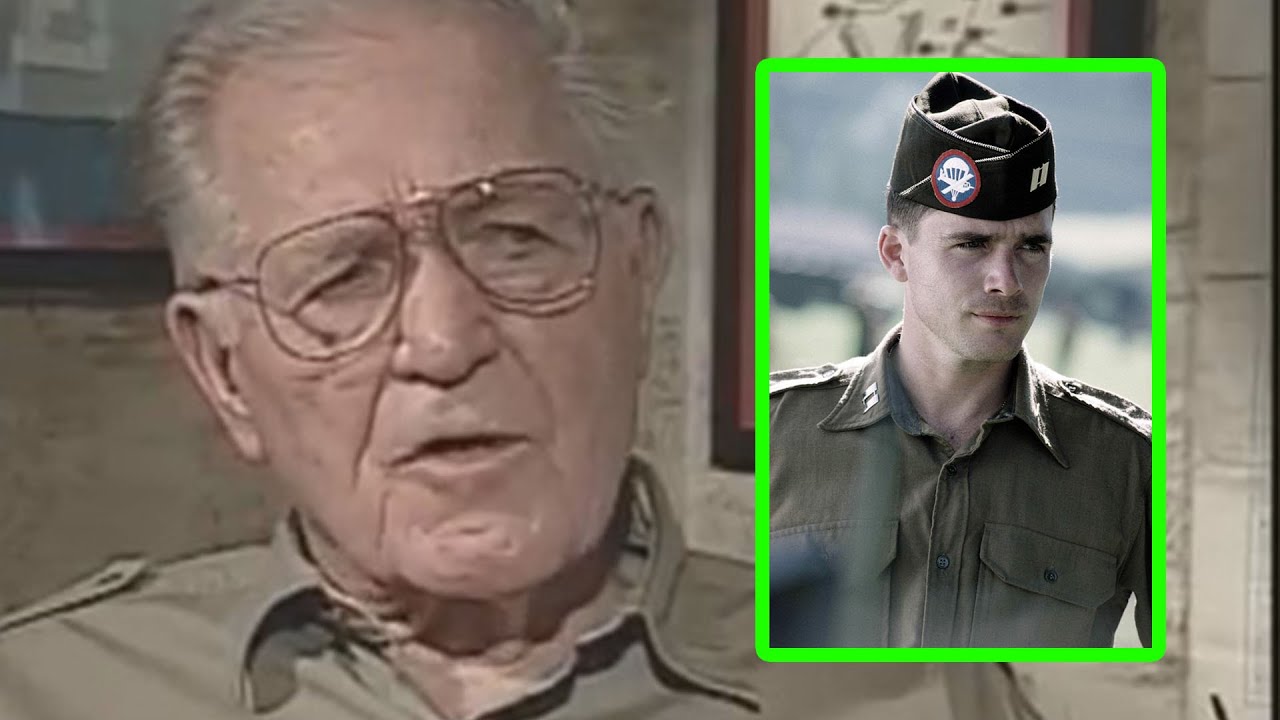
The account, drawn from Winters’s own recorded recollections about his friend and fellow officer Ronald “Sparky” Speirs, sheds extraordinary new light on one of the most controversial figures in the history of Easy Company and reveals the behind-the-scenes 𝒹𝓇𝒶𝓂𝒶 that nearly derailed Stephen Ambrose’s bestselling book before it ever reached readers.
According to Winters, the trouble began not on the battlefield but in a corporate boardroom. When Ambrose completed the manuscript of “Band of Brothers,” the legal department at Simon & Schuster reviewed the pages and grew alarmed at the number of accusations contained within them, particularly the repeated claims that Speirs had shot prisoners of war and, in one notorious episode, had gunned down a noncommissioned officer who was drunk in Normandy.
Winters recalled that Ambrose telephoned him one evening in a state of visible distress, explaining that the publisher feared a wave of lawsuits and was reluctant to move forward with a book that made such explosive allegations about identifiable, living men. “He went down this list that Simon & Schuster was concerned about with lawsuits,” Winters said, describing the moment Ambrose laid out the problem and admitted he did not know how to solve it.
Winters, who had commanded Easy Company through some of the war’s most brutal fighting, including the assault on Brecourt Manor and the defense of Bastogne, responded with the same calm decisiveness he had shown in combat. “I said, ‘Steve, relax, I’ll take care of it for you,'” Winters recounted. “I don’t know what I’m talking about, but I’m sticking my neck out here.
I’ll take care of it for you.”
The first item on the publisher’s list of concerns was not Speirs at all but another legendary Easy Company officer, Lewis Nixon, whom the manuscript described as an alcoholic. Winters said he waved away that worry immediately, telling Ambrose that he knew Nixon personally and could guarantee there would be no legal fallout from that characterization.
Then came the far more delicate matter of Speirs. Winters said he picked up the telephone and called his old friend directly, relying on a bond forged in combat and cemented when Winters had made Speirs a company commander. The two men had remained close for decades, and Winters knew he could speak to him with a candor that few others could risk.

“Sparky, you know these stories have been going around for years, and everybody says that nobody saw it directly,” Winters recalled telling him. “I’m going to ask you, are they true?”
What Speirs said next has now become part of the historical record. According to Winters, Speirs did not hesitate, did not deny, and did not equivocate. “He said, ‘Oh yeah, yeah, they’re true, Dick,'” Winters recounted.
Winters then explained the predicament facing the publisher, telling Speirs that Simon & Schuster was deeply worried about lawsuits and that the entire book could be jeopardized. Speirs’s response, according to Winters, was immediate and characteristically blunt. “He said, ‘No problem.
You want me to put that in a letter?'” Winters recalled. “Gladly.”
Speirs did exactly that. He wrote a letter confirming the truth of the accounts, and that letter, Winters said, remains preserved in the files to this day. With that single document, the legal threat evaporated.
“That letter is in those files,” Winters said. “There’s never been a problem with Simon & Schuster. Never had a problem.
Nobody’s ever had a problem with that thing, because it’s a true story.”
The revelation carries enormous weight for historians and for the millions of viewers who came to know Speirs through the acclaimed 2001 HBO miniseries “Band of Brothers,” in which he was portrayed as a fierce, enigmatic combat leader whose willingness to 𝓀𝒾𝓁𝓁 seemed to border on the ruthless. The series depicted Speirs, among other things, gunning down German prisoners and distributing cigarettes to them beforehand, a scene that became one of the most discussed moments in the entire production.

Winters’s account makes clear that the depiction was not dramatic invention. It was, by Speirs’s own admission to his commanding officer, rooted in fact. The confirmation came not under oath, not under interrogation, but in a private phone call between two men who had trusted each other with their lives.
The timing of the disclosure is significant. For decades, the stories about Speirs circulated as rumor and legend within the ranks of veterans, repeated in bars and reunions but rarely confirmed on the record. Ambrose’s book brought them into public view, and the miniseries cemented them in popular culture.
Yet the question of whether Speirs himself ever acknowledged the truth of the allegations remained unsettled for many observers.
Now, in Winters’s own words, that question appears to have been answered. Speirs not only acknowledged the stories but volunteered to put his admission in writing to protect the book that would make him and his comrades famous.
The episode also offers a rare glimpse into the moral complexity of the war in Europe and the Pacific, where the rules of war were often tested by the brutal realities of combat. The killing of prisoners and unarmed men violated the Geneva Conventions and the laws of armed conflict, yet such incidents occurred with troubling frequency on all sides. The question of how to reckon with those acts, and how to remember the men who committed them, has haunted veterans, historians, and filmmakers for generations.
Winters’s remarks suggest that he approached the matter not with moral condemnation but with the pragmatism of a commander protecting his men and his unit’s legacy. He did not distance himself from Speirs. He did not express shock.
He simply made a phone call, asked a direct question, and secured a document that allowed the truth to be published without legal consequence.
 The friendship between the two men endured. Winters had been responsible for elevating Speirs to company command, and the two remained close for the rest of their lives. That bond, forged under fire and tested by the uncomfortable truths of war, appears to have been strong enough to withstand even the most sensitive of confessions.
Historians have long noted that “Band of Brothers” occupies a unique place in American memory, presenting the men of Easy Company as ordinary citizens who rose to extraordinary challenges. The new details about Speirs complicate that narrative without dismantling it, reminding audiences that the heroes of the Greatest Generation were capable of actions that defy easy moral categorization.
For the families of the men involved, and for the surviving veterans who knew Speirs personally, the account is unlikely to come as a complete surprise. The stories had circulated for years, and many who served alongside him regarded him as one of the most effective and fearless combat leaders in the regiment, a man whose ferocity in battle saved lives even as it raised uncomfortable questions.
What remains undisputed is the outcome. Because Speirs was willing to confirm the truth in writing, “Band of Brothers” was published without legal interference, went on to become one of the most influential works of military history of the modern era, and introduced a new generation to the men of Easy Company. The book and the miniseries that followed transformed how Americans understand the war in Europe and the sacrifices made by the soldiers who fought it.
Winters, who died in 2011, spent his later years as the moral center of the Easy Company story, admired for his leadership, his humility, and his commitment to preserving the memory of his comrades. His decision to pick up the phone and ask Speirs the hardest possible question may stand as one of his most consequential acts, not on a battlefield but in defense of a book that would carry his men’s story into history.
The letter Speirs wrote, tucked away in Winters’s files, remains a quiet testament to a moment when truth and loyalty converged, when a warrior’s confession became the shield that protected the story of Easy Company from the courtroom and delivered it, intact and unflinching, to the world.