Deborah Kerr was nominated for the Academy Award for Best Actress six times and never won. When the Academy finally gave her a golden statuette in 1994, it was an honorary Oscar, a lifetime achievement award widely interpreted as a belated apology. By then, Kerr was living in southern Spain, her body slowly surrendering to Parkinson’s disease, more than a decade removed from her last film set. The woman who shocked audiences by rolling in the Hawaiian surf with Burt Lancaster, whose singing voice in The King and I was not her own, and who was branded an English rose despite not being English at all, had long since retreated into a private, dignified silence.
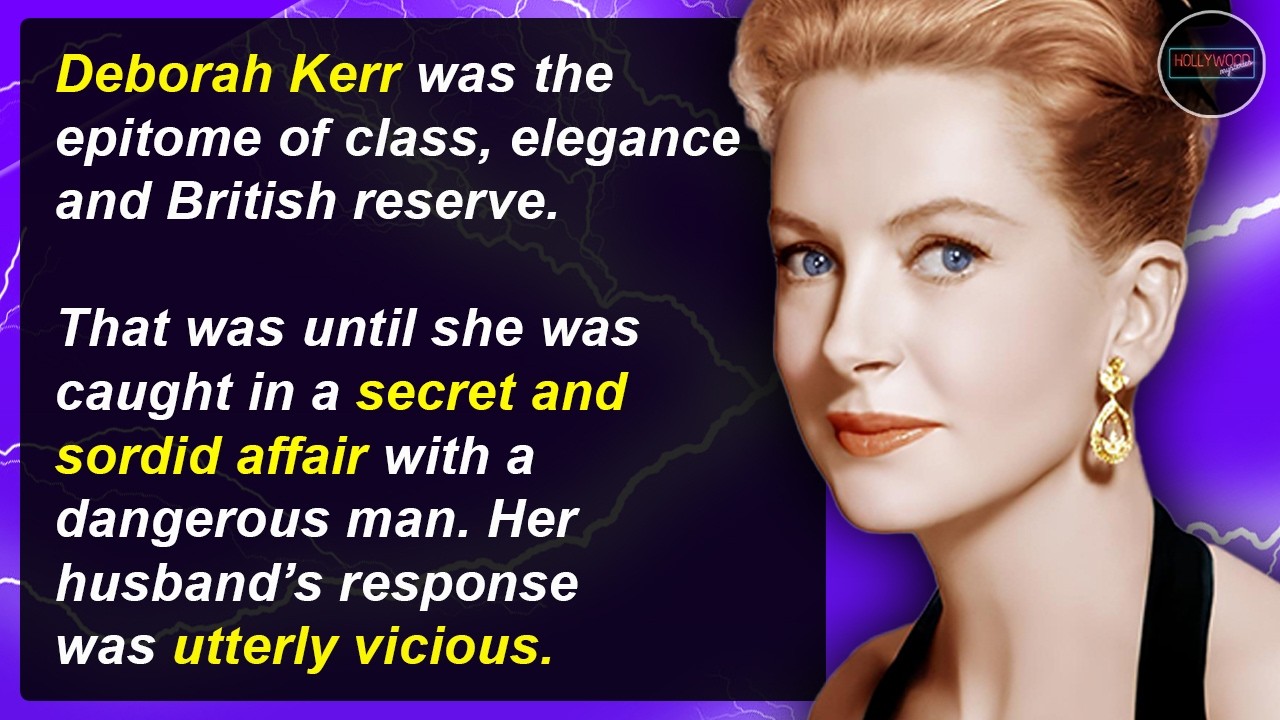
Born Deborah Jane Trimmer on September 30, 1921, her birthplace became a matter of civic dispute a century later. For most of her life, biographers assumed she was born in Helensburgh, a resort town on the Firth of Clyde where her parents had lived. It was not until 2021, when researchers at Glasgow Clyde College requested her birth certificate for a centenary plaque project, that the record was corrected. She had been registered in the Hillhead district of Glasgow, her birth recorded on October 21, 1921, by her father, Arthur Charles Trimmer.
The discovery triggered a spirited campaign to reclaim her for Glasgow. A lecturer named James McIver told the BBC, “We want to reclaim her as a Scottish thistle. ” A blue plaque was installed at what is now Ruskin Terrace. The English rose, it turned out, had always been a Scottish thistle, a fact that 20th-century publicity machines had methodically obscured.
Her father was a civil engineer who moved to Glasgow after the First World War to work for Sir William Arrol and Co. , the firm that built the Forth Bridge and Tower Bridge. He was also a former pilot who had lost a leg during the Battle of the Somme. That detail mattered in shaping the household and the daughter who grew up in it.
Kerr learned early about damage survived in silence, about carrying on with composure while part of you is permanently gone. The family’s time in Scotland was brief. By the mid-1930s, Kerr was at school in Bristol, where she won prizes for piano and took dance instruction under a teacher named Katherine Blott. Dance was her first serious ambition.
She won a scholarship to the Sadler’s Wells Ballet School in London and made a professional stage debut as a member of the corps de ballet in a production of Prometheus in the late 1930s. She began not as an actress, but as a dancer. Then her body betrayed her ambition. “I was mad about ballet, but I grew too tall,” she later told the Chicago Tribune.
She was too tall for classical ballet, and so she pivoted from dance to drama. An early episode in 1939 at a Bristol Eisteddfod radio voice test revealed how close her trajectory came to veering in a different direction. A BBC judge named Francis Dillon, listening to her audition alongside 65 other hopefuls, declared she had a beautiful microphone voice. Kerr won first place and expressed interest in further radio work.
An alternate history might have seen her become a radio star. But film was already reaching for her. Her earliest screen experience was an exercise in near invisibility. She had a role in Contraband, the 1940 film by Michael Powell and Emeric Pressburger.
Her scenes were deleted, cut before the world could see her. The irony is that the same filmmakers would later make her a star. She surfaced in other British productions with gathering momentum. Major Barbara in 1941 raised her profile.
Love on the Dole gave her a first lead role, plunging her into the world of northern working-class poverty. She also appeared in Hatter’s Castle and The Day Will Dawn in 1942. The camera understood her, even if the public had not yet fully learned her name. The film that vaulted her from promising young actress to genuine star was The Life and Death of Colonel Blimp, released in 1943.
Powell and Pressburger cast her in three roles spanning decades of the story, playing three different women loved by the same man across 40 years of British history. At 21, she was carrying the emotional weight of a nearly three-hour epic with a maturity that belied her age. The film itself became an object of political controversy. The British government objected to its implications that old-fashioned notions of military honor were outmoded.
Winston Churchill was reportedly outraged and initially blocked its release in the United States. An ultimately shortened version was shown in American cinemas only in 1945. Kerr said nothing publicly about the controversy. She was already learning the discipline of silence that would define her public persona for the next 60 years.
In 1947 came Black Narcissus, again directed by Powell and Pressburger, in which Kerr played Sister Clodagh, a young nun leading a small order to a remote Himalayan convent. The film was shot largely at Pinewood Studios, with vertiginous mountain vistas created through paint, glass, and the cunning of the art department. It won Academy Awards for cinematography and art direction. Kerr’s performance is a master class in suppression, the earthquake beneath the stillness visible on her face.
That same year was the fulcrum of her transition to Hollywood. She signed a contract with Metro-Goldwyn-Mayer, and the recording of her public image began in earnest. MGM wanted a cool, reserved English lady. The studio’s publicity department coined a slogan: “Deborah Kerr, it rhymes with star.
” She was to be a particular kind of star: graceful, restrained, unthreatening. Her own assessment of this period was considerably less charitable. “I came over here to act,” she said of her early Hollywood years, “but it turned out all I had to do was to be high-minded, long-suffering, white-gloved, and decorative. ” In another interview, she was blunter still.
“I wore a halo of decorum and was just about as exciting as an oyster. ”
Her first Academy Award nomination came from Edward, My Son in 1950. It did little to dislodge the typecasting. It was a gilded cage, and she knew it.
Her personal life was following a trajectory that mirrored the tension between surface propriety and subterranean feeling that defined her screen work. In 1945, through an introduction by actor Stewart Granger, she met Squadron Leader Anthony Bartley, a decorated Battle of Britain fighter ace. Bartley proposed by telegram while she was filming in Ireland: “Have been posted to the South Pacific. Stop.
Will you marry me? ” She replied, “Yes. Stop. Where and when?
” They married before he left for the Pacific. For a time, it worked. They had two daughters, Melanie and Francesca, and presented the image of a solid, enviable marriage. But beneath the surface, the marriage was troubled by a structural imbalance.
Kerr’s career was ascendant, her earning power dwarfed Bartley’s. The constant separations imposed by her filming schedule created absences no amount of love letters could bridge. Rumors of alleged affairs with co-stars, including Cary Grant, Stewart Granger, Robert Mitchum, and Burt Lancaster, gnawed at the relationship. Whether these rumors had substance is a question the historical record does not cleanly resolve.
What is clear is that by the mid-1950s, the marriage was fraying. The rupture in Kerr’s carefully maintained public image arrived in 1953 with From Here to Eternity. Director Fred Zinnemann cast her as Karen Holmes, the sexually frustrated wife of an army officer in pre-war Hawaii. The role required her to be everything MGM had spent six years insisting she was not: raw, angry, hungry, adulterous.
Hollywood insiders were skeptical that the prim English lady could play a woman consumed by illicit passion, but Zinnemann saw what the studio system had tried to bury. She prepared with ferocious discipline. “I studied voice for 3 months to get rid of my English accent,” she told the New York Daily Mirror. “I changed my hair to blonde.
I knew I could be sexy if I had to. ” That last sentence was a quiet detonation. She had always known. The studio had simply never let her show it.
Then came the beach scene. Kerr and Burt Lancaster entwined in the surf at Halona Cove on the coast of Oahu, the Pacific washing over them as they kissed with an abandon that made audiences forget they were watching a movie. It became one of the most reproduced images in cinema history. The Production Code’s Breen office objected to the staging, particularly to Kerr positioned atop Lancaster, but the scene survived.
Here was the English rose, the white gloves, the suffocating respectability, lying in the sand, soaked and breathless in the arms of a man built like an Olympian. America understood that it had been wrong about her. “I don’t think anyone knew I could act until I put on a bathing suit,” she said. The line has been repeated so often it has calcified into a quip, but there is real bitterness underneath.
The frustration of a woman who had been doing extraordinary work for over a decade and only got noticed when she showed some skin. From Here to Eternity earned her a second best actress nomination. She lost to Audrey Hepburn for Roman Holiday, but the film proved to Hollywood that Deborah Kerr could burn. The mid-1950s became a period of extraordinary professional range.
In 1953, the same year as the beach scene, she opened on Broadway in Tea and Sympathy, directed by Elia Kazan, playing Laura Reynolds, the older woman who offers tenderness and ultimately physical comfort to a young man accused of being homosexual. It was a role she later identified as the one closest to her own personality. “I suppose the part nearest me is Laura Reynolds in Tea and Sympathy,” she said in a 1978 interview with the Christian Science Monitor. The show ran for 712 performances at the Ethel Barrymore Theater from September 1953 to June 1955.
Then came The King and I in 1956, the Rodgers and Hammerstein adaptation in which she played Anna Leonowens, the English governess who matches wills with Yul Brynner’s formidable king. It earned her another best actress nomination and remains one of her most widely seen performances. But it also contains one of the most carefully guarded deceptions in Hollywood musical history. Kerr’s singing was dubbed by Marni Nixon, a classically trained soprano whose voice audiences heard without ever seeing her face.
The lengths to which 20th Century Fox went to conceal the substitution were remarkable. Nixon was required to sign a contract forbidding her from revealing the work. The two women stood together during recording sessions, Nixon singing live and Kerr miming for the camera. The secret held for years until Kerr herself broke it, publicly crediting Nixon in an interview.
It was a gracious act, a refusal to accept credit she had not earned. The nominations kept coming. In 1957, she was nominated for Heaven Knows, Mr. Allison, a two-hander with Robert Mitchum about a nun stranded on a Pacific island with a gruff marine.
In 1958, she was nominated for Separate Tables. In 1960, she was nominated for The Sundowners, again directed by Zinnemann, again opposite Mitchum, this time as an Australian drover’s wife yearning for a settled home. Six nominations across 12 years. Six losses.
It is a record shared with Thelma Ritter and later Amy Adams, but Kerr’s six nominations were all in the lead category, a distinction no one has surpassed in futility. Between the nominations, she made An Affair to Remember in 1957 with Cary Grant, a Technicolor romance that would become an unexpected cultural touchstone decades later through its central role in the plot of Nora Ephron’s Sleepless in Seattle. And in 1961 came The Innocents, Jack Clayton’s adaptation of Henry James’s The Turn of the Screw, which may be the finest gothic horror film in the English language. Kerr plays Miss Giddens, a governess who becomes convinced the house is haunted by malevolent ghosts.
Or is she going mad? The film refuses to answer, and Kerr inhabits that ambiguity with terrifying precision. While her screen career was reaching these heights, her personal life underwent its most significant upheaval. On the set of The Journey in 1958, she met Peter Viertel, the German-born American novelist and screenwriter.
Viertel was a man of considerable substance. Born in Dresden to Jewish parents, he had grown up in Santa Monica amid the European émigré intellectual elite, in a household where Bertolt Brecht and Greta Garbo were Sunday visitors. He had fought in World War II with the Marines and later the OSS. He had worked with John Huston on The African Queen and written the novel White Hunter Black Heart, which critic Pauline Kael called “The best Hollywood novel I’ve ever come across.
”
His own romantic history was tangled. He was married to Virginia “Gigi” Schulberg, then had a relationship with fashion model Bettina, who left him for Prince Aly Khan. “They fell in love. I had been divorced and I was lonely,” Kerr later remembered.
“Peter was also divorced and lonely. ”
In May 1958, the Bartleys announced what was described as an amicable separation. But amicable is a generous word for what followed. Anthony Bartley was reportedly furious.
He wanted to take the two girls away from Kerr and make them wards of an English court. It was the closest thing to a public scandal in Kerr’s otherwise meticulously managed biography. The divorce was finalized in 1959. On July 23, 1960, she married Viertel.
The marriage would last 47 years until her death. They settled in Klosters, Switzerland, in a house set in the woods above the ski resort, furnished with natural wood and flowers everywhere. Later, they divided their time with a home in Marbella on Spain’s southern coast. Viertel was credited with introducing surfing to Europe, bringing a surfboard from California to Biarritz in the 1950s while French locals stared in bewilderment.
“Personally, I think if a woman hasn’t met the right man by the time she’s 24, she may be lucky,” Kerr once joked. She was 38 when she married the right one. Kerr’s film career continued at a high level through the early 1960s but began to thin as the decade progressed. She played another governess in The Chalk Garden in 1964 and worked with John Huston again in The Night of the Iguana that same year.
In 1967, she appeared in Casino Royale, earning the distinction of being, at 45, the oldest Bond girl in any James Bond film, a record she held until Monica Bellucci in Spectre nearly 50 years later. The late 1960s brought a seismic upheaval in American cinema. The New Hollywood, the youth revolution, Easy Rider and Bonnie and Clyde, the abandonment of the studio system’s rigid star hierarchies in favor of younger, grittier talent. Actresses who had built their careers on the poise and polish of the old order found themselves, almost overnight, without a clear place.
Kerr saw what was coming and made a choice. “I didn’t want to do disaster movies,” she later said. The remark is usually quoted as a punchline, but it is also a declaration of artistic principle. “I’d rather drop dead in my tracks one day,” she said, “than end up in a wheelchair in some nursing home watching interminable replays of The King and I.
” She walked away on her own terms, with her dignity intact. She did not stop working entirely. She re-centered her career around the stage and later television. She returned to Broadway in 1975 to create the role of Nancy in Edward Albee’s Pulitzer Prize-winning play Seascape.
In 1977, she played the title role in Candida in London’s West End. The theater, she maintained, was always her first love. On television, she appeared in prestige mini-series, most notably A Woman of Substance in 1984, for which she received an Emmy nomination. Her final credited screen appearance came in 1986.
Her memoir never materialized, and she was blunt about why not. “Autobiographies are all the same,” she said. “It’s always rags to riches or I slept with so-and-so. Damned if I’m going to say that.
”
She had her own formulation for the essential mystery of her craft. “I adore not being me. I’m not very good at being me. That’s why I adore acting so much.
” She was to the end a woman who believed that some things belonged to the person who lived them, not to the public that merely watched. “I’m really rather like a beautiful Jersey cow,” she once said. “I have the same pathetic droop to the corners of my eyes. ”
Her late years were defined by formal recognition and the slow, merciless advance of Parkinson’s disease.
In 1991, BAFTA gave her a special award. In 1994, the Academy bestowed that honorary Oscar, praising a full career’s worth of elegant and beautifully crafted performances. She accepted via a filmed message from her home in Marbella, unable to attend in person. In the New Year Honours List of 1998, she was made a Commander of the Order of the British Empire for services to theater and cinema.
She was unable to accept it in person because of ill health. “It is a very special award,” she said. “I didn’t think I would ever gain it. ”
Peter Viertel described her in a late interview with tenderness.
“She never was really conscious that she was world-famous,” he said. “She was an actress. The camera goes right through the skin. The camera brings out what you are, and in her case, there was always a kind of humanity that she had in all of the things that she played.
I think she made movies that have never worn off their splendor. ”
Deborah Kerr died on October 16, 2007, aged 86, in Suffolk, Eastern England, with her family present. She had been suffering from Parkinson’s disease. The end was quiet, the kind of death she would have chosen, private and dignified.
Peter Viertel died 19 days later on November 4, 2007. He was 12 days short of his 87th birthday. Forty-seven years of marriage and less than three weeks apart in death. At the time of his passing, a documentary filmmaker named Michael Scheingraber was filming a project about Viertel titled Peter Viertel: Between the Lines.
The film, when completed, included Viertel’s reminiscences about Kerr and the Academy Awards, a last tender act of witness from a man who had known her better than anyone. David Denby, The New Yorker’s film critic, wrote that Kerr made maturity exciting, a concept almost incomprehensible in an era obsessed with youth. His conclusion that there is no one remotely like her today is not nostalgia.
It is a reckoning with what was lost when the industry stopped making room for women whose power lay not in spectacle, but in depth.