In January 1841, in a small rented room in Springfield, Illinois, during one of the harshest winters anyone could remember, friends of a man quietly gathered razors, knives, and anything with a sharp edge. They were afraid to leave him alone with them. The man in that room was Abraham Lincoln, twenty years before he saved the Union. The people who loved him were not confident he would survive that winter.
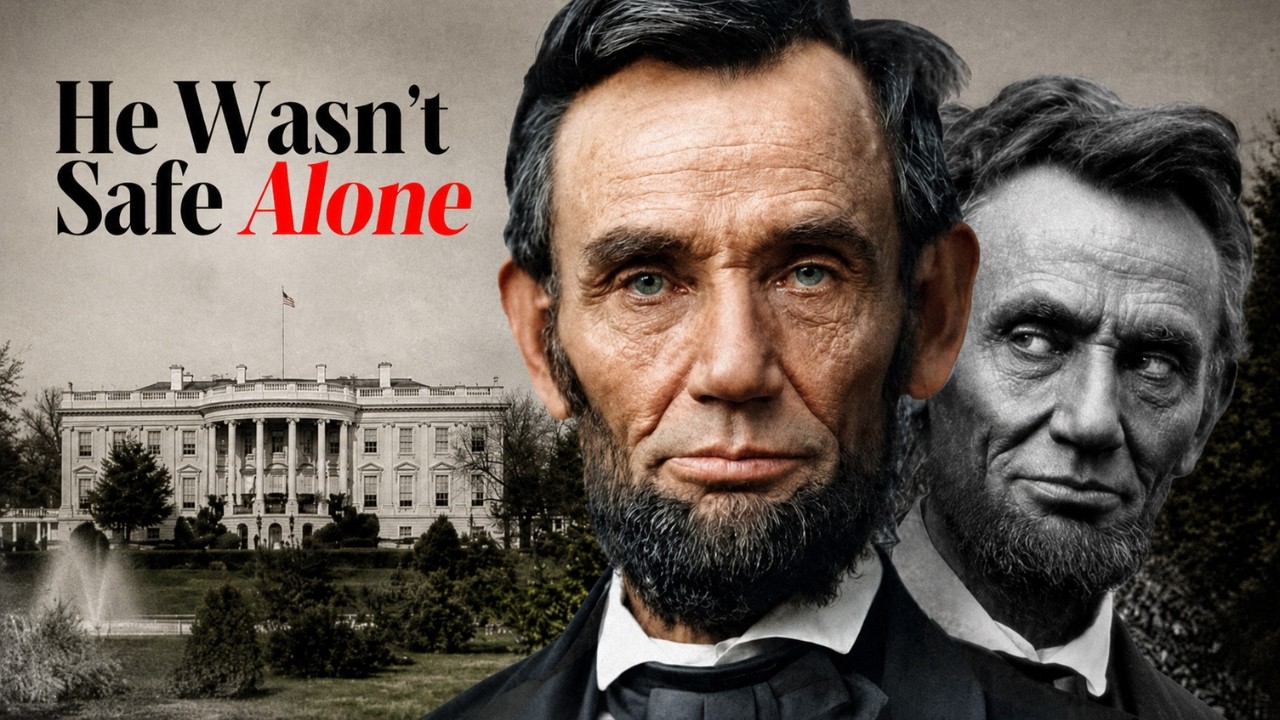
The man who would become the most sorrowful figure in America was also the only one strong enough to carry the nation’s grief. But the story of the war Lincoln fought inside himself for thirty years is one that marble monuments often leave out. Every American carries his face in their pocket, on the penny—small, copper, and familiar. His likeness towers nineteen feet above the Reflecting Pool in Washington.
Yet the men who truly knew him told a different story from the polished one. His law partner, William Herndon, who watched him across a shared office for sixteen years, put it in a sentence that has haunted historians ever since: Lincoln’s melancholy dripped from him as he walked. Those closest to the sixteenth president believed he was the saddest man they had ever known. Some saw more than sadness.
There was a winter, twenty years before the war, when people who loved this man feared leaving him alone in a room. This is not a story about weakness. The darkness Lincoln carried inside him was inseparable from the man who held a fractured country together. To understand one, you must reckon with the other.
The story begins not in Washington, but on the plains of Illinois, in a small settlement called New Salem. In the fall of 1818, inside a one-room cabin in the Indiana woods, family tradition holds that a nine-year-old boy helped his father build a coffin. They carved the wooden pegs by hand. The woman inside was his mother, Nancy, who died at thirty-four from a disease that swept through the settlement.
She was buried on a wooded hill without a minister to say prayers. Months passed before a traveling preacher came by to pray over the grave. The boy was Abraham Lincoln, and loss came to him early and never truly left. His only sister, Sarah, died ten years later in childbirth at age twenty.
A neighbor remembered the young man sitting alone in a smokehouse doorway when he heard the news, his face in his hands as tears ran between his fingers. At nineteen, he had already buried half his family. When the lanky young man arrived in New Salem at twenty-two with little more than the clothes on his back, people met someone determined to outrun something. He wrestled local strong men and earned their respect.
He told stories that made grown men gasp with laughter. He read borrowed books by firelight, taught himself grammar, and ran for the legislature. Neighbors remembered him as the friendliest man in the settlement. In that same settlement lived a young woman named Ann Rutledge, the daughter of the tavern keeper.
She was twenty when he met her—intelligent, kind, and a serious student in a town where educated people were rare. What exactly happened between Ann Rutledge and Abraham Lincoln has been debated for more than a century. The evidence comes to us indirectly, gathered decades later. But when the people of New Salem were finally asked, they spoke with striking unanimity.
Their old teacher, Graham, stated it plainly: Lincoln and she were engaged. Lincoln told him so, and she hinted the same. Whatever the nature of their relationship, it ended in August 1835 when typhoid fever swept through the settlement. Ann Rutledge fell ill at the height of the summer heat and died on August 25, 1835, at twenty-two.
She was buried in Concord Cemetery, a rural burial ground on a low hill about seven miles from the village. Lincoln seemed steady at first. A neighbor named John Hill later recalled that he bore it well for a while, then his condition changed. After a few days, a heavy rain fell and seemed to unhinge him.
Something about the rain falling on that fresh grave broke everything the young man had been holding together. According to accounts gathered from his neighbors years later, he told friends he could not bear the thought of rain and snow falling on her grave. The people of New Salem began to worry. His friend Henry McHenry described the change: Lincoln seemed entirely different, withdrawn and solitary, sunk in deep thought and indifferent to what went on around him.
The cheerful man had gone silent. He went out alone, and neighbors soon knew where. He would go to Concord Cemetery and sit for long periods beside the fresh mound, reading from a small Bible he carried. According to the same recollections, he told friends words they repeated for the rest of their lives: “My heart is buried in the grave with that dear girl.
”
No one can be certain that every word has come down exactly as spoken, but the picture the whole village agreed on was the same. The strongest and most cheerful young man in New Salem sat alone on a hillside with the dead. Worry turned into something like fear—fear of what he might do to himself. An older friend, a burly justice of the peace named Bowling Green, finally intervened.
He took Lincoln to his home a few miles outside the village and kept him there with his wife, feeding him, watching him, and providing calm for two or three weeks until the worst had passed. Lincoln was twenty-six. This was the first time the people around him had organized themselves to preserve his life. He eventually returned to himself, back to his law books, surveying work, and legislative seat.
The stories and laughter returned. To a stranger passing through in 1836, he would have seemed the most cheerful man in the county. But that same year, while riding the judicial circuit with a fellow legislator named Robert Wilson, Lincoln said something Wilson never forgot. He told Wilson that although he appeared to enjoy life passionately, he was a victim of terrible melancholy.
Wilson recalled that Lincoln said he had never dared to carry a pocket knife. A frontier lawyer who had split wood and used an axe since boyhood was afraid to keep a small blade in his pocket because of what that darkness might push him to do when it swept over him. The cheerfulness was real, but it was a room built over a dark cellar. His neighbors had seen the cellar door open once in the weeks after Ann Rutledge’s death, and they had pulled him back from it.
They believed the darkness had passed with the season, like fevers and storms pass. They were wrong. In the spring of 1837, Abraham Lincoln rode into Springfield on a borrowed horse with all his possessions in two saddlebags. He was twenty-eight, newly licensed to practice law, and too poor to buy a bed.
He walked into a general store and asked the young owner the price of a mattress, sheets, and covers. The total was seventeen dollars. Lincoln said it was probably cheap enough, but he had no money. The storekeeper, a Kentucky merchant named Joshua Speed, looked at the tall stranger and made an offer that would change both their lives.
He had a large room upstairs with a double bed, and Lincoln was welcome to share it. Lincoln went upstairs, set down his saddlebags, and came back down with a changed expression. “Well, Speed, I’m moved,” he said. That was the beginning of the closest friendship in Lincoln’s life.
For nearly four years, the two young men shared that room above the store, talking about law, politics, poetry, and, on the hardest nights, the workings of Lincoln’s own mind. Speed would become the only man Lincoln voluntarily let into his depths. Years later, Speed’s memories more than anyone else’s allowed historians to see what that melancholy really looked like from the inside. By that time it had a name, and everyone in Springfield seemed to know it.
Lawyers who rode the circuit with Lincoln, sleeping two and three to a bed in prairie taverns, saw a man who could captivate a courtroom with a story, then an hour later sit in a corner with his chin on his knees, so far away that no one dared speak to him. His colleague Henry Whitney watched those silences for years and used the strongest words he had: “There was no element in Mr. Lincoln’s character so prominent, so obvious, and so ingrained as his mysterious and profound melancholy. ”
Prominent, obvious, ingrained.
These were not describing a passing mood but something structural, a sadness so embedded in the man that they treated it as part of his very nature. And what they did about it was striking: nothing. On the Illinois frontier, there was no cure to offer and no language for it other than the old word “melancholy. ” So they let him sit.
They waited for the storyteller to return. He always did. But something from those years suggests that silence ran deeper than any of them knew. On August 25, 1838, the Sangamo Journal, the Whig newspaper where Lincoln published his political letters, carried an unsigned poem of thirty-six lines presented as the last words of a man found dead by suicide in a deep forest on a branch of the Sangamon River.
The poem is grimmer than anything else on the page, a monologue spoken on the edge of self-destruction by a voice that has stopped arguing with its own despair. For over a century, no one paid it any attention. Then, after Lincoln’s death, Joshua Speed mentioned to a biographer that Lincoln had once written and published a poem on that very subject. Speed remembered it as a few lines under a melancholy title.
Biographers searched and found nothing. The poem entered Lincoln lore as a ghost, referenced but never identified. It remained a ghost until 1997, when independent researcher Richard Lawrence Miller, while combing through eleven years of the Sangamo Journal page by page, found the unsigned verses. It took five more years for him to realize what he might have.
The meter matched Lincoln’s other published poems. So did the grammar, word choice, and tone. It was the paper Lincoln wrote for. The case remains open; the poem is unsigned, and some scholars are not convinced.
Others, including historian Michael Burlingame, have said it certainly reads like Lincoln. The one detail that refuses to be coincidence: the poem was published on August 25, 1838. Ann Rutledge died on August 25, 1835, exactly three years earlier to the day. If the poem is his, then the cheerful young Springfield lawyer, the storyteller, the rising Whig politician, and the most entertaining person in Sangamon County had marked the third anniversary of her death by putting his darkest thoughts into the mouth of a dead man and publishing them where the whole town would read them—hidden by dropping his name, yet needing others to see it.
The story takes a dramatic turn in the winter of 1840, the coldest anyone could remember. On January 1, 1841—a date Lincoln would later speak of the way men speak of a wound—the cellar door did not just open; it collapsed. Lincoln described the weather that season as “too severe for feeble nerves. ” His own words for his mind.
He had reason to watch his internal barometer that winter, because everything he had built was under pressure at once. In the legislature, his signature political project, a grand program of railroads and canals, was collapsing under its debts, dragging the state toward ruin and his reputation with it. His engagement to Mary Todd was in trouble, unraveling by the end of December. Joshua Speed, the only man who knew where the cellar door was, had sold the store and was preparing to leave Springfield for Kentucky for good.
The room above the store was ending. The engagement was ending. The career was crumbling. And the cold kept coming.
What exactly happened on January 1, 1841, remains one of the enduring mysteries of Lincoln’s life. Speed’s account, given years later, says the engagement to Mary Todd was broken that day. Other scholars who have read the surviving letters believe the rupture happened differently, or that the deeper blow was Speed’s departure, or the political wreckage, or all of it together. Historians still argue, and Lincoln never explained.
He gave the day a name only. In a later letter, he called it “that fatal first of January. ”
What is not in dispute is what happened afterward. Lincoln stopped attending the legislature.
For days at the height of the session, his seat remained empty while roll calls continued without him. He kept to his room, and the people who loved him began to fear that room. Joshua Speed, remembering that January for the rest of his life, described it in words biographers have handled carefully ever since because there is no way to soften them. “Lincoln went crazy,” Speed recalled.
“We had to remove razors from his room, take away all knives and other such dangerous things. It was terrible. ”
Read that again. This is not rumor from a stranger, not slander from a political opponent.
His closest friend told a biographer what he did himself: he walked into Abraham Lincoln’s room and carried out the razors, the knives, and everything with an edge, because he did not trust his friend alone with them. Six years earlier in New Salem, neighbors had watched quietly and informally, taking the young man to a farmhouse until the storm passed. This time it was worse, and Springfield was not a small village. This time there was a doctor.
During those January weeks, Lincoln placed himself under the care of Dr. Anson Henry, a physician and friend, reportedly spending hours a day in his company. On January 23, 1841, Lincoln sat down and wrote a letter to John Todd Stuart, his first law partner, who was away in Washington serving in Congress. It is a short letter, written in the hand of a man who steadied himself enough to finish one page.
He apologizes that he cannot summarize the news of the nation: “I am now the most miserable man living. If what I feel were equally distributed to the whole human family, there would not be one cheerful face left on the earth. Whether I shall ever be better I cannot tell. I awfully forebode I shall not.
To remain as I am is impossible. I must die or be better. ”
A thirty-one-year-old lawyer describing his condition to a friend with the same precision he used in giving testimony: “I must die or be better. ” He placed the two paths side by side on the page, as clearly as if measuring them, and then, slowly, without any miracle marking the moment, he chose the second path.
His recovery was quiet, as real recoveries are. Letters to Speed over the following months show a man rebuilding himself. In the summer, he traveled to Kentucky and rested at the Speed family home. He returned to his law practice.
He returned to work, because work, as he was learning, was a wall that darkness climbed more slowly. In November of 1842, in a Springfield parlor, he married Mary Todd, setting out to build an ordinary life that was supposed to keep the cellar door closed. A home, a law practice, and in time, children. Four boys, one after another.
He loved them with a tenderness that amazed people; the stern-faced lawyer allowed his sons to wreck his office and would not let anyone say a word against them. That bet was tested early. In 1850, his second son, Eddie, died a month before his fourth birthday. Ten months later, a new son was born into a house full of grief, and they named him William, called Willie.
As time passed, the boy grew into the one person who seemed made of the same quiet metal as his father. The bet held, but it did not break. Then the country split in two. The family moved into a White House full of history.
In the second winter of the war, fever crept upstairs to the son who was most like him. On the night of February 5, 1862, the White House glowed like a lantern. Hundreds of guests filled the East Room under gaslights—generals, senators, and diplomats in their sashes—while the Marine Band played. It was the largest reception of Lincoln’s presidency.
Upstairs, in a room called the Prince of Wales Room, an eleven-year-old boy groaned with fever. William Wallace Lincoln, “Willie,” was the third son and the one everyone said was most like his father—thoughtful where his younger brother Tad was wild, gentle, and fond of books, already beginning to write poetry. Visitors noticed how the president and this particular son would walk through the house hand in hand, sharing silence comfortably. Of everything Lincoln had built to keep the darkness at bay, Willie was the keystone.
Both Willie and Tad fell ill that week, probably with typhoid fever, possibly from contaminated White House water. Doctors assured them Willie was improving. On their advice, the reception went ahead as planned. Elizabeth Keckley, the formerly enslaved seamstress who had become close to Mary Lincoln and whose memoir preserved those days, recorded how the music drifted upstairs to the sick room in soft, muffled whispers.
During the evening, Mary slipped upstairs again and again to stand by the bed. Morning came, and Willie’s condition had worsened. He struggled for two more weeks while the war raged and his parents took turns at his bedside, the commander in chief of a million men wiping his son’s brow. At five o’clock in the evening on Thursday, February 20, 1862, Willie Lincoln died.
Keckley was summoned to the room shortly afterward. What she witnessed there she recorded six years later in sentences that still carry the shock: “I watched the President as he entered and stood over the bed, looking long at the boy. ‘My poor boy. He was too good for this earth.
God has called him home. I know that he is much better off in heaven, but then we loved him so. It is hard, hard to have him die. ’” Then, she wrote, his tall body shook with emotion.
He buried his face in his hands, while she stood at the foot of the bed, marveling at genius and greatness weeping for a lost idol of love. Four days later, on the day of the funeral, the family gathered privately around the coffin in the Green Room for a final farewell. As they stood there, the sky opened over Washington. Benjamin French, the commissioner who arranged the funeral, recorded with something like awe that one of the fiercest rain and wind storms the city had seen in years fell at that hour.
The storm outside, he wrote, seemed to harmonize with the storm of grief inside. Rain again, beating on the roof over a coffin, just as it had once fallen on a low hill in Illinois over a grave Lincoln could not bear to think of getting wet. Twenty-seven years apart, the same weather, the same man beneath it. After the burial, Lincoln withdrew from people and wept alone.
Willie’s body was placed in a borrowed vault in Georgetown to await the day it would return home to Illinois, and it was reported that the president returned to that vault alone, more than once. A carriage, a cemetery gate, a tall figure entering to sit with his boy. One testimony from those months may be the most haunting record of Lincoln ever made. He reportedly asked a Union officer, almost casually, a question no one knew how to answer: “Do you ever find yourself talking with the dead?
” Since Willie’s death, he said, “I find myself every day involuntarily talking with him, as if he were with me. ” Every day, involuntarily, in the midst of a war that was killing other men’s sons by the tens of thousands, the president walked the White House corridors carrying on one-sided conversations with his boy. Those who had known him for a long time braced for what history seemed to promise. New Salem in 1835.
Springfield in 1841. The pattern was clear to anyone who knew where to look: great loss, then the closed room, then friends deciding what could be left alone with him. But this time there was no Bowling Green to take him to a quiet farm, no Speed to stand guard. There was a war council waiting downstairs, a general who did not want to fight, and a nation that could not be told its president had sunk into darkness.
Washington waited for Abraham Lincoln to break. What happened instead is the part of the story no monument tells, and it had taken decades to form. He did not break. This is the astonishing and simple truth at the heart of this story.
The man whose friends once emptied his room of everything sharp received the hardest blow of his life in the midst of a civil war, then walked back downstairs and continued the work. The pattern that had repeated twice before, in 1835 and 1841, did not complete this time. Historians have long treated that as a simple puzzle or a simple miracle. Biographer Joshua Wolf Shenk, who spent seven years studying Lincoln’s inner life, offers a different answer, one that turns the whole story on its head.
Lincoln never got better. He got something else instead. Shenk argues that somewhere amid the wreckage of that winter of 1841, Lincoln made a quiet bargain with himself, the kind that leaves no documents, only consequences. He seems to have accepted that personal happiness, that birthright of ordinary men, would not be his.
The letter to Stuart had mapped two paths: death or improvement. But improvement for him never meant healing. So he sought a third thing: a reason to exist. Speed later recalled that Lincoln said in his darkest hours that he was ready to die, but he had not done anything to make any human being remember that he had lived.
That was the thread he grasped—not joy, but purpose. If he could not be happy, he could be useful. And the desire to leave some mark became the wall he rebuilt every morning. Those who saw the president telling jokes in the darkest hours of the war thought they were witnessing frivolity.
Some were offended by it. But what they were actually watching was a survival mechanism working in plain sight—a technique refined over thirty years of private practice. The humor was never the opposite of the melancholy. It was the tool he had made to carry it.
Asked once how he could joke at such a time, Lincoln reportedly answered: “With the fearful strain that is on me night and day, if I had not laughed I should have died. ”
He was not pretending cheerfulness. He may have been the most realistic man in Washington. The poetry reading, the long silences his aides learned not to interrupt, the fatalism that worried visitors, the storytelling that seemed to light him up like a lamp—all of it, seen through this lens, resolves into a single picture: a man operating a system, a system tested in New Salem, rebuilt in Springfield, and now bearing the heaviest burden any American president has ever carried.
And here is the strangest shift of all: the possibility that the melancholy was not merely something Lincoln survived. It may have been something the country needed. Consider what the war actually required of the man at the top. It required someone not swept up in elation after a victory, because he had never trusted elation in his life.
Someone who did not collapse after a defeat, because he had already reached the bottom of himself and knew the terrain of that region. Someone with deep patience for suffering, his own and others’, because he had carried suffering daily since he was nine years old. The generals broke one after another—McClellan’s arrogance, Hooker’s pride. Each was undone by the war’s refusal to flatter them.
The man who did not break was the one who had never expected life to be merciful in the first place. His colleague Henry Whitney, who had witnessed his silences on the circuit years before, saw the connection clearly when war came. Shenk calls this pattern “melancholic success”: Lincoln did not succeed despite his depression. He forged the depression and the lifelong effort to manage it into those very qualities—humility, empathy, resilience, and clarity about the worst—upon which his presidency rested.
You can hear it in the words he left behind. The Second Inaugural Address, delivered in March 1865, is not a victory speech, though victory was weeks away. It is one of the great sorrowful speeches ever given, ending not with triumph but with tenderness: “With malice toward none, with charity for all, with firmness in the right as God gives us to see the right, let us strive on to finish the work we are in, to bind up the nation’s wounds, to care for him who shall have borne the battle and for his widow and his orphan. ”
Scholars have long noted that no man who had not known grief could have written it.
One reads it as though melancholy itself were finally given a public voice, discovering after thirty years of seclusion that what it had to say was mercy. That is the paradox this story carries from a rain-soaked hill in New Salem. We have been waiting all along for the moment when Abraham Lincoln defeated his darkness. That moment never comes.
There is no scene where the weight lifts, no letter announcing a cure. Instead, there is something quieter and perhaps greater: a man who stopped waiting to be healed and decided that a wounded life could be used—deliberately, completely—in something that would outlast it. Every schoolchild knows what he built with that: a Union preserved, four million people freed, a definition of the country so generous we are still trying to live up to it. What the textbooks do not mention is the price of that work.
That it was all built by a man who woke each morning to the old familiar weight and chose each morning the second path. He had only six weeks left to walk it. On the afternoon of April 14, 1865, Good Friday, many people noticed something unusual about the president. He was happy.
Lee had surrendered five days earlier. The war was finally coming to an end. Those who saw Lincoln that day described a lightness of spirit his face rarely wore. He talked about the coming years, about travel, about the life he and Mary might finally have.
Mary herself later remembered that during their carriage ride that evening, he said they must both try to be more cheerful in the future. Between the war and losing Willie, both of them had been very miserable. It is one of the small, unbearable mercies of history: the man who never trusted happiness allowed himself a little of it on his last day. That evening he went to the theater, and at Ford’s Theatre, minutes after ten, the story ended as every schoolchild knows it.
He was fifty-six. He never woke, dying the next morning in a room across the street in a boarding house—a room, it was noted, too short for his lanky frame. Twenty-four years earlier, in another rented room in another winter, he had written that he must die or become better. And he had spent every day since choosing the second path.
That choice was taken from him at its height. The nation’s grief was a roaring ocean, and it built the memorials, the marble chair, the carved mountain, the face on the coin. But grief on that scale makes things look polished. It erased the melancholy from the story entirely.
The sad-eyed portraits became symbols of dignity. His silences became wisdom. The cellar vanished beneath the temple floor. It fell to those who truly knew him—Herndon with his hundreds of interviews, Speed with his painful memories of January—to insist amid the polished legend that the man was made of harder, darker stuff than marble.
For a long time, many did not want to hear it. Perhaps we are only now ready, because when his story is told in full, it does not diminish him. It does something monuments cannot. It brings him closer.
A nine-year-old carving wooden pegs for his mother’s coffin. A young man collapsing with grief in the rain over a grave. A friend carrying the sharp objects out of a room. A letter saying “the most miserable man living,” written by the same hand that would one day write “with malice toward none, with charity for all.
” These are not two different men. They are one man, and the second sentence would not exist without the first. The mercy in it was drawn from somewhere, and now we know where. Somewhere in Illinois tonight, rain falls on a small rural cemetery near what was once New Salem, where a girl named Ann Rutledge has lain for nearly two centuries.
He could not bear that thought once. It nearly destroyed him. And yet, from that unbearable place, he walked through Springfield, through the fatal first of January, through a fevered upstairs room in a wartime White House, and carried what he learned there all the way to the marble. We remember Abraham Lincoln and tell ourselves it is because he never stumbled.
The truth is better. We remember him because he stumbled deeply and repeatedly in ways that terrified everyone who loved him—and still, every morning, he rose and chose to be useful. He was not cured. He was never cured.
He was merely willing to spend another day of his wounded life on something larger than the wound itself.