On December 26, 1991, Chuck Noll walked into a press conference at Three Rivers Stadium in Pittsburgh after 23 years and four Super Bowl titles. At 61, he was about to announce the end of the most successful coaching career in professional football history. Reporters expected emotion, reflection, even tears. Instead, Noll quoted Ralph Waldo Emerson: “Your actions speak so loudly, I cannot hear what you say,” and said he wanted to keep it that way.
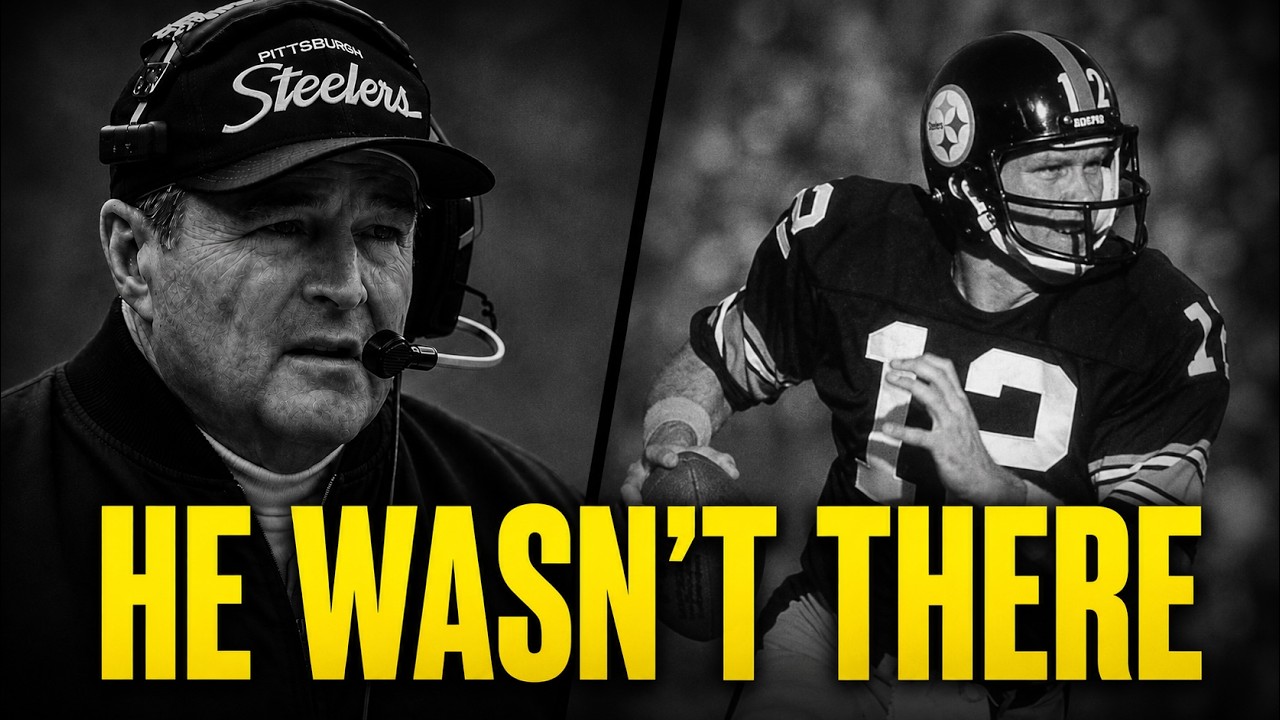
Then he delivered seven words no one in the room understood: “I think it’s time to move on to my life’s work. ”
The room fell silent. No one asked the obvious question, because no one realized what those words meant. Football was not Chuck Noll’s life’s work.
This was not a metaphor. It was not false modesty from a man who had won more Super Bowls than any other coach. It was a precise statement about how he actually saw himself—a man who happened to coach football the way another man might practice medicine or build houses. It was what he did.
It was not who he was. His players spent decades trying to understand him. Most did not grasp it until after he was gone. Born in Cleveland in 1932, Noll was the son of a butcher who died when Noll was a teenager.
He paid his way through the University of Dayton on an athletic scholarship and graduated with a degree in secondary education, intending to become a teacher. He lived across the hall from a student from Hawaii named Jimmy Ako, who played the ukulele. By the end of the semester, Noll had learned to play it too, mastering several songs before the year was out. Years later, after two Super Bowl titles, after the Steel Curtain defense, after the Steelers had become the most dominant franchise in professional football, some of his players made a Christmas visit to his home in Upper St.
Clair outside Pittsburgh. Noll picked up the ukulele and played for them. The players did not know how to process that information. He also converted a closet in his home into a darkroom for photography.
He earned his pilot’s license and flew regularly. He learned to scuba dive. He studied philosophy, wine, and cooking with the same systematic attention he applied to a 3-4 defensive scheme. He built things.
He read widely. After his retirement, he and his wife Marianne sailed for months, living aboard their boat. Their son Chris joked that when he was in college, his parents could never be found—and when they retired, no one could find them either. Biographer Michael MacCambridge spent years trying to understand how the same man who built the greatest dynasty in NFL history could simply walk away from it as if ending a work shift.
MacCambridge concluded that the answer was exactly that. Football was one chapter in a longer book. His players were reading that chapter. Noll was already thinking about the next one.
The question is where that worldview came from. The answer begins 40 years before that press conference, in a locker room in Cleveland. Noll played for the Cleveland Browns under Paul Brown in the 1950s as a middle linebacker, the lineman who carried the plays from the sideline. Brown was the most influential coach of his generation, and Noll watched him with the attention of a man who intended to surpass him.
When Brown cut a player, he used a specific phrase. He would sit the man down and tell him, “It’s time to move on to your life’s work. ”
Brown meant it as an ending. Noll heard it as a philosophy.
He took the phrase to Pittsburgh, used it for 30 years to guide players, to cut them, and to explain what professional football really was and was not. He said it so often that his players assumed it was just coach-speak. It was not. It was the way he actually lived his life.
When Noll held his first team meeting as head coach of the Pittsburgh Steelers in 1969, the team had won only one game the previous year. Mel Blount, a starting defensive back, was taking notes. He expected a speech about what it took to make the team, about winning, about the commitment required to turn around a franchise that had lost for decades. Instead, Noll said: “Gentlemen, welcome to the National Football League.
You’re now getting paid to play. Football is your profession, but I can tell you it’s not your life. You can’t let it be. Part of my job is to help you find your life’s work.
”
Blount thought it was funny. He was 22. He wrote it down in his notes and moved on. Noll said it every year, to winning and losing teams, before and after Super Bowls.
He also said something Robin Cole remembered as a joke: “They can’t pay you enough for it. ” He meant it. Noll never accepted a major endorsement deal. He had no interest in becoming a television personality.
He had no interest in the kind of fame that chased great coaches. Terry Bradshaw, who spent more time under Noll than any other player, said years later: “He was tough on me. I learned from him how to be mentally tough. And for that I can’t thank him enough, because that got me through divorces, through Super Bowls, through those times when I had bad times in big ballgames.
He made me mentally strong, which I wasn’t. ”
Bradshaw understood what Noll gave him. He did not always understand Noll himself. What Noll built between 1974 and 1979 has never been repeated.
Four Super Bowl titles in six seasons: Super Bowls IX, X, XIII, and XIV, against the Vikings, the Cowboys, the Cowboys again, and the Rams. No team before or since has won four Super Bowls in six years. No coach has ever won four Super Bowls at all. The Steel Curtain defensive line—Joe Greene, L.
C. Greenwood, Dwight White, and Ernie Holmes—was the most fearsome unit in professional football. Bradshaw evolved from a quarterback Noll considered replacing in his early years into one of the best the game has seen. Franco Harris, Lynn Swann, John Stallworth, Jack Lambert, Jack Ham, Mel Blount—nine Hall of Famers on one roster, assembled through drafting and development, not spending and trading.
The way Noll built the team was as revealing as what he built. He did not recruit personalities. He recruited intelligence. He asked his scouts to find players who could think, adapt, and learn, because his system required players to understand what they were doing and why, not merely execute instructions.
He believed a player who understood the game would perform better under pressure than one who had only memorized assignments. He did it without charisma, without theatrics, without the motivational speeches his contemporaries considered mandatory. “Pressure is something you feel when you don’t know what you’re doing,” he said, and he believed it. He applied it in practice, expecting his players to be so prepared that pressure was a concept that applied only to other teams.
When a reporter once asked if winning ever got boring, he replied: “A life of frustration is inevitable for any coach whose main enjoyment is winning. ” He was telling anyone who listened that winning was not his main enjoyment. Almost no one heard him. On December 26, 1991, before the press conference, Noll walked into Dan Rooney’s office at Three Rivers Stadium and said four words: “I think it’s time.
” Rooney had been preparing to discuss staff changes. He was not expecting this. He could only express sadness and gratitude. There was a brief discussion of arrangements, an exchange of thanks, a handshake.
Then Noll left. Biographer Michael MacCambridge wrote that he disappeared like Johnny Carson. In 1992, the New York Giants were looking for a head coach after firing Ray Handley. George Young, who had worked with Noll in Baltimore, wanted to talk to him.
Noll declined. He was done with football. The Bradshaw question followed him even into retirement. Bradshaw was one of the greatest quarterbacks of his generation, and the relationship between the two men was one of the great unresolved tensions of the Steelers era.
Noll had publicly questioned Bradshaw’s intelligence during a trial in 1973, a wound that never fully healed. After retirement, Bradshaw became a television personality and showman—the kind of public figure Noll spent his entire career avoiding becoming. The two never fully reconciled. Meanwhile, Noll sailed.
He and Marianne lived on the boat for months at a time. He flew his own plane. He studied wine seriously, the way he studied everything, with the intent of truly understanding it. When his players called, he was happy to hear their news, but he had other things to occupy him.
He later said: “I tried to look around to see what I wanted to do. Football was the thing I knew the most about. ” Already in the past tense. Chuck Noll died on June 13, 2014, at his home in Sewickley, Pennsylvania.
He was 82. Marianne was by his side. His players came from across the country to say goodbye. Joe Greene served as one of the pallbearers—the same Joe Greene who was Noll’s first draft pick in 1969, the cornerstone of the Steel Curtain, the foundation on which everything else was built.
Greene said Noll was the biggest reason Pittsburgh became the city of champions. He also told a story at the wake about the time Noll scolded him for verbally abusing an official: “Joe, these men have families and children, and they probably don’t appreciate you talking to them that way. ” Greene stopped doing it. He said that remark about how to treat people stayed with him longer than any coaching instruction.
Mel Blount stood outside St. Paul Cathedral and said: “The Steeler nation lost one of its pillars. ” Lynn Swann said the Steelers’ style, how they conducted themselves on and off the field, was built entirely on the foundation Chuck laid. Jack Lambert drove from his farm in Kittanning, sat in his truck outside the funeral home for an hour before the visitation began, then went inside and spent 20 minutes in private conversation with Marianne Noll.
Then he went home before anyone else arrived. No photos, no statements, no public appearance. Terry Bradshaw was doing a one-man show at a casino 45 minutes away. He did not attend the viewing.
He did not attend the funeral. When former Steelers public relations director Joe Gordon was asked about Bradshaw, he said: “He’s the most insincere person I’ve known in my life. ” Each man handled it in his own way. Each was trying, in his own way, to grasp the truth of Chuck Noll’s character.
One detail about the phrase “move on to my life’s work” only gains its meaning if you know where it came from. Paul Brown used it for players whose contracts were ending. It was the end of the road, but said with dignity. Noll took the phrase and changed its meaning.
He said it to players who still had full careers ahead of them, to prepare them for the day they would need to hear it. He said it to rookies who thought football was everything, so they would be aware of what they would do next when that day came—and it would surely come. At 61, after winning more championships than any coach in the history of the sport, Noll walked into Dan Rooney’s office, said four words, shook his hand, and left. He had told his players throughout their careers that football was only preparation for something else.
He had been describing himself the whole time. The men who played under him eventually understood. Those who made the trip to Pittsburgh in June 2014 and sat in the pews of St. Paul Cathedral understood it the way they understood most of what Chuck Noll taught them: fully, but a little too late.
He would have said that was exactly the point.