A convicted fascist executioner who hunted partisans and ordered the killings of civilians across northern Italy met his end in a stone-walled courtyard on a cold morning in 1945, refusing a blindfold and asking only for a cigarette before the bullets struck him down.
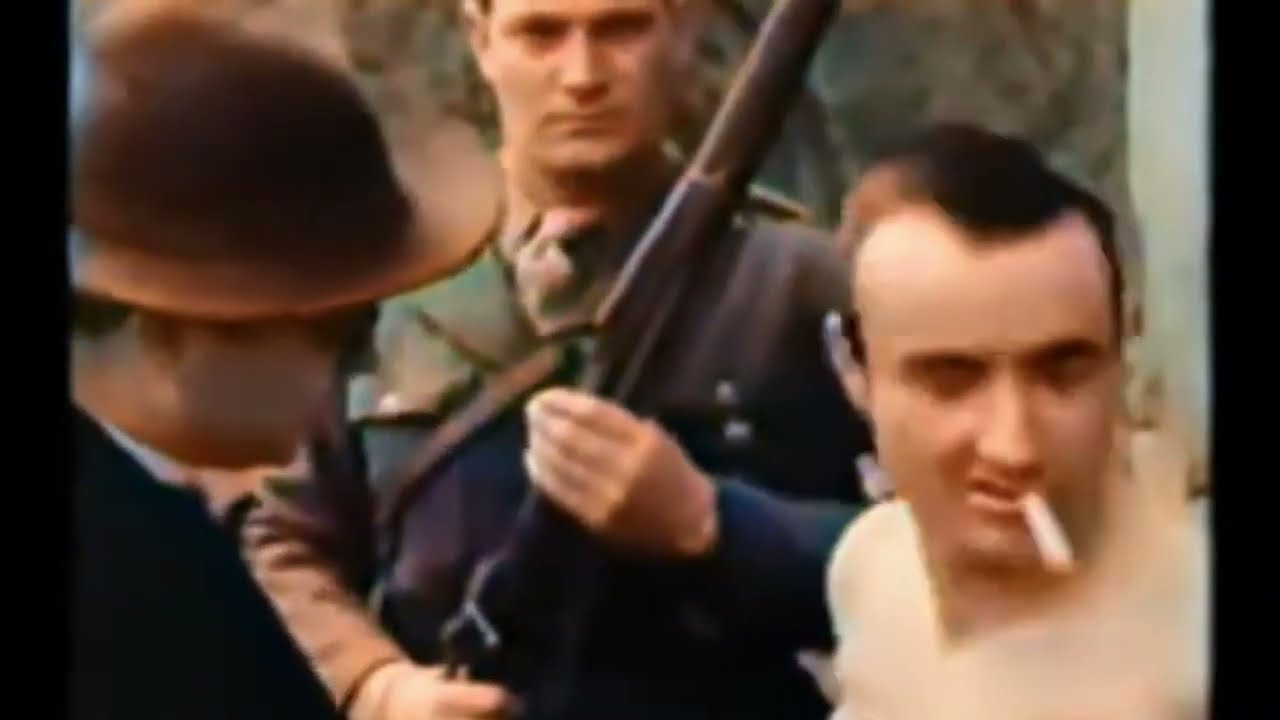
Italo Palesse, a former Blackshirt and collaborator with German security forces, was executed by firing squad days before the surrender of Nazi Germany, bringing to a close a manhunt that had transformed the hunter into the hunted as the Axis collapsed around him.
His final request was simple. A cigarette. His eyes left open.
No cloth across his face. Witnesses described his expression as calm, almost defiant. Some say he smiled just before the order came.
Then the volley rang out, the rounds tore through his body at once, and he fell without making a sound.
Palesse was not one of the loud faces of fascism. He did not deliver speeches. He did not pose for propaganda.
But behind closed doors, in darkened rooms and ruined villages, his presence was felt through fear, through pain, through silence.
Born in Italy at the dawn of the twentieth century, he came of age alongside the rise of Benito Mussolini. He joined the Blackshirts, the paramilitary enforcers of Italian fascist control, and rose quickly through the ranks. While some wore the uniform for status, Palesse wore it out of conviction.
He believed in order, in discipline, in the elimination of opposition at any cost.
As the Second World War ground on, his operations centered on northern Italy. He worked with fascist police units and German special security task forces. His duties included hunting down partisans, interrogating resistance members, and carrying out executions in occupied cities and towns.

Survivors later testified that Palesse was merciless. He often delivered the fatal shot himself after brief sham trials. He was especially feared in small mountain communities, where villagers were dragged from their homes, families were scattered, and houses were burned.
In one documented case, retaliating for partisan activity, he ordered the execution of ten civilians in a public square. The message was meant for anyone who dared defy the regime. The bodies were left as a warning.
The silence that followed was the silence he understood best.
But as 1945 approached and the Axis began to crumble, Palesse’s world fell apart. German forces withdrew. Mussolini fled north.
The partisans grew stronger by the day. The man who had spent years hunting others suddenly found himself the prey.
He tried to escape across the Alps. Local resistance fighters captured him days before Germany’s surrender. He was taken to a town controlled by the partisans, where a rapid investigation was conducted.
Unlike other proceedings, this one did not last weeks or months. Eyewitness documents and direct testimony sealed his fate.

The list of crimes under his name was long. Summary executions. Torture.
Forced labor. Collaboration with Nazi occupiers. He was sentenced to death by firing squad.
Palesse did not appeal. He did not weep. He did not beg.
When the time came, he asked only for a cigarette and for the blindfold to be lifted from his eyes. His face was calm, almost challenging.
The execution took place in a small courtyard surrounded by stone walls. The morning was cold. The shots pierced his body all at once.
He fell without a sound.
His death marked the end of one man’s war, but it also marked the close of a brutal chapter in northern Italy, where occupation, resistance, and retribution had turned neighbor against neighbor and left scars that would take generations to fade.
For the families of those he killed, the execution offered no return, no reunion, no repair. It offered only a finality, a name attached to a grave, a story that could be told without the fear that had once silenced entire villages.

For the partisans who captured him, the swift judgment was a necessity of war. They had seen what Palesse did. They had buried the dead.
They had watched homes burn. They had no appetite for lengthy trials while the smoke of conflict still hung in the air.
For historians, Palesse represents a particular kind of perpetrator, not the charismatic leader or the public ideologue, but the quiet enforcer, the man who carried out the darkest work of a regime and then vanished into the machinery of violence.
His last cigarette, his open eyes, his silent fall, these are the final images of a life spent in the service of fear. They are also the images that close the file on a man who believed in order at any cost, and who discovered that history, like a firing squad, does not always offer a blindfold.
The courtyard where he died is quiet now. The stone walls still stand. The cold morning of 1945 has passed into memory.
But the story of Italo Palesse remains, a warning about what ordinary conviction can become when it is married to absolute power and absolute cruelty.
In the end, he asked for a cigarette and no blindfold. He wanted to see what was coming. Perhaps he wanted the world to see him, too, one last time, before the bullets came and the silence returned.