When Lyndon Baines Johnson died of a heart attack at his Texas ranch on January 22, 1973, the American public watched a carefully orchestrated display of national mourning. Flags flew at half-mast, foreign dignitaries filled Washington National Cathedral, and military escorts carried the casket back to the family cemetery in Stonewall, Texas. The eulogies painted a sweeping portrait of a political giant who had engineered the Great Society, passed the Civil Rights Act, and commanded global foreign policy during the Cold War.
To most observers, the chapter on the 36th president had been closed, bound, and sealed. It had not.
While the official tributes poured forth, a woman named Alice Glass sat in silence, holding private documents that could dismantle the sanitized biography being sold to the public. To the inner sanctum of the Texas Democratic establishment, she was not a forgotten socialite. She was a walking national security threat.
Alice Glass had been Johnson's covert intellectual compass, his secret advisor, and his intimate partner since the late 1930s. She had operated inside his inner circle when he was still an insecure, hyper-ambitious young congressman scrambling for relevance. She knew the details of his psychological vulnerabilities, his financial anxieties, and his backroom arrangements with the corporate titans of Texas industry.
To understand why the political establishment viewed one woman with such profound terror after 1973, one must look back to 1937. When Alice Glass first met the young, lanky Lyndon Johnson, she was operating at the peak of Southern media and financial influence. She was the common-law wife of Charles Marsh, a wealthy and ruthless Texas newspaper publisher who could make or break political careers with a single headline. Marsh was actively funding Johnson's early congressional ambitions.
Alice was an anomaly in mid-century Texas. She was exceptionally beautiful, remarkably tall, and possessed a razor-sharp understanding of international relations, European diplomacy, and global politics, realms the unpolished Johnson completely lacked. She did not merely capture his attention. She captured his mind.
The relationship evolved far beyond a standard clandestine affair. It became an intellectual and political partnership. Alice transformed her estate in Virginia, known as Longlea, into a secret command center for the rising star. Throughout the late 1930s and early 1940s, senior senators, powerful journalists, intelligence operatives, and foreign diplomats gathered there away from the Washington press corps.
Alice was present for every private conversation, every structural deal, and every compromised strategy that laid the bedrock of Johnson's early power base. She did not merely listen. She advised, curated his reading materials, and refined his instincts into sophisticated political weapons.
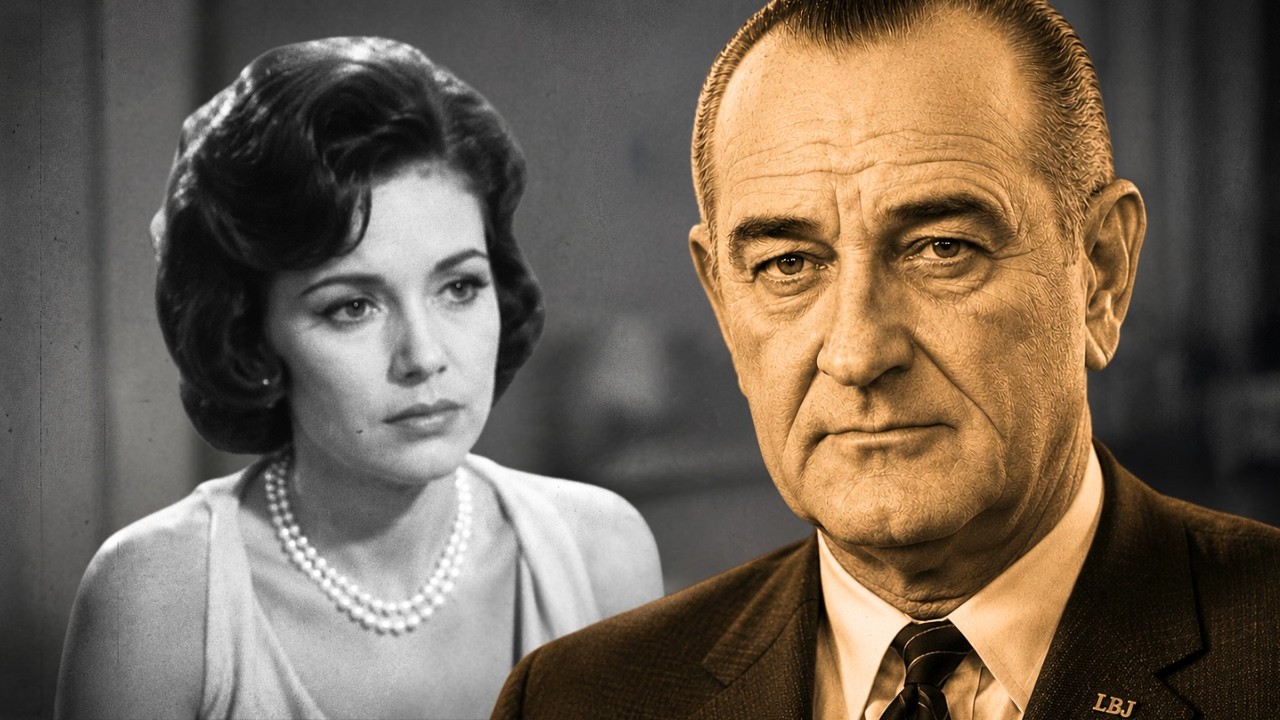
By the onset of the Second World War, whispers about the depth of their intimacy began to fracture the quiet corridors of Austin and Washington. Lady Bird Johnson was fully aware of the arrangement, enduring the humiliation with a stoic resilience that prioritized her husband's career over personal pride. When Charles Marsh finally discovered the betrayal by the young politician he was bankrolling, the situation became volatile and dangerous.
Johnson was forced to use his expanding federal connections to insulate Alice, securing her financial independence through layered real estate transactions and media holdings. Yet these very acts of protection left behind a permanent paper trail. Corporate registries, private letters, encrypted telegrams, and property deeds linked the ascending political titan directly to the glamorous socialite, a record that defied any future attempt at absolute denial.
The fracture between Lyndon Johnson and Alice Glass came as the 1950s drew to a close. Johnson was no longer just a powerful senator from Texas. He was maneuvering for the presidency. His inner circle of veteran fixers and public relations strategists analyzed the political landscape with cold neutrality. The Cold War demanded a specific image, and the electorate would never tolerate a candidate entangled in a high-profile romantic scandal with an elite, independent socialite.
The separation was carried out with chilling bureaucratic precision. Alice Glass was quietly decoupled from the inner political circle. Her access to strategy rooms, her direct phone lines to campaign command centers, and her status as a trusted advisor were revoked without warning or explanation. The abandonment was total, finalized without a shred of public acknowledgement or personal closure.
Johnson understood that as he stepped onto the global stage, his personal history had to be sanitized. The revision of history began in real time. Alice Glass was pushed to the margins of his biography. In campaign literature and authorized profiles, the brilliant woman who had orchestrated his early rise was rewritten as a casual family friend and an occasional Texas hostess.
As Johnson ascended to the peak of global authority, first as vice president and then as president, Alice retreated entirely into her private world. From her estates, she watched television as the man she had once mentored wielded the full power of the American presidency. The psychological strain was immense. She did not merely watch him govern. She watched him escalate the Vietnam War, a conflict she morally and passionately loathed.
Her deep opposition to his foreign policy transformed a painful romantic disappointment into a profound political resentment. The man she had helped create was now sending hundreds of thousands of young Americans to die in a conflict she viewed as a humanitarian disaster.
During these years, investigative journalists frequently descended upon Texas seeking the hidden stories behind the president's rise. Alice was repeatedly approached for interviews and offered massive platforms to tell her story. She refused them all. This silence was not an act of peace or lingering affection. It was an act of survival enforced by the weight of the Johnson political apparatus.

Alice understood that the White House possessed the power to destroy her life. Any public revelation about Johnson's early campaign finances, his backroom deals, or the true nature of their history would have triggered a swift counterattack from the federal government. The official narrative of the LBJ presidency was being curated by loyalists, friendly historians, and White House press flacks. Any mention of Alice Glass's early influence was minimized, scrubbed from archival collections, or presented through a strictly platonic lens.
Alice maintained her composure with aristocratic discipline. She married into another prominent, wealthy family, using the new name to build a thick wall of privacy around her past. She became a ghost in plain sight. Yet this enforced compliance was deeply corrosive. The true history of how an unpolished, crude man had been refined, educated, and elevated into a global presidential contender by an elite, progressive socialite remained locked away from the world.
When Johnson's heart failed him completely in January 1973, the machinery of historical erasure moved from a defensive posture to permanent execution. The death of the former president triggered a coordinated effort to finalize his legacy, and that legacy had no room for the complications of Alice Glass.
During the state funeral proceedings and the endless miles of print obituaries, Alice's name was completely absent. The tributes detailed his legislative victories, his devotion to Lady Bird, and his rustic life as a cowboy philosopher on the LBJ Ranch. The erasure was, for all intents and purposes, flawless. To the vast majority of the American public, Alice Glass simply did not exist.
To the few aging Texas politicians, retired fixers, and old guard journalists who remembered the late nights at Longlea and the quiet real estate transactions in Austin, she was dismissed as an irrelevant socialite from a bygone era. The Johnson machine had achieved its ultimate goal. She was excised completely from the official legacy of the 36th president.
The final countermove began just as the keepers of the Johnson legacy believed they had secured victory. Shortly after Johnson's death, Alice Glass entered the most brutal phase of her own life. She was diagnosed with a severe, aggressive, and ultimately terminal illness. Her physicians made it clear that her remaining time was measured in short, painful months.
It was within this moment of ultimate vulnerability that Alice found her absolute freedom. With her own death looming, she possessed the one asset the Johnson political machine could neither touch nor terrorize. She had nothing left to lose. She no longer had a social status to maintain, no fear of financial retaliation, and no dread of the political fixers who had kept her silent for decades. The old king was dead, and her own time was running out.
She made a calculated decision to preserve the unvarnished truth of her life and her influence. Working from her private quarters, often through bouts of escalating physical pain, she began systematically gathering her private papers, diaries, and the remaining unredacted letters that documented the exact nature of her decades-long relationship with Lyndon Johnson.

She made the crucial strategic choice to bypass the traditional historical archives and presidential libraries controlled by the Johnson family estate and its network of loyal guardians. She knew that sending her documents there would result in their immediate classification, restriction, or outright destruction. Instead, she coordinated with independent researchers, unaligned historians, and trusted academics who operated entirely outside the orbit of the Texas Democratic establishment. She quietly transferred the physical proof of her influence into hands that could not be bought or intimidated by the legacy machine.
In these detailed personal testimonies and letters, she laid bare the private conversations where Johnson had confessed his deepest political fears, his raw ambitions, and the specific ethical compromises he had made to secure absolute power. The collection provided specific, undeniable evidence that shattered the sanitized textbook history of his early rise. She completed this meticulous preservation strategy just as her physical body failed her completely. Alice Glass died in August 1976.
The moment the existence of Alice Glass's preserved papers and letters became known to the historical community, the defensive apparatus of the Johnson establishment moved with aggressive speed. Johnson loyalists, former West Wing aides, and authorized biographers launched a public relations counteroffensive.
They argued with fierce intensity that the relationship between the late president and the socialite had been merely a platonic friendship, nothing more than an intellectual acquaintance common among the elite political circles of mid-century Texas. They publicly questioned the validity and authenticity of the late-emerging documents, pointing to Alice's long decades of silence as proof that the affair lacked historical consequence. They focused their sharpest criticisms on the motives of the independent researchers, attempting to minimize Alice's role and rewrite her as a minor, inconsequential Texas hostess who had misconstrued her proximity to greatness.
But their attempts at damage control failed against the cold, hard nature of the evidence she had preserved. The physical documents were far too precise, detailed, and legally sound to be dismissed as standard social correspondence. The timelines within her letters lined up with mathematical precision with Johnson's sudden, unexplained early financial influxes and his rapid political advancement in the late 1930s. The letters matched the archival records of his early campaign movements, his private property acquisitions, and his secret legislative maneuvers with flawless accuracy.
The unvarnished record permanently confirmed what the inner circle had always whispered in the corridors of power. Alice Glass was not a footnote in history. She was a central architect of the man who became president.
The timeline of Alice Glass reveals the precise cost of entering the orbit of absolute political ambition. In 1937, she established an intense, secret, romantic, and intellectual partnership with Lyndon Johnson while operating at the center of Texas media wealth. In 1942, she served as his primary foreign policy advisor and hostess at the Longlea estate, leaving a distinct paper trail of financial and personal connection. In 1958, she was systematically discarded, marginalized, and silenced as Johnson sanitized his personal life for a national presidential campaign. From 1963 to 1969, she was forced into an uneasy, weaponized silence under the weight of Johnson's imperial presidency and the escalating Vietnam War. In 1973, she was erased completely from the public historical record, state funeral proceedings, and national obituaries following Johnson's fatal heart attack. In 1976, she secured her permanent re-entry into the historical narrative by preserving her private papers and letters immediately before her death.
The enduring legacy of Alice Glass stands as a stark testament to how the pursuit of the American presidency demands the total liquidation of personal loyalty. Lyndon Baines Johnson chose historical immortality over human connection, trading the woman who had refined his mind for the absolute power of the Oval Office.
From a purely tactical perspective, his calculation was entirely correct. Had a high-society romantic scandal erupted during the conservative landscape of the Cold War, it would have halted his Senate career and permanently blocked his path to the White House. The decision to isolate, minimize, and erase Alice Glass was viewed by the political machine not as malice, but as a structural necessity for the preservation of power.
But the human consequence of that calculation was a devastating betrayal. Alice Glass spent the entire second half of her life watching the man she had meticulously helped build sacrifice her very identity to protect his public image. Her final deathbed preservation of the record was a quiet, devastating act of defiance against a political apparatus specifically designed to erase her from existence.
She proved to the world that while a sitting president can control the contemporary press, command the global military, and rewrite the laws of a superpower, he cannot permanently dictate the final historical record. In the end, the master of politics won the White House, but he failed to bury the woman who knew exactly how he got there.