LONDON — The woman the prisoners of Auschwitz called “the Hyena of Auschwitz” walked to the gallows without a tremor, and Albert Pierrepoint, Britain’s most seasoned executioner, would later set down in his memoirs that Irma Grese was among the calmest people he had ever hanged.
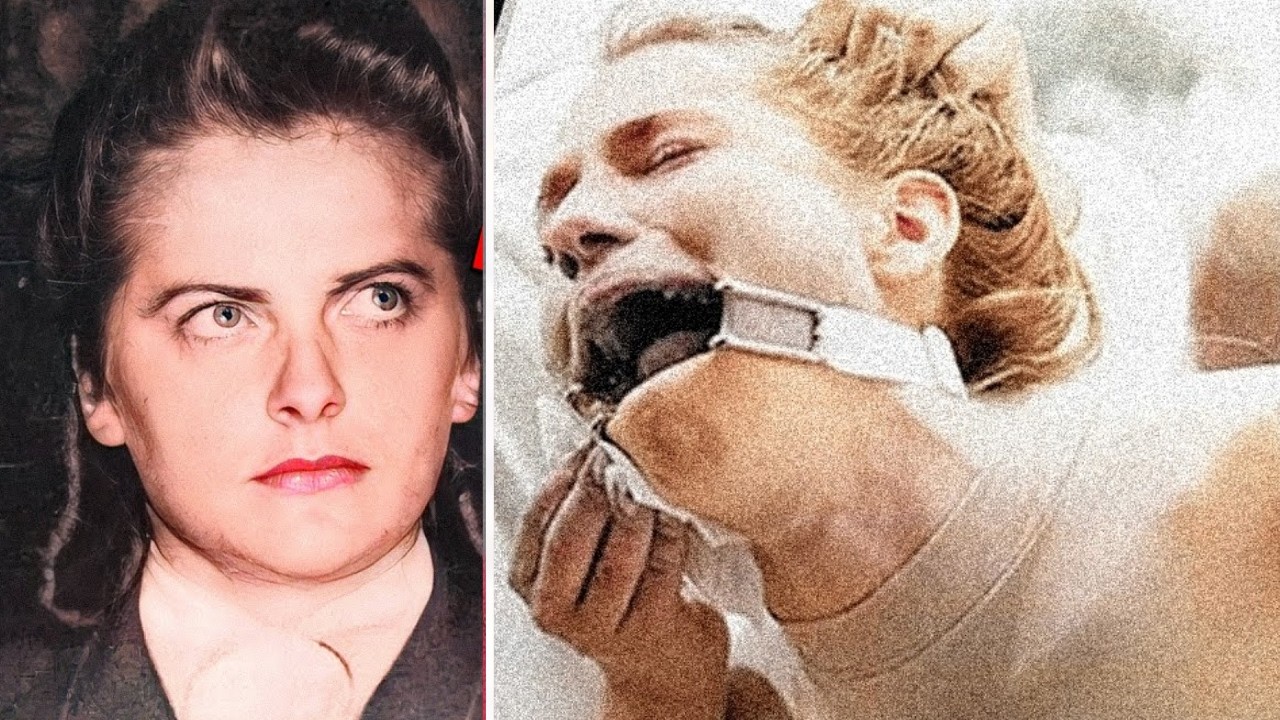
She was twenty-two years old. The date was December 13, 1945. The place was Hameln Prison in northern Germany, a former Nazi penitentiary taken over by British forces after the collapse of the Third Reich.
By the time the rope was placed around her neck, Grese had already become the youngest woman ever executed under British law and one of the most notorious female war criminals of the twentieth century.
Her execution closed one of the earliest chapters of postwar justice, carried out just five months after British troops liberated the camp where she was serving, and months before the world’s attention turned to the International Military Tribunal at Nuremberg.
Grese was born on October 7, 1923, in Wrechen, a small farming village in northeastern Germany. Her father, Alfred Grese, worked long hours as a dairy laborer to feed five children. Money was scarce.
Opportunity was scarcer, particularly for girls. Then, when Irma was thirteen, her mother, Berta, killed herself by drinking hydrochloric acid after learning of her husband’s infidelity. The family never recovered.
Irma’s schooling collapsed. She dropped out at fourteen and drifted through farm work and a brief stint at a hospital in Hohenlychen, connected to the SS medical establishment, where she lacked the qualifications to train as a nurse.
What filled the void was the League of German Girls, the female wing of the Hitler Youth. It gave the teenager the discipline, order and sense of belonging her home had never provided. By 1942, with Germany fighting on every front, the eighteen-year-old volunteered for the SS Women’s Auxiliary Service, a corps created to place women in guard roles across the concentration camp system.
Her training at Ravensbrück, the largest women’s camp in Germany, was short and ideological. Recruits were drilled in surveillance, punishment and unquestioning loyalty to the SS. By March 1943, Grese had been transferred to Auschwitz-Birkenau.
She was nineteen.
She adapted with startling speed. Survivors would testify that she carried a rubber truncheon and a whip, that she kept a German Shepherd trained to maul prisoners on command, and that she set the dog on women too weak to work and on pregnant mothers and children. She was said to smile while she beat people, and to laugh at those who begged.
 The nickname followed her through the barracks: the Hyena of Auschwitz.
Her duties went beyond guarding. Witnesses placed her at the railway platforms during selections, the moments when SS officers decided who would live and who would be sent to the gas chambers. Though she held no medical rank and no senior command, survivors said she took part in choosing who died.
Thousands of women and children are believed to have been sent to their deaths after selections in which she participated.
She served under Josef Mengele, the physician infamous for his experiments, and alongside Josef Kramer, who would later command Bergen-Belsen. Survivors also described psychological cruelty: prisoners forced to stand for hours in agonizing positions, women stripped naked in freezing temperatures, victims singled out for repeated torment. By twenty-one, Grese was among the most feared figures in the camp.
In January 1945, as the Soviet Red Army advanced, the SS evacuated Auschwitz. Grese was moved to Bergen-Belsen in northern Germany, a camp originally built for prisoners of war and converted in late 1944 into a holding site for Jews and others. By the time she arrived, the camp was disintegrating.
Tens of thousands of prisoners were crammed into filthy barracks with almost no food, water or medicine. Typhus, dysentery and tuberculosis swept through the population. More than 35,000 people died there in a matter of months.
Grese continued as a supervising guard under Kramer, who had been appointed commandant in December 1944. Witnesses said she kept beating prisoners, kept using her dog to intimidate them, and kept organizing roll calls that left inmates standing for hours in the freezing cold. Survivors remembered her walking through the chaos looking polished and confident, whip in hand, while bodies piled up around her.
On April 15, 1945, soldiers of the British 11th Armored Division reached the gates. They had not expected to find a concentration camp. Inside lay more than 13,000 unburied corpses, some naked and skeletal, some heaped on top of one another.
Roughly 60,000 people were still alive, most too weak to stand, many covered in open sores, thousands close to death. Medical officers, including Brigadier Glyn Hughes, took charge of relief efforts, but the damage was already done. About 14,000 more prisoners died in the weeks after liberation.

Within hours, the British rounded up the SS personnel still in the camp. Grese did not run or hide. Reports say she stood calmly in her uniform and surrendered without protest, composed in a way that unsettled the soldiers who arrested her.
Survivors identified her immediately.
The British began assembling evidence: photographs, official documents, filmed footage of the camp as they found it, and statements from survivors. The material would be shown in courtrooms and printed in newspapers around the world.
The Belsen Trial opened on September 17, 1945, in a British military courtroom in Lüneburg, northern Germany. It preceded the Nuremberg trials and was formally known as the Belsen Trial. Forty-five defendants faced justice, among them SS guards, camp doctors and functionaries from both Auschwitz and Bergen-Belsen, including Josef Kramer, Fritz Klein and Elisabeth Volkenrath.
Grese was the youngest defendant and the most widely known woman in the dock.
The proceedings lasted two months and ended on November 17, 1945. For the first time, survivors were given a public platform. A Hungarian woman named Ilona Stein, along with witnesses from Poland, France and the Netherlands, described Grese ordering brutal punishments and laughing as prisoners cried out.
The testimony was consistent and cumulative, painting a portrait of a young woman who wielded extraordinary cruelty inside the camp system.
Grese did not deny the core facts. She admitted she had served at the camps and confirmed she had been assigned to selections during roll calls. But she insisted she had merely followed orders and bore no responsibility for the killings.
Her demeanor in court disturbed observers as much as the evidence. She did not weep. She did not appear ashamed.
At times she smiled or looked bored while witnesses described violence linked to her. British officers later said watching her sit in the courtroom was harder than listening to the testimony itself.

The court deliberated on more than twenty survivor statements, official documents and camp records. On November 17, 1945, Irma Grese was found guilty of war crimes and crimes against humanity and sentenced to death by hanging. She was twenty-two.
Of the forty-five defendants, eleven received death sentences. Most others drew long prison terms; a handful were acquitted for lack of evidence. Several of the condemned appealed for clemency.
Grese did not. She filed no appeal and accepted the sentence without protest.
The executions took place on December 13, 1945, at Hameln Prison, carried out by Albert Pierrepoint, one of Britain’s most experienced hangmen. That day he was assigned to execute eleven Nazi war criminals in sequence. The hangings began early.
Pierrepoint worked in silence and with speed. Grese was the third to die and the only woman.
She walked to the gallows in a simple white blouse, a gray jacket and a skirt, her hands bound behind her back. A black hood was placed over her head. According to accounts, she showed no fear.
Pierrepoint later wrote that she was one of the calmest people he had ever executed, walking steadily to the spot and offering no resistance. The process took only minutes. Her body was buried in an unmarked grave near the prison, its location kept secret for years to prevent sympathizers from gathering there.
Her death settled the legal case but not the questions. Some said she received exactly what she deserved. Others struggled to reconcile her age with the scale of her alleged crimes.
Her story became a case study in how ordinary people, shaped by poverty, trauma and ideology, can be absorbed into systems of mass murder, and in how young a person can be and still be held responsible.
In postwar Germany, some tried to deny or minimize what had happened in the camps. The Belsen Trial made that impossible. The evidence was too detailed, the testimony too consistent, the verdicts too public.
And the case of Irma Grese forced the world to confront a truth it had been slow to accept: that women, not only men, carried out the brutality of the Nazi regime, and that one of the youngest of them was hanged for it before the year of liberation had ended.