On the evening of June 5, 1944, a 53-year-old man sat alone in a trailer in southern England and wrote a letter he hoped no one would ever need to read.
He folded it, put it in his pocket, and got into a car. He drove to an airfield to talk to the men he was sending into France.
This is the part of D-Day that never made it into the history books. Not the beaches, not the heroes on the sand at dawn, but the hours before, when the decision had already been made and could not be unmade.
The man was Dwight David Eisenhower.
He was born on October 14, 1890, in Denison, Texas, the third of seven sons in a family of modest means and strong convictions. He grew up in Abilene, Kansas, a town that taught its children to work and not to complain about working.
Eisenhower absorbed both lessons. He was athletic and competitive, with a formidable temper that he controlled with visible effort most of the time.
He went to West Point not because he felt a calling to the military, but because West Point was free. That was the kind of practical arithmetic a boy from Abilene understood.
He graduated in 1915 as part of the class known as "the stars fell on," because so many of its members would eventually wear general's stars. He did not distinguish himself academically, and he carried that ordinary record for decades in a military system that kept precise track of such things.
He did not go to France during the First World War. The war that made the careers of his contemporaries and rivals passed him by while he trained thousands of men in a Pennsylvania camp for a conflict he could not get himself assigned to.
The armistice came and went, and he was still in Pennsylvania, having spent the entire war in America.
That left a mark. The American military of the 1920s and 1930s gave its best assignments to men with combat records, and Eisenhower did not have one. He had administrative records and training records — the record of a man who had spent a war doing things that needed doing, which is not the same as having led men under fire.
He spent the years between the wars as a staff officer, moving through assignments that asked everything of his organizational intelligence and very little of the qualities military culture most visibly celebrated.
He worked for Pershing after the war, organizing the American Battle Monuments Commission in France — a job that required him to spend years cataloguing the graves of men who had done what he had not.
He worked for MacArthur in Washington and then in the Philippines. The years in Manila were, by his own account, among the most difficult of his professional life. MacArthur was a man of enormous capability and enormous ego, and working for him meant navigating both at once.
Eisenhower learned things in those years that no classroom could have taught: about managing men who were impossible to manage, about the difference between authority and the consent that makes authority function, and about the cost of serving a commander who mistook his own certainty for wisdom.
In September 1939, when Germany crossed into Poland, Eisenhower was a lieutenant colonel. He was 48 years old, had been in the army for 24 years, and had never led men in combat.
Under the normal arithmetic of the prewar army, his career prospects were not inspiring. What changed that arithmetic was the war itself, and the man who saw what the war required.
George Marshall became army chief of staff on the same morning Germany invaded Poland. What Marshall understood immediately was that the coming war would require a different kind of officer than the army had been producing.
It would require men who could operate at a scale and complexity the American Army had never attempted — and who could do it in partnership with allies who were suspicious of American competence.
Marshall kept a notebook. It was not a diary but a running record of observations, a document of names and qualities and specific things done well or badly. He had been watching officers for years.
Eisenhower's name appeared in that notebook in connection with the Louisiana Maneuvers of 1941, when nearly half a million American soldiers trained across 30,000 square miles of pine forest and swamp.
Marshall went to Louisiana not to watch the troops but to watch the commanders. What he saw in Eisenhower was not flash. There was nothing in it that would have made a good photograph or a good newspaper story.
What he saw was a man who could manage complexity without becoming consumed by it, who could hold the whole enormous machine in his head and make decisions that served the machine rather than his own position within it.
By June 1942, Eisenhower was in London commanding American forces in the European theater. By December 1943, he had been named supreme commander of Operation Overlord.
He understood what it meant: he was now responsible for an enterprise of a scale that had no precedent in the history of warfare.
The numbers still do not fully convey what they meant. One hundred fifty thousand men on the beaches on the first day alone. Five thousand ships. Eleven thousand aircraft.
The planning for the specific beaches of Normandy had consumed months of work by hundreds of officers. It had also generated disagreements between the British and the Americans that at times threatened to fracture the alliance before the operation ever began.
Montgomery believed the Americans were too impatient and too optimistic. Churchill believed a direct cross-Channel assault was the wrong approach and kept trying to redirect the operation toward softer objectives long after the decision had been made.
The British generally believed American soldiers lacked the seasoning for what was being proposed. The Americans generally believed the British were still thinking in the framework of 1914.
Eisenhower sat in the middle of all of it. He managed it not by suppressing the disagreements but by absorbing them, holding together a coalition that wanted to come apart.
He was the man in the middle not because he was neutral, but because he had decided the coalition was more important than any of the positions within it. He maintained that conviction through 18 months of pressure that would have broken a different kind of commander.
By June 1944, the machine was built. The plan was as complete as planning could make it. The training was done. The loading was done. The deception operations — the elaborate fiction of a phantom army opposite Calais — were running.
The weather was the only variable human effort could not control, and the weather was the problem.
He wrote the letter on the evening of June 5. It is important to understand exactly what the letter is. He had written it in the knowledge that it might need to be sent — which is not the same as believing it would need to be sent.
A man who genuinely believed his operation would fail would not have spent six months building it. He wrote the letter because he had been in the army long enough to know that operations fail, that careful plans come apart on contact with the enemy, and that the margin between success and catastrophe at this scale was narrower than anyone's planning assumptions could guarantee.
He wrote it because a commander who has accepted the possibility of failure is a different kind of commander than one who has not — one whose decisions in the hours before the operation are less distorted by the need to protect himself from a reckoning he has not yet prepared for.
The letter said the landings had not succeeded. It said the troops, the air forces, and the Navy had done everything bravery could ask of them. It said his decision to attack at that time and place was based on the best available information.
Then came the last sentence, the one that matters most: "If any blame attaches to the attempt, it is mine alone." He underlined those last two words.
Reading back over what he had written, he caught two errors and corrected them by hand. In the upper right corner, where he had dated the letter, he had written July instead of June. He crossed out July and wrote June above it.
In the body of the letter, he had written "our landings." He crossed out "our" and wrote "my."
Those corrections — small, handwritten, visible on the original document in the collections of the Eisenhower Presidential Library in Abilene, Kansas — are the most honest record that exists of what he was doing that evening.
He was working out in real time where the responsibility lay. He caught himself distributing it to the collective and corrected the error, because the collective would include the men who had done what he had asked of them. If the thing failed, it was not on them. It was on the man who had decided to do it.
He folded the letter, put it in the left breast pocket of his uniform against his chest, and walked outside into the English summer night.
The weather was gray and uncertain, which was appropriate, because so was everything else.
The weather in June 1944 had become, in its way, one of the most consequential subjects in the history of warfare.
England in the spring of 1944 was unlike anything it had experienced since the Norman Conquest went in the other direction nine centuries earlier. Every road carried military traffic. Every field that could accommodate vehicles had vehicles in it. The ports were stacked with ships.
The airfields — dozens of them, carved out of the English countryside — were crowded with aircraft. In the villages of Kent and Berkshire and Hampshire and Devonshire, the public houses had American accents in them.
Two million men, 5,000 ships, 11,000 aircraft: the most intricate and elaborate military operation ever attempted, held in place by weather and tides and the need for a specific alignment of moon and light that would not return once missed for weeks.
Group Captain James Stagg was the Royal Air Force meteorologist assigned to Supreme Headquarters Allied Expeditionary Force. His task was, in the plainest terms, impossible: to tell the supreme commander when the weather over the English Channel and the Normandy coast would be good enough for the largest military operation in history to proceed.
The North Atlantic in June does not offer certainties. It offers probabilities, and the probabilities Stagg was looking at in early June were troubling.
The original date for the landings was June 5. Tide conditions, moon phase, and the timing of first light over the beaches all aligned that morning in a combination that would not recur for another two weeks.
Then the low-pressure system came down from the north, the way low-pressure systems come down from the North Atlantic without consulting anyone's plans. The sea state rose. The cloud cover thickened.
Eisenhower made the call no one in his position wanted to make. He postponed.
On the morning of June 4, at approximately 4:15 a.m., in a room at Southwick House in Hampshire — a requisitioned country house that had become the nerve center of the operation — he sat with his commanders, listened to Stagg's forecast, and said that June 5 was no longer possible.
The ships that had already put to sea were recalled. Tens of thousands of men who had been told they were going — who had already made whatever internal adjustments men make when the waiting becomes the thing that is happening right now — were told they were not going yet.
They sat in the holds of ships anchored in the Channel for another day, with the smell of diesel fuel and the motion of the sea and the knowledge of what was waiting on the other side of the delay settling over them in a way the planning documents had no category for.
Then on the evening of June 5, Stagg came back to the room. There was a window, he said: 24 to 36 hours of conditions that were not good but were workable.
The sea state would be marginal for the landing craft. The cloud cover would limit the air forces. Visibility would be less than ideal. After the window closed, another storm was coming — and after that, the next tidal alignment was two weeks away.
Two more weeks of secrets that could leak. Two more weeks of a deception operation that had to be maintained. Two more weeks of German intelligence that might figure out what everyone in England was doing and why they were all pointing in the same direction.
He went around the room and asked what everyone thought. Tedder, Eisenhower's deputy, was cautious. Air Chief Marshal Leigh-Mallory, who commanded the air forces, was worried about his planes. Ramsay, commanding the naval forces, said he needed a decision immediately because the ships required time to reposition. Montgomery, whose ground forces would be in the first wave, was prepared to proceed.
The room held genuine uncertainty — not the professional caution commanders perform when they want the record to show they raised concerns, but real doubt about whether the conditions Stagg described were sufficient for what was being attempted.
Eisenhower went quiet. This was something his staff had learned to read: the silence before the decision, the visible focusing of attention that preceded a commitment.
He had spent six months making himself as prepared as it was possible to be for this moment. The moment had arrived, and the preparation and the decision were two different things. Only one of them could happen right now.
He spoke four words. Accounts of exactly what he said vary slightly across the recollections of those present, but the substance is consistent: something to the effect of "Okay, let's go."
The decision was made. The operation was on.
He got up from the table and left the room. He drove to Portsmouth. Then later that evening, on what began as an impulse but was probably something more, he got back into the car and drove to Greenham Common airfield in Berkshire.
The men of the 101st Airborne Division were there, and there was a reason he had chosen them specifically.
The paratroopers were not going to land on the beaches. The beaches were for the seaborne forces arriving at dawn in landing craft — the part of D-Day everyone knew about. The paratroopers were the part that came before.
They were jumping in darkness, hours before the first landing craft touched sand, into the interior of the Cotentin Peninsula behind the German lines.
Their objectives were specific and critical. The German army had flooded the low ground behind Utah Beach, the westernmost of the American landing sites, so that the only way off the beach was through a handful of causeways crossing the inundated fields.
If those causeways were not in Allied hands when the infantry arrived at Utah, the men coming off the landing craft would have nowhere to go. They would pile up on a beach with water behind them, flooded fields in front of them, and German defenses on the high ground. They would die there.
The paratroopers were supposed to secure those causeways. They were also supposed to knock out a coastal artillery battery near Sainte-Mère-Église that had the range to fire on the landing craft, disrupt German communications throughout the peninsula, and create enough chaos behind the lines that the defenders could not organize a coherent response before a foothold was established.
These were the things the 101st was being asked to do at night, in unfamiliar terrain, cut off from any possibility of reinforcement until the seaborne forces broke through from the beaches — hours after the paratroopers were already on the ground.
Eisenhower understood all of this in the particular way a man understands things when he has spent six months building the plan that depends on them. He knew the arithmetic. He knew what it meant for the paratroopers to succeed and what it meant for them to fail.
He knew the casualty projections, which had been revised upward and then upward again as intelligence reports indicated German forces in the drop zones had been reinforced.
He knew all of this when he pulled up to Greenham Common. He knew it when he got out of the car and walked onto the airfield.
What he did not know — what no mathematics could tell him — was whether the men he was about to meet were ready. Not ready in the sense of trained and equipped, because the training records and equipment manifests were in order. Ready in the other sense, the sense that has no entry in a planning document.
The airfield at Greenham Common was working at the level of purposeful intensity any large organization reaches in the final hours before it does the thing it has been built to do. Engines were being checked and rechecked. Equipment was being staged and loaded. Voices ran through lists of things that had to be confirmed.
The men wore the marks of what they were about to do. Their faces were painted dark green and black, a practice that had become standard for airborne operations in low visibility. In the particular light of that evening, the effect was to make 13,000 men look not quite like the American boys they had been two years earlier.
The paint changed what you saw when you looked at them. You saw soldiers — specifically in the way the word describes a person who has been changed by a particular set of experiences into something that is not exactly what they were before.
They were carrying between 80 and 100 pounds of equipment each: the main parachute, the reserve parachute, weapons, ammunition, rations, medical supplies, communication equipment, and the personal items men carry when they understand that whatever they have with them is all they will have.
They had checked everything multiple times — not because they doubted their previous checks, but because checking was something to do while waiting, and waiting was the hardest part.
To understand who those men were, you have to know something about how they had arrived at that airfield. Airborne duty in the American Army was voluntary. Nobody was compelled to train as a paratrooper, and the army made that clear from the beginning.
Every man at Greenham Common had, at some point in the previous two or three years, raised his hand and indicated he was willing to learn to jump out of aircraft into combat zones and fight behind enemy lines without the support systems conventional infantry could rely on.
He had then gone through a training process at Fort Benning, Georgia, designed to find the limits of what he could endure and then push him past them. Roughly half of every class washed out.
The men who completed the training were not the men who felt no fear. Fear was present in the training and acknowledged to be present. What distinguished the men who completed it was not the absence of fear but the management of it — the capacity to continue doing what was required while the fear was present, to treat it as information rather than instruction.
By June 1944, the men at Greenham Common had been living with that management for months. They had trained in England through the winter and spring, run exercises in the dark over English countryside, and jumped again and again from the aircraft they would use in France.
The act of stepping out of an airplane at altitude had become something close to familiar. Not routine — nothing about jumping into hostile territory in the middle of the night is ever entirely routine — but familiar in the way a difficult thing becomes familiar when you have done it enough times to know you survived it before.
They were waiting now for the last time they would do it before it was real. The waiting had a different quality than any previous waiting. Everyone on the airfield knew what the distinction was.
Eisenhower moved among them the way he always moved among soldiers: without the ceremony his rank entitled him to demand, and without the performance of accessibility some commanders use as a substitute for the genuine article.
He did not arrive with a prepared speech. He did not assemble them into formations and address them from an elevated position. He walked into the crowd of men on the airfield, stopped, and talked.
His habit with soldiers, documented across the months of visits he had made to units throughout England in the lead-up to D-Day, was to ask three questions. Not military questions. Not questions about training or equipment or tactical objectives.

Where are you from? What did you do before the war? What are you going to do when it's over?
Those questions deserve more attention than they usually receive, because they are not the questions military protocol suggests a supreme commander should be asking in the hours before the largest operation in military history.
They are the questions you ask when you want to know who someone is. They locate a person in the geography and specific history of their own life. They acknowledge that the man standing in front of you has a life that exists before and outside and after this moment — that he is something more than the uniform and the equipment and the serial number and the casualty projection.
No German general in the history of the Wehrmacht asked his enlisted men what they planned to do after the war. The question would have been structurally incomprehensible within a system that defined a soldier's identity by his function and his obedience, not by the texture of his civilian life.
The Wehrmacht was an extraordinarily effective military organization by any conventional measure, and the professional distance between its officers and its enlisted men was part of what made it effective. Professional distance creates the kind of discipline that does not require individual judgment at every level.
What the Wehrmacht could not produce — and what Eisenhower had been working for years to produce in the American Army — was something harder to specify. Call it the capacity for independent action under conditions where the orders have not arrived and may not arrive, and the situation on the ground is changing faster than any communication system can convey.
That quality would prove essential in the scattered, disorganized hedgerow-by-hedgerow campaign that began in the hours after D-Day. It allowed American soldiers at the squad level to identify objectives and pursue them without waiting for authorization from commanders who were miles away and possibly unavailable.
That quality could not be manufactured by discipline alone. It required men who understood their judgment was expected to function — and who had received enough evidence from the people above them that the system trusted them to use it.
Eisenhower asking where they were from was part of that evidence. It was not a gesture or a performance. It was the concrete expression of a belief about what soldiers are and what commanders owe them: that the men who do the fighting are not units in a plan but human beings with histories, and that treating them as human beings is not a concession to sentiment but a strategic requirement.
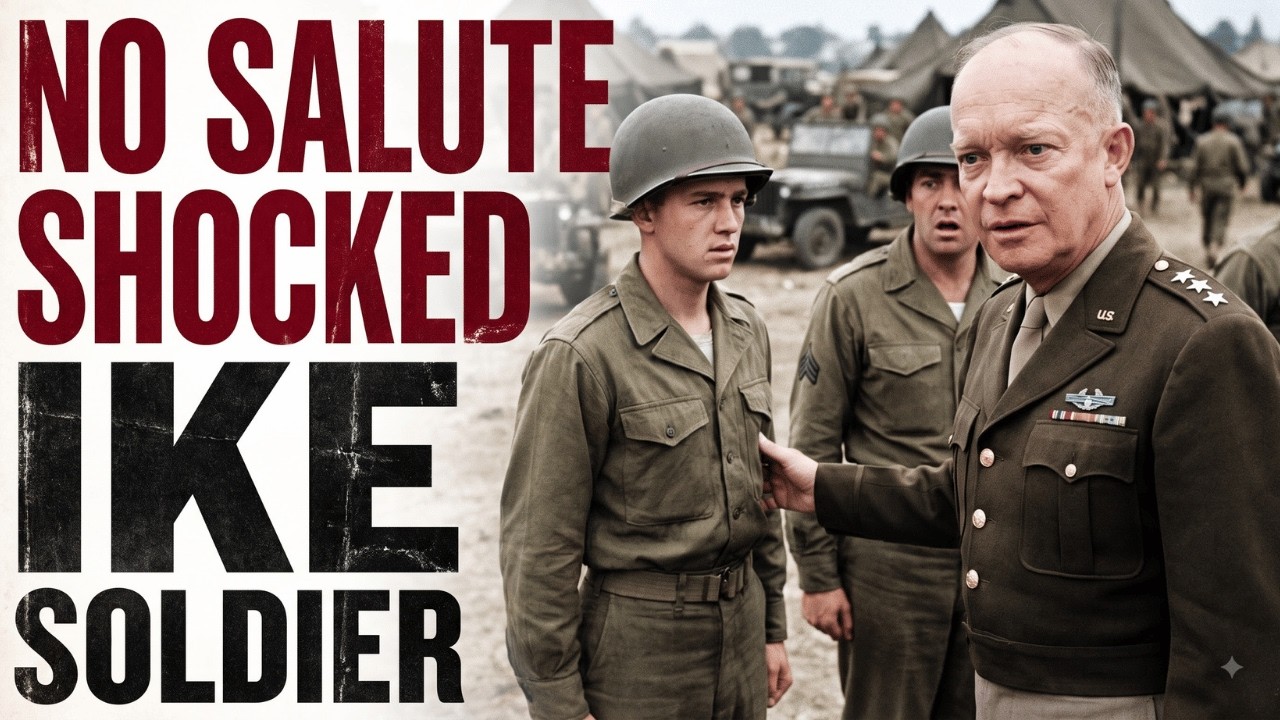
He crouched next to them, sitting on the grass. He shook hands with men whose palms were greasy with camouflage paint. He stopped at groups of four and five and eight, asked the questions, and listened to the answers.
Some of the men recognized him immediately and scrambled to a version of attention. He waved it off consistently — the same small gesture of dismissal each time, not unkind, not irritated, simply not interested in the formality.
These men were loading parachutes and checking weapons and writing letters in the last minutes they had to write them. The question of whether they had properly rendered a salute to the Supreme Commander of Allied Forces in Europe was not in Eisenhower's accounting of the relevant question of the moment.
Others, focused on equipment or on whatever private matter they were managing, did not notice him until he spoke. The realization, the moment of recognition, the scramble to attention, the visible embarrassment at having failed the formality — it followed a consistent pattern, and his response followed a consistent pattern as well.
He was not interested in the salute. He was interested in where they were from.
Among the men he spoke with that evening was First Lieutenant Wallace Strobel, a 22-year-old from Saginaw, Michigan, assigned to the 502nd Parachute Infantry Regiment.
Army Signal Corps photographers who accompanied Eisenhower that night took photographs of the two of them together. In the image most widely reproduced in the decades since — in books, documentaries, and museum exhibits on every continent where people study the Second World War — Strobel is holding his helmet and Eisenhower is leaning slightly toward him.
It is the posture of a man in conversation rather than the posture of a man in command. They appeared to be in the middle of saying something to each other.
Strobel survived D-Day. He survived the subsequent campaign in Holland during Operation Market Garden. He survived the siege at Bastogne during the Battle of the Bulge. He came home to Saginaw and lived the life that waited for him there.
He talked about that conversation on the airfield for the rest of his long life — not because of anything specific Eisenhower said, since no single line from their exchange entered the historical record as remarkable, but because of the quality of what the conversation was. The supreme commander of Allied forces came to talk to him like a person.
That was what Strobel remembered fifty years later. In a 1994 interview with CBS News on the 50th anniversary of D-Day, he said something that reframes the entire visit in a way no official account of the evening has quite managed.
He said that while he believed Eisenhower had come to boost the morale of the troops, he honestly thought it was Eisenhower's morale that had been improved by being with such a remarkably high group of men.
The Supreme Commander came to give something to the paratroopers. What he found was that they gave something to him.
They were not anxious. They were not huddled in uncertainty waiting for a general to come and reassure them. They were ready in the deep sense of the word — not ready because they believed nothing would go wrong, but ready because they had accepted that things would go wrong and had prepared as completely as training and equipment and the specific intelligence of young men in their early twenties could prepare them.
Their confidence was not the confidence of inexperience. It was the confidence of men who had been through enough to know what they could do, and who had concluded on the evidence that what they could do was sufficient.
That confidence, visible to Eisenhower in the conversations on the airfield, gave him something no briefing and no weather forecast could provide. It gave him evidence — not the statistical evidence of planning documents and casualty projections, but the direct human evidence of people who were about to do the thing and who were, in the fullest sense he could observe, ready to do it.
He had sent the order. He had written the failure note. He had made the call in the room at Southwick House, said the words, and set two million people in motion. And here, on an airfield in Berkshire in the hour before the thing began, he saw the reason he had been right to do all of it.
The engines were running when he finally stepped back from the last of the conversations. The sound of the aircraft engines occupied the entire atmosphere rather than simply the ears — a physical presence as much as an auditory one, something you feel in your chest and your sinuses and the bones of your face.
One by one, then in sequence, then in the organized flow of a large and practiced operation, the men of the 101st Airborne began moving toward the aircraft. They climbed in. The doors closed behind them. The aircraft began to move.
He stood on the airfield and watched the C-47s lift off from Greenham Common, beginning at approximately 12:16 a.m. on June 6, 1944. They went one at a time and then in groups, their navigation lights visible until the cloud cover swallowed them, the sound of them receding as they moved out over the English countryside toward the Channel — and then the Channel itself, and then whatever the other side of the Channel was about to become.
Kay Summersby stood a few yards from Eisenhower. She was 35 years old, Irish-born, a woman who had been at his side since North Africa and who had developed, over the months and years of the war, a view of him under pressure as sustained and intimate as any that existed.
She was not a biographer or a historian in those moments. She was the person standing next to him.
She wrote about what she saw. She wrote that his shoulders did not bow. She wrote that his expression was not the expression of a man in grief or in fear. She wrote that as the last aircraft disappeared into the overcast above the airfield, he looked — and the word she used was particular and precise — alone.
Not physically alone. He was surrounded by staff officers and drivers and the operational machinery of a supreme commander's entourage. Alone in the way men look who have made the irrevocable decision and are standing in the moment immediately after it, when the decision has passed from something you are making into something that is simply now happening, and nothing you do or say or feel will change any of it.
They walked back to the car. The airfield was quieter now. The aircraft were gone. The men were in the air over France. The plan that had taken six months to build, the decision that had been made in a room in Hampshire, and the letter in the pocket were all, in their different ways, complete.
The part that was his to do was done. He stood in the quiet for a moment. Then they got into the car, and the driver pulled out of the airfield and onto the road back.
Somewhere in the first minutes of that drive in the dark, Eisenhower broke the silence with four words. He paused in the middle of them.
"I hope to god," he said. Then, after a moment: "I hope to god I know what I'm doing."
That sentence has been repeated many times in the decades since Summersby wrote it down. It has been quoted in biographies and documentaries and in the kinds of profiles of great men that inevitably discover great men were, under the formal surface, human.
It is sometimes treated as a charming admission of humility, or as evidence of the relatable self-doubt that makes historical figures feel accessible. Neither reading is quite right, because neither captures what the sentence actually is.
It is not a performance of humility. It is not self-deprecation. It is the honest expression of a man who understood, as he sat in that car on that road, that the gap between what he had done to prepare and what the night would require was a gap that preparation could close but could not eliminate.
He had been as certain as six months of work and the best available intelligence and counsel could make him. But certainty — the real kind, the kind that knows rather than believes — was not what he had. What he had was the decision, made with everything he could bring to it, made in the way decisions at that scale can only be made, and then released into the execution of the men who had been prepared to carry it.
The letter was still in his pocket. It was there through the night, through the first fragmentary reports coming in on the radios.
The airborne landings were scattered. Units were separated. Communications were broken. Men fought in villages whose names the planners had memorized from maps but which, in the dark and the confusion, looked nothing like the maps suggested.
The early news from the beaches, when it came, was mixed in ways that were difficult to interpret. Omaha was in serious trouble. The 1st Infantry Division and the 29th Infantry Division had hit a beach better defended than intelligence had indicated, and the losses in the first hours were staggering.
There were moments when it was genuinely unclear whether the assault on Omaha would collapse. It did not collapse. The men on the beach held it through the specific, irreducible combination of training and stubbornness and the refusal to accept the alternative — through acts no casualty projection had been able to specify in advance, because the planning documents had no category for the specific thing humans do when they are afraid and exhausted and they keep moving anyway.
By the end of the day, Allied forces were ashore on all five beaches. The beachhead was smaller than the optimistic planning assumptions had projected. The advance inland was more limited. The price had been higher than the best-case scenarios. But they were in France, and they were not going back.

The letter was never needed.
At some point in the weeks that followed — the exact timing is not documented — Eisenhower took the letter out of his wallet and put it elsewhere. It eventually passed into the collections of his presidential library in Abilene, Kansas, where it remains today.
It is a small piece of paper, misdated at the top, with two corrections visible in the handwriting and two words underlined so firmly that the pencil dented the paper beneath them: "mine alone."
When people encounter the failure letter for the first time, what most often stops them is not the prose, which is plain, or the sentiment, which is appropriate, or even the existence of the document itself. What stops them is what the document tells you about the man who wrote it.
He was prepared for failure. He had prepared for it specifically and thoroughly — not because he believed failure was coming, but because a commander who has accepted the possibility of failure is a different kind of commander, one whose decisions in the hours before the operation are less distorted by the need to protect himself from an outcome he has not yet acknowledged as possible.
And he had accepted it in the specific and personal way the corrections in the letter reveal. Not our failure. Not the operation's failure. My decision. My blame, if blame there is.
The crossed-out word is the evidence of the acceptance happening in real time: the handwriting, the mind catching the error, the pen correcting it, on a piece of paper in a trailer in England that no one was supposed to see.
He put the letter in his pocket. He went to the airfield. He asked where they were from. He listened to what they said. He stood on the airfield until the last aircraft was gone. He got into the car. He said the true thing quietly to the one person who was there to hear it.
The men of the 101st Airborne jumped into France in the early hours of June 6, and they did not all come back.
The drop was not what had been planned. The cloud cover, the anti-aircraft fire from German positions below, and the inexperience of many transport pilots with conditions that were difficult even for experienced crews — all of these conspired to scatter the paratroopers across the Cotentin Peninsula in ways that bore only partial resemblance to the drop plan.
Men who were supposed to land in organized serials on designated zones came down instead in the wrong fields, in the wrong villages, in flooded fields ankle-deep and sometimes chest-deep with cold water, in orchards and on rooftops and in the middle of German-held positions no one had anticipated they would land in.
The small metal crickets — devices that made a distinctive click-clack sound and had been issued to every man as an identification signal — became the technology that organized what the drop had scattered. In the dark, separated from their units, individual paratroopers moved toward the sound of other crickets.
They formed into groups that had nothing to do with the organizational chart of the 101st Airborne Division. Surgeons gathered men from three different battalions. Lieutenants found themselves commanding groups they had never trained with. Privates who had landed alone chose a direction and moved toward the sound of gunfire, because the gunfire was where the fight was, and the fight was the reason they had come.
This was the moment where the question of what kind of army produces what kind of soldiers received its answer.
A scattered night drop in hostile territory should have produced paralysis. Without clear chains of command, without communication, without the ability to verify orders or confirm positions, the organizational basis for coordinated action had been largely destroyed in the first minutes after the aircraft reached French airspace.
The unit structure months of training had built was dissolved by the wind and the clouds and the flak and the navigational errors into something that looked, from the outside, like chaos.
From the inside, it looked like American soldiers. They organized themselves not because someone told them to, but because they had been trained in a system that expected them to think and trusted them to act on what they thought — and had given them enough evidence over the course of their training that the system believed in their judgment.
They moved. They attacked. They held crossroads and destroyed bridges and secured causeways and made life in the early hours of June 6 genuinely difficult for the German defenders, who were trying to figure out where the Americans had come from and how many of them there were.
The answer, in the first confused hours, was everywhere and impossible to count.
The causeways behind Utah Beach were secured. The men coming off the landing craft in the gray light of June 6 had somewhere to go.
The plan had not survived contact with the German army intact. No plan does. But the objective had been achieved by men whose training and whose culture had prepared them to achieve it in conditions the plan had not anticipated.
Among those who came home from the campaign was Wallace Strobel, the 22-year-old lieutenant from Saginaw whom Eisenhower had stood next to on the airfield.
Strobel came home. He raised a family. He went into business. He carried the war inside him the way combat veterans carry things — not constantly, not visibly, but there, available when the calendar reached certain dates or when someone asked a certain kind of question.
In 1994, on the 50th anniversary of D-Day, CBS News tracked him down for an interview. He was 72 years old. He sat in a chair and spoke carefully.
He confirmed what historians had long suspected about the famous photograph and the conversation it depicts. There was nothing in it that resembled a battlefield speech or a final exhortation. The Supreme Commander had talked to him the way a neighbor talks over a fence.
He had asked where Strobel was from. He had asked what Strobel did. He had listened to the answer.
And then Strobel said the thing that changes the meaning of the whole evening. He thought the general had come to boost the morale of the men. But looking back honestly, he thought it was Eisenhower's morale that had been lifted by being with such a remarkably high group of troops.
The Supreme Commander did not lift the paratroopers. The paratroopers lifted him.
That observation has sat in the historical record for decades, cited occasionally in Eisenhower biographies, not always given the weight it deserves.
What it says is that the man carrying the failure letter, the weight of the decision, and the knowledge of the casualty projections walked onto that airfield to give something to the men — and found that they had something to give to him.
They were ready. Not in the way a plan is ready, checked and verified and signed off on. Ready in the human sense that is harder to specify and more important to have.
Their readiness, visible and specific, gave Eisenhower something no intelligence briefing could have given him. It gave him direct evidence that the system he had built — the training, the culture, the years of working to produce soldiers who could think independently and trust their own judgment — had worked.
He had believed it would. He had organized his entire command philosophy around that belief. But belief and evidence are different things, and on the airfield at Greenham Common, for an hour on the last evening before the largest operation in history, he had the evidence.
He got back in the car. He watched the last aircraft disappear. He said, "I hope to god I know what I'm doing."
He did know — not with certainty, because certainty was not available and has never been available at that scale and in those conditions. Any commander who claimed otherwise was a different kind of problem than the problem of doubt.
He knew with everything that preparation and care and six months of the most intensive work of his professional life could produce. He knew with the added confidence of having spent an hour with the men he was sending in, and having come away finding them not afraid, not broken, not in need of rescue from the weight of what they were about to do.
He knew well enough.
The letter in his pocket was never needed. The failure it had been written to explain did not arrive.
The decision made in the room at Southwick House — by a man sitting with commanders who expressed uncertainty, in conditions that were workable but not ideal, for reasons the historical record preserves in four words that vary slightly depending on which account you read — was right.
But it would have been right in the essential sense even if the landings had failed. Not strategically right; a failed operation is a failed operation, and the consequences of a failed D-Day would have been enormous. Right in the sense that it was made correctly: with the available information, with the best counsel available, with the acceptance already written and signed and folded and put in a pocket before a single soldier had reached the beach — that the man who made it would own the consequences alone.
The failure letter sits today in a glass case in Abilene, Kansas. The paper is beige. The handwriting is firm. There are two corrections visible to anyone who looks closely: the crossed-out month, the crossed-out word.
The letter has been reproduced in books and documentaries and museum exhibits on every continent where people still care about what happened on June 6, 1944.
What it says, ultimately, is not about failure. It says that the man who launched the largest military operation in the history of the world had prepared specifically and thoroughly for the possibility that it might not work.
And that preparation — the act of writing those sentences, crossing out those words, folding that paper, and carrying it — is a document of a particular kind of character. It is harder to name than courage, because it includes courage but is not only courage.
It is the willingness to look directly at the worst version of what you are doing, to be the one who answers for it, and to do that before you know how the thing turns out.
He asked where they were from. He listened. He got in the car. He said the true thing.
And the night moved toward morning.