In the first days of May 1945, the war in Europe was ending unevenly. Some sectors collapsed into peace while others kept fighting with a violence that seemed incomprehensible, since everyone involved knew the outcome was already decided.
The German army was not one thing in those final days. It was a hundred thousand different situations, each resolved according to the calculations of the specific men involved. Those calculations were shaped by a factor that had not been present earlier in the war and that was changing everything about how the end unfolded: the Russians.
The Soviet advance from the east had moved with a momentum and scale that dwarfed even the dramatic operations of the Third Army. Entire German army groups had been encircled and destroyed. Cities had changed hands in battles that lasted days and left nothing standing.
German soldiers and civilians who had experienced or witnessed what the Soviet advance looked like on the ground, or who had heard from others who had, carried a level of fear about falling into Soviet hands that was qualitatively different from their fear of falling into American hands.
This was not simply propaganda, though the Nazi regime had certainly used the fear for its own purposes. It was based on something real. The Eastern Front had been fought with a brutality the Western Front had not matched, and the men on both sides knew it.
The consequences of that knowledge were visible everywhere in the final days, as German units and commanders made choices that would have been unthinkable a year earlier.
The most significant of those choices, in terms of military scale and political implications, involved a German force operating in Czechoslovakia in the first week of May 1945. The force was what remained of Army Group Center, commanded by Field Marshal Ferdinand Schörner, and it was substantial.
It was not substantial in the sense of being capable of changing the outcome of the war, which was already decided. It was substantial in the sense of being one of the largest coherent German military formations still in the field, with hundreds of thousands of men, significant equipment, and a command structure that was still functioning long after the situation had become hopeless.
Schörner himself was a complicated figure. He was a committed Nazi and a brutal disciplinarian who had maintained order in his command through methods his own officers found extreme even by the standards of the Wehrmacht in 1945.
He had been promoted to field marshal by Hitler personally in the final weeks, which was less a military honor than a political signal. It was Hitler's way of identifying the commanders he believed would fight to the end regardless of the military reality.
Schörner would eventually flee his own command in the final hours, abandoning the men he had led. It was the end that his particular combination of fanaticism and self-preservation instinct produced.
But in the days before that end, the commanders beneath Schörner were making their own calculations. One of those commanders, a general named Hermann Balck, who was responsible for a substantial portion of the forces in the Czech theater, had arrived at a conclusion that was both militarily rational and politically extraordinary.
He had decided he was not going to surrender to the Russians. He was going to find a way to surrender to the Americans, and he was going to bring as many of his men with him as he possibly could.
He was going to do this even though the agreed Allied boundaries placed his forces in the Soviet zone of operations. What he was proposing was not simply a military surrender, but a deliberate political act that cut across the agreements Roosevelt, Churchill, and Stalin had made at Yalta.
The force Balck sought to bring across to the American side was not a regiment or a division. It was an army: hundreds of thousands of men with their equipment, supply trains, and command structure moving west through Czechoslovakia toward the American lines while trying to stay ahead of the Soviet advance closing from the east.
The logistics of this movement were staggering. The political implications were enormous. The time available was measured in hours, because the Soviet forces were moving fast and the window between the German lines and the American lines was narrowing with every passing hour.
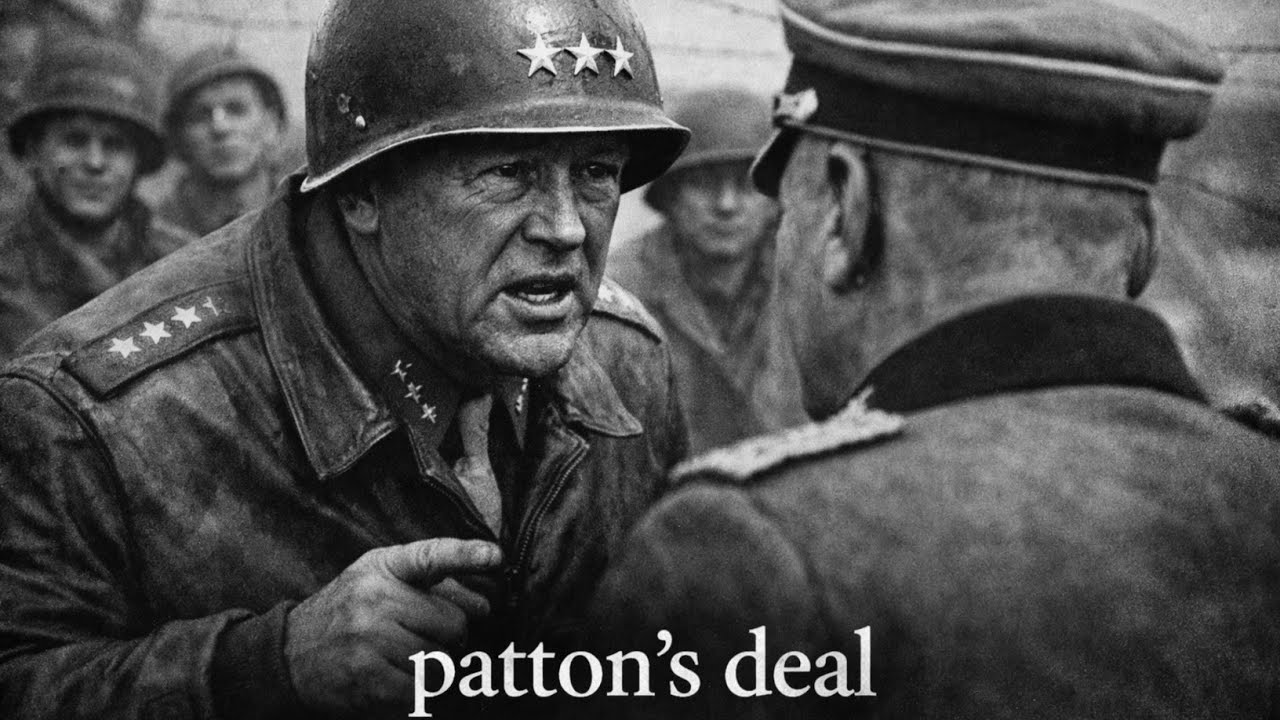
Balck sent emissaries to the American lines. The emissaries reached Patton's headquarters, and Patton, reading the proposal that had come through his forward units, found himself at the center of one of the most consequential decisions of the entire Western campaign.
It was a decision that was simultaneously military, political, and human in ways that did not resolve neatly into any of the categories military training prepared commanders to handle.
The military case for accepting Balck's surrender was straightforward. Hundreds of thousands of German soldiers coming across to the American side meant hundreds of thousands of soldiers who were not fighting, not causing casualties, and not requiring combat operations to neutralize.
It meant a clean end to a major German formation without a battle. It meant American soldiers going home instead of dying in the last days of a war that was already won.
The political case was more complicated. The Yalta agreements had drawn boundaries. The Soviet zone was the Soviet zone. German forces in the Soviet zone were supposed to surrender to Soviet forces.
Accepting Balck's army meant violating those agreements. It meant taking something that had been allocated to the Soviets. It meant making a decision above Patton's authority, with implications for the post-war relationship between the Allied powers that Patton was not empowered to resolve by himself.
Patton knew all of this. He had not survived 30 years in the American military without understanding where his authority ended and where the authority of his superiors began. He referred the matter up the chain.
He contacted Bradley. Bradley contacted Eisenhower. At the highest levels of the Allied command structure, the question was debated with the urgency the timetable demanded, because every hour of debate was an hour in which the Soviet advance was closing the window through which Balck's forces were trying to move.
The decision that came back was a compromise that satisfied nobody completely, and it was probably the only decision possible given the constraints.
Patton was authorized to accept the surrender of German forces that reached the American lines. He was not authorized to actively facilitate their movement or to hold the lines open in ways that could be construed as a deliberate policy of diverting German forces from the Soviet zone.
The distinction was fine enough to be almost meaningless in practice, but it gave Patton the legal and political cover he needed, and he used it.
He met Balck at a forward American headquarters in the first days of May. The meeting was, by every account of the people present, one of the strangest of the entire war.
Balck was a German general who had spent years commanding forces on behalf of a regime that was now collapsed. He was surrendering an army of hundreds of thousands of men to an enemy general in order to avoid surrendering to a different enemy.
He was doing all of this in the full knowledge that the political arrangements of the post-war world were being shaped in real time by decisions being made in rooms like this one.
Patton looked at Balck across the table and asked him directly how many men he was bringing across. Balck gave a number. Patton looked at the number for a moment.
Then he asked Balck whether he understood that the men he was bringing across were going to be processed as prisoners of war in accordance with American and international standards.

They were not being recruited into any other service or given any guarantees about their post-war treatment beyond the protections of the Geneva Convention. Balck's cooperation in an orderly surrender was the only thing Patton was in a position to offer him.
Balck said that he understood. He said that it was enough. Patton said that it was going to have to be, because it was all there was.
Then Patton said something the officers present remembered afterward as the most direct summary of the situation they heard from anyone during the entire final days of the war.
He said that he understood why Balck had made the choice he had made and that he was not going to pretend otherwise. The fear of the Soviet advance was a real thing based on real events, and he was not going to insult Balck's intelligence by suggesting it wasn't.
He said that the men coming across were going to be treated correctly. He intended to keep that promise because he kept his promises, and because the men coming across were soldiers who had fought in a war that was now over. Whatever they had done in that war was a matter for the processes being established to deal with it.
But then he said something else. He said that he wanted Balck to understand something clearly.
He said that the Soviet Union was an ally of the United States, and that the arrangements made between the Allied powers were arrangements Patton operated within regardless of his personal views about them.
He said that his personal views about the Soviet Union and about what the post-war world was going to look like were not relevant to this conversation, and that he was not going to share them.
He said that what was relevant was that Balck was surrendering to the United States Army. The United States Army was going to process that surrender according to its agreements with its allies and its obligations under international law.
Balck needed to understand that the surrender he was making was to the institution, not to the individual. The institution had obligations that extended beyond anything Patton personally might think or feel about the situation.
It was, the officers present agreed, a remarkable piece of self-discipline from a man who was not known for self-discipline.
Patton's views about the Soviet Union were not a secret within the Third Army. He had expressed them with his characteristic directness on multiple occasions, in ways that had reached Eisenhower and had contributed to the growing sense at the highest levels of Allied command that Patton was becoming a political problem as well as a military asset.
He knew what he thought. In this meeting with this German general who had brought hundreds of thousands of men across to the American side, partly because he shared some of those thoughts, he chose to say none of it. He represented the institution rather than himself and kept the conversation where it needed to be.
The surrender was processed. The men came across. The numbers were staggering in a way that even Patton's staff, who had been processing surrenders for weeks, found difficult to absorb.
Hundreds of thousands of German soldiers moved through the American lines in an operation that was simultaneously a military surrender and a mass human migration. Men who had been fighting for years were now simply trying to get to the right side of a line before the line moved.
The Soviets protested. The protest went through diplomatic channels and produced the kind of carefully worded responses that diplomatic channels produce. It satisfied nobody, resolved nothing, and papered over a tension that was going to define the next 50 years of European history.

Patton was not involved in those diplomatic exchanges. He had done what he had been authorized to do, within the boundaries he had been given. The political consequences were above his level, and he knew it and was content to leave them there.
He wrote about the meeting with Balck in his diary. He wrote that Balck was a soldier who had made a rational decision in an irrational situation, and that he respected the decision without necessarily respecting everything that had led to the situation in which the decision had to be made.
He wrote that the men who had come across were now prisoners and that they were being treated correctly and that this was the right outcome.
He wrote that the end of the war in Europe was producing situations that no military training had prepared anyone to handle. The only tool available was judgment, and judgment was an imperfect tool, but it was the only one there was.
He wrote that he hoped the decisions being made in these final days were the right ones. He wrote that he was not certain they were. He wrote that certainty was not available and that this was something he was going to have to live with.
That was not a sentence that came easily to a man who had built his entire identity around the proposition that certainty was the fundamental quality of command.
The war in Europe ended on May 8, 1945. The men who had come across with Balck were in American prisoner of war facilities. When the end came, they were alive.
They were going to go home eventually, to whatever Germany was going to become, to whatever lives were possible in the aftermath of what had happened. That was not nothing. In the spring of 1945, it was very far from nothing.
Patton was in his headquarters when the formal surrender came through. His staff expected something — a statement, a reaction, something that matched the scale of what had just ended.
What they got was Patton sitting quietly for a moment and then asking what was next. The occupation of Germany was beginning and there was work to do. George Patton had never in his life been comfortable with endings, only with what came after them.
What came after for Patton was six more months of a world that was not sure what to do with him now that the thing he had been built for was finished.
He died in December 1945 in circumstances that remain disputed, in a hospital in Heidelberg, from injuries sustained in a car accident that may or may not have been an accident, depending on which account you find most credible.
He was buried in Luxembourg among his men, in the ground of the country his army had helped liberate. The question of what he would have done with the post-war world if he had lived to engage with it fully is one of the more interesting unanswerable questions of the 20th century.
Balck survived the war and was eventually tried for war crimes related to his command in Norway earlier in the war, before Czechoslovakia, before the final days. He was convicted and sentenced, served his sentence, was released, and died in Germany decades later.
Whether the choice he made in the first days of May 1945 — the choice to bring his men across to the American side rather than leave them to the Soviet advance — was calculated into his case in any way is not clearly documented.
It was the kind of choice that the processes established to deal with the aftermath of the war were not designed to weigh, because those processes were designed to look backward. Both of those things were part of the same person, the same story, and the same war.
That was the nature of the ending of the Second World War in Europe. Almost nothing about it resolved cleanly. Almost everything about it required holding two true things at the same time without letting either one erase the other.
Patton had understood that in the room with Balck. He had represented his institution, kept his personal views where they belonged, processed the surrender, and written in his diary that he hoped the decisions were right without being certain they were.
For a man of his temperament, that was an extraordinary accommodation to the complexity of the moment. It was probably the most sophisticated thing he did in the entire war, and it happened in a room that most people have never heard of, at a meeting that most histories of the war pass over quickly, in the first days of May 1945, when everything was ending and nobody quite knew what was beginning.