On June 4, 1944, the people of Rome poured into the streets to celebrate their liberation. After nine months of brutal German occupation, marked by hunger, massacres, and the deportation of Jews to Nazi death camps, hundreds of thousands rejoiced. Among them were freed prisoners and thousands of Jews who had survived by hiding.
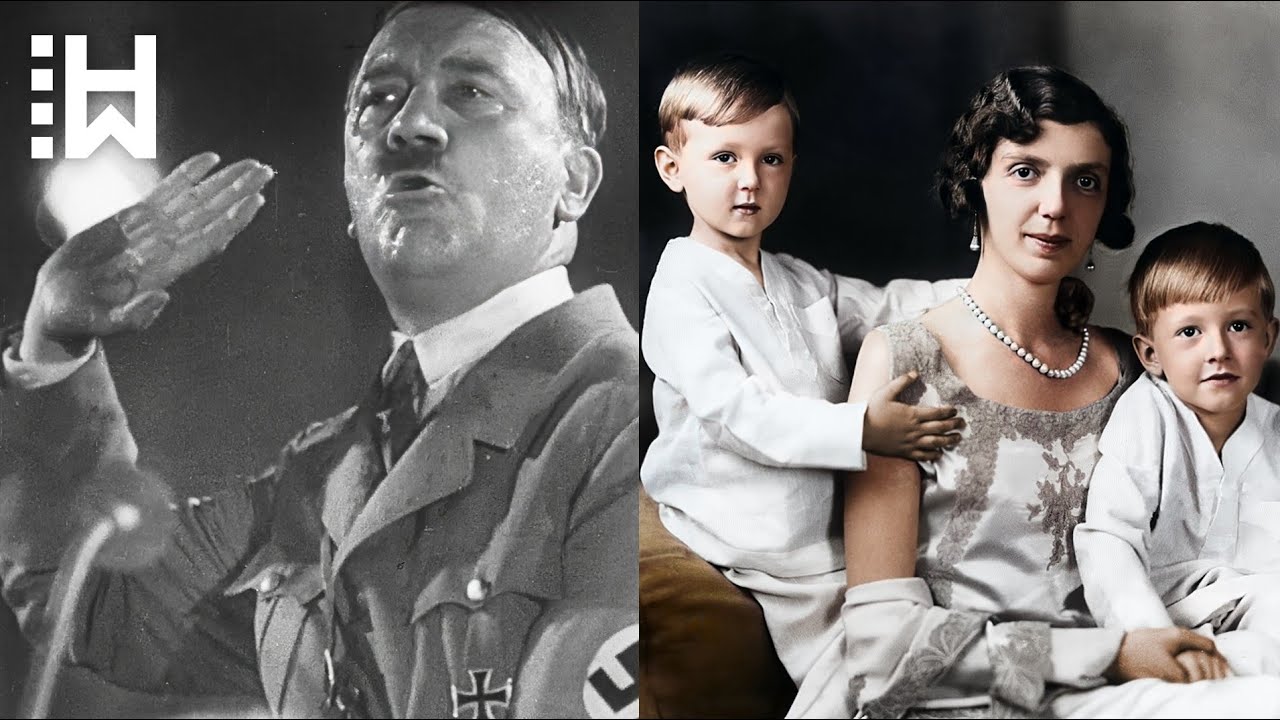
But for every Italian, the war was not over. Far away in Nazi Germany, inside the Buchenwald concentration camp, an Italian woman was held under a false name on the personal order of Adolf Hitler. She was no ordinary prisoner. She was a daughter of the Italian king. Her name was Mafalda, Princess of Savoy.
Mafalda was born on November 19, 1902, in Rome, in what was then the Kingdom of Italy. She was the second daughter of Victor Emmanuel III, who had reigned as king since July 1900. Mafalda was especially close to her mother, Elena of Montenegro, the Queen Consort of Italy. From her, she inherited a strong sense of family and human values, along with a passion for music and art.
When the First World War began on July 28, 1914, Mafalda and her sisters accompanied their mother on her frequent visits to Italian military hospitals. There they took part in comforting and caring for the troops.
On September 23, 1925, Mafalda married the German Prince Philip of Hesse, whose uncle was the last German Emperor, Wilhelm II. Between 1926 and 1940, the couple had four children: three sons and one daughter.
The 1920s and 1930s were a difficult time in Europe as authoritarian regimes rose, especially in Italy and Germany. While communists were killing nobles and seizing their wealth, fascist governments promised aristocrats the opposite: protection. This may be one reason Mafalda's husband, Prince Philip, joined the Nazi Party in 1930 and the SA in 1932.
Philip became a close friend of Hermann Göring, head of the German air force, the Luftwaffe, and introduced other aristocrats to the Nazi Party. He also served as an intermediary between Hitler and Mussolini and acted as an art agent for Hitler in Italy, purchasing numerous important works for the Führer. By the time Philip realized how evil the Nazi regime was, it was too late.
On July 25, 1943, Italy's fascist dictator Benito Mussolini was dismissed as prime minister and arrested on the order of Mafalda's father, King Victor Emmanuel III. Hitler believed Philip and his family were complicit in Mussolini's downfall. When Italy officially surrendered to the Allies on September 8, 1943, Hitler had Philip arrested. Hitler had no sympathy for Mafalda either, calling her the blackest carrion in the Italian royal house.
In late August 1943, shortly before Mussolini's dismissal and Philip's arrest, Mafalda traveled to the Kingdom of Bulgaria. She went to attend the funeral of the husband of her sister Giovanna, Bulgarian Tsar Boris III. Boris had been under strong pressure from Nazi Germany to deport Bulgaria's Jewish population to concentration camps in German-occupied Poland.
Boris III refused to permit the extradition, claiming he needed the Jews for the construction of roads and railways. It is believed he knew the fate awaiting Jews in the camps, and that the road and railway work was a way to save them from deportation to the Nazi death camps.
In August 1943, Adolf Hitler and Tsar Boris met in Germany to discuss not only the Tsar's refusal to deport Bulgaria's Jews, but also a declaration of war on the Soviet Union. Hitler became furious when the Tsar did not obey his demands. Shortly after returning to Sofia, Tsar Boris died of an apparent heart attack on August 28, 1943.
It is believed, however, that he was poisoned on Hitler's order with a slow poison that takes weeks to kill its victim, causing blotches to appear on the skin. It was while Mafalda was in Bulgaria that Italy surrendered to the Allies on September 8, 1943. Hitler considered this a betrayal and began occupying Rome the same month.
Unaware that her husband Philip had already been arrested and sent to Flossenbürg concentration camp, Princess Mafalda decided to return to Rome to join her children, who had been given sanctuary in the Vatican. She reached Nazi-occupied Rome on September 22.
One day later, she was asked to come to the German embassy under the pretense of a phone call from her husband. It was a trap. Mafalda was immediately arrested and put on a plane to Munich, then to Berlin for questioning. She was finally deported to Buchenwald concentration camp, where she was locked up under the false name Frau von Weber.
She lived in an isolated barracks and was forbidden to reveal her true identity. But news that the daughter of the king of Italy was in Buchenwald spread anyway. Her treatment at the camp, though privileged compared with that of other prisoners, was still harsh.
Mafalda lost a great deal of weight and ate very little. Whenever she could, she made sure the precious extra food she received was shared among those who needed it most.
In August 1944, Allied troops bombed an ammunition factory inside Buchenwald. Mafalda, housed close to the factory, was badly wounded in the arm. She also suffered severe burns and bruises all over her face and body. Two Italian prisoners found her still alive under a pile of rubble.
She told them, "I am dying. Remember me not as the princess, but as your Italian sister." She was hospitalized in the camp's brothel, which also served as an infirmary. Without proper care, infection set in and her condition worsened dramatically.
After four days of immense suffering, she developed gangrene and her arm had to be amputated. Nazi headquarters approved the operation when it was already too late. Mafalda, the Italian king's daughter, was finally operated on in the brothel of Buchenwald by a German SS doctor, Karl Schidlowski.
The operation was carried out too late and lasted an unusually long time. Mafalda was left with no post-operative care or support, and she never regained consciousness. She bled to death on the night of August 28, 1944, at the age of 41.
Shortly before the operation, sensing her end was near, Mafalda asked a friend in the camp to do her a favor: to say hello to her four children and to all of Italy, from the Alps to Sicily.
After Mafalda's death, the prisoners were ordered to burn her naked body in the furnace. But because there were Italians among them who recognized her, they arranged for her to be placed in a wooden coffin and buried as an unknown woman in a mass grave. As an identifier, only the number 262 was affixed, along with the words "an unknown woman." Later, thanks to that identifier, it was possible to locate her remains among many other anonymous wooden coffins.
The sad truth behind Mafalda's death is that she was intentionally operated on too late in order to cause her death. This method of excessively long or delayed operations had already been used at Buchenwald, always performed by SS doctors on high-profile personalities the Nazis wanted to get rid of.
Some justice was served after the war when the SS doctor Karl Schidlowski, who operated on Mafalda and let her bleed to death, was sentenced to death by hanging. He was executed on May 3, 1947. Only in 1951, since Buchenwald lay in a Soviet-controlled zone, were her remains transferred from Weimar, the city near the camp, to the crypt of the Hesse family at Kronberg Castle.
Mafalda was born a princess in a palace in Rome, yet she died in a Nazi death camp, as did millions of other victims of the criminal Nazi regime. Her tragic story, like the stories of millions of others who perished in the Nazi atrocities, should never be forgotten.