On December 22, 1947, in Krakow, Poland, the former staff of Auschwitz heard their sentences read aloud. After a month of gruesome testimonies, the court revealed that many SS officers had committed inhumane torture and mass murder, often for pleasure, and that their cruelty went far beyond what their superiors ordered.
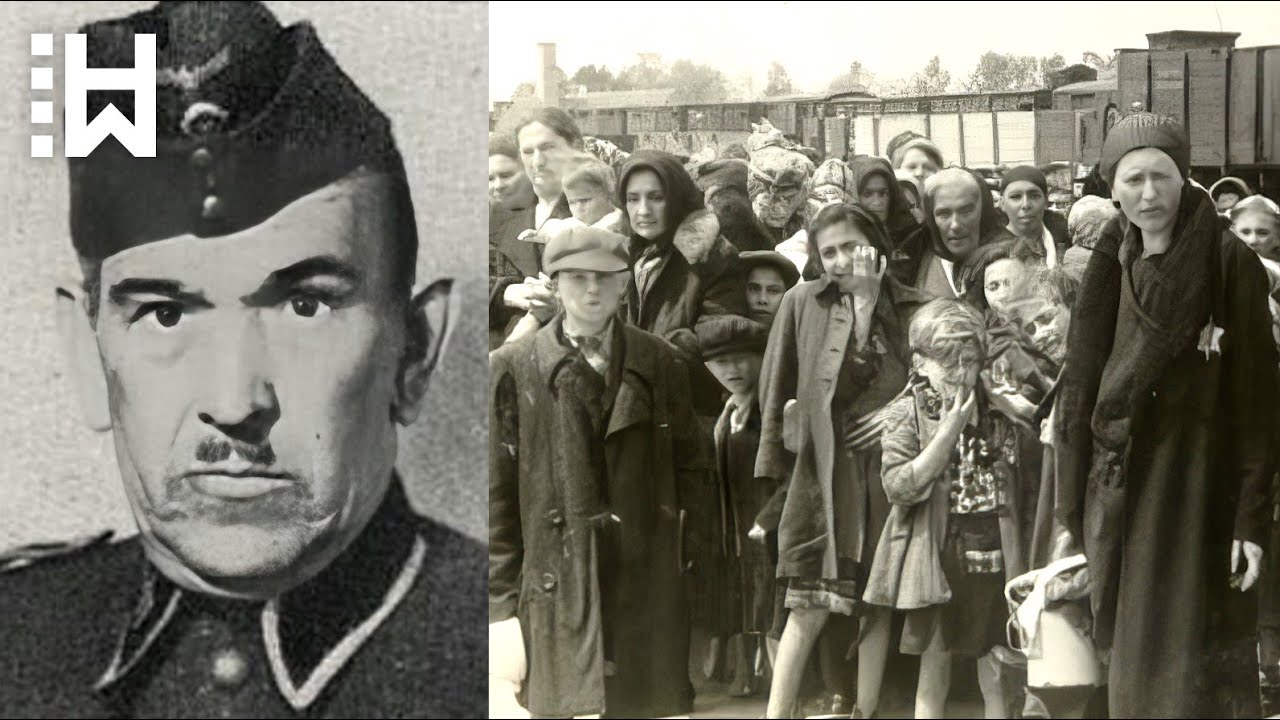
One of the perpetrators of this criminal Nazi regime was August Bogusch. He was born on August 5, 1890, in Lubliniec, then part of the German Empire. A clerk by profession, he married Eugenie Mandel in June 1921.
In October 1932 Bogusch joined the Nazi Party, and in April 1933 he joined the SS. The Schutzstaffel, or Protection Squads, had been established in April 1925 to protect Adolf Hitler and other Nazi leaders and to provide security at political meetings.
SS members were subject to strict military discipline and swore an oath of complete loyalty to Hitler and those he appointed. In January 1929 Heinrich Himmler became head of the SS, and the organization expanded greatly in size and strength. By the time Hitler came to power in 1933, Himmler had made the SS the dominant organization within the Reich.
From the beginning of the Nazi regime, Hitler entrusted the SS first and foremost with the removal and eventual murder of political and so-called racial enemies. The SS became a virtual state within a state and was staffed by men who saw themselves as the racial elite of the Nazi future.
From 1939, the SS assumed responsibility for solving the so-called Jewish Question. This culminated in 1941, when the leadership planned, coordinated, and directed the so-called Final Solution, the genocide of European Jews during World War II known as the Holocaust. SS officers were directly responsible for managing concentration camps, where millions of Jews were murdered by poison gas.
August Bogusch arrived at Buchenwald in August 1939, one month before the outbreak of the Second World War. Established in July 1937, Buchenwald was one of the largest concentration camps within the German borders.
The camp played an important role after Kristallnacht, the coordinated violent riots against Jews across Nazi Germany and recently incorporated territories on November 9 and 10, 1938. The SS and police sent almost 30,000 Jewish males to concentration camps, and 10,000 of them were sent to Buchenwald, where authorities subjected them to extraordinarily cruel treatment. Over 250 of these prisoners died from injuries incurred during their arrest or from initial mistreatment at the camp.
Prisoners lived in the Buchenwald main camp, surrounded by an electrified barbed-wire fence, watchtowers, and a chain of sentries outfitted with automatic machine guns. At the entrance stood a notorious punishment block known as the Bunker, where prisoners who violated camp regulations were punished and often tortured to death. The main camp also included 33 wooden barracks, disinfection buildings, a brothel, and a crematorium.
Most early inmates at Buchenwald were political prisoners, people arrested for some form of political opposition to the Nazi regime. One such prisoner was Ernst Thälmann, who had been chairman of the Communist Party of Germany before Hitler's rise to power. Arrested in 1933, Thälmann was murdered by SS staff in Buchenwald in August 1944 after being held there for several years. In addition to political prisoners and Jews, Buchenwald held repeat offenders, Jehovah's Witnesses, Sinti and Roma, and German military deserters.
August Bogusch left Buchenwald in January 1941, shortly before physicians and scientists began a program of medical experimentation on the camp's prisoners. On January 27 he arrived at Auschwitz, located in German-occupied Poland, where he first served as a guard.
Bogusch became known for his incredible hatred toward Polish prisoners, whom he called names such as Polish swine and bandits. Among Auschwitz prisoners, whom he would beat for the smallest violations of the rules, he had a reputation as a stupid, rapacious, and sneaky man. He blackmailed inmates, demanding things and services he had no right to, and if a prisoner refused or delayed, Bogusch reported him, which entailed severe punishment.
He was infamous for skillfully using his whip to make inmates suffer as much as possible. On a few occasions he placed prisoners over a special construction called the goat and punished them with 25 lashes. While the prisoners were beaten, they had to count out the blows in German, and if they made a mistake, the counting and beating began again. When he finished, an inmate had to stand up and say thank you in German. Bogusch would flog prisoners with a smile on his face, and his blows were especially strong and painful.
Sometimes Bogusch did not administer the punishment himself but sent inmates to a notorious penal company. Prisoners were assigned there for various reasons, including escape attempts, contact with civilians, or the illegal possession of food, money, and additional clothing. Assignment to the penal company, situated in infamous Block 11 and led by the sadistic Otto Moll, lasted from one month to one year. Prisoners were completely isolated, had to perform the hardest labor, and were continually beaten by SS men and prisoner functionaries.

On one occasion Bogusch pulled a female Polish prisoner by the collar and took her to the penal company, where she received 25 lashes with a whip. After the war the prisoner testified that the reason for the punishment was that she had accepted food from people while working outside the camp.
Another of Bogusch's specialties was hitting prisoners in the face and kicking them. Once, a Jew was hanged in the camp for an escape attempt. After the execution, Bogusch terrorized other prisoners, calling one of them over to the gallows and threatening to hang him too. When the prisoner resisted, Bogusch hit him in the face.
At Auschwitz he also worked as a block leader. Bogusch watched the prisoners constantly, checking whether they were working hard enough and pushing them to work even harder. He did not allow any of them to go to the toilet, nor did he allow them to consume even a scant amount of bread during working time, stating that they could do so after finishing work.
Bogusch also took part in selections on the rail ramp and actively participated in taking prisoners, especially Jews and those who were sick, to the gas chambers. During these actions, especially when unloading transports and loading victims onto trucks to be murdered, Bogusch was extremely brutal and was seen beating and kicking them.
During the German occupation of Poland, London radio announced that Bogusch had already been sentenced to death by the Polish underground.
In mid-January 1945, as Soviet forces approached the Auschwitz camp complex, the SS began evacuating Auschwitz and its subcamps. SS units forced nearly 60,000 prisoners to march west from the camp system. Prisoners suffered from cold weather, starvation, and exposure during these death marches.
On January 21, 1945, August Bogusch joined the escort of one such death march and, along with other SS guards, drove prisoners to Wodzisław, about 70 kilometers from Auschwitz. On the way he beat the prisoners and ordered SS men to shoot on the spot those inmates who, due to exhaustion, could not march any further. Out of the 300 prisoners who left Auschwitz on this particular death march, 100 were shot along the way.

Bogusch was then sent to Mysen concentration camp near Oslo in German-occupied Norway. Soon after, in February 1945, he was transferred again to Buchenwald, and finally to Gusen, a subcamp of Mauthausen concentration camp in Austria.
Established in May 1940, the Gusen site had attracted the SS because of its proximity to stone quarries. Gusen retained its autonomous status until early 1944 and had its own numbering system, death registry, SS guard battalion, and postal administration. Living and working conditions in Gusen, as in Mauthausen, were harsh, leading to the deaths of more than half of the prisoners by murder, mistreatment, starvation, exposure, and disease.
In December 1940 the SS had already ordered construction of a crematorium inside Gusen to dispose of the bodies of the dead. Initially the SS deployed prisoners in construction of the camp and in the Gusen and Kastenhof stone quarries. During 1943 the SS increasingly deployed Gusen prisoners in armament production. By the end of 1944, some 6,000 prisoners worked in 18 factory halls in Gusen producing rifles, machine pistols, and aircraft motors.
The stress on armaments production brought some benefits to prisoners in 1943 and 1944. SS authorities increased rations, allowed packages with food and medicine to come in from outside, and issued worker vouchers for especially productive workers. In 1944, with the danger from Allied bombing increasing, Gusen authorities deployed thousands of prisoners to build underground tunnels housing the armaments production sites.
Like other concentration camps in the interior of the German Reich, Gusen was a destination for thousands of concentration camp prisoners in 1945. In January and February 1945, the SS forcibly evacuated thousands of prisoners to Gusen from Auschwitz, Gross-Rosen, and Sachsenhausen. Most of the new arrivals were Jews.
In February 1945, shortly before August Bogusch arrived, Gusen reached its peak capacity of just over 26,000 prisoners. More than 10,000 prisoners died in Gusen between January and May 1945, including 4,500 prisoners who were shipped back to Mauthausen to die. During April, Kapos acting on SS orders beat several hundred prisoners to death. At the end of that month, in one of the last gassing operations in the Third Reich, the SS murdered 650 ill prisoners with poison gas in a barrack.
In early May 1945, some in the SS and in the Upper Austrian Nazi Party leadership toyed with the idea of forcing surviving prisoners into the underground tunnels dug for the armaments industry and caving the tunnels in with explosives. However, neither the SS nor the Nazi Party zealots carried out these plans.
Gusen concentration camp was liberated by US soldiers on May 5, 1945. They found some 20,000 prisoners who were sick and starved. In the confusion during the liberation, prisoners enraged by the killings perpetrated by the Kapos and barrack elders the previous month killed a number of prisoners who had served as Kapos, room elders, or other types of auxiliary service to the SS staff. Over the course of its existence, some 35,000 of a total of over 60,000 registered prisoners were killed in Gusen.
After the end of the war, August Bogusch was finally made to face justice and pay for his crimes. He was captured by the Allies and handed over to the Polish authorities. Bogusch was tried at the Auschwitz Trial, which began in November 1947 and lasted one month.
On December 22, 1947, the Polish Supreme National Tribunal in Krakow sentenced Bogusch to death by hanging. He was 57 years old when he was executed on January 28, 1948. There were no tears shed for August Bogusch.