During the American Civil War, inventors and military leaders experimented with a wide range of unconventional weapons, from steam-powered guns to early submarines. Some of these innovations were ahead of their time, while others proved impractical, unreliable, or even dangerous to the soldiers who used them. One such invention was Winan’s Steam Gun, attributed to industrialist Ross Winan. The weapon was believed to have an effective range of about 100 yards and was demonstrated by Charles S.
Dickinson, who traveled to Baltimore, Maryland to present it. As unrest spread through Baltimore, federal troops intercepted the weapon, possibly viewing it as a tool for city defense. Once stability returned, the gun was seized and transported to Massachusetts, where the U. S.
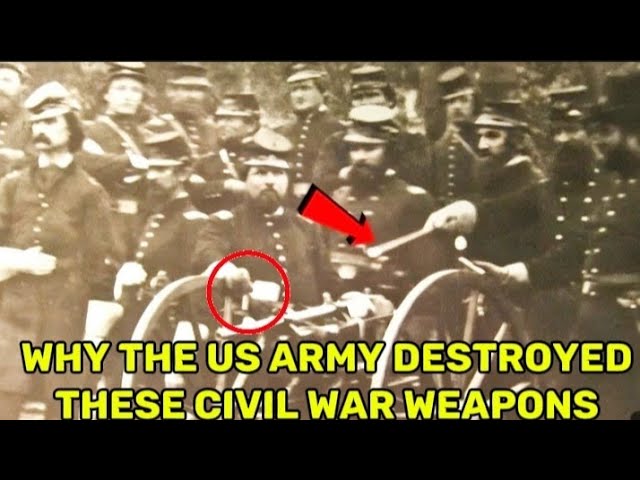
government put it on display. Another notable experiment was the Coffee Mill Gun, also known as the Devil’s Coffee Mill or the Agar gun. This hand-cranked firearm could fire . 58 caliber cartridges at an estimated 120 rounds per minute, making it one of the earliest rapid-fire weapons of the era.
In 1861, President Abraham Lincoln witnessed a demonstration and was fascinated by its potential for sustained fire. However, practical battlefield experience exposed serious flaws. The weapon suffered from frequent jamming, technical issues, and a single-barrel design that overheated quickly. Although the U.
S. War Department acquired 60 units, the Agar gun was rarely used in active combat due to these logistical and reliability concerns. The concept of armored trains also emerged during this period. While they did not revolutionize warfare during the Civil War, they laid the groundwork for future military innovations.
These early experiments demonstrated the importance of mobility in battlefield defense and influenced the development of armored military vehicles in later conflicts, including the Russian Civil War and both World Wars. Greek fire, a mysterious incendiary weapon from the ancient world, also inspired military experiments. In 1864, a Confederate plot to set fire to New York City using specially designed incendiary devices failed when the saboteurs lacked the knowledge to ignite and sustain the fires. Earlier in the war, inventor Levi Short had attempted to introduce a rocket-based version of Greek fire.
He personally demonstrated his invention to President Lincoln, who was more interested in military outcomes. U. S. Rear Admiral David Porter saw potential in the concept and hoped the incendiary projectiles would aid the Union Navy’s campaign against Vicksburg.
When tested, the rockets performed as expected, but the fires they caused burned for only about seven minutes, causing minimal damage. Admiral Porter dismissed the weapon in 1862 after witnessing the disappointing results. The city of Athens, Georgia, adopted a double-barreled cannon designed to disrupt enemy formations. The weapon was based on the concept of chain shot, which involved two cannonballs connected by a chain.
Its success depended on both barrels firing simultaneously and maintaining their trajectory. In practice, the barrels often failed to fire at the same time, causing the chain shot to deviate off course. In other cases, the chain snapped midair, making the weapon unreliable and unsuitable for combat. Despite its failures, the cannon remained part of Athens’ defensive preparations and was never used in battle.
It remains a landmark in the city today. The idea itself was not new, as the Earl of Northampton had used a similar artillery piece during the 17th-century English Civil War. The Confederacy also developed the coal torpedo in 1864, a deceptive explosive device created by Thomas Courtney. The Confederate Secret Service aimed to disrupt Union supply lines by secretly introducing explosives into coal stockpiles.
If the fake coal was unknowingly shoveled into a Union steam-powered ship’s boiler, it would detonate. At least two Union ships were confirmed to have been targeted this way, and records suggest land-based facilities may have been targeted as well. The tactic was part of an asymmetrical warfare strategy, though it had limited impact compared to direct military engagements. The concept resurfaced decades later during World War II, when a modernized version using plastic explosives was developed.
Some ship owners even adapted the technique for insurance fraud. In the 1850s, T. P. Porter patented the Porter Turret rifle, a multi-chambered design with a wheel-shaped cylinder holding nine rounds of .
44 caliber ammunition. The circular magazine meant that for every bullet fired toward an opponent, another chamber was pointed in the opposite direction, often directly at the shooter or nearby bystanders. This unsettling design made many users hesitant to adopt the weapon due to the risk of accidental discharge. Some high-capacity models held up to 30 rounds, but these carried additional risks.
If a stray spark ignited the entire magazine, the shooter could face a catastrophic explosion. Despite these flaws, variations of the turret still found their way onto Civil War battlefields. The design’s failures highlighted the importance of safety and practical engineering in the evolution of repeating firearms. In 1862, the U.
S. Navy introduced the USS Alligator, a 47-foot submarine designed by French inventor Brutus de Villeroi. Despite the French government’s refusal to support the project, de Villeroi’s design drew interest from the United States. The Alligator was equipped with advanced features for its time, including an air purifying system and a lockout chamber that allowed divers to exit the submarine while it remained submerged.
It was initially tested on the Appomattox River, but the mission was unsuccessful. The submarine was then transported to the Washington Navy Yard, where the water was not deep enough for proper submergence. After being fitted with a screw propeller to improve maneuverability, it was sent to Charleston, South Carolina for further missions. While being towed during a powerful storm off Cape Hatteras, a notorious area for shipwrecks, the Alligator sank to the bottom of the “Graveyard of the Atlantic,” ending this early experiment in underwater warfare.
The pike, a two-handed infantry weapon with a wooden shaft and steel point, was thought to be obsolete in the era of gunpowder. However, it experienced a brief resurgence in the Confederacy due to supply shortages. In 1862, Georgia Governor Joe Brown ordered a total of 10,000 pikes to arm local troops, including some with modified blades. The practicality of these changes is still debated.
Confederate soldiers issued these pikes faced the reality of modern firearms and quickly found the weapon to be ineffective. An example of one of these pikes is housed at the South Carolina Confederate Relic Room and Military Museum. These inventions were born out of necessity during a period of fierce and relentless conflict.
While many proved unsuccessful on the battlefield, they reflected the bold ambitions of 19th-century military engineers and their willingness to experiment with new technologies.