In May 1836, a Comanche war party raided a small Texas stockade called Fort Parker, killing five settlers and taking five others captive in an attack that lasted less than five minutes. Among those taken were 17-year-old Rachel Parker Plummer, her infant son, her nine-year-old cousin Cynthia Ann Parker, and several other relatives. Rachel’s family had built the fort with their own hands, believing the timber walls and blockhouse would keep them safe on the frontier. But on the morning of May 19, when a small group of Comanche riders approached the gate asking for a parley, the family patriarch, 68-year-old John Parker, walked out to negotiate.
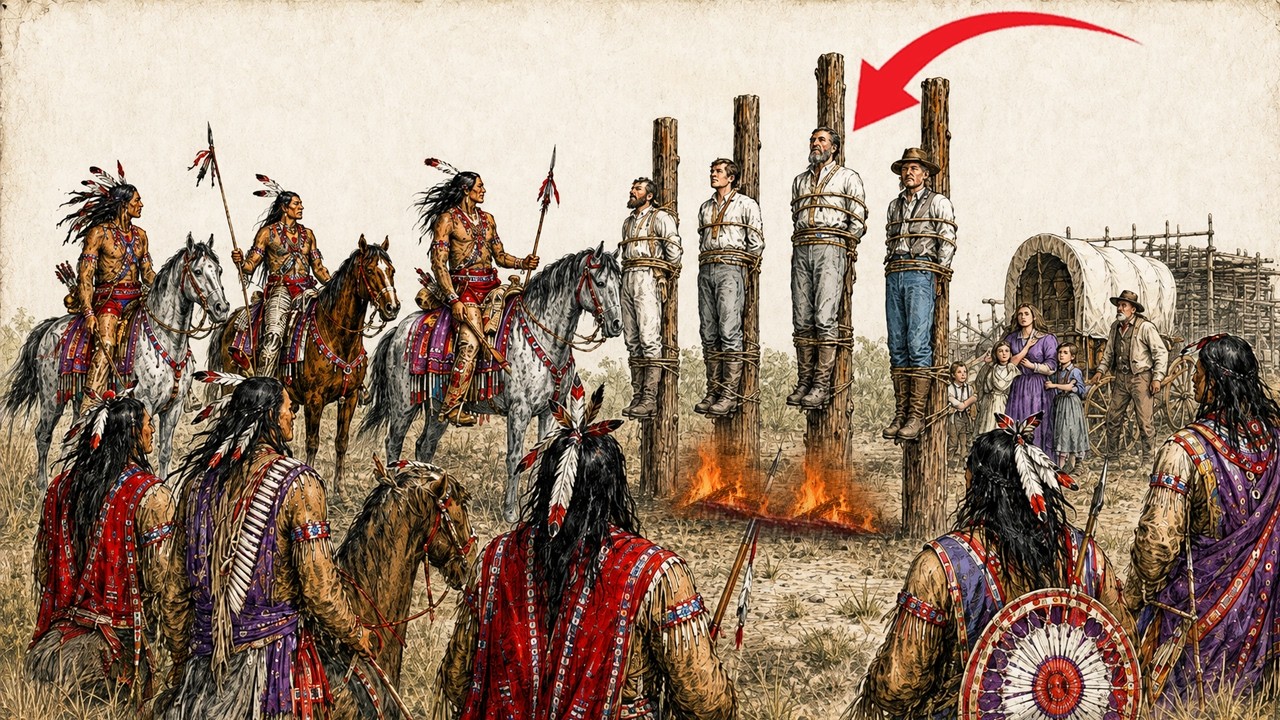
He was cut down immediately, and the waiting warriors swept into the fort before the gate could be closed. The Comanche were the dominant military power of the Southern Plains, highly skilled light cavalry who could cover 80 miles in a day. Their tactics were built on speed and surprise, striking hard, taking horses, goods, women, and children, and leaving before pursuit could be organized. The settlers inside Fort Parker had no chance of relief, as the nearest settlement was miles away across open prairie.
Rachel later described the moment she saw the attackers in a line that has become famous: “More Indians than I dreamed possible. ” She tried to run with her 14-month-old son James Pratt in her arms but was seized, stripped, beaten, and dragged by her hair across the prairie. Five captives were kept alive and ridden out of the burning fort: Rachel, her son, Cynthia Ann, Cynthia Ann’s six-year-old brother John Richard, and Rachel’s aunt Elizabeth Kellogg. The remaining 23 people inside the fort escaped in the chaos, hiding in timber and creek bottoms and carrying news of the raid to the outside world.
Once the raiding party dispersed, Rachel entered a life of slavery in Comanche camps. She was forced to gather firewood, dress hides, cook, and carry water, and was beaten for slowness or defiance. She was subjected to sexual violence and forced to run gauntlets between rows of women and children armed with sticks. Her son was taken from her and died in captivity.
She was held for 21 months before being ransomed back in February 1838 by Comancheros traders. Rachel returned to her husband Luther in the spring of 1838, emaciated and scarred. She wrote her captivity narrative in early 1839 and died within months of finishing it. She was 20 years old.
Elizabeth Kellogg was ransomed within months by Delaware Indians paid by Sam Houston and returned to her family. John Richard Parker was eventually ransomed but returned restless and later rode back to the plains on his own. Rachel’s son James Pratt never came back at all. The Parker raid was part of a wider pattern of Comanche captivity that shaped the Texas frontier.
In March 1840, Comanche negotiators brought a 15-year-old captive named Matilda Lockhart to San Antonio. According to witness Mary Maverick, Matilda’s head, face, and arms were covered in bruises and sores. Her nose had been burnt off, and she was left with two open nostrils surrounded by a large scab. Maverick wrote that Comanche women had burned the girl’s nose by shoving a burning piece of wood in her face.
Texas officials demanded the immediate return of all captives. The Comanche negotiators refused, shots were fired, and 12 Comanche chiefs were killed in what became known as the Council House Fight. The Comanche response came that summer in the largest raid in Texas history, when 400 to 600 warriors rode to the Gulf Coast, sacked the town of Victoria, and looted the port town of Linnville. Eyewitnesses described warriors riding along the beach wearing top hats and dragging bolts of ribbon behind their horses.
The central figure in the Fort Parker story was nine-year-old Cynthia Ann Parker. She grew up Comanche under the name Naduah, married a Comanche war chief named Peta Nocona, and bore him three children, including a son named Quanah. In 1860, 24 years after the raid, Texas Rangers under Sul Ross attacked a Comanche camp on the Pease River. They found a woman with blue eyes and a small daughter and took her back to her Anglo relatives.
Cynthia Ann did not want to be there. She tried to escape repeatedly, refused to speak English for long periods, and begged in Comanche to be returned to her husband and sons. She never was. Her daughter Prairie Flower died of a childhood illness within a few years, and Cynthia Ann died in 1870, broken by grief in a world that no longer spoke her language.
Historians point out that the popular memory of Fort Parker as a massacre with dozens dead is largely mythology. The actual death toll was five people. The terror of Fort Parker was not the body count but the taking, and the fact that when the Rangers found Cynthia Ann, she did not want to come home. Her Comanche son Quanah Parker grew up to be the last free war chief of the Comanche people.
He led raids as a young man and fought United States Cavalry before surrendering at Fort Sill in 1875, out of horses, out of buffalo, out of options. He later became a rancher and political leader, a bridge between two worlds. He is buried in Oklahoma beside his mother. The Comanche world ended by the 1870s not primarily through defeat in battle but through the destruction of the ecology that sustained it.
The buffalo were gone, the horses were dying, and the plains were being fenced. Rachel Parker Plummer left behind a narrative that has kept her voice alive for nearly two centuries. In it, she described her attempt to escape in words that still carry the shock of that morning: “I tried to make my escape, but alas, alas, it was too late as a party of the Indians had got ahead of me. Oh, how vain were my feeble efforts to try to run to save myself and little James Pratt.
“