By autumn 1944, the Japanese navy had only a handful of experienced pilots left. It spent six months gathering its survivors into one unit: Attack Force T, named for typhoon. Its mission was to strike American carriers in pitch darkness or weather so severe that no one else could fly. The unit was Japan’s best remaining asset, and everyone knew it.
Formed in March 1944, the force was initially assigned to the Imperial General Headquarters itself. Command went to Captain Shozo Kono, one of the last outstanding senior aviators still in service. Crews were drawn from the veterans who had survived the war to that point. The unit flew torpedo planes exclusively.
Its single mission was to locate the American carrier force after nightfall and hit it with torpedoes. On the nights of October 13, 14, and 15, 1944, off Formosa, the opportunity came. Around 30 aircraft launched each night to attack the U. S.
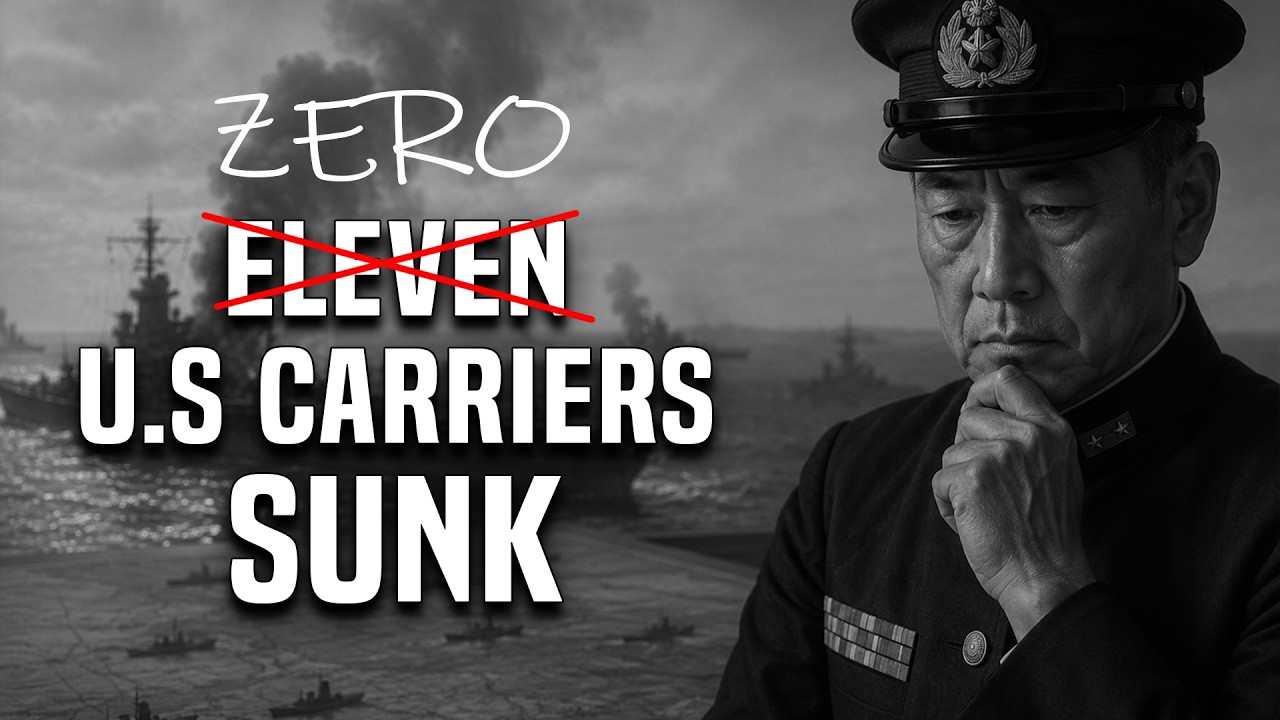
Third Fleet. Those three nights were the only part of the five-day battle in which the Japanese hit anything at all. Then the Imperial General Headquarters announced what they had achieved. Eleven carriers sunk.
Two battleships, three cruisers, and a destroyer or light cruiser on top of that. Tokyo celebrated. The Emperor issued an imperial decree. Based on that tally, the commander of the Combined Fleet ordered his surviving surface ships to leave the Inland Sea and pursue the remnants of the American fleet.
Only two American cruisers had been damaged. Nothing had been sunk. The gap between those two pictures was the single greatest intelligence failure Japan committed in the Pacific War. It was not a product of lying.
It happened because two things occurred at the same time, and only one of them was Japanese. Start with the man who built the unit. Vice Admiral Shigeru Fukudome commanded the Second Air Fleet. He spent three months personally managing its training in southern Kyushu.
He believed in flying in bad weather, a doctrine that went back to the 1930s, when the Japanese navy convinced itself that its harsh home waters produced better pilots than America’s warm training fields in California and Cuba. Attack Force T was that belief made into a military unit. Fukudome also knew the truth about what he had. Half the unit consisted of army crews flying heavy army bombers.
According to his own report, they had received between two and six months of over-water training, against a professional standard of three years. When he inspected them, he asked each man whether he had ever seen a submarine. Many had not. On the matter of distinguishing ship types at night from a low-flying torpedo plane under enemy fire, he later wrote that almost no one among the army crews was capable of doing it.
He sent them anyway. He had nothing else to send. He was also short on the units he was sending. In September, he moved his headquarters from southern Kyushu to Takao Air Base in southern Formosa and began transferring his squadrons island by island, starting with fighters.
By October 12, he had moved around 100 fighters and 10 seaplanes to Formosa. The bulk of the Second Air Fleet, including Attack Force T itself, was still based in Kyushu. That is why the night attacks that followed launched from Japan against ships off Formosa. It is also why no senior officer was present to receive the crews when they landed.
On the morning of October 12, a radar station on Formosa’s east coast picked up the first American formation at 8:28 a. m. Fukudome had 230 fighters available and divided them between the skies over Takao and the skies over Taihoku. He predicted the odds would be six to four in his favor: he could launch more aircraft at once than a carrier group could, and he was fighting over his own island.
He watched from a command post carved into the base of a hill. Aircraft began falling from the sky in flames. He clapped his hands and called it a magnificent performance. Then he looked again and realized every burning plane falling was his own.
Every plane still holding formation above was American. By the third wave that day, no Japanese fighter could take off from the ground. An hour before the first attack arrived, his chief of staff had advised him to stay in the exposed administrative building instead of moving to the new command post, reasoning that it would be better for morale. He moved anyway.
A bomb in the first wave destroyed his office. What his fleet actually achieved against ships at sea is worth explaining because it defines the heart of the problem. On the 12th, 101 aircraft of the Second Air Fleet launched from Kyushu using Okinawa as a staging point. They attacked in daylight in one large formation and claimed hits on two carriers.
Two days later, around 400 aircraft launched. The day after that, around 170 more launched. Those last two days produced nothing at all. Most crews never even found the American fleet.
Only the night unit hit anything. Three nights, 30 planes each night, and the entire declared victory rested on them alone. All of that was the Japanese half of the failure, the half that gets retold. The other half was happening about 90 miles away aboard two American ships, and it was the reason the calculations did not stop at optimism but collapsed completely.
On the 13th, a torpedo hit the heavy cruiser Canberra below her armor belt in the engine rooms. Twenty-three men died instantly. Around 4,500 tons of water entered through the hole and through the gap left by a damaged propeller shaft, flooding a boiler room and both engine rooms. The ship stopped dead 90 miles from Japanese airfields.
She was a Baltimore-class cruiser named after an Australian ship lost off Guadalcanal, the only U. S. Navy warship ever to carry a foreign name. By every logical expectation, the ship was finished.
Admiral William Halsey ordered the heavy cruiser Wichita to tie on and begin towing her. The next day, a torpedo hit the light cruiser Houston amidships below the hull. Water flooded all four engine rooms. Her armored deck buckled.
Roughly 6,000 tons of water may have entered. Her captain ordered the ship abandoned, then reversed the order. What followed was one of the most remarkable damage-control efforts in U. S.
Navy history. Halsey ordered her towed as well. Two light cruisers and eight destroyers were detached to escort the pair. The group received a name in fleet signals: Crippled Division One.
Two days later, on the 16th, Japanese aircraft reached the group and hit Houston with a second torpedo while she was under tow. She still did not sink. This is the mechanism, and it is more precise than the story usually told about this battle. A weapon launched in darkness by a crew that could not identify its target struck a ship, and the ship did not sink.
Each of those three nights produced attack reports that were honest descriptions of what the men saw. Fires. Explosions. Ships stopping.
Most of that was real. The conclusion drawn was that the ships had been destroyed, because in the experience of any navy, a heavy cruiser stopped dead within range of enemy air bases was considered as good as lost. Kono’s crews attacked in darkness at low altitude, often attacking the same target more than once. Each aircraft reported its own contact.
Two planes working over the same ship added two ships to the total summary. A destroyer came back reported as a cruiser. A cruiser came back as a battleship. A battleship came back as a carrier.
There was nothing to verify against. Kono radioed his figures directly to the Combined Fleet and to Imperial General Headquarters in Tokyo in parallel with sending them to his fleet commander. Fukudome saw Kono’s report and recognized immediately that it was exaggerated. He had conducted his own prewar statistical studies on how much pilots overestimated their results.
His personal estimate was that the real result was about one third of what was claimed. He could not even prove it. There was no basis to reject the claims of men who described what they saw and supported it with whatever evidence they had. The announcement was issued on the 16th.
Tokyo confirmed it. Admiral Soemu Toyoda, commander of the Combined Fleet, had already ordered a full pursuit on the morning of the 15th, sending out ships anchored in the Japanese Inland Sea on the logic that a defeated enemy must be finished off. What awaited them was the part that should have been better known. Halsey realized within a day what the Japanese believed, because the order was broadcast openly.
So he took his two crippled cruisers, crawling eastward under tow too slowly to escape, and turned them into bait. He placed them about 100 miles ahead of his carriers. He detached two light carriers, two cruisers, and four destroyers to cover them from a distance. Then he deliberately exaggerated their condition reports so the picture reaching Tokyo was of two helpless ships and a beaten fleet withdrawing.
In fleet language, the group gained a second name: Bait Division One. His own message on the subject was in the same spirit. He reported that the ships Tokyo had broadcast as sunk had been salvaged and were withdrawing at high speed toward the enemy. It almost worked.
A Japanese surface force emerged from the Inland Sea heading for the crippled ships. It came close enough to discover that the American carriers were not damaged and were not withdrawing. It turned back. Halsey struck with his aircraft too early.
The enemy withdrew, and the trap closed on nothing. What did not turn back was the cost. Against American ships, the Japanese flew 761 sorties over those days and lost 179 aircraft, with a roughly similar number destroyed in the air and on the ground over Formosa. The naval air arsenal built at Takao Air Base was leveled.
Fukudome entered the battle expecting six-to-four odds in his favor. He came out having fought at nine-to-one against him. Nine days later, the Japanese fleet entered Leyte Gulf without air cover, because that cover had been consumed off Formosa in three nights and a false victory. The two ships Canberra and Houston were towed to Ulithi, about 1,300 miles from where they were hit, at speeds that made them targets for a week.
They stayed afloat thanks to their crews through most of that period. Canberra was later rebuilt, converted into a guided missile cruiser, and served into the 1970s. Houston moved from Ulithi to Manus and from Manus to a New York shipyard. The war ended before the yard finished work on her.
Between them, the two ships took three torpedoes from the best-trained crews the Japanese navy had left, and neither was lost. Fukudome learned the truth in 1945 after the surrender, when he was told that only two American cruisers had been seriously damaged. He wrote seven years later that he was stunned by the size of the gap and did not try to evade responsibility for that report. His own summary of the cause consisted of four words: night attacks lead to worldwide exaggerations.
What no one can reconstruct is what lay behind that. No surviving set of debriefings exists from the crews who made those claims. Most of the men who flew on those three nights did not survive the Philippine campaign that began the following week. Everything known about what they believed they did comes from the officer who received their reports, did not believe them, and wrote about it from memory in an American professional journal in 1952.
The most important collection of eyewitness testimony in the Pacific War is a summary of testimony that no longer exists.