For decades, the story of Ridgecrest Hollow remained buried in county records and old newspaper archives. Virgil Crow, a timber surveyor for the Continental Lumber Company, first encountered it in October 1923, while surveying an unmapped section of the Ozark Mountains. He was 34 years old and had spent seven years in the wilderness without serious incident. The camp foreman, a man named Sutherland, had warned him against the trip, saying, “I’d turn back if I were you.
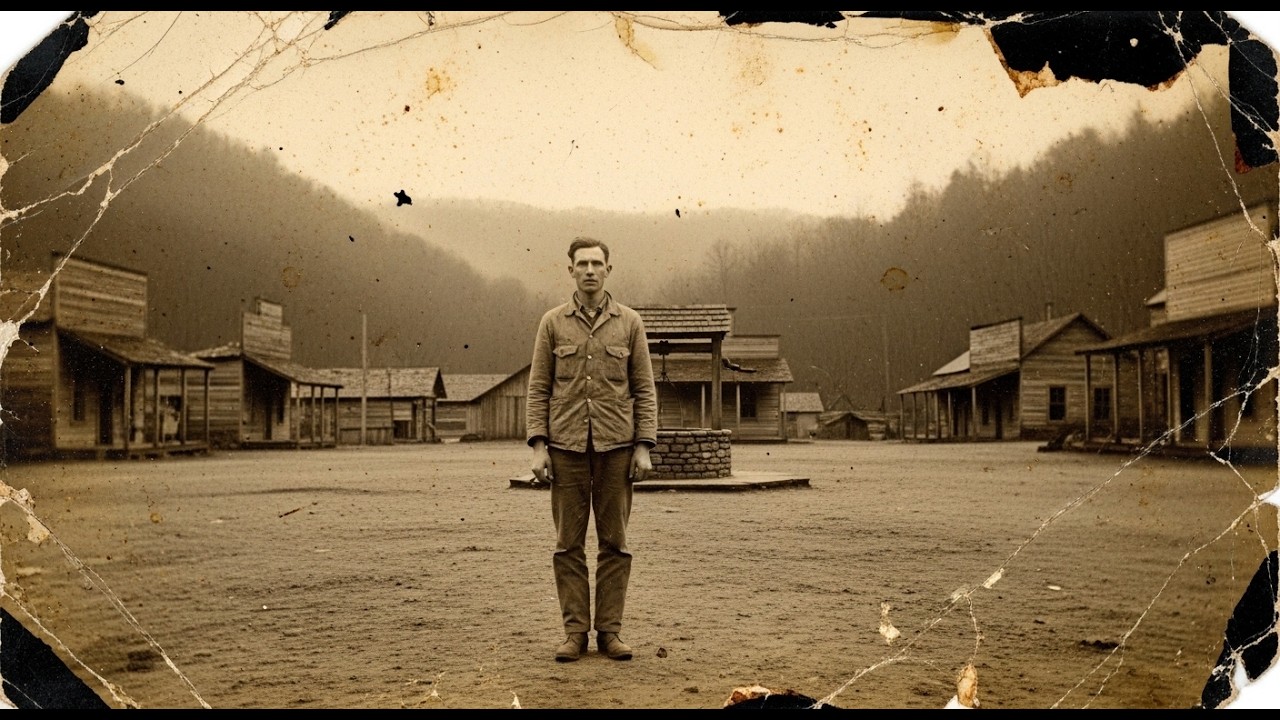
Nothing up there worth finding. ” Virgil disregarded the warning. On October 9, he followed the Little Piney Creek upstream and reached the town after climbing over the ridgeline. From above, the hollow appeared peaceful, but completely lifeless.
Around two dozen buildings clustered around a town square, yet no smoke rose from chimneys, and no lights showed in windows. When Virgil descended into the valley, he found the settlement strangely maintained. The general store was unlocked, with goods organized on shelves and a ledger open to entries recorded just 11 days prior. The church was similarly prepared, with a Bible open on the pulpit.
Every building appeared recently used, yet the town was empty. Virgil also heard a low, persistent humming throughout the valley. Suddenly, a door slammed shut in a nearby house without any wind. He heard synchronized footsteps approaching from multiple directions and fled the settlement in fear.
When he reported the incident to Sutherland days later, the foreman insisted the town had been abandoned since the flu of 1918, when most of its inhabitants perished. The survivors, eight or nine people, had left in March 1919, leaving all their belongings behind. Sutherland insisted any figure Virgil saw could not have been people. Virgil began investigating the town’s history.
He located Emmett Howell, a former sheriff who had investigated Ridgecrest Hollow in 1919. Howell confirmed the town was empty when he visited, yet he described seeing figures with faces that were “wrong,” standing in a perfect circle around the well, their proportions subtly altered. Howell told Virgil he had heard the mysterious humming and believed he was looking at things that “used to be people” but were no longer. He warned Virgil that knowledge of the place creates a connection, a thread that can follow a person.
Howell explained that the figures appeared to be waiting for something and seemed to need people to accomplish their purpose. He advised Virgil to stay away from remote places and never return to the Ozarks, fearing the pull toward the hollow would grow stronger over time. After his encounter, Virgil moved to Kansas City, taking a job surveying buildings. He found the pull hardest to resist at 3:00 a.
m. , waking with a compulsion to travel north and west. Sutherland later tracked him down and reported that people were disappearing in that region of the Ozarks—hikers, hunters, and a young geologist who had been acting oddly before vanishing, reportedly standing outside his tent at night, staring north as if listening to something. Virgil began researching the area in the Kansas City library, discovering historical records spanning nearly a century.
A French trapper in 1843 had described a “Hollow of Faces” matching the same location. A missionary priest, Father Matthias Kincaid, visited the town in 1892 and recorded witnessing a worship service that was not Christian, noting that the residents’ faces shifted in the lamplight and that they were worshipping something older than human settlement. Kincaid’s final journal entry stated he was returning to the hollow, writing, “I am part of it now, whether I wish to be or not. The pattern requires witnesses.
”
Dr. Helena Vance, an anthropologist specializing in “thin places”—locations where the boundary between realities is weak—told Virgil that Ridgecrest Hollow was artificial. She explained that the town was deliberately arranged around a central well to amplify a natural geological anomaly. She claimed the machinery beneath the valley used converted human beings as components.
According to Dr. Vance, when someone visits the hollow and witnesses the figures, a connection is established, eventually pulling them back to be “converted” into operators for the signal. In late 1924, Virgil agreed to return to the hollow to document his experience. Dr.
Vance waited ten miles away with a protocol to follow. When Virgil descended, he found more figures than before, standing in circles around the now-glowing well. He recognized some of the recent faces from news reports of missing people. The hum had intensified, and he felt his own features beginning to shift, his bones softening into the wrong geometry.
Virgil escaped when Dr. Vance intervened, physically pulling him away from the figures. The conversion was interrupted, but not entirely reversed. Virgil’s face would periodically slip into the wrong proportions, and he could permanently feel the signal, like a constant inner hum.
Dr. Vance published a paper on thin places that was largely dismissed by the academic community. Virgil spent the rest of his life resisting the pull, tracking disappearances and noting that similar patterns were emerging in Appalachia, the Pacific Northwest, and the Rockies. He died in 1978, leaving his complete account to a researcher, Dr.
Marcus Webb, who spent 20 years documenting additional thin places and conversions. Webb died in 2007, having been unable to convince the scientific community, noting that the machinery was accelerating. A warning runs through this account: learning about these locations can create a connection to the signal, and those who hear the story may begin feeling the pull themselves. The advice is to stay in populated areas, avoid remote places, and resist the urge to travel toward unfamiliar locations.
The figures at Ridgecrest Hollow are still standing in their circles, smiling with wrong faces, humming the signal that continues to draw people in, waiting for the pattern to complete.