The 911 call was not for a role in a new blockbuster. It was because Tom Sizemore had collapsed at home, unconscious. At 61, his body finally gave out. He was pronounced dead on March 3, 2023, after suffering a brain aneurysm.
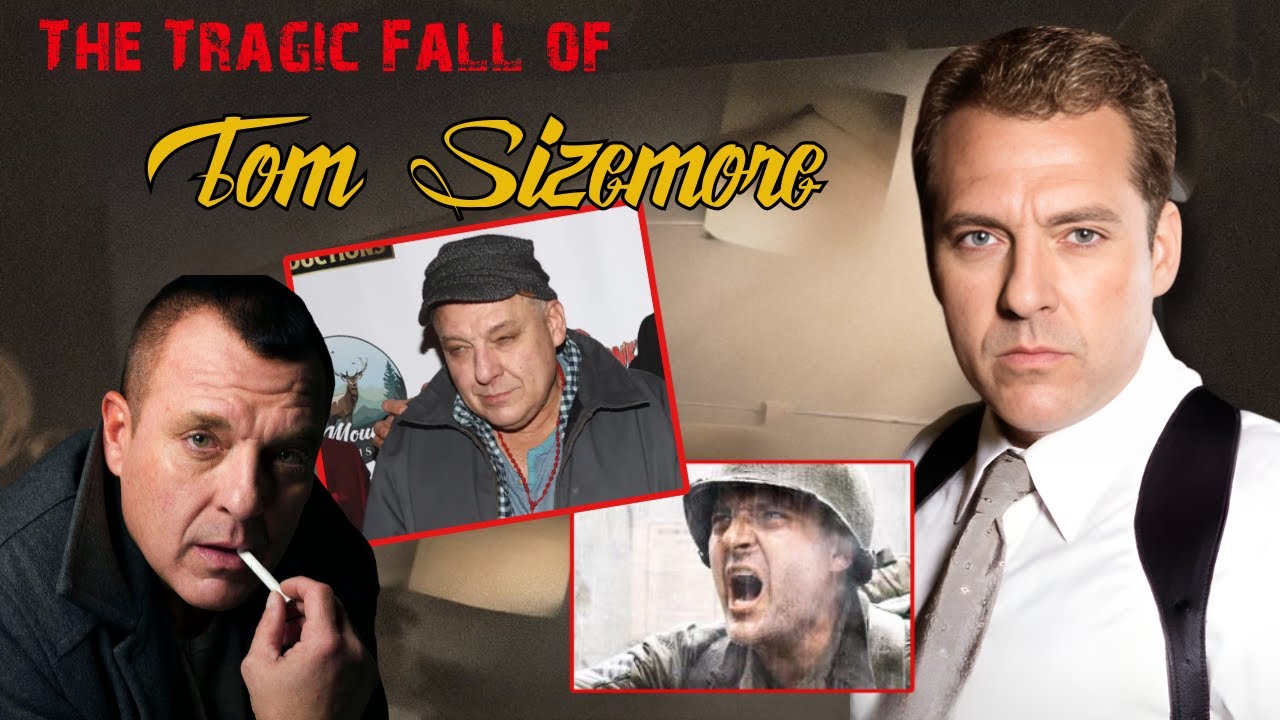
The cause was a stroke. His death marked the end of a life that had become Hollywood’s most brutal cautionary tale: a gifted actor whose brilliant career was destroyed not by a lack of talent, but by addiction, violence, and the simple fact that no one dared to hire him anymore. Sizemore was born on November 29, 1961, in Detroit, Michigan. His upbringing stands as the first great contradiction of his life.
His father, Thomas Edward Sizemore Sr. , was a lawyer and a professor who taught law and philosophy at the University of Detroit. His mother, Judith, worked for the city’s ombudsman office, a job built on patience, civic procedure, and rational mediation. He was raised in a stable, middle-class home of books, debate, and logic.
He would later become the screen’s avatar for primal, unthinking rage. As a restless kid, Sizemore found his calling in the dark of a movie theater. He often cited two films that changed his life. The first was “Beckett,” the 1964 classic starring Richard Burton and Peter O’Toole, a film of grand theatrical bombast.
The second, and the one that truly set his course, was Martin Scorsese’s “Taxi Driver. ” Watching Robert De Niro’s Travis Bickle—a man dissolving into loneliness, violence, and a desperate need to be seen—Sizemore was mesmerized. He saw in De Niro not a performer but an ideal. Here was the second contradiction: he didn’t just chase a dream.
He attacked acting with the same academic rigor his father applied to the law. Sizemore earned a Bachelor of Fine Arts in theater from Wayne State University and later a Master of Fine Arts from Temple University in Philadelphia. He was a classically trained stage actor who studied Chekhov and Shakespeare. When he later played the unhinged detective Jack Scagnetti in “Natural Born Killers,” he wasn’t losing control.
He was a master performer executing a perfect, controlled portrait of a man losing control. After years in New York theater, he moved to Los Angeles. In the late 1980s and early 1990s, Hollywood was dominated by polished heroes like Tom Cruise and Kevin Costner. Sizemore was something else entirely: a man who looked less like the guy who gets the girl and more like the guy waiting in the car outside her house.
It was his superpower. He broke in through a series of small, savage roles for directors like Oliver Stone and Kathryn Bigelow, playing cops, soldiers, and criminals in films like “Born on the Fourth of July,” “Point Break,” and “Passenger 57. ”
In 1993, he landed a role in “True Romance,” written by Quentin Tarantino and directed by Tony Scott. He played Detective Cody Nicholson and held his own in a scene with the legendary Dennis Hopper.
The industry was talking. Oliver Stone then put him in “Natural Born Killers” as the monstrous Detective Scagnetti, a performance that made him a star. In 1995, director Michael Mann cast him in “Heat” as Michael Cheritto, the cool, disciplined family man and heavy weapons expert in Robert De Niro’s crew. It was the validation of his life’s ambition.
He was in De Niro’s crew. His career hit its absolute summit when Steven Spielberg cast him as Technical Sergeant Mike Horvath in “Saving Private Ryan. ” It was the most important role in the film next to Tom Hanks’s Captain Miller. Horvath was the film’s spine, conscience, and loyalty.
It was also the moment his personal demons stepped into the spotlight. Sizemore had struggled with addiction since he was 15. By the time he was a star, his drug of choice was heroin. His idol, Robert De Niro, had noticed during the filming of “Heat.
” Sizemore later recounted that De Niro came to his trailer, told him he was a great actor but a mess, and warned him he would be dead in five years if he didn’t clean up. De Niro then personally drove him to a private jet and flew with him to rehab. Sizemore got clean, but by the time “Saving Private Ryan” was offered to him, he had relapsed. Spielberg, known for running the tightest sets in Hollywood, knew about the problem.
He confronted Sizemore with an ultimatum: he would drug test him every single day of the shoot. If he failed a single test, Spielberg said, he would fire him on the spot, recast the part, and reshoot every scene with another actor. It was an unprecedented demand and a profound act of faith. Sizemore passed every test for the entire grueling shoot.
The performance he delivered was the finest of his career. “Saving Private Ryan” was released in 1998. It was the highest-grossing film of the year, nominated for 11 Academy Awards, and won five. Sizemore was at the center of it.
He followed it with a lead role as John Gotti in “Witness to the Mob,” earning a Golden Globe nomination. In 1999, he reunited with Michael Mann for “The Insider” and was cast by Martin Scorsese for “Bringing Out the Dead”—the man who had been mesmerized by “Taxi Driver” was now a Scorsese actor himself. In 2001, he starred in “Pearl Harbor” and delivered the iconic line “Nobody gets left behind” in Ridley Scott’s “Black Hawk Down. ” At the dawn of the new millennium, he was untouchable.
Then the structure was gone. There was no Spielberg ultimatum, no daily blood test. He was left alone with his fame, his money, and his demons. The crash was catastrophic and brutally public.
It began with a relationship. In the early 2000s, he began a turbulent affair with Heidi Fleiss, the notorious “Hollywood Madam. ” In 2003, at the peak of his fame, he was arrested. The charges were domestic violence, criminal threats, and harassment against Fleiss.
The trial was a media circus. Fleiss testified tearfully about beatings and psychological torment; Sizemore painted her as unstable and vindictive. The evidence, including photographs of her injuries and threatening voicemails, was damning. He was convicted on multiple counts, including battery and assault.
The curtain fell on his A-list career instantly. Michael Mann, who had been a mentor, later said of him: “The Michael I knew was a sweet, wonderful, and very bright guy. The person who emerged was a stranger. The trust was broken.
” For Sizemore, the career was the only structure keeping his addiction in check. With it gone, he fell into a freefall. His addiction came roaring back, now joined by methamphetamine. His life became a rap sheet.
In 2005, he was arrested again for violating probation by failing a drug test. He had been caught trying to fake his urine sample with a prosthetic device. The judge sentenced him to seven months in jail. That same year, a private sex tape was leaked to the internet.
He was no longer just a troubled actor. He was a punchline. He was blacklisted from major studios. He scrambled for cash in the world of low-budget, direct-to-video schlock, filming multiple movies in a single week, sometimes showing up for a day, collecting a check, and leaving.
The bleakest statistic of his fall came in 2006 with a film called “Zyzzyx Road. ” It was shown for one week in a single Dallas theater at noon, purely to fulfill a Screen Actors Guild contractual requirement. It sold six tickets. Its total official domestic box office gross was $30.
From the highest-grossing film of the year to a film that made $30. In 2007, he was the subject of a short-lived reality series, “Shooting Sizemore. ” In 2010, he joined VH1’s “Celebrity Rehab with Dr. Drew,” putting his withdrawal and therapy on display for the cameras.
He moved on to the spin-off “Sober House,” and for a time, Dr. Drew pointed to him as one of the program’s biggest successes. But the arrests continued. In 2017, he pleaded no contest to two charges of domestic violence against a new girlfriend.
In 2019, he was pulled over for expired registration and found with heroin and non-prescribed medications. In 2020, he was arrested for DUI and narcotics. In 2018, a woman named Kirsten Pike sued him for $3 million, alleging he had sexually abused her on the set of a B-movie titled “Born Killers” in 2003, when she was 11. Sizemore denied the allegations.
The case was dismissed in 2020 on statute of limitations and jurisdictional grounds, not on the evidence. The accusation added another layer of darkness to his public image. In 2013, Sizemore published a memoir titled “By Some Miracle I Made It Out of There. ” The title came from a quote his mother uttered after one of his brushes with death.
The book was a raw confession. He estimated he had spent millions on drugs and detailed overdoses, suicide attempts, and homelessness. “I was a guy who had it all,” he wrote. “I had the multi-million dollar house, the movie star life, and I just threw it all away.
”
In 2017, the ghost got a call. It was from David Lynch, casting his long-awaited revival of “Twin Peaks. ” Lynch chose Sizemore to play Anthony Sinclair, a duplicitous insurance man in a crucial multi-episode arc. He was clean, focused, and acting.
A crew member later said that on his first day, Sizemore was so nervous he was just walking around base camp sweating. He told a colleague that “Twin Peaks” was the first time anyone had taken a chance on him in a long time on a production that was so big. It was a lifeline. But a single role could not undo decades of self-destruction.
The end came on March 3, 2023. It was not cinematic. There was no redemption, no final monologue. It was a brain aneurysm.
It was the quiet clinical surrender of a body battered by decades of abuse. Sizemore leaves behind two legacies. There is the immortal actor on screen: Sergeant Horvath holding a tin of dirt in “Saving Private Ryan,” the defiant lieutenant in “Black Hawk Down,” the disciplined professional in “Heat. ” And there is the man: a deeply fragile, tormented soul who played men defined by their codes of loyalty and professionalism, but who lived a life of total chaos, without a code at all.
He was a passenger in a body driven by a relentless illness that stole his career, his family, his dignity, and finally his life.