For more than 60 years, Rita Moreno appeared to have something almost unheard of in Hollywood: one husband, one marriage, and one child. To the outside world, she had built the stable family life that so many stars failed to find. She and her husband, Leonard Gordon, stayed married for 45 years. There was never a public divorce, and their daughter Fernanda grew up with both parents at home.
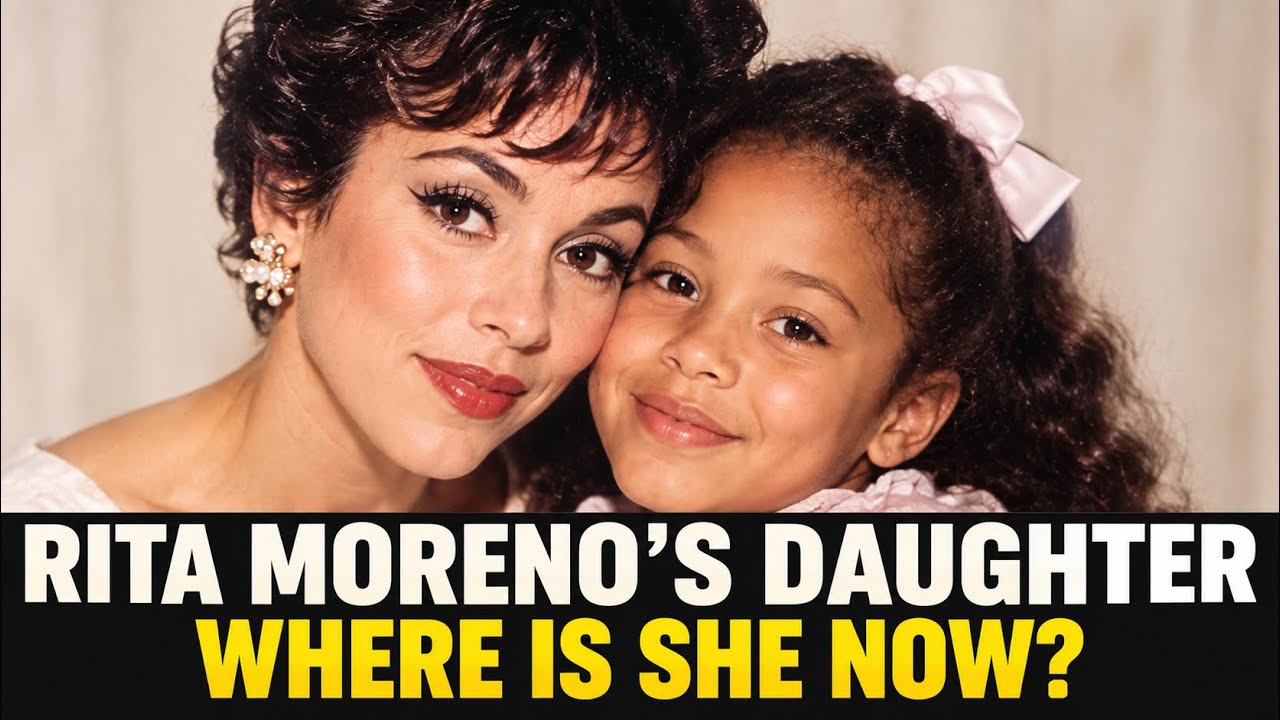
But decades later, Moreno revealed something startling. Behind closed doors, the marriage was very different from what the public saw. She wanted to leave. She felt controlled.
And she eventually admitted there was one main reason she stayed: her daughter, Fernanda. The revelation reframes the entire story of the Moreno family. Fernanda was not just the only child of one of Hollywood’s greatest legends; her birth changed the course of Rita’s life. Her childhood influenced one of the biggest decisions Rita ever made.
And eventually, growing up in the shadow of an Oscar-winning mother, Fernanda made a surprising decision of her own. She never tried to become the next Rita Moreno. Instead, she built a different kind of life. Today, more than half a century after Rita first held her only daughter, their roles are slowly beginning to reverse.
But to understand how that happened, the story begins shortly before Fernanda was born, when Rita had already learned what love could do to her and had nearly paid the ultimate price for it. By the early 1960s, Rita Moreno had experienced two very different versions of Hollywood. There was the glamorous side: beautiful dresses, film premieres, MGM, famous men, and eventually “West Side Story. ” But there was another Hollywood too, one that pigeonholed her based on her ethnicity, asked her to change her accent, and celebrated her one day while ignoring her the next.
In 1962, everything seemed to change. Moreno won the Academy Award for Best Supporting Actress for her role as Anita in “West Side Story,” becoming the first Latina to win an acting Oscar. But behind that professional triumph was a far more turbulent private life. For years, she had been involved with Marlon Brando.
She loved him passionately, and he broke her heart repeatedly. Their on-and-off relationship lasted for years and brought jealousy, reconciliations, and deep emotional pain. At one point, she became pregnant, but the pregnancy ended in a miscarriage that led to serious complications. Eventually, after years of turmoil, Moreno reached a breaking point and attempted suicide.
She survived, and therapy eventually helped her rebuild her life. For perhaps the first time, she began to question why she kept returning to relationships that hurt her. Slowly, she began to want something different: not another Marlon Brando, not more chaos, but stability. Then she met Leonard Gordon, a cardiologist from outside the film world.
In 1965, Rita married him. From the outside, it looked as though she had finally escaped the chaos. But the most important change was still to come. Shortly after the wedding, Rita became pregnant.
This time, the story would end very differently. Rita Moreno became a mother, and the child became the emotional center of her life: her only daughter. Rita and Leonard named their daughter Fernanda Luisa Gordon. Rita was in her thirties when Fernanda was born and never had more children.
That made Fernanda unique from the start. For a woman whose own childhood had been defined by separation, this mattered deeply. Rita had left Puerto Rico with her mother when she was very young, and her younger brother stayed behind; the siblings never grew up together. Years later, Rita explained that she never had a big family.
When asked to define herself outside Hollywood, she did not begin with actress or Oscar winner. She described herself as a family person, then spoke about Fernanda, saying her daughter was someone she adored madly. Later, she described Fernanda in even more emotional terms: her daughter was her soul, and her grandsons were her air and the light of her life. Rita also understood something unusual for a Hollywood mother.
She knew what the spotlight could do to a child. She had started acting herself when she was young and knew what it meant to grow up around adults, auditions, rejection, pressure, and attention. So, although Fernanda was the daughter of one of Hollywood’s most famous mothers, Rita did not seem determined to create another child star. She wanted Fernanda to have a normal childhood.
That did not mean Fernanda was completely separate from her mother’s world. She sometimes traveled with Rita, appeared in some performances, and grew up surrounded by the entertainment industry. But Rita did not build her daughter’s identity around fame. This raised an interesting question: What happens when your mother is Rita Moreno and she does not expect you to become Rita Moreno?
Fernanda would eventually answer that question herself, but before she could build her own life, she had to grow up inside a marriage the public completely misunderstood. For years, the photos told a reassuring story: Rita Moreno, Leonard Gordon, their daughter, a successful actress, a doctor, a child, and later grandchildren. It all looked fairly traditional, especially by Hollywood standards. As the years passed, the marriage became noteworthy simply because it lasted: 10 years, then 20, 30, 40, and finally 45.
There was no loud divorce and no string of new husbands. To observers, it seemed Rita Moreno had done what few major stars could: she made a Hollywood marriage work. For a long time, Rita helped maintain that image. She appeared with Leonard, smiled, and held his hand.
They acted like a couple that had found the secret to success. But behind that public image, Rita was struggling. And something began to change relatively early in the marriage. Rita was evolving.
She had spent years trying to become what others wanted: Hollywood wanted one version of Rita, and men wanted another. Gradually, Rita wanted to decide for herself who she would be. According to Rita, Leonard struggled with that. Years later, she explained that she began thinking about divorce around the seventh year of their marriage.
But she did not leave, and the marriage continued. Fernanda grew up with both parents together. For decades, the public knew almost nothing about how Rita felt. It took Leonard’s death and Rita’s extraordinary candor afterward for the full story to emerge.
And when it did, one detail changed everything: Fernanda was not simply living inside that marriage. Without knowing it, she had become one of the biggest reasons her mother stayed. Before reaching Rita’s revelation, there is another part of the story worth considering: what became of Fernanda herself. Being the only child of Rita Moreno could easily have become an identity she could not escape.
Fernanda had access to Hollywood. She understood performance and explored acting and entertainment. But she did not spend her life trying to recreate her mother’s career. Instead, education became important.
Fernanda attended Tufts University and later studied at the University of Southern California. She performed and acted, but she also explored creative work away from the camera, including graphic design and jewelry design. There was no attempt to market herself as another Rita Moreno and no lifelong campaign to become a second-generation star. Fernanda seemed comfortable moving between Hollywood and ordinary life, and that may be one of the greatest gifts Rita gave her: the freedom not to become like her.
Fernanda herself has offered occasional glimpses into what the relationship was actually like. At the 2021 Oscars, mother and daughter appeared together on the red carpet. They were not acting like an icon and her nervous adult daughter; they were laughing and enjoying themselves. Fernanda described their dynamic simply as two women having a good time.
Then she said something wonderfully ordinary about one of Hollywood’s most decorated performers: she called Rita the greatest mom ever and described herself as lucky. That is significant, because we hear many stories about the children of Hollywood legends growing up resenting their famous parent. Fernanda’s public comments paint a very different picture. She has spoken with admiration about Rita’s strength, about the example her mother set, and about their closeness.
When Rita later watched Fernanda praise her in the documentary “Rita Moreno: Just a Girl Who Decided to Go for It,” she admitted that her daughter’s words moved her more than almost anyone else’s. Celebrity praise was flattering, but praise from Fernanda was different. It touched her deeply because Fernanda knew the woman behind Rita Moreno. But there was one part of her mother’s life that was far more complicated: her marriage.
Eventually, Rita stopped pretending it had been perfect. For 45 years, the marriage seemed beyond question. Rita and Leonard had kept their marriage together, and no matter what problems they faced, surely the length of the union proved it worked. Then Rita began telling the truth.
She described Leonard as funny and intelligent, a man she respected, but she also described him as controlling. Rita said her loud, vibrant personality bothered him: the laughter, the theatrical sense, the big character that audiences loved. Leonard sometimes referred to it as her “showbiz personality. ” Rita felt increasingly constrained.
Here the story becomes a painful paradox. For decades, Rita Moreno fought an industry that tried to dictate what kind of woman she was allowed to be: too Latina, too ethnic, too loud, too much. She fought to regain control of her identity. Yet inside her own home, she later felt she was being asked to make herself smaller again.
She realized relatively early that something was wrong and later remembered talking about divorce after about seven years of marriage. But she stayed, and stayed, and stayed. Why? Decades later, Rita finally answered that question directly.
She said she would probably have left Leonard if they had not had their daughter. The idea of Fernanda growing up without her father in the home was something Rita found very difficult to accept. She wanted her daughter to have a family: a mother, a father, stability, perhaps the very things Rita herself had missed as a young child. So the woman who survived Marlon Brando, survived Hollywood, and fought for her independence throughout her career made a very traditional decision.
She kept the family together for years, then for decades. This does not mean Fernanda caused Rita’s unhappiness. That distinction is important. Fernanda was a child, and the decision was Rita’s alone.
But it shows how profoundly motherhood changed Rita Moreno. Before Fernanda, Rita’s romantic relationships threatened to consume her. After Fernanda, the question became different: what was she willing to sacrifice for her child? Rita’s answer was, for better or worse, a great deal.
Meanwhile, as her parents’ marriage continued, Fernanda began building her own family. In 1996, she married David Fisher. Two years later, their first son, Justin, was born, followed by another son, Cameron. Suddenly, Rita’s small family expanded again.
She became a grandmother. For some stars, grandchildren become a nice footnote in interviews about their careers. For Rita, they became the center. She has repeatedly spoken about Fernanda and her two grandsons with extraordinary affection.
Her daughter was her soul; her grandsons were her air and light. The woman who once left Puerto Rico and lost contact with most of her original family had built another family, and she wanted to be close to it. By the late 1990s, Rita bought a home near Fernanda and her growing family. Hollywood remained important; Rita continued to work, perform, and win.
But another world ran alongside her public life: a daughter, a son-in-law, two grandsons, a family. Then, in 2010, the man at the center of that family became seriously ill. Leonard Gordon was dying. Whatever Rita felt about their marriage, she did not abandon him.
She stayed by his side, slept at the hospital, and cared for him. When Leonard died, 45 years after their wedding, what Rita felt shocked her. She grieved for Leonard, but she also experienced something else: relief. Freedom.
She later described looking at her husband after his death and struggling to reconcile the frail man before her with the unhappiness she had lived through during the marriage. Then she returned home, and something changed. Rita was approaching 80. For the first time in decades, she no longer had to answer to a husband.
She could laugh as loudly as she wanted, be as wild as she wanted, and take up as much space as she wanted. Rita later described what happened in two words: she blossomed. It is one of the most surprising admissions in her story. She had been married for 45 years.
She stayed by Leonard’s side while he died. She loved and respected parts of him. Yet his death released something inside her. She did not rush to find another husband.
Instead, she discovered she loved living with herself. But independence did not mean isolation, because Fernanda remained close. Over the next decade, mother and daughter entered a completely new phase of their relationship, one that eventually brought them back to the film that changed Rita’s life nearly 60 years earlier: “West Side Story. ”
When Steven Spielberg remade “West Side Story,” Rita Moreno returned.
But she was not playing Anita. Now a Hollywood veteran, she played Valentina, a new character created for the film, and served as an executive producer. There was another Moreno family member on set: Fernanda, who worked as Rita’s stand-in for scenes. For Fernanda, the experience was extraordinary; she later described working on the film alongside her mother as the gift of a lifetime.
Consider what that meant. In the original “West Side Story,” Rita was the young Puerto Rican actress struggling for respect. She won an Oscar for Anita. Nearly 60 years later, she returned to the same story, older, more famous, and more powerful.
This time, her daughter stood beside her. Fernanda also helped Rita on “80 for Brady. ” It was a beautiful mirror of the arrangement they had decades earlier. When Fernanda was young, she accompanied Rita into her world.
Now, as Rita aged, Fernanda helped her navigate it, not as a child star and not as a second Rita Moreno, but as her daughter and work partner. The child Rita once protected from Hollywood had found a way to participate in it on her own terms. As Rita entered her nineties, that relationship became even more important, because something eventually happens in every close parent-child relationship: the protector begins to change, and the roles reverse. For most of Fernanda’s life, Rita was the mother, the one who protected her, supported her, made decisions, took her places, and helped her.
But Rita Moreno is now in her nineties, and she has been strikingly candid about what that means. She still works, still performs, and still appears in public. But aging has brought changes: memory is not what it once was, and some things require more help. Increasingly, Rita relies on Fernanda, her only daughter.
The little girl Rita once tried to protect with all her strength is now helping to protect Rita. Fernanda advises her, travels with her, attends events with her, and helps with daily realities. Perhaps most moving is the ability of mother and daughter to talk about what comes later. Rita knows she will not live forever, and Fernanda knows that too.
They do not spend every day discussing death, but they do not pretend it will not come. Rita has described her daughter as brave in facing the fact that they will eventually have to say goodbye. Fernanda has shown every sign of understanding how fortunate they are in this relationship. At the Oscars, she did not describe Rita as an icon; she called her the greatest mom ever, a lucky girl.
That may be the greatest compliment Rita Moreno could receive. Millions of people know Rita Moreno, but only Fernanda knows “Mom. ”
So what happened to Rita Moreno’s only daughter? Fernanda Gordon grew up, went to college, explored acting and performance, but never tried to reinvent her mother’s extraordinary Hollywood career.
She became a designer, married, and became a mother to two sons. She worked alongside Rita when she wanted to. She built a life that could include Hollywood without being consumed by it, and most importantly, she stayed close to her mother. That may sound ordinary, but in the stories of Hollywood families, ordinary can be exceptional.
There was no decades-long estrangement, no daughter publicly trying to escape her mother’s legacy, and no bitter war over Rita Moreno’s fame. Instead, Fernanda appears to have achieved something her mother spent much of her youth searching for: a stable sense of who she is. And Rita seems exceptionally proud of that. There is something else beautiful in Fernanda’s story.
Rita spent her early life surrounded by people trying to turn her into something else. Hollywood wanted her to fit a stereotype. Marlon Brando left her desperate for his approval. Leonard, according to Rita, sometimes wanted her to suppress parts of her personality.
Rita spent decades learning that she was simply allowed to be Rita. Perhaps one of the greatest things she gave Fernanda was permission to simply be Fernanda: not an Oscar winner, not an EGOT recipient, not the next Anita, just herself. It is easy to tell Rita Moreno’s life through awards: the Oscar, the Grammy, the Tony, the Emmy, the Presidential Medal of Freedom, and the Hollywood Walk of Fame. But Rita herself points elsewhere: family.
That may be because she knows exactly what it feels like not to have a big family. She left Puerto Rico as a small child, grew up away from her brother, and spent years seeking love in relationships that caused her tremendous pain. Then came Fernanda, her only child. Fernanda changed Rita’s priorities.
She became one of the reasons Rita wanted to settle down and one of the reasons Rita stayed in her marriage. In the end, the mother-daughter bond lasted longer than the marriage itself. Fernanda became a wife and mother, and Rita became a grandmother. Then Leonard died, Rita entered a new period of independence, and Fernanda remained by her side.
Decades after Rita tried to shield Fernanda from Hollywood’s pressures, Fernanda stood beside her mother on the set of “West Side Story. ” Decades after Rita cared for Fernanda, Fernanda began helping to care for Rita. Now they face the one thing no parent or child can avoid forever: time. One day, Fernanda will have to say goodbye to Rita Moreno.
The rest of the world will lose an icon, an Oscar winner, an EGOT recipient, Anita, and a pioneer. But Fernanda will lose something entirely different: her mother. Perhaps that is why Rita Moreno’s story looks different when told through the life of her only daughter. Behind that extraordinary career was a strikingly human side: a woman who wanted to build a family, a mother who did not always make perfect decisions but loved her daughter fiercely, and a daughter who was given the chance to build her own life yet never drifted from her mother’s.
Rita Moreno may have spent more than 70 years being celebrated by audiences around the world. But when she talks about the most important people, she always comes back to Fernanda and her grandsons. Hollywood gave Rita Moreno nearly every award it could offer, but Fernanda gave her something Hollywood could not: family.
Today, the little girl Rita once protected is the woman standing beside her.