Terri Becker was 19 years old when she was killed in 1975. She had spent the evening at a high school football game in Westminster, Colorado, and was walking along a stretch of highway trying to hitch a ride home when she vanished. She never made it home. Two days later, two people riding motorcycles found her body in a field.
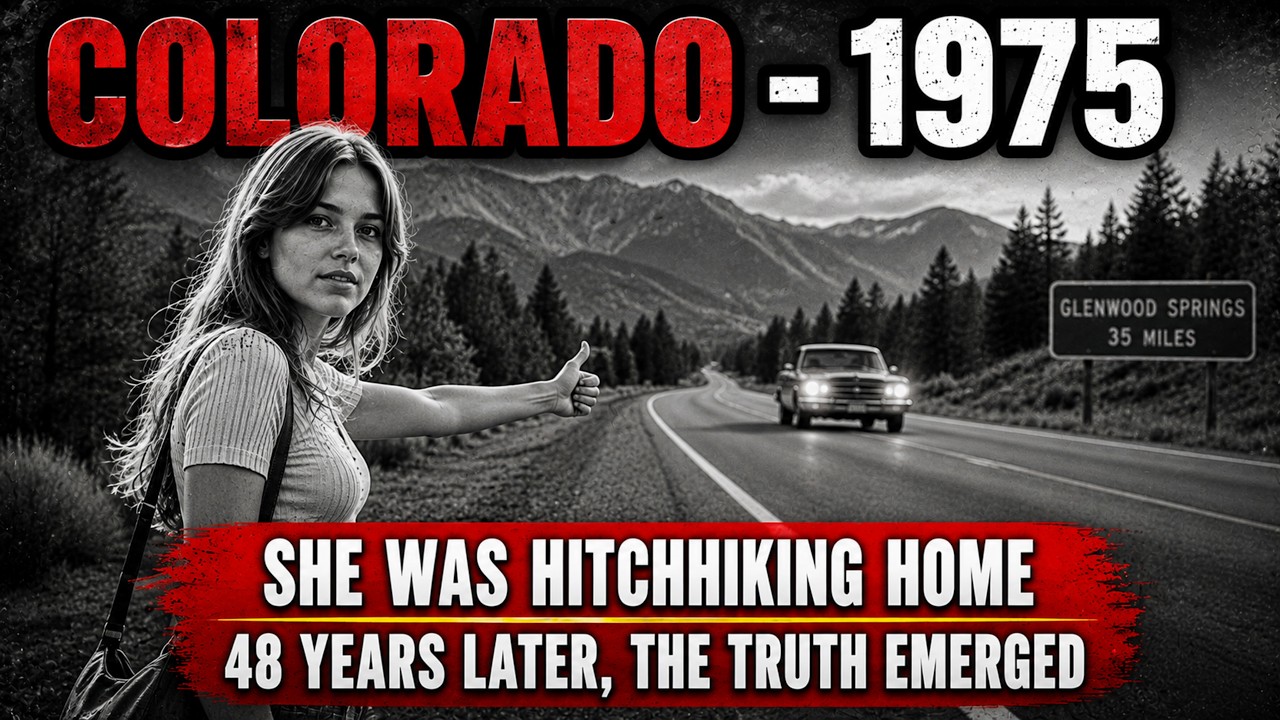
Investigators believed Terri had done the only thing available to her that night, the same thing she had done safely a hundred times before: accept a ride from a stranger. There was no witness account of the car she got into, no description of a driver, and no plate number. In an era before cell phones, before ATM cameras, and before security cameras on that highway, a young woman could simply vanish between one town and the next. Her clothing and personal items were found scattered near her body, as if she had been left there without a second thought.
The hours that should have brought her walking back through the door turned into worry, then into dread, as December 4th slid into December 5th with no word from her at all. The Westminster Police Department did what any competent department would do in 1975. They looked hard at the most obvious suspect: the boyfriend. He was the reason Terri had made the trip to Brighton in the first place, but he had an alibi that could not be argued with.
Investigators also collected biological material during the autopsy that was tied directly to a sexual assault. But DNA profiling as an investigative tool did not exist yet. It would not be developed for criminal cases until the late 1980s, and it would not become part of a searchable national database for another two decades after that. So the evidence sat, dormant, in a records room in a cardboard box, waiting for someone or something to bring it back to life decades later.
The first breakthrough came in 2003. By then, DNA testing had become a real working tool for cold case investigators. The Colorado Bureau of Investigation went back to the biological evidence collected during Terri’s 1975 autopsy and entered it into CODIS, the FBI’s Combined DNA Index System, a national database built specifically to catch matches like this one. And then, nothing happened.
For years, the DNA profile sat in the database with no name attached to it. The case might have stayed cold forever if not for another murder that took place 16 years later and nearly 1,000 miles away. In 1991, in Las Vegas, Nevada, 32-year-old Sherri Bridgewater was killed under similar circumstances. Her case generated its own DNA profile in 2013, and when it was entered into CODIS, it matched the profile from Terri’s murder.
Two departments, two different states, two women killed 16 years apart, and one man’s unidentified DNA linking every part of it together. But what they still didn’t have was his name. To find that name, investigators turned to genetic genealogy. This technique works by comparing an unknown DNA sample against public genealogy databases, the kind regular people use to build their own family trees, looking for partial matches to distant relatives.
The Colorado Bureau of Investigation, a genetic lab called Parabon NanoLabs, and a Denver-based genealogy firm called Solved by DNA all took up the work together. And almost immediately, they ran into a wall that had nothing to do with the science. It turned out the man they were looking for had a long criminal history. Not long before Terri’s murder, Thomas Elliot had committed a burglary in Lakewood, Colorado.
While serving his sentence, he was shuffled through the Department of Corrections system, eventually ending up in a Las Vegas facility. Almost immediately after getting out, he committed a crime against a child, a case serious enough to earn him a 10-year sentence. And for that entire decade, the families of two dead women had no idea that the man responsible for the worst day of their lives was simply sitting in a cell doing time for an entirely different crime, waiting to walk free again the moment his sentence was up. And it didn’t take long for him to kill again.
In the years after Terri’s murder, while he moved through prisons and parole boards and different addresses in different states, Elliott lived the kind of quiet, unremarkable life a lot of career criminals live between arrests. Because as far as any database in the country knew, no one was looking for him at all. Two separate systems in two separate decades had caught this man breaking the law, but neither system had any way of knowing what he had already done in that Colorado field 16 years earlier, because his name had never been attached to it. The final confirmation came when investigators obtained Thomas Elliot’s own genetic material and tested it directly against the sample that had been sitting in evidence storage since 1975.
It was a match. But the justice system that had failed to catch him while he was alive would never get the chance to try him in front of 12 of his peers. Thomas Elliot was already dead. In late January and early February of 2024, two police departments in two different states told the story together.
Lieutenant Jason Johansson of the Las Vegas Metropolitan Police Department stood in front of reporters and named Elliott as the man who killed both Sherri Bridgewater and Terri Becker, laying out for the first time in public how a cold case stretching back nearly half a century had finally been closed. For 22 years, the two cases sat in separate filing systems in separate states, connected only by the fact that the same man had committed both crimes. If Elliott had never killed again in Las Vegas, if Sherri Bridgewater’s case had never generated its own DNA profile in 2013, there’s a real chance Terri Becker’s murder never gets solved at all. Chandra Thurston, who had carried Terri’s case for years as the lead criminalist assigned to it, spoke about what it had felt like on the inside of that decades-long search.
The announcement was not the end of a professional pursuit that had run for decades. It was the end of 48 years of simply not knowing. David Becker, Terri’s brother and the only member of her immediate family still living, spoke to reporters after the announcement. He talked about how hard it was to believe that after 45 years, DNA could still bring an answer, and about what that answer actually meant to him personally.
Knowing the man responsible was no longer out there, he said, meant knowing he could never take another sibling’s life away from another family somewhere else, all over again. The man who killed Terri Becker had escaped every form of earthly justice simply by dying decades before anyone connected his name to either crime. But for the family, there was a final resolution. The uncertainty that had followed them for 48 years, the not knowing who did this, whether he was still alive, whether he was still out there somewhere close enough to hurt someone else, was finally, permanently over.
It wasn’t the ending anyone would have chosen, but after 48 years of nothing, it was an ending all the same. This one came full circle not with a trial, not with a verdict, but with a name.