For three scorching days in July 1863, the rolling farmland of Gettysburg, Pennsylvania became the stage for a battle that would come to define the American Civil War. Under an unforgiving sun, Union and Confederate forces clashed in a catastrophe that would determine the fate of a divided nation. At the heart of that confrontation lay a desperate gamble, one that has been remembered ever since as Pickett’s Charge. Confederate General Robert E.
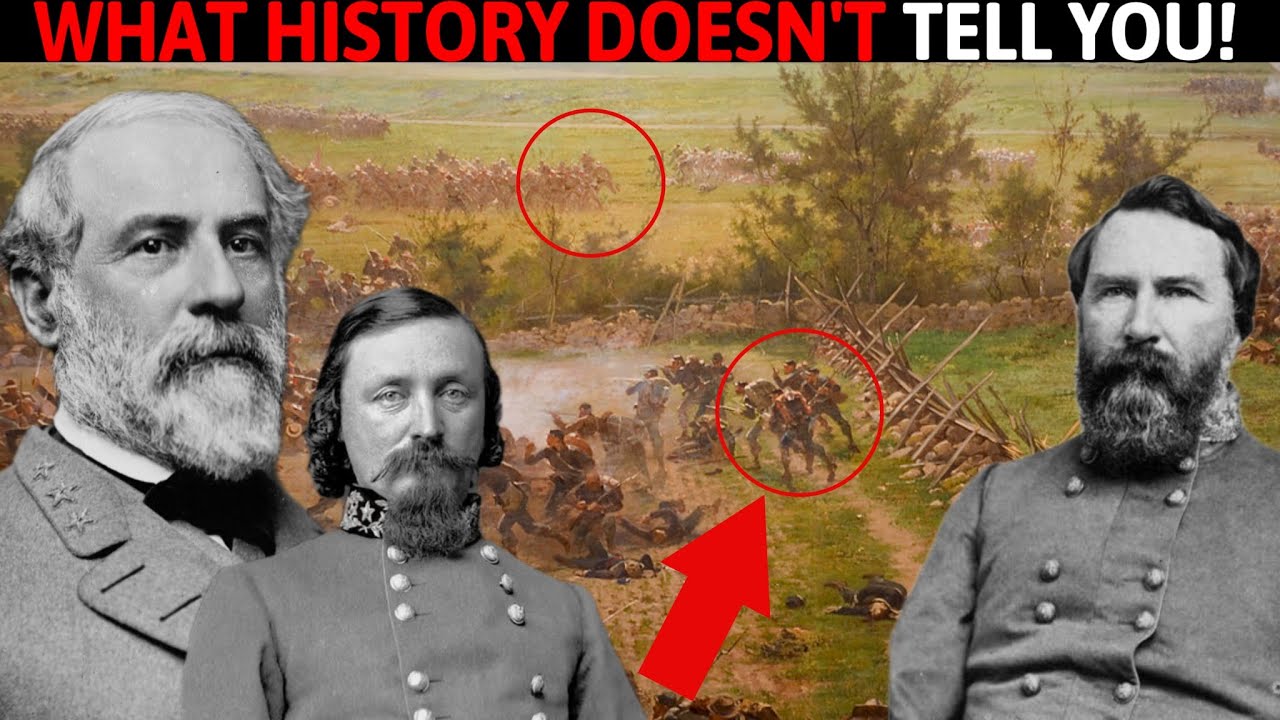
Lee, riding the momentum of a series of stunning victories, believed he saw his moment to deliver a decisive blow. He ordered a massive frontal assault directly into the center of the Union lines atop Cemetery Ridge. The attack was meant to shatter the defenders under Major General Winfield Hancock. Although the assault bears the name of General George Pickett, the weight of leading the infantry charge fell to Lee’s trusted subordinate, the veteran James Longstreet.
Longstreet, a seasoned soldier who had witnessed war’s horrors firsthand, foresaw the coming disaster with terrible clarity. He confronted his revered commander and issued a warning heavy with the weight of history. “General, I have been a soldier all my life,” he said. “I have been with soldiers engaged in fights by couples, by squads, companies, regiments, divisions, and armies, and should know as well as anyone what soldiers can do.
I believe that no 15,000 men ever arrayed for battle can take that position. ”
Despite that plea, Lee’s resolve held firm, and the order stood. Three divisions, roughly 12,500 men—the elite of the Confederate infantry—prepared to march across the valley of death under Generals George Pickett, J. Johnston Pettigrew, and Isaac Trimble.
On the tense evening of July 2, Union commander George Meade, relying on intelligence and instinct, anticipated Lee’s deadly intention: a concentrated strike aimed directly at the Union center. His prediction proved tragically accurate. At 2 p. m.
on the burning afternoon of July 3, after a massive but largely ineffective Confederate artillery bombardment meant to weaken the Union defenses, the infantry stepped off. They did not charge. They marched in terrible silence, side by side, across nearly a mile of open, undulating Pennsylvania farmland. They were a perfect target, advancing steadily into crushing Union fire.
What followed was a slaughter. Union forces, entrenched on the high ground and supported by heavy artillery, unleashed a devastating fire. Sheets of lead and iron tore through the advancing ranks. Three fatal flaws sealed the Confederates’ fate: they were significantly outnumbered, their own artillery had failed to suppress the enemy guns, and they were advancing across open ground against a deeply entrenched and concealed enemy.
Within a nightmare of fifty minutes, the quiet fields became a battlefield. As the suffocating smoke finally began to clear, the terrible truth emerged. Nearly 1,500 Union soldiers lay dead or wounded. The Confederate losses were catastrophic: 6,500 casualties.
More than half of those who had marched out that day were killed, wounded, or captured. One entire regiment was annihilated. Exhausted, stunned, and bleeding, the broken men stumbled and crawled back toward the uncertain safety of the Confederate lines on Seminary Ridge. General Robert E.
Lee rode out to meet his shattered army, accepting full responsibility. “All this has been my fault,” he told the survivors. Among the stricken commanders was George Pickett, whose division had been destroyed. When Lee later approached and urged him to rally his men for a possible counterattack, Pickett, his spirit broken, replied with harsh lamentation: “General, I have no division.
”
No Union counterattack came that day. Both armies were utterly spent, overwhelmed by exhaustion and grief. On July 4, Independence Day, an uneasy truce prevailed as both sides gathered their bloated dead and cared for their legions of wounded. As this grim task unfolded at Gettysburg, significant news arrived.
General Ulysses S. Grant had accepted the surrender of Vicksburg, Mississippi, ending his campaign to split the Confederacy. These two simultaneous Union victories—Gettysburg in the East and Vicksburg in the West—irreversibly broke the South’s momentum. Together, they marked a critical turning point in the Civil War.
The question of why Lee ordered the attack remains a subject of enduring debate. The full truth died with him. He left no revealing memoirs and his official battle report offered few details. Pickett’s own report, which was rumored to sharply criticize Lee’s decision, was ordered destroyed by the commanding general himself.
No copy has ever been found. In the charged atmosphere following the battle, Virginia newspapers enthusiastically praised the bravery of Pickett’s Virginia troops during the assault, implying that troops from other Southern states had fallen back. This biased coverage played a significant role in cementing the name “Pickett’s Charge,” despite the fact that the geographic label was misleading. Pickett himself grew deeply resentful of having his name attached to such a disastrous failure.
The assault’s legendary status, often seen as the pinnacle of Confederate courage, has also faced scrutiny. Some historians, echoing contemporary observers, have questioned the accuracy of its heroic mythology, pointing to accusations that Pickett himself led cautiously from the rear. Ultimately, Pickett’s Charge became far more than a military action. It represents the final moments of the Confederacy’s main field army in the East and a powerful symbol of doomed bravery, immortalized in the literary and cultural movement known as the “Lost Cause.
” The blood-soaked ground near the corner of Cemetery Ridge remains hallowed earth, whispering an eternal story of courage, sacrifice, and the terrible price paid by a nation divided against itself.