In the autumn of 1854, a man named Ambrose Kettering arrived on horseback in a place that no longer appears on any map. He was 38 years old, tall at about six feet two inches, with a lean build and hands that looked like a surveyor’s—calloused from the compass and rod, yet with long, quiet fingers more suited to a music teacher than a mountain man. He had been hired by a company called Elk Horn and Big Sandy Turnpike, which wanted to carve a passable road through a certain gap east of the settlement to move timber and iron without breaking wagon axles on the rough terrain. Kettering was given six weeks to clear the ground, mark the angles, blaze the trees, and deliver a set of engineering drawings that the firm’s office in Frankfurt could approve.
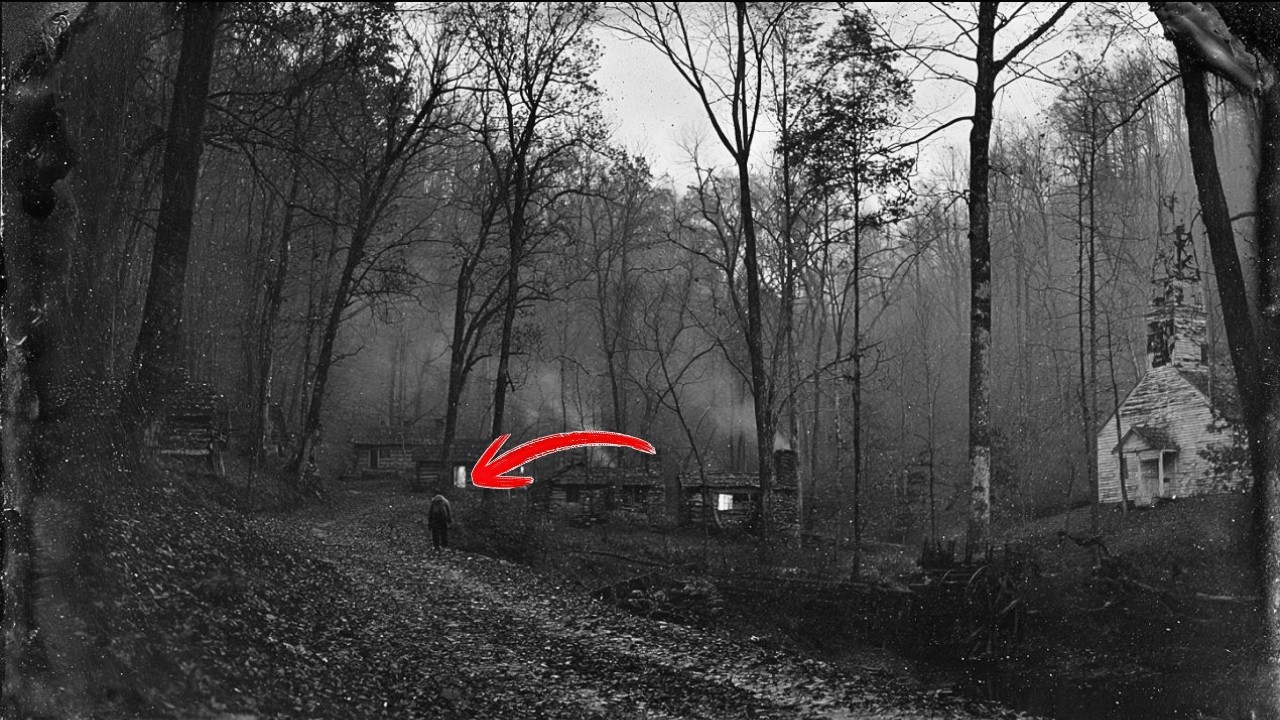
He had done this kind of work across 11 counties in three states, and by every measure of his profession, he was a precise man. His first impression of Harrow Crossing, as he later wrote in letters, was that it was a town that had forgotten how to grow. There were no more than 40 houses along the two winding streets, each one old but well-kept, as if the residents had long ago decided not to add anything new but instead to preserve what was already there. The general store sat at the junction of the two streets, with a saloon across from it.
The church stood slightly up the slope, painted white, with a small cemetery behind it and a bell that rang the hour in a faint, slightly cracked tone. A mill stood on the creek at the northern edge, still turning, and a smokehouse sat behind the saloon. Beyond everything, the mountains rose so close that a man could not walk 15 minutes in any direction from the store without finding himself under the trees. Kettering checked into a room above the saloon, which the locals called the Marchbanks, run by a man whose wife was named Verly Marchbanks.
The settlement was small enough that a stranger’s presence was noticed immediately, and Kettering, with his instrument case and his fine suit wrapped in oilcloth, stood out in a place where most men wore the dust of the hills. He began his work, running lines through the underbrush and setting his stakes. The people of Harrow Crossing watched him with a quiet wariness. They were polite but reserved, and Kettering, who had worked in many such settlements, understood the rhythm of their caution.
But as the days passed, he began to notice things that unsettled him. The townsfolk did not speak much about the gap he was surveying. When he asked questions about the road, about the terrain, about why the ground seemed so hard in certain places, their answers grew shorter, their eyes glancing away. One evening, a man approached him at the saloon.
The man was older, with a weathered face and eyes that had seen too much. He told Kettering, in a low voice, that the gap had a name the locals did not say aloud. He called it the place where the ground remembered. He said that men who had gone up there to cut timber or hunt had come back changed, if they came back at all.
He warned Kettering not to spend the night on the mountain, and to finish his work before the snows came. Kettering, a rational man who believed in measurements and angles, dismissed the warning as superstition. He had heard such stories in every county he had ever worked. But he could not dismiss the fear in the old man’s eyes.
He could not forget the way the man had looked at him, as if he knew something that Kettering would never understand. Over the following weeks, Kettering pressed on with his survey. He climbed the ridge above the gap, mapping the contours of the land, noting the ancient trees and the strange quietness of the forest. There were places where the woods were too silent, where no birds sang and no animals stirred.
He found old stones arranged in patterns that could not be natural, circles and lines that suggested a presence far older than the settlement below. He asked Verly Marchbanks about the stones. She told him that they were just rocks, that the children played among them sometimes, and that her mother had warned her never to touch them. She said it with a smile, but Kettering saw the fear behind her eyes.
By the end of the fifth week, Kettering had completed his survey. He had drawn his maps, marked his stakes, and was ready to deliver his report. But before he left, he went one last time to the gap. He said later, in his letters, that he wanted to see it one more time, to make sure he had not missed anything.
He did not come back that night. The people of Harrow Crossing waited, and then they sent a search party. They found his horse at the edge of the tree line, its saddle still on, its reins trailing. They found his instruments scattered on the ground, the compass still spinning as if it had been dropped mid-measurement.
But they did not find Kettering. They searched for days, then weeks. The story was told in the county seat, in the newspapers, in the way that such stories are told. But the mountain gave nothing back.
And in the winter of 1854, when the first snows fell, the people of Harrow Crossing decided, one by one, to leave. They packed their things, boarded up their homes, and moved to towns that had names on maps. By the following spring, the settlement was gone. The church was silent, the mill stopped turning, and the houses began to sag under the weight of the weather.
The name Harrow Crossing faded from memory, and the land reclaimed the gap, as if it had never been touched. Ambrose Kettering’s body was never found. His maps were never delivered.
And the town that had been so careful to preserve its old buildings slowly crumbled into the forest, a ghost of a place that had forgotten how to grow.