In 1887, Cold Creek was a small farming settlement in Eastern Tennessee where a death at home was usually handled by the family before any official notice was written. At the Voss farm, the same walnut bed had stood through three marriages. By the autumn of that year, it had also stood beside three deaths.
Dempsey Voss, Elvira Voss's third husband, was found dead at dawn in the upstairs bed chamber. He was 44 years old, heavy-set, and known as a steady worker. His mud-stained boots stood beneath the bed, and his patched work shirt lay over a chair.
He had gone upstairs complaining of a headache and weakness shortly after midnight. By sunrise, he was beyond help.
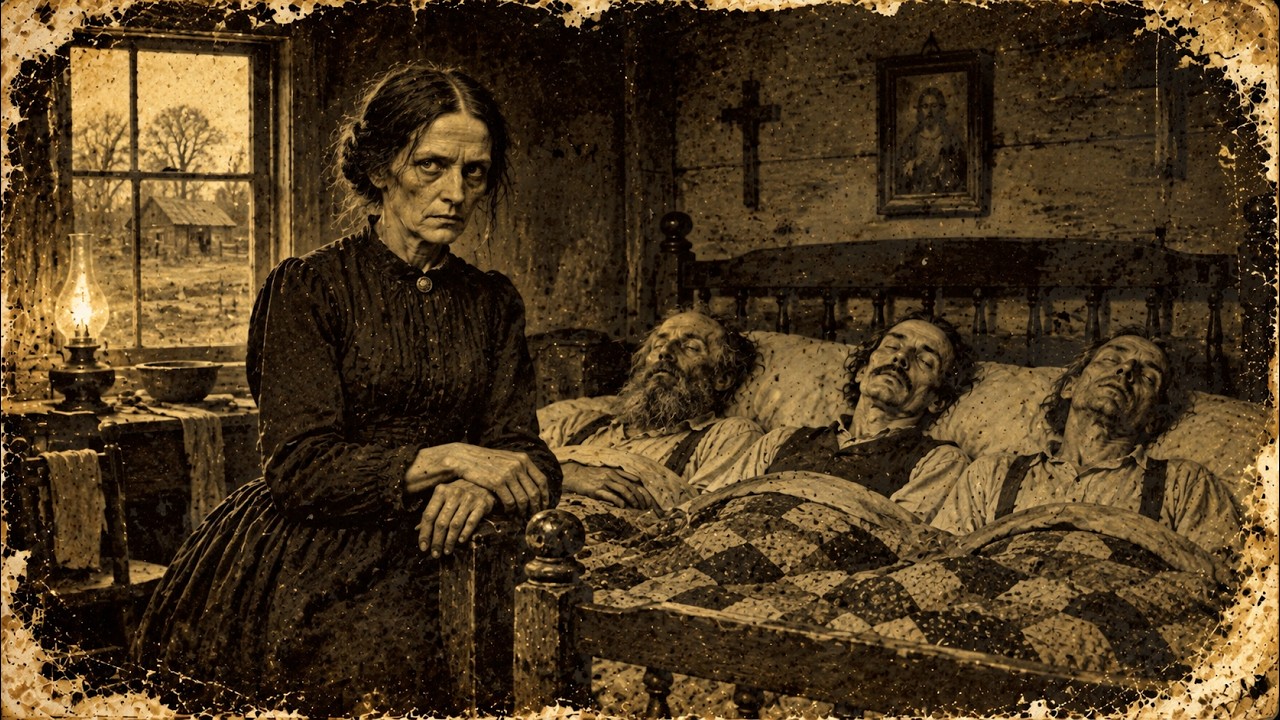
Elvira received neighbors in a black wool mourning dress altered from older clothes. Her dark hair was pinned tightly, and a ring of iron keys hung at her waist. She told them Dempsey had been ill only a few hours, had grown confused during the night, then quiet.
The Voss farmhouse was old but solid. Its upstairs bed chamber stood directly over a low cellar. The walnut bed was pressed against the interior wall beneath a tightly latched window. The room had no stove, no fireplace, and no visible chimney.
Yet when Dr. Violet Caraway entered with her leather medical satchel, she noticed a faint sour smell in the stale air. It resembled wet grain and old liquor mash.
At first, that smell seemed explainable. Small farms often kept feed, cider, and fermenting scraps near the house. The Voss farm had debts, and Elvira had managed its accounts for years. A sour odor could have come from a barrel, a pantry, or spilled feed.
Caraway examined Dempsey's body. She found no wound, and there was no violent struggle in the room. His skin did not show the ordinary signs of a long fever. His hands were clenched, but not from labor, and his face held a strange grayness.
Elvira said Dempsey had suffered from weak lungs. That answer had weight in Cold Creek. Men often died after hard winters, bad harvests, and years of tobacco work. Broad illnesses were commonly called lung fever when no clearer cause could be found.
A local doctor might make a brief note, and a family would bury its dead before another day had passed. But Dr. Caraway had heard something before coming upstairs. Dempsey was not Elvira's first husband to die in that bed.
Her first husband, Martin Hale, had died nine years earlier. Her second husband, Joel Raynor, had died six years after that. Both deaths had been described as sudden nighttime illnesses, and both had occurred in the same upstairs chamber.
When the physician learned that Elvira's two previous husbands had also died in the same bed, Sheriff Ambrose Doolan delayed the usual burial preparations and ordered the room left undisturbed.
Doolan was a broad-shouldered man in a worn gray coat with a trimmed beard and a weathered hat. He had known Elvira for years. He knew the farm had struggled after Martin Hale's death. He also knew that accusing a widow on the morning of her husband's death could destroy an innocent person's life.
He did not accuse her. He simply kept the room closed.
Dempsey's body was carried downstairs after Dr. Caraway finished her first examination. The walnut bed remained where it was. The window stayed latched. The bedclothes remained folded back at the foot of the mattress. The sour smell lingered in the curtains.
Elvira objected to the delay. She said Dempsey deserved a proper burial before nightfall. Doolan told her the county would not interfere longer than necessary. Then he asked why the window was shut so firmly in a room that smelled stale.
Elvira looked at the latch before she answered. She said Dempsey disliked night air and believed an open window brought sickness into the house.
The latch itself told a different story. Its small iron handle had been worn bright by repeated use. The window had not merely been closed against rain. It had been fastened night after night.
Caraway bent near the curtains and smelled the fabric. The odor was faint, but it was stronger there than near the door. She then checked the bedclothes. The same sour trace clung to the linen around the pillows.
The physician did not yet know what it meant. She considered bad air from the cellar, tainted food, or fumes from some household work, but the smell did not belong in a sleeping room, and the sealed window gave it nowhere to go.
That afternoon, Sheriff Doolan began asking questions outside the house. Cold Creek had little privacy. The nearest farm sat across a creek crossing and a dirt lane. A neighboring farmwife remembered all three marriages.
She did not claim to know what happened inside the Voss house, but she remembered Elvira's habits. On the night Dempsey fell ill, Elvira had visited her before sunset to borrow lamp oil. She had seemed tired but calm.
Near midnight, the neighbor had seen a light move below the Voss house, low behind the cellar windows. Elvira had later come to her door carrying an empty bucket. The neighbor assumed Elvira had been fetching water for Dempsey.
Then she remembered Martin Hale's final night. He had also complained of a headache. Elvira had closed the upstairs shutters and sent for no doctor until morning. Joel Raynor had grown weak in the same room years later. Again, Elvira had been seen carrying water downstairs after midnight.
None of this proved a crime. A wife nursing an ill man might fetch water many times. A woman keeping shutters closed against cold air might simply follow the household beliefs she had been raised with. But the pattern had a shape.
Doolan found a former Voss farmhand later that day. The man had worked for Dempsey during planting season. He said Dempsey had recently argued with Elvira about noises under the house.
At first, Dempsey believed rats had gotten into the cellar. Then he noticed the sour smell after midnight. He had asked Elvira why she kept the cellar door locked. She told him it contained old jars, spoiled feed, and nothing worth seeing.
The farmhand recalled Dempsey's words because they had been spoken angrily. Dempsey had said there was no proper work under that house, and that he meant to know what it was.
The farmhand also remembered an argument three days before Dempsey died. Dempsey had said he would speak with the sheriff after market day if Elvira would not open the cellar herself.
When Doolan repeated this account in the farmhouse parlor, Elvira said Dempsey had been embarrassed by debt and prone to temper. She called the farmhand a liar who had been dismissed for poor work.
The sheriff made no answer. He only asked for the keys at her waist. Elvira's hand moved over the iron ring. "They are house keys," she said. "Then we will need them," Doolan replied.
The sheriff did not force the cellar door that day. Caraway first wanted to understand the deaths themselves. She asked Doolan to bring the old household records from Dempsey's ledger box.
The box stood in a cupboard beside the kitchen hearth. Dempsey had kept farm accounts inside it: seed purchases, feed costs, unpaid notes, and tax receipts. Beneath those papers lay an older bundle tied in twine.
There were two physician notes. One concerned Martin Hale, who died in 1878. The other concerned Joel Raynor, who died in 1881. Both had been called lung fever. Both notes were brief.
Each described a man who had complained of pain in the head, dizziness, weakness, and confusion. Each had worsened during the night. Each had collapsed before dawn.
Neither note described a clear high fever. Neither described the deep coughing, swollen throat, or lung congestion that Dr. Caraway expected from a fatal chest illness.
The old doctor had not been careless by the standards of the time. He had worked alone over rough roads with limited tools, and he had been called after the men were already failing. Still, the symptoms did not fit the name he had written.
Caraway compared the old notes with Dempsey's condition. The same confusion. The same nighttime decline. The same lack of an ordinary fever. The same final weakness.
She set the notes beside Dempsey's farm ledger and told Doolan that the men may have died from poisoned air. The sheriff looked toward the ceiling, toward the room above them. "From where?" he asked. "That is what we must find," she said.
The physician now saw the bedchamber differently. It was no longer simply the place where three men had become sick. Something in the room or something entering it could have acted on all three.
Elvira heard this from the kitchen doorway. Her face remained composed, but she tightened her grip on the keys. Doolan asked again for the cellar key.
Elvira said the cellar had no connection to the deaths. She said it had always smelled bad. She said the old house trapped dampness and smoke. The sheriff told her that if the cellar were harmless, opening it would settle the matter.
She gave him a key, but not the one he needed. It turned uselessly in the lock. Doolan noticed the mistake. So did Dr. Caraway.
The next morning, while the bedchamber remained sealed, Doolan returned to the upstairs room with the physician. Dempsey's body had been taken to a cool outbuilding for the delayed burial arrangements. The bed stood alone now. Its carved walnut headboard darkened against the wall.
The sheriff examined the room inch by inch. He found no hidden medicine bottle, no poison packet, and no signs that food had been brought upstairs. He checked the wall near the bed. The plaster was old, but mostly sound.
Then he opened Dempsey's ledger box again. One receipt had been folded between farm accounts. It was older than the rest, dated to the year Martin Hale died. It listed a walnut bedstead, copper fittings, and masonry work paid for in the same season.
The receipt did not prove that the objects were connected. A man might buy a bed, repair a hearth, and purchase copper for ordinary farm work. But Martin had bought all three at once, shortly before the first death.
Doolan brought the receipt upstairs. Elvira followed him to the doorway. She did not cross the threshold. "That bed was my mother's," she said. The receipt said otherwise. The bedstead had been bought by Martin Hale.

Doolan looked at the headboard. Its carved upper edge was fitted tight against the wall. One small wooden cap, hidden by the posts and the bedding, appeared slightly darker than the rest of the walnut. He told Elvira he would need the bed moved.
For the first time, her calm broke. She stepped into the room and placed a hand on the bedpost. "You will not tear apart my house because three men had weak bodies," she said.
Doolan did not raise his voice. He told her the room was under examination. Then he asked two neighbors to help shift the bed away from the wall. The floorboards groaned under its weight. Dust rose behind the headboard.
The bed had stood in that position for years, perhaps since Martin Hale brought it into the house. Once there was room behind it, Doolan saw that the small carved cap was not decorative. It covered a narrow opening.
He pried it loose with a pocketknife. Behind the walnut carving lay a copper tube blackened inside with soot. The tube entered the hollow headboard near the pillows. It passed through the wall behind the bed and disappeared downward into the house.
For a moment, no one spoke. The walnut bed had not simply witnessed three deaths. It had carried something into the room.
Caraway held a lamp near the opening. A faint smell of old smoke rose from the tube. The sour mash odor seemed stronger now, no longer trapped in the curtains and bedclothes alone, but coming from the wood itself.
Elvira backed away from the doorway. Doolan looked at her. "What is beneath this room?" "There is nothing," she said, but the copper tube gave him a root.
The cellar lay directly below the bedchamber. Its door opened from a narrow passage behind the kitchen. Doolan had already tried Elvira's false key. Now he returned to the door with the exposed tube in mind.
The door was made of thick boards reinforced by iron strap. A second lock had been added more recently. Elvira stood behind him, no longer speaking. The sheriff sent a deputy to fetch tools from a nearby shed.
Before the deputy returned, Elvira moved toward the passage and tried to close the kitchen door between them. Doolan caught it with one hand. "Stand back," he told her.
When the tools arrived, the lock was broken open. A smell of damp earth, ash, and fermenting grain rolled out of the darkness. A steep set of wooden steps led down to the cellar. Doolan lit a lantern and descended first. Caraway followed, holding the rail.
The cellar ceiling was low. Stone foundation walls pressed close around them. The floor was packed earth. At the far end stood a small copper still. Mash tubs rested beside it, covered with cloth. A firebox of charred brick sat beneath the copper vessel.
A draft channel ran through the foundation wall, hidden behind stacked crates and old sacks. The lower end of the soot-lined tube entered that channel.
The still had not been abandoned. The copper joints were worn smooth from use. The firebox held recent ash. One tub contained sour grain mash. The same smell that clung to the bedchamber filled the cellar.
The hidden arrangement now made practical sense. A proper chimney above the roof would have announced night distilling to every neighbor and passing revenue man. But a concealed tube running inside an old wall could carry smoke and fumes upward without drawing attention. It also explained why Elvira had guarded the cellar key.
What it did not yet explain was whether the still had killed three men by accident. A concealed still could leak. A hidden flue could fail. Bad air could drift through an old house. If Martin, Joel, and Dempsey had slept above the wrong place at the wrong time, the deaths might have been tragic but unplanned.
Caraway was not ready to accept that answer. The tube did not merely run behind the wall. It ended inside the headboard, close to where a sleeping man's face would rest. That fact suggested direction.
The sheriff searched the bedstead again. He examined its joints, its carved posts, and the underside of the rail nearest the wall. Near the right bedpost, hidden beneath a small lip of walnut, he found a flat brass plate.
It was no larger than a man's palm. The plate slid sideways in a narrow groove. When Doolan moved it, the copper opening inside the headboard widened. When he slid it back, the opening closed. The brass was worn bright at its edge. It had been handled many times.
Elvira stared at the plate. Doolan asked whether Martin Hale had built it. Elvira did not answer.
The sheriff called for the former farmhand. He brought the man upstairs and showed him the brass plate. The farmhand looked at it for a long moment, then said Dempsey had tried to pry something loose from that side of the bed several days before his death.
The farmhand had thought Dempsey was repairing a loose rail, but Dempsey had cursed under his breath and said, "No honest bed needs a door in it." He had then told the farmhand that Elvira had better explain the cellar work before he fetched the sheriff himself.
The meaning of Elvira's night routine changed again. She had fastened the window. She had urged each husband to rest. She had left the room on the excuse of carrying water downstairs.

In the cellar, she could tend the firebox. Upstairs, beside the bed, she could open the brass plate. The room itself became part of the method. The closed window was no longer an old fear of night air. It was what kept the fumes around the bed.
Still, Doolan and Dr. Caraway needed more than suspicion. They had a hidden still, a tube, a control plate, and the matching accounts of three nighttime deaths. But if Elvira were to be charged with murder, they needed to know whether the arrangement could truly make the bedchamber deadly.
The county commissioners were called to the farmhouse. Doolan wanted witnesses who had not relied on gossip, old notes, or Elvira's words. He also refused to place any person in danger.
The reconstruction took place after Dempsey's body had been removed and the room had been cleared. The walnut bed remained pulled away from the wall, its carved cap removed. The copper outlet stood exposed inside the hollow headboard.
Caraway explained the risk in plain terms. A smoky fire could create air that gave little warning once a person had breathed enough of it. The first signs could be headache, confusion, weakness, and sleepiness. A victim lying in bed might not understand that the room itself was killing him.
The commissioners stood downstairs with Doolan. Elvira was kept in the kitchen under the deputy's watch. Caraway went upstairs only long enough to make sure the chamber was empty. She closed the door behind her.
The window was latched as it had been on the nights of the deaths. No one remained inside. A damp white cloth was fixed above the mattress where a sleeping man's face would have been. Then Doolan returned to the cellar.
The firebox still contained old fuel. Under controlled conditions, he reopened the draft channel. He did not need a great blaze. Even a small smoky fire sent fumes toward the copper root at the bedpost upstairs.
The deputy slid the brass plate open on Doolan's order and then withdrew. For several minutes, nothing could be seen from the hallway. Then a thin gray thread slipped from the open mouth inside the headboard. It curled across the mattress.
More followed. The smoke did not rise cleanly to the ceiling. It spread outward at the level of the bed. It gathered around the pillows, then drifted through the closed room in a slow, heavy cloud.
The sour mash smell came with it, stronger now, mixed with hot soot and the bitter breath of the firebox. The damp cloth above the mattress began to darken. Caraway waited only long enough to confirm the path, then she opened the window and stepped back. The room had become difficult to enter without coughing. The cloth was streaked black.
The same bed that had seemed cursed now stood exposed as the end of a hidden exhaust line. Martin Hale had died there. Joel Raynor had died there. Dempsey Voss had died there.
Not because the bed carried bad luck. Not because three men had inherited weak lungs. Not because Cold Creek had given Elvira a cruel fate. The bed had been built around the outlet. The brass plate made the difference between danger and choice.
When Elvira saw smoke crossing the empty mattress, she stopped struggling to maintain her story. Until then, she had insisted that the still, if it existed, was only a hidden source of income. She said Martin had begun it. She said she had continued it because the farm would otherwise be lost to debt.
But the reconstruction left no place for accident. Doolan told the deputy to remain with her while he secured the house. Elvira suddenly moved toward the back door. She did not run far. The deputy caught her at the threshold beside the kitchen garden. The sheriff brought her back inside.
On the kitchen table lay the brass plate, the old receipt for the bedstead and copper fittings, and the physician notes that had once called two murders lung fever. Elvira looked at each object, then she confessed.
Her first husband, Martin Hale, had built the concealed still during a hard year when debt threatened the farm. He had used the hidden route to keep smoke from showing above the roof. Elvira had learned the work because Martin needed help. She knew the mash, the firebox, the copper fittings, and the sliding outlet beside the bed.
After Martin began drinking more heavily, he threatened to destroy the still rather than risk losing the farm to an informer. Elvira said he had spoken of selling the place and leaving her with nothing. On the night Martin died, she waited until he was weak and asleep. She fastened the window. She went downstairs. Then she opened the plate beside the bed and fed the cellar fire.
Joel Raynor discovered the still after marrying her. At first, he agreed to keep it hidden. Later, he demanded that it be dismantled. He said he would not live above poison and secrecy. Elvira used the same method again.
Dempsey had been the last to learn. He had not only threatened to report the still. He had tried to open the bed frame and remove the brass plate himself. Elvira understood that once he did, the hidden system would be found.
She told Doolan that she had never intended to lose the farm. Caraway answered that she had chosen three nights, three men, and the same locked room.
Elvira was arrested on charges connected to the deaths of Martin Hale, Joel Raynor, and Dempsey Voss. The sheriff took custody of the brass plate, the copper tube, the farm receipt, and the physician notes.
The walnut bedstead was removed from the upstairs chamber under county supervision. The hidden tube was taken apart with it. The cellar still was dismantled. The mash tubs were emptied. The fire brick was broken apart. Once the concealed route had been opened, the Voss house no longer held its secret system together.
Caraway submitted a correction to the county death entries. The earlier records had named lung fever. Her later report described matching nighttime collapse in a sealed room caused by poisonous fumes from the cellar fire. The correction did not restore Martin, Joel, or Dempsey. It did restore the truth of what had happened to them.
The Voss farm was later sold to settle debt and legal costs. Its new owners removed the damaged wall behind the bed and rebuilt the upstairs chamber with an ordinary window that opened freely over Cold Creek.
For years, neighbors had spoken of Elvira as an unlucky widow. Some had said the old walnut bed brought sickness. Others had thought three husbands had simply failed under the hard life of the farm.
After the investigation, no one in Cold Creek called it a curse again. It had been a method. And Elvira Voss had known exactly how to use it.