In the spring of 1945, the Third Reich was collapsing. Adolf Hitler was dead by his own hand in a Berlin bunker, and German soldiers across Europe were surrendering to the nearest Allied forces.
In the chaos of that final collapse, one man believed the rules of unconditional surrender did not apply to him. His name was Hermann Göring, and he was about to receive one of the most psychologically devastating rejections in modern military history.
Göring was, by any objective measure, the second most powerful man in Nazi Germany. He served as Commander-in-Chief of the Luftwaffe, President of the Reichstag, Minister of Aviation, and Director of the Four Year Plan, which gave him control of the German war economy.
He was also Hitler's designated successor. If anything happened to the dictator, Göring was legally supposed to become the absolute ruler of the Third Reich.
He had signed orders that contributed to the systematic extermination of millions. He had looted priceless artwork from occupied nations for his private estates. He was a war criminal of the highest order.
But in his own mind, Göring believed he was something else entirely. He saw himself as a statesman, a diplomat, a gentleman warrior who happened to be on the losing side of a temporary military disagreement.
While ordinary German soldiers were being herded into freezing prisoner-of-war camps, Göring prepared for what he believed would be a civilized surrender to the Supreme Commander of the Allied Forces, General Dwight D. Eisenhower.
He did not flee or hide his identity. He actively sought out American forces because he believed the Americans would treat him as a respected adversary.
He imagined Eisenhower would invite him to sit across a polished table, offer him a drink, and negotiate a gentlemanly peace. His narcissism was so profound that he could not understand his own irrelevance.
When advance units of the United States Army encountered the former Reichsmarschall, they did not find a broken fugitive. They found a man who looked like he was arriving at a luxury resort.
Göring arrived with a massive personal entourage, including his valet, his chef, and his wife. He brought enormous quantities of monogrammed leather luggage.
Inside the suitcases were custom-tailored uniforms, rare vintage champagne, a large supply of opioid pills to feed his drug addiction, and stolen artwork he had hoarded throughout the war.
He wore a specially designed powder-blue Luftwaffe uniform with gold braiding and heavy, jewel-encrusted medals pinned to his chest. He looked, by any description, like a deranged peacock strutting through the apocalypse.
The American soldiers who first encountered him were stunned. These were young men from places like Ohio, Texas, and Pennsylvania who had fought through the hedgerows of France and the forests of Germany.
They had watched friends die in the mud and had liberated concentration camps. Now standing before them was the second most powerful Nazi in history, smiling and extending his hand for a friendly handshake.
He casually requested to be taken directly to General Eisenhower's personal headquarters. He was immediately taken into American custody.
The initial interactions were a master class in narcissistic delusion. Göring behaved as if he were an honored guest rather than a captured war criminal.
He was jovial, talkative, and charming. He complimented American officers on their uniforms and joked about the war as if it had been a spirited athletic competition.
He repeatedly requested a private meeting with Eisenhower, referring to the Supreme Commander as a fellow professional soldier who would understand the complexities of the situation.
Göring genuinely believed his rank and historical importance entitled him to a seat at the negotiation table. He expected to be treated the way Napoleon had been treated after Waterloo: a defeated emperor, but an emperor nonetheless.
The American intelligence officers assigned to process him were simultaneously fascinated and revolted. They had interrogated hundreds of captured German officers, but none had displayed this level of self-importance.
Göring spoke about himself in the third person. He described his past decisions as the brilliant moves of a misunderstood genius. He expressed no remorse for the millions of deaths he had enabled.
He seemed to view the Holocaust, the destruction of nations, and the air war that killed hundreds of thousands of civilians as unfortunate side effects of a grand strategy history would eventually judge favorably.
The intelligence officers took careful notes and passed their reports up the chain of command to the only person whose reaction truly mattered: General Dwight D. Eisenhower.
Eisenhower had been Supreme Commander of the Allied Expeditionary Force since the planning stages of the Normandy invasion. He was quiet, methodical, and deeply intelligent.
He operated with a controlled strategic patience that was the opposite of Patton's explosive aggression. He did not scream or threaten. He destroyed his enemies with cold, calculated precision.
When the reports about Göring's behavior landed on his desk, Eisenhower's response was immediate, absolute, and psychologically devastating. He did not agree to meet Göring.
He refused to see him. He refused to be in the same building as him. He refused to acknowledge his existence as a human being worthy of any form of diplomatic recognition.
Eisenhower issued a direct and brutally clear order. Hermann Göring was to be treated as an ordinary prisoner of war.
He was to be stripped of his uniform. His medals were to be confiscated. His luggage was to be seized and cataloged as evidence. His stolen artwork was to be returned to its rightful owners.
His champagne was to be poured out. His personal staff was to be dismissed. He was to receive the exact same treatment as every other captured German soldier: a canvas cot, cold rations, and a latrine in the mud.
The order landed on the processing officers like an earthquake. They had been somewhat intimidated by Göring's rank and his relentless charm offensive, but Eisenhower's directive left no room for interpretation.
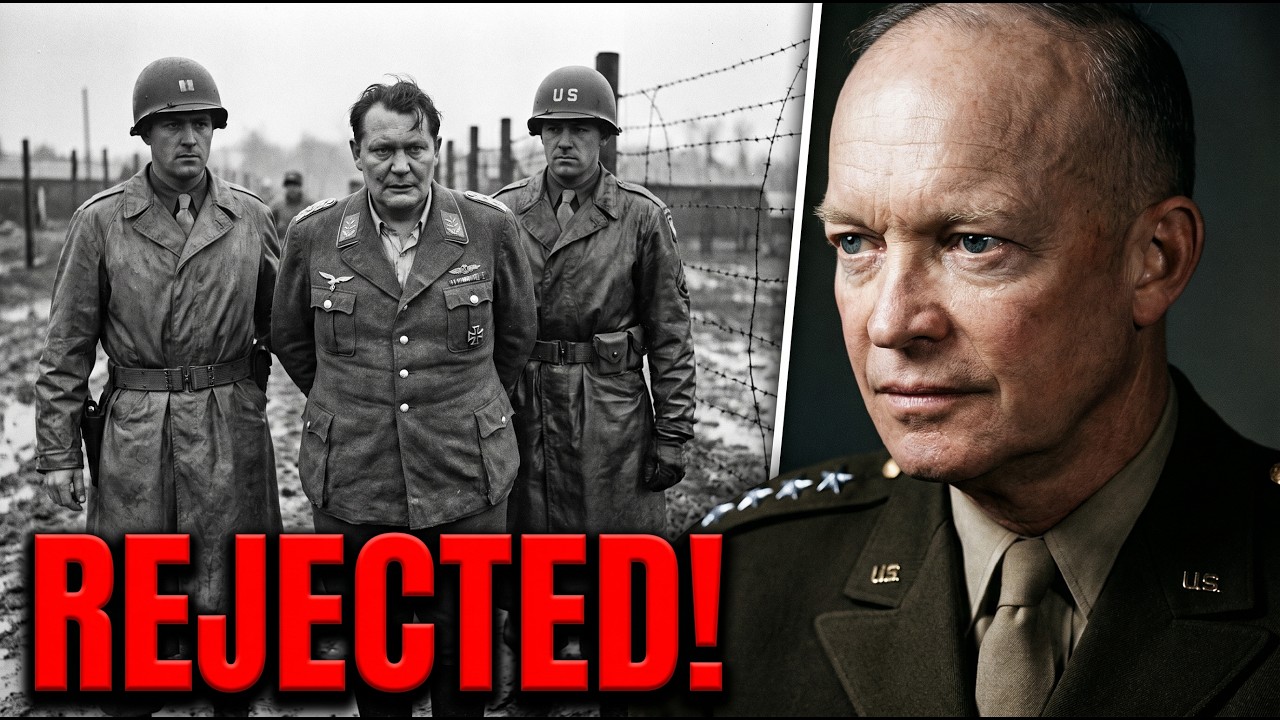
The Supreme Commander had looked at the second most powerful man in Nazi Germany and decided he was worth less than nothing. Göring was not a dignitary to be entertained. He was a criminal to be processed and judged.
The moment Eisenhower's order reached the processing facility, the atmosphere changed immediately and permanently. The American officers who had been navigating Göring's charm offensive suddenly stood straighter.
The apologetic deference evaporated within seconds. They were no longer hosting an inconvenient diplomatic guest. They were processing a war criminal, and they followed their orders with unapologetic precision.
The stripping of Göring began methodically and without ceremony. The first to go were the medals.
Göring had spent twenty years collecting those medals with an almost obsessive devotion. He had personally designed many of them and had awarded some to himself.
His chest was a heavy, glittering landscape of gold, silver, and precious stones that he wore as physical proof of his own magnificence. When an American officer began removing them one by one and dropping them into a plain metal box, Göring stared in disbelief.
He had expected negotiation. He had expected the Americans to be awed by his rank and presence. Instead, a young lieutenant was casually dropping his Grand Cross of the Iron Cross into a cardboard evidence box without even looking at it.
Göring protested loudly with the practiced authority of a man who had spent decades having his protests immediately obeyed. He invoked his rank. He invoked the Geneva Convention. He invoked his personal relationship with Hitler.
He demanded for the fourteenth time to speak directly with General Eisenhower. He insisted there had been a catastrophic misunderstanding and that he was not an ordinary prisoner but a senior statesman who had come to negotiate a dignified peace.
The American officers listened with complete indifference. Nobody raised his voice. Nobody argued. They simply continued working through the inventory list, removing each item systematically and recording it.
Then they took the uniform. The powder-blue creation with its gold braiding, custom cut, hand-stitched collar, and delicate silver buttons was taken from Göring's body.
It was replaced with a standard-issue American prisoner-of-war garment, a plain, rough piece of fabric designed for function, not for theater.
When Göring looked down at himself in that uniform, something fundamental broke behind his eyes. The uniform had not merely been clothing. It had been his identity.
Every element of his personality, his authority, and his sense of self-worth had been constructed through the physical appearance of power. Without the medals and the braiding, he was revealed as what he truly was.
He was a grossly overweight, middle-aged drug addict with bad skin and terrified eyes, standing in a plain room in a plain uniform, waiting to be told where he was permitted to sleep.
The drugs were the next crisis. Göring was severely addicted to paracodeine, a powerful opioid he had consumed in industrial quantities for years.
When American medical officers discovered the enormous stockpile of pills in his luggage, they confiscated the entire supply. This was not punitive. It was standard medical procedure for a catastrophic dependency.
But for Göring, the loss of his pills was a physical and psychological catastrophe. Without the opioids, his body began to rebel within hours.
The sweating, the shaking, and the desperate need were things he had never expected the Americans to witness. He had arrived planning to project authority. He was now experiencing acute withdrawal in a military holding facility.
The most psychologically devastating blow, however, was delivered entirely through silence. General Dwight D. Eisenhower never came.
He never sent a senior representative. He never sent a message. He never acknowledged Göring's existence in any way that could be interpreted as recognition of his status.
From Eisenhower's perspective, there was simply nothing to discuss. The war was over. Unconditional surrender had been signed. Göring was a prisoner awaiting trial for crimes against humanity.
The Supreme Commander had roughly three thousand more important things to handle, including the logistical management of millions of displaced persons, the reconstruction of a continent, and delicate negotiations with the Soviet Union.
Hermann Göring was not on the list. He was not even close to the list.
This silence was more devastating than any direct confrontation could have been. If Eisenhower had come and screamed at Göring, that would have given the Reichsmarschall a stage.
It would have acknowledged that he was significant enough to deserve the personal fury of the Supreme Commander. By refusing to appear at all, Eisenhower communicated something far more brutal.
You are irrelevant. You are not important enough to argue with. You are not interesting enough to contemplate. You are a piece of administrative paperwork waiting to be processed.
Göring sat in his holding room and waited. Hours passed, then days. The grandiose diplomatic meeting he had envisioned never materialized.
Instead, military intelligence officers rotated through his room asking questions in a businesslike, impersonal manner, taking notes, and leaving without ceremony. They were not impressed by him. They were not afraid of him.
The interrogations were thorough and clinical. The Americans wanted specific, verifiable information about the structure of the Luftwaffe, the location of hidden assets, and the decision-making processes of the Nazi High Command.
They were not interested in Göring's philosophical justifications, his historical revisionism, or his self-portraits as a misunderstood military genius. When he attempted those speeches, the interrogating officer would wait in silence and then repeat the original question.
Within his first week of captivity, Göring had been stripped of every external marker of his identity and power. The medals were gone. The uniform was gone.

The drugs were almost gone, replaced by a medically supervised reduction program that left him physically diminished and psychologically exposed. The champagne had been confiscated.
The artwork had been seized as stolen property. His personal chef had been dismissed. His wife had been separated from him and was being processed separately. His entourage had evaporated.
And the meeting with Eisenhower, the meeting he had built his entire surrender strategy around, had not happened and was not going to happen.
But the Americans were not finished with him. The military intelligence officers had been evaluating Göring's psychological profile throughout his first days of captivity, and they had identified something important.
Despite everything they had taken from him, Göring's narcissism remained fundamentally intact. He still believed he was special. He still believed he was historically significant.
He still spoke about himself with a casual, breezy arrogance that was remarkable under the circumstances. The medals were gone, but the ego that had demanded those medals was still pumping at full pressure.
The interrogation specialists recognized that this residual arrogance was both Göring's greatest weakness and their most powerful tool. They decided to use it.
The senior American intelligence officer assigned to Göring's case requested a private, extended interrogation session. Unlike the previous clinical sessions, this meeting was designed to feel different.
The officer arrived without a notepad. He sat down across from Göring in a relaxed, conversational posture. He spoke to Göring as if he were genuinely curious and found the former Reichsmarschall historically significant.
He let Göring talk. He let him build himself up and reinflate the massive, punctured balloon of his self-regard. And as Göring relaxed into the warm bath of apparent admiration, the officer began steering the conversation with surgical precision.
The goal was the exact information the Allied prosecution teams would need to build a case that would put Hermann Göring in front of a war crimes tribunal.
The interrogation strategy the Americans designed for Göring was a masterpiece of psychological manipulation. They had studied him carefully during his first days of captivity.
They had read his personnel files, his psychological evaluations, his wartime correspondence, and the detailed reports from officers who had spent hours listening to him talk.
They had identified the single most powerful lever in the architecture of his personality. Göring did not merely want to be important. He needed to be remembered.
He needed history to look at him the way he looked at himself: a complex, brilliant, tragically misunderstood figure caught on the wrong side of an unfortunate historical turning point.
His narcissism was not just about present power. It was about legacy. It was about the terrifying prospect of being forgotten, erased, and reduced to a footnote in somebody else's war story.
The lead interrogator, Colonel Burton Andrus, understood this completely. He did not walk into Göring's cell with aggression or contempt. He walked in with something far more dangerous: apparent fascination.
He told Göring he believed the Reichsmarschall had a genuinely unique and historically significant perspective on the collapse of the Third Reich. He said he was personally interested in understanding how such a catastrophic strategic failure had occurred.
He positioned Göring not as a criminal to be interrogated, but as a historical witness whose insights were valuable and worth preserving. He essentially told Göring that he was interesting.
The effect was immediate and profound. Göring began to talk with enormous energy and detail, restructuring his experience of the war as a narrative in which he was the tragic, clear-eyed realist surrounded by incompetent fanatics and a delusional dictator.
He distanced himself systematically from the worst atrocities of the regime, claiming ignorance and claiming he had argued against certain measures. He claimed his influence had been deliberately undermined by rivals like Himmler and Bormann.
He positioned himself as a pragmatist who had tried to steer the Third Reich toward rational decisions but had been overruled by the irrationality of Hitler's inner circle. He spoke for hours.
He was encyclopedic. He was articulate. And in his own deeply distorted way, he was genuinely compelling. While he talked, the American prosecution teams were taking every word and building a legal case against him.
Göring did not understand what was happening because his narcissism had created a catastrophic blind spot. He believed he was managing the narrative.
He believed he was conducting a strategic public relations campaign that would establish his historical reputation as a complex, morally ambiguous figure rather than a straightforward war criminal.
He believed that by being cooperative and intellectually engaging, he was earning goodwill that would translate into favorable treatment at whatever legal proceedings were eventually held. He was wrong about every one of those assumptions.
The more he talked, the more evidence the prosecution accumulated. The more he explained and justified and contextualized, the more clearly he revealed his detailed knowledge of and active participation in the crimes of the Nazi regime.
Every sophisticated attempt to distance himself from the Holocaust produced documentary evidence confirming his direct involvement in its administration and implementation.
The Nuremberg trials began in November 1945. Hermann Göring was the most prominent defendant in the dock when the proceedings opened before the International Military Tribunal in the ruined German city.
He was seated in the front row of the defendants, flanked by Rudolf Hess and Joachim von Ribbentrop. From the opening moments, it became clear he had decided to treat the proceedings as a stage.
Göring arrived at Nuremberg having completed his drug detoxification program, which had the unintended effect of dramatically sharpening his mental faculties.
The foggy, opioid-dulled version of Hermann Göring that had bumbled through the early weeks of captivity had been replaced by a focused, energetic, dangerously intelligent version determined to dominate the courtroom.

He was magnificent in the worst possible way. During cross-examination, Göring displayed a devastating command of detail, a sharp intelligence, and an absolute refusal to be psychologically destabilized by the prosecution.
He challenged evidence. He cross-examined the logic of accusations. He delivered lengthy, carefully constructed statements that were simultaneously defiant and crafted to appeal to German nationalist sentiment.
He was performing for an audience far beyond the courtroom walls. He understood that the Nuremberg trials were being documented, photographed, and broadcast around the world.
He was determined that the record would show Hermann Göring going down fighting, never breaking, never begging, never conceding the essential legitimacy of the tribunal.
The prosecution teams found him infuriating. Several times during cross-examination, experienced Allied lawyers found themselves outwitted and outmaneuvered by the former drug addict in the dock.
But the evidence was overwhelming and completely damning. The meticulous, obsessive documentation that had characterized the Nazi bureaucracy at every level had produced an almost incomprehensible volume of paper evidence.
There were orders signed by Göring. There were memos written by Göring. There were directives approved by Göring. There were conference minutes recording his attendance at meetings where the systematic murder of millions had been planned and authorized.
His personal correspondence was filled with casual references to the administration of terror that revealed the degree to which industrialized mass murder had simply been another bureaucratic function to him.
The same intelligence and organizational ability that had made him an effective administrator of the Nazi war economy had created a paper trail so comprehensive that no amount of courtroom theatrics could overcome it.
On October 1, 1946, the International Military Tribunal delivered its verdicts. Hermann Göring was found guilty on all four counts of the indictment.
He was guilty of conspiracy to wage aggressive war. He was guilty of crimes against peace. He was guilty of war crimes. He was guilty of crimes against humanity.
The tribunal sentenced him to death by hanging. The sentence was to be carried out on the morning of October 16, 1946.
The verdict landed like a detonation inside whatever remained of Göring's carefully constructed self-image. He had genuinely believed throughout the trial that his intelligence and courtroom performance would produce a different outcome.
He had believed the historical complexity of his position would be recognized, that the tribunal would see him as something other than a common criminal deserving of a common criminal's death.
Instead, he had been found guilty of everything. And he had been sentenced to hang, not shot like a soldier, but hanged like a murderer, like exactly what he was.
In the days following the verdict, Göring made one final desperate attempt to control his own narrative. He submitted an appeal to the Allied Control Council requesting that his sentence be changed from hanging to death by firing squad.
His stated reason was that hanging was not an appropriate death for a soldier and former head of state. His real reason was that he could not bear the humiliation of dying the same death as a common thief or murderer.
He wanted to die with a rifle pointed at his chest, the way a military man dies, with a weapon facing him as an equal. The appeal was denied without ceremony or discussion. Hermann Göring would hang.
He did not hang. In one final extraordinary act of defiance, Hermann Göring cheated the executioner.
On the evening of October 15, 1946, just hours before his scheduled execution, Göring crushed a small glass cyanide capsule between his teeth and died in his cell.
The source of the cyanide was never definitively established. Various theories involving concealment in his body, a sympathetic American guard, or a transfer during a final meeting with his wife have been investigated and debated for decades.
The capsule had apparently been concealed somewhere on his person for the entire duration of his captivity, surviving every search conducted by the American authorities. Whether this was brilliant planning or extraordinary luck remains unclear.
The American military authorities were furious and profoundly embarrassed. General Eisenhower's command had been responsible for Göring's custody.
The most prominent defendant of the most important war crimes tribunal in history had died before his sentence could be carried out. It was a humiliation for the administration of military justice.
But Göring's final act of defiance was also, in the most bitter and ironic way possible, his ultimate defeat. He had spent his entire captivity trying to control his narrative.
He wanted to be remembered as complicated and brilliant and historically significant, rather than simply evil. His suicide was widely reported as the last desperate act of a coward who could not face the consequences of his own choices.
He had spent two years performing courage and defiance in the courtroom. Then, at the final moment, he proved the performance was exactly that. A performance.
He could not face the rope. He could not face the moment when the trapdoor dropped and every medal and uniform and title and self-constructed mythology became utterly irrelevant in the face of simple biological death.
He ran from it, exactly as he had spent his entire life running from the core emptiness at the center of his identity.
Hermann Göring died with the cyanide burning through his blood in a small Allied prison cell. He was stripped of his medals, his champagne, his stolen artwork, his drugs, his titles, and his subordinates.
He was stripped of the meeting with Eisenhower that he had constructed his entire surrender fantasy around. And he was stripped, finally, of the dignity of the death he had so desperately wanted.
General Dwight D. Eisenhower, the man Göring had so desperately sought to impress, never thought about him again. Eisenhower had more important things to do. He was rebuilding a continent.