In December 1944, during the fighting in the Hürtgen Forest near the Elsenborn Ridge, a German soldier climbed out of his foxhole and ran toward the American lines. Shells were not falling near him. They were falling directly on him. Rather than lie flat, he ran straight at the rifles, at men who would shoot the moment they saw him. He preferred to die in the open rather than spend one more second underground.
That soldier belonged to the 12th Panzer Division, young troops indoctrinated to believe nothing could stop them. They were coming apart under fire from guns they never saw. In account after account, the same answer keeps appearing. Not tanks, not fighter planes roaring overhead, but American artillery.
Every army had artillery. The Germans had good guns and skilled crews, men who had survived Stalingrad and buried half their friends. So why would experienced killers choose rifle fire over another minute of shelling? Because something was different in the way the Americans killed them. For years, no one on the German side could name exactly what it was. It shows up again and again in postwar memoirs and interrogation records. Tank crews, infantrymen, officers who had fought since the invasion of Poland all said the same thing: guns no one could see coming.
Go back to 1939. The United States Army ranked nineteenth in the world, smaller than Portugal's. Its factories were still making car doors and washing machine tubs, not gun barrels. Its soldiers trained with trucks painted to look like tanks because there were not enough real ones. They had not fought a major war in more than two decades.
Hitler was not worried. He described Americans as a hybrid nation, without a future, without fighting spirit, nothing to worry about. German officers agreed. Amateurs.
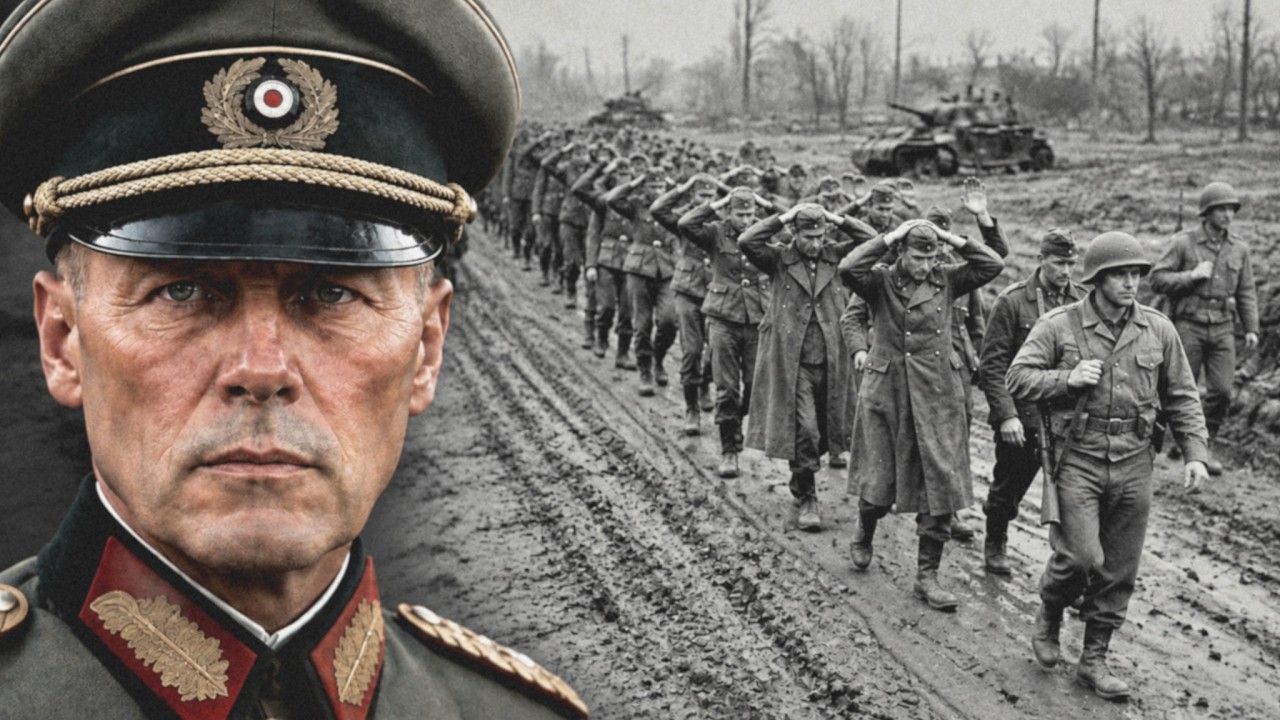
Then came February 1943, which seemed to prove them right. At Kasserine Pass, American positions stretched thin across 30 miles of desert. The commander directed the battle from a bunker 70 miles behind the front, 70 miles from his men. Rommel's tanks struck the line. It did not bend. It broke. Panzers poured through gaps that should never have opened. Artillery crews were overrun before they fired a shot. Infantrymen dropped their rifles and ran. Some had no boots, no weapons, abandoning anything that slowed them in the sand.
About 6,500 Americans became casualties in less than a week. Nearly half were taken prisoner, hands above their heads, watched by men utterly certain how this war would end. Rommel wrote it down that night, plainly. The Americans, in his private notes, were cowards who had not learned how to fight. Yet he could not help adding that they were learning fast, and that their equipment was better than anyone had expected.
Omar Bradley, the same man who would later command the largest American army ever assembled, called it the worst performance in his country's history. He was not wrong, not yet.
Four weeks was all it took for everything Rommel believed to collapse. On March 23, 50 tanks of the 10th Panzer Division drove toward the Americans at El Guettar. Same enemy, same confidence. The crews expected a repeat of Kasserine. Mines took the first tanks. Then hidden tank destroyers opened fire. Then the sky changed.
There was no slow creeping barrage that gave a man room to hide. There was dead silence. Then the ground exploded from every direction at once, as if the earth itself had decided to answer. Thirty tanks burned during the advance. Infantry caught in the open were chased by fire that followed wherever they fled, adjusting faster than any human could find new cover. Survivors crawled back through smoke that had not cleared in an hour. The officers who led that morning's attack were not among them.

When prisoners were brought in, some of them wept, and these were hard men. They told their interrogators something that should freeze the blood. The mines stopped their advance. The hidden tank destroyers finished the job. Then the artillery hunted what was left of them in the open. Infantrymen had nowhere left to run.
Rommel had called them amateurs three weeks earlier. The Americans called it "time on target." Different guns, different calibers, miles apart. Every battery fired at a precisely timed second, calculated so that no matter how far the shells traveled, they all landed in the same instant. At El Guettar, the shelling came from one direction. This shelling came from every direction at once, from guns miles away that a man on the ground would never see.
Now the Germans faced something their artillery doctrine was never designed to handle. By 1944, a single man near the front line could call down enough fire to destroy a company, and he was not following any particular gun. He picked up a radio, dictated six numbers. Somewhere behind him, in a tent he had never seen, an officer he had never met plotted those numbers on a map and gave an order to guns he had never spoken to, served by men who did not know his name. Three minutes later, the numbers became craters.
The German battery, working through a slower chain of command and a coordination system less dependent on maps, was often still doing calculations from the first request. By then, the Americans had already begun filling in the next six numbers.
Then the Americans took away the one thing that had kept a soldier alive: the foxhole. A new fuse, small enough to fit an ordinary shell, smart enough to sense the ground without touching it. The shell no longer needed to fall into the hole. It only had to burst above it, and the fragments did the rest, raining down on positions that had seemed safe. For years, a deep hole had been the way to survive. Now the ground itself promised nothing. Men in the trenches did not need to name it. They simply stopped trusting the dirt under their feet.

Now return to the Elsenborn Ridge. Now you know why a man climbs out of his foxhole and runs toward the rifles. The 12th SS Panzer Division was moving through the Ardennes toward Antwerp. Young, fanatically loyal, convinced things would go as they had at Kasserine. Hundreds of American guns were already waiting. Below, inside the trenches, men were learning something in real time. The ground under their feet no longer saved them. The shell did not need to fall into the hole. It only had to burst above it. Their tanks stopped where they were hit and burned there. The attack toward Antwerp ended within sight of its first day's objective. Some men chose a bullet in the open over another minute underground with nowhere to hide. That is not cowardice. It is arithmetic, and they had already done the math.
But the guns were only half the story. There was no secret cannon, no superweapon hiding in an American factory. The weapon had been built years earlier at Fort Sill, Oklahoma, while most armies were cutting their artillery budgets. Almost everyone, including Germany, still tied one observer to one battery, in one private fight at a time. The Americans broke that chain.
A single unarmed reconnaissance plane, a small, fragile Piper Cub that barely outran a car, circled over German lines. Within minutes, fire rained from dozens of guns the pilot had never touched, directed by a voice relayed over the radio. One eye, a thousand guns, three minutes. You cannot outfight a machine like that. You can only feel what it does to you.
Heinz Guderian, the inventor of blitzkrieg, was asked after the war what he thought of American operations. He said he had to congratulate Patton, because Patton did exactly what he himself would have done. From the father of mechanized warfare, that is not a compliment. It is an admission.
Rommel called them amateurs in February 1943. Nineteenth in the world, still training with painted trucks. By 1945, the men who fought them along the Western Front had one word left for the Americans, a word they never used for anyone else. Terrifying.
It was never about the weapon in any soldier's hands. It was about the three minutes standing behind him, unseen.