On January 27, 1945, the temperature at Stalag 9-A stood well below freezing. More than 1,200 American prisoners of war stood in the snow, and none of them knew that one man among them was about to decide which of them would live and which would die.
The German commandant walked the length of the formation, a pistol hanging from his belt. The sound of his boots on the frozen ground was the only noise besides the breathing. Frozen vapor hung in the air, and 1,200 men tried not to shiver visibly.
He stopped in front of a sergeant. It was a first sergeant, the highest enlisted rank in the camp. The commandant issued an order, one sentence: "Tomorrow morning, only the Jews will come out for roll call."
The sergeant said nothing, not yet. But what he did over the next 24 hours would put a loaded pistol against his head and would decide whether 200 of the men standing in that snow would still be alive a month later.
His name was Roddie Edmonds, and he was 25 years old. He had reached Belgium with the 106th Infantry Division just days before the Germans launched their largest offensive on the Western Front.
Breaking through the Ardennes forest amid fog and snow, the Germans caught fresh American divisions that were not fully prepared. Edmonds's battalion, the 422nd, was surrounded within 72 hours. After ammunition and food ran out and all hope of relief was gone, they surrendered on December 19, 1944, in one of the largest mass surrenders of American forces in the European theater.
Then the march began, lasting for days. No trucks, no trains, not at first. Just columns of unarmed men walking east into the depths of a collapsing Reich that no longer had enough to feed its own soldiers, let alone the 20,000 prisoners it had never planned for.
Temperatures stayed below freezing most of the time. The men slept sitting up, huddled together in barns and open fields, because lying down in that cold meant some of them would not get up again. Guards shot anyone who fell out of the column and could not return to it.
Edmonds marched like everyone else. No special treatment for his rank. By the time the column reached Stalag 9-A, more than five weeks after his capture, he had lost so much weight that men who had known him in Belgium later said they barely recognized him.
The camp told them everything before anyone spoke a word. Rows of barracks behind barbed wire, watchtowers at every corner, and guards watching the new arrivals the way men watch cattle while counting them.
Because Edmonds held the highest rank among the new arrivals, camp protocol made him the only man the Germans would deal with directly. Every order meant for the American prisoners passed through him first. He had not asked for that responsibility. It found him anyway.
The camp commandant's name was Siegmann. Guards lowered their voices when he passed. Men who had spent longer in the camp moved out of his path before he got close enough to notice them. No one needed to be told what kind of man he was. They had already seen it in the behavior of everyone around him.
The order came over the camp loudspeakers on the evening of January 27. That night, Edmonds turned to his men and said five words: "We're not doing that."
Instead, he moved between the barracks in the dark, giving his instruction in a low voice so it would not reach the guard posts. Every American would report tomorrow, every single one. The sick too. No exceptions, no distinctions. If anyone asked, they were all the same.
The instruction spread from bunk to bunk faster than anyone could stop it, from hand to shoulder, from man to man, until every barracks in the camp knew before midnight.
No one slept much that night. Two hundred Jewish American soldiers lay among those 1,200 men in the darkness, listening to each other breathe, waiting for a dawn that might be the last for some of them.

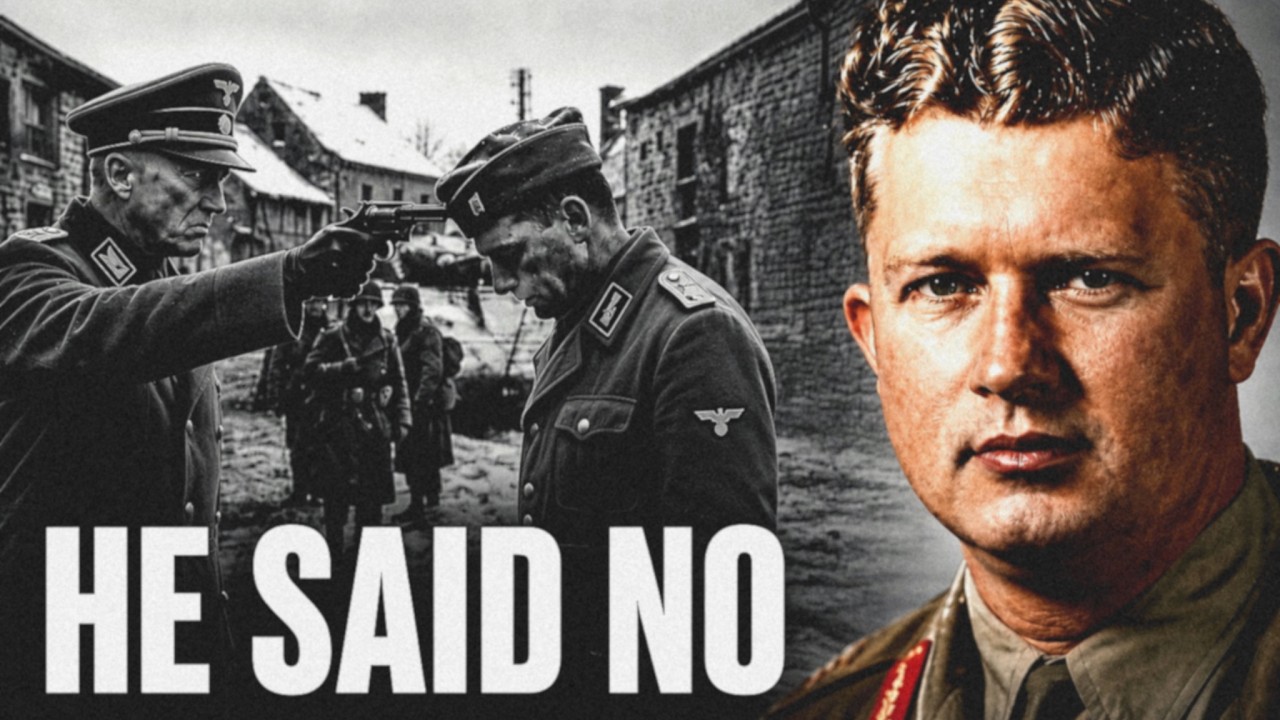
Morning came, and the soldiers assembled. When Commandant Siegmann came out to count them, he did not find two rows. He found one. More than 1,200 men stood shoulder to shoulder, Christians and Jews indistinguishable in the bitter cold dawn.
His face shifted from confusion to rage in about three seconds. He rushed to the front row, toward the only man wearing sergeant's insignia, and shouted the only sentence that made sense to him. They could not all be Jews.
Not one man in the formation moved. Edmonds looked at him calmly. Witnesses who stood close enough to see his face described it that way decades later, still amazed by it.
"We are all Jews here," he said.
Siegmann's hand moved toward his holster. He drew the pistol and pressed it directly against Edmonds's forehead. Neither man moved. More than 1,200 prisoners held their breath at once.
Identify the Jews or die where you stand.
Edmonds did not pull away from the pistol. He kept speaking in the same calm, measured tone. Under the Geneva Convention, they were required to give only their name, rank, and serial number. If you shoot me, he said, you will have to shoot all of us. And when this war ends, which it will soon, you will face trial for war crimes.
Siegmann lowered the pistol. He turned and walked back to the camp office, and he never raised the matter again.

The 200 Jewish American soldiers returned to their barracks alive that morning. But no one in that camp knew, in that moment, that the danger had passed. No one felt relief. A man humiliated in front of 1,200 prisoners could still choose revenge.
No one in those barracks could know whether Siegmann had truly let it go or was waiting for a quieter moment to settle the score. For the next 63 days, every roll call and every order over the loudspeaker carried the same unspoken question. Was this the day he would come for them?
It never happened.
On March 30, 1945, the second day of Passover, American forces liberated Stalag 9-A. For men who had spent two months not knowing whether that January morning had truly ended, liberation meant something specific and immediate. The first full meal in weeks, and gates that finally opened outward instead of only inward.
Roddie Edmonds returned home to Tennessee, married, raised a family, and went to church every Sunday for the rest of his life. He told no one what had happened in that camp. Not his wife, not his children, not once in 40 years. He died in 1985, and the story died with him for a time.
His son, Chris Edmonds, became a Baptist pastor. Years after his father's funeral, out of curiosity more than anything about a war his father had never discussed, he began reading Roddie's old wartime diaries. They said almost nothing. Soldier's abbreviations, dates, locations. Nothing about a pistol, or a camp commandant, or 1,200 men standing in the snow.
The full story only emerged years later, when a passing mention in a 2008 newspaper article led Chris to a name he had never heard: Lester Tanner. As one of the 200 Jewish American soldiers who had stood in that formation, Tanner led him to another man who had stood beside his father that morning, Paul Stern.
Stern was in his nineties by then. He had not spoken of that morning in more than 60 years, not because he was hiding it, but because no one had ever asked. When he finally spoke, he remembered it as if it were yesterday.
The cold, the sound of Siegmann's boots stopping in front of Edmonds, and that steady voice, like ordinary conversation, as if a man were discussing the weather instead of his own execution. "He was very calm," Stern said, "even with a gun to his head." It is astonishing, even now.
In 2015, Yad Vashem, Israel's official Holocaust remembrance authority, named Roddie Edmonds Righteous Among the Nations. He became the first American soldier ever to receive the honor, and one of only five Americans in the history of the award.
A man who never mentioned what he had done, not out of modesty before anyone. He simply never imagined it was a story worth telling. More than 200 men lived long enough to return home because one American sergeant refused to point.