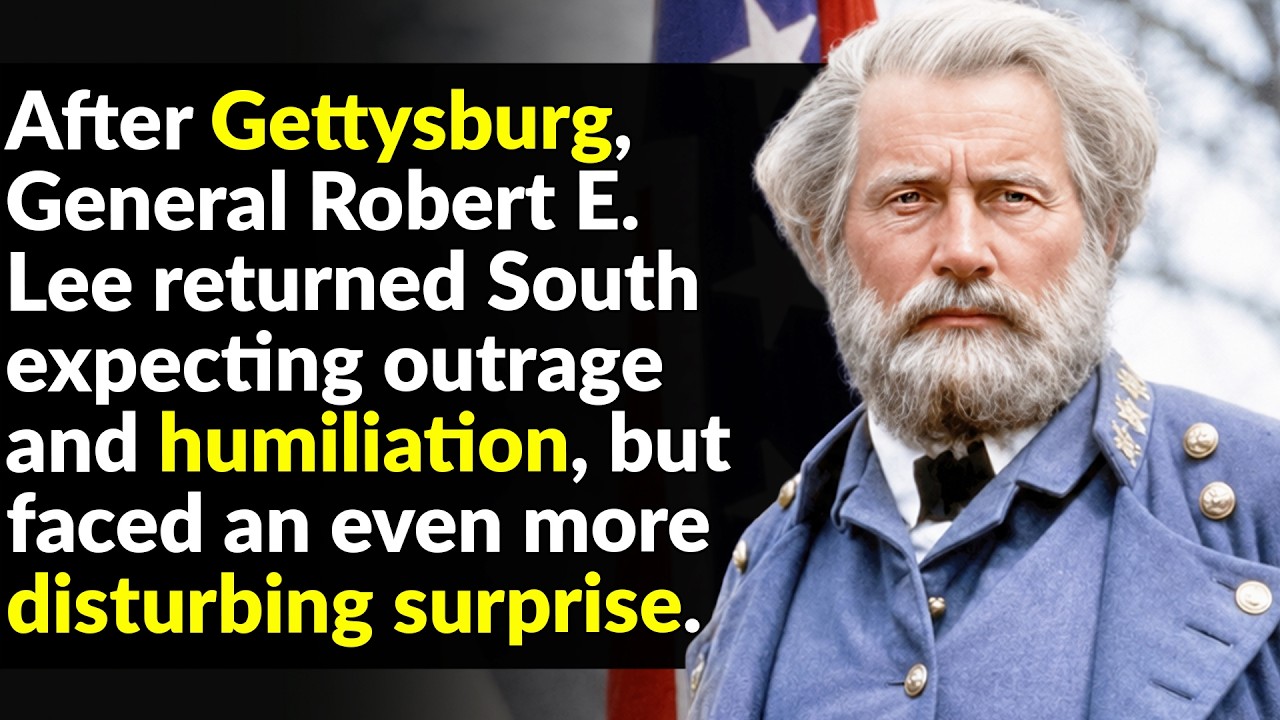
When General Robert E. Lee returned to the South after the Battle of Gettysburg, he expected anger and embarrassment, but he faced an even more disturbing surprise. Two years after the outbreak of hostilities between the Northern and Southern states, which led to the American Civil War, the conflict was not going well for the Union. The Confederate commander Robert E.
Lee was growing bolder, having recently won the Battle of Chancellorsville against Union forces in early 1863. Lee chose to press his advantage further, planning a second invasion of the North. What he didn’t know was that the North already had its own plans. While Lee was planning his campaign, he received news that demanded a more immediate course of action.
The North was moving toward them. Union forces had crossed the Potomac River into the border state of Maryland, and Lee wanted to move quickly. As he prepared his troops to respond, he positioned them near Cashtown, a town only eight miles from Gettysburg, Pennsylvania. Any army could fall victim to internal disputes, and the Union Army was no different, especially with someone like Major General Joseph Hooker in command.
Despite leading the Army of the Potomac, he clashed so badly with the high command that President Abraham Lincoln was looking for any excuse to fire him. So, when Hooker unexpectedly resigned, Lincoln agreed without hesitation and promoted George Meade in his place. Before long, both sides were ready for a confrontation, though one held a distinct advantage. Having already overwhelmed the local forces at Gettysburg, the Confederates felt they could handle anything that came their way within reason.
As Brigadier General J. Johnston Pettigrew and his men approached the town, they saw Union cavalry arriving at the same time, but just to the south. However, the Confederates believed these were nothing more than the militia they had already defeated, and therefore posed no threat. Even so, they tried to stay one step ahead.
On the Union side, the Army of the Potomac was preparing to confront the invaders as soon as possible. Fortunately, they had just arrived at Gettysburg with a good idea of Confederate plans. Knowing it was only a matter of time before the enemy marched toward the town, Union Brigadier General John Buford placed his men along three hills to the west, where he believed they would come from. Finally, the stage was set and the players were in position, but someone had to start things off.
Even though they didn’t know the full scope of what they were up against at first, the Confederate forces felt confident they would emerge victorious, despite being outnumbered. With about 75,000 troops, they faced 100,000 Union soldiers. The battle began on July 1st when the two armies met, and Union Lieutenant Marcellus Jones fired the first shot. The Confederates thought they could gain the upper hand by advancing through the nearby Herbst Woods and attacking Union forces from there.
But they were completely mistaken. Union Brigadier General Solomon Meredith’s “Iron Brigade” slammed into the Confederates, driving them back and capturing hundreds of men in the process. Unfortunately for the Union, when it came to the Battle of Gettysburg, the South was just getting started. After overcoming the Confederates in Herbst Woods, the Union Army was optimistic about their chances, but the fighting was far from over.
Brigadier General Pettigrew, leading a North Carolina brigade, responded by pushing directly toward the woods, driving the Iron Brigade out of its advantageous position. Meanwhile, Union forces were not faring any better on the other side of town. Buford’s division had been wrong about the Confederate advance toward Gettysburg from the west, but that wasn’t their only plan. That evening, two Confederate divisions outmaneuvered the Union corps positioned to the north and northwest, crushing them in a short time.
They couldn’t wait long before making a difficult and inevitable decision. Despite all their preparations, the Union Army wasn’t doing well against the Confederates in the west or the north. So, they had to make a tough choice. Settling on a more practical position to fortify, most Union forces withdrew to Cemetery Hill, south of Gettysburg, hoping the high ground would give them an advantage over the enemy.
Suddenly, the situation had become much bigger than they had anticipated. Throughout the first day of battle, General Lee watched all the actions closely and began to feel concerned as Union forces took up positions on Cemetery Hill. He realized this probably wouldn’t work in their favor, but he left it to the judgment of his general, Richard Ewell, who chose not to attack. While Lee thought this was the right call at the time, historians have often viewed this decision as a critical mistake.
To make matters worse for them, Union forces were only getting stronger. Of course, Lee was using this time to prepare for his grand assault. As both armies reinforced their ranks and prepared to fight again, Lee planned an attack that would strike the Union from all sides, ordering his First Corps to hit the Union’s left flank under Lieutenant General James Longstreet. He then prepared General Ewell to lead the Second Corps in a march toward Cemetery Hill once the battle began.
But one of these groups encountered an unexpected opportunity. Everything was going according to the Confederate plan as Longstreet’s men advanced toward the Union left flank. But instead, they found another corps blocking their path. Union Major General Daniel Sickles had abandoned his position in search of better ground, and his men in the Third Corps suddenly found themselves face to face with the Confederates without any support.
Fortunately, Meade realized things weren’t going as planned when all corps commanders showed up to a scheduled meeting except Sickles. Once the general reached Sickles, he informed him that any retreat would only endanger the rest of the Union forces. So, Sickles stayed and fought the enemy, suffering a horrific leg wound from an artillery shell that would later require amputation. Meanwhile, other Union corps held their ground, though not without sacrifice.
Across the battlefield, a Confederate division led by General Richard Anderson pushed forward with the plan and reached Seminary Ridge, where they faced a formidable opponent. It was only a matter of time before the Union Second Corps drove them back, at one point through a bayonet charge that seemed suicidal. Still, others were trying to hold their positions too, with no guarantee of success at all. Union forces were holding their own against the Confederates, but the battle had already become bloody enough.
Colonel Strong Vincent witnessed the carnage from one of the Union’s most critical tactical positions. As the fighting intensified, the Confederate pressure grew relentless. The sheer determination of the Southern soldiers was pushing the Union lines to their breaking point, yet they refused to give way. The cost was mounting on both sides, but neither army was willing to back down.
The day stretched on, filled with the chaos of gunfire and the screams of the wounded. Vincent knew that the fate of the entire battle, and perhaps the nation, rested on their ability to hold the line. He rallied his men, urging them to stand firm against the oncoming tide. On the second day, the Confederates launched a massive assault against both Union flanks.
Longstreet’s men slammed into the Union left at Little Round Top, while other Confederate forces attacked the right at Culp’s Hill and Cemetery Hill. The fighting was brutal and unforgiving. Vincent and his brigade were ordered to defend Little Round Top at all costs. As the Confederates charged up the rocky slope, the Union soldiers unleashed volley after volley into their ranks.
The Southerners faltered but kept coming, their determination fueled by the belief that victory was within reach. Vincent was struck down by enemy fire, but his men held their ground, repelling the attack and securing the high ground for the Union. The assault on Culp’s Hill was equally ferocious. Confederate troops under General Ewell launched wave after wave against the entrenched Union positions.
The fighting devolved into hand-to-hand combat, with soldiers clubbing each other with rifle butts and stabbing with bayonets. The hill changed hands multiple times, but the Union defenders, reinforced by fresh troops, managed to push the Confederates back. By the end of the day, both sides had suffered heavy losses, but the Union had successfully defended its positions. Lee, determined to break the Union center, planned a massive frontal assault for the third day.
He believed that a concentrated attack on the center of the Union line would finally break their resolve. On July 3rd, he ordered a massive artillery bombardment, the largest of the war, to soften up the Union defenses. For two hours, Confederate cannons pounded the Union lines, the ground shaking with the fury of the explosions. When the bombardment finally ceased, Lee ordered approximately 12,000 men under General George Pickett to march across the open field toward the Union center at Cemetery Ridge.
The Union artillery, which had been mostly silent during the bombardment to conserve ammunition, opened fire on the advancing Confederates. The cannonballs tore through the Southern ranks, creating gaps in their lines, but they continued their steady advance. As they approached the stone wall at the Angle, Union infantry opened fire with devastating effect. The Confederate charge, now known as Pickett’s Charge, was repulsed with heavy casualties.
Over half of the attacking force was killed or wounded. The Confederates retreated in disarray, leaving the field littered with their dead and dying. Lee, shocked by the failure of the assault, rode out to meet his defeated troops and urged them to rally. He took responsibility for the disaster, telling his men, “This is all my fault.
” The Confederate Army was severely weakened, and Lee had no choice but to order a retreat. On July 4th, the same day that Vicksburg fell to Union forces, Lee began his retreat back to Virginia. The Union Army, though victorious, was also exhausted and bloodied. Meade was criticized for not pursuing the retreating Confederates more aggressively, but the victory at Gettysburg was a turning point in the war.
The Battle of Gettysburg was one of the bloodiest battles in American history, with over 50,000 casualties. The Confederate defeat ended their second invasion of the North and marked the beginning of the end for the Confederacy. President Lincoln later traveled to the battlefield to honor the fallen, delivering the Gettysburg Address, which redefined the war as a struggle for a new birth of freedom. The battle had been a turning point, but the cost was staggering.
Families on both sides received the devastating news of their loved ones’ deaths, and the nation was left to mourn its losses and ponder the future. As Lee retreated, he was haunted by the losses. He had lost over 20,000 men at Gettysburg, nearly a third of his army. The Confederate cause, once so promising, was now on the defensive.
The Union, though victorious, was also in mourning. The battle had been a brutal reminder of the high price of freedom. In the months that followed, both armies would regroup and prepare for the next phase of the war. The fighting would continue for nearly two more years, but the outcome of the war was no longer in doubt.
The Confederacy had lost its best chance at winning independence on the battlefield. The war would continue, but the tide had turned decisively in favor of the Union. General Meade, while hailed as a hero, was criticized for his failure to launch a vigorous pursuit of Lee’s retreating army. Many believed that a more aggressive commander might have destroyed the Confederate Army entirely.
But Meade was cautious, his army equally battered by the three days of brutal fighting. Lincoln was deeply frustrated, writing a letter to Meade expressing his disappointment, though the letter was never sent. The war would drag on, with more bloodshed and more sacrifices, but the foundation for Union victory had been laid at Gettysburg. The town of Gettysburg itself was left in ruins.
The streets were filled with the dead and dying, and the residents were left to deal with the aftermath of the battle. The fields were littered with the debris of war, and the stench of death hung in the air. It would take months to bury the dead and begin the slow process of recovery. The battle had taken a heavy toll on the town and its people, but they would rebuild.
For the soldiers who had fought there, the memory of Gettysburg would stay with them for the rest of their lives. The screams of the wounded, the roar of the cannons, and the sight of their fallen comrades were burned into their minds. Many would suffer from the psychological scars of the battle for years to come. The war had changed them, and nothing would ever be the same again.
As the war continued, the Union Army would go on to achieve more victories, culminating in the surrender of the Confederate Army at Appomattox Court House in 1865. But Gettysburg remained a defining moment in the conflict, a turning point that would be remembered for generations. The battle had proven that the Union could be saved, and that the cost of freedom was always high. The words of Lincoln’s Gettysburg Address would echo through the ages, a testament to the sacrifices made by the soldiers who fought there.
The battle was over, but its legacy would live on forever.