Nearly 5,000 Union veterans gathered at the Ohio State Fair on August 11, 1880, to hear President Rutherford B. Hayes speak. When another speaker was called forward, a tall, leathery-faced man with a deeply lined face and a determined mouth stepped up. He looked at the crowd, which included many young boys, and delivered a short but unforgettable warning: “There is many a boy here today who looks on war as all glory.
But boys, it is all hell. ”
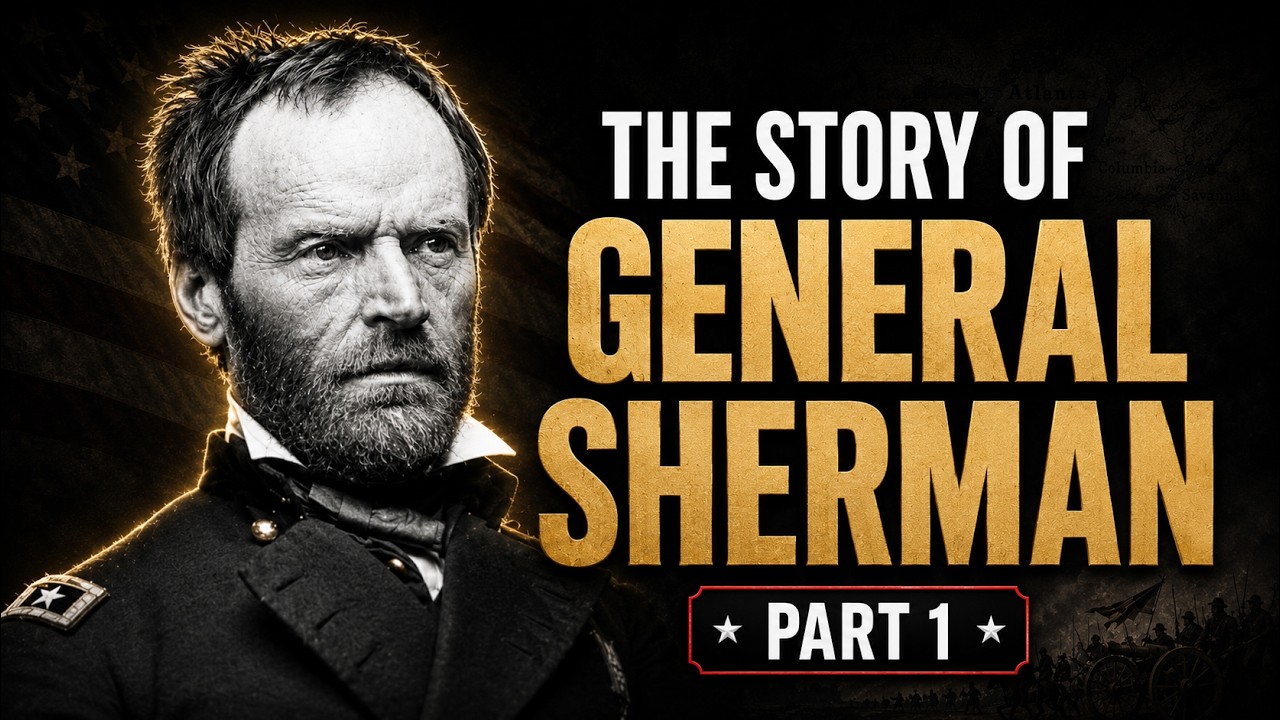
That speaker was William Tecumseh Sherman, one of the most controversial and consequential military figures of the American Civil War. The man who would become synonymous with total warfare was filled with contradictions. He held democratic tastes but distrusted democracy.
He could be ruthless in war and yet promised Southerners that once peace came, he would share his last cracker and help shield their homes. Born on February 8, 1820, in Lancaster, Ohio, Sherman was the son of Ohio Supreme Court Justice Charles Robert Sherman. His middle name, Tecumseh, came from his father’s admiration for the great Shawnee chief. When Sherman was nine, his father died unexpectedly, leaving his mother with 11 children and no inheritance.
A prominent family friend and neighbor, Thomas Ewing, a future U. S. Senator and cabinet member, took young Tecumseh in. It was under Ewing’s care that the boy was baptized and given the Christian name William.
Sherman secured an appointment to West Point through his foster father and entered the academy in 1836. He was an average student when it came to conduct, accumulating about 150 demerits a year. Despite his playful behavior, he ranked well in academic studies, particularly in drawing, chemistry, mathematics, and natural philosophy. His conduct record, however, dropped him from fourth to sixth in his graduating class of 1840, costing him a coveted place in the engineers—a career his stepfather wanted for him.
Instead, he chose the artillery. The next 13 years were largely undistinguished. Sherman served in Florida during the Second Seminole War, where he already showed a brutal understanding of modern warfare, advocating for raids on villages and the destruction of food supplies to defeat the enemy. He later served at Fort Morgan in Alabama and Fort Moultrie in Charleston, where he mingled comfortably with Southern aristocracy and, at the time, held no quarrel with slavery.
When the Mexican-American War broke out, Sherman was assigned recruiting duties in Pittsburgh, a deep disappointment to a man hungry for action. He later sailed around Cape Horn to California, where he landed in San Francisco just days after it was renamed. Assigned administrative duties, he missed the conflict entirely. He did accompany the military governor on the inspection that officially confirmed gold had been discovered in the region, but the lack of combat action left his pride wounded.
On May 1, 1850, at age 30, Sherman married his stepsister, Ellen Ewing. The union was socially acceptable at the time, and the wedding was attended by President Zachary Taylor and Senators Daniel Webster and Henry Clay. Both his new wife and his stepfather pressured him to leave the military, and Ellen wanted him to convert to Catholicism. He refused both and remained in the army.
The pressure did not subside. Burdened by family obligations and the constant demands of his in-laws, Sherman resigned his commission on September 6, 1853, and entered the banking business in San Francisco. The bank initially prospered, but a downturn in early 1857 forced its closure. A subsequent banking position in New York also collapsed amid the Panic of 1857.
Broke, depressed, and suffering from asthma, Sherman fell into a deep personal and professional crisis. While visiting St. Louis to investigate business opportunities, he bumped into an old acquaintance, a shabbily dressed man selling wood. It was Ulysses S.
Grant, another West Point graduate who had resigned his commission and fallen on hard times. The two chatted briefly, wished each other well, and went their separate ways. Neither could have known how their paths would later converge. Sherman tried his hand at law in Leavenworth, Kansas, but lost his first case.
He described himself as a man in a pit, not worthy of further notice. In 1859, he found a new purpose when he accepted the superintendency of a new military academy in Louisiana, what would later become LSU. He organized the institution well and became genuinely popular with students and faculty. It was the happiest year of his professional life.
The secession crisis shattered that peace. On Christmas Eve 1860, Sherman learned that South Carolina had seceded. He warned Southern friends that no nation of mere agriculturists had ever successfully fought a nation of mechanics. When Louisiana moved toward secession, Sherman resigned on January 18, 1861, just eight days before the state’s secession ordinance.
On his last day, he found the cadets formed in two lines on the parade ground. He walked slowly among them, speaking to each one. At the end, he tried to address the assembled cadets but was overcome with emotion. After a long silence, hand over his heart, he said, “You are here,” turned, and left.
Back in Ohio, Sherman was approached with offers for military command. He met with President Lincoln in Washington shortly before the war, a meeting that turned into a disaster. Lincoln’s folksy storytelling stunned and irritated Sherman, who exploded to his brother afterward, telling him the politicians had gotten things into a hell of a fix. When Fort Sumter was fired upon on April 12, 1861, Sherman remained reluctant to take on high command, declining offers to lead Ohio volunteers or Missouri troops.
He believed the war would be long and that unprepared Union officers would be doomed. “Only I think it is to be a long war, very long, much longer than any politician thinks,” he said. In May 1861, Sherman finally accepted his first command as colonel of the 13th U. S.
Infantry. He believed the Southern people had been deceived and wanted a limited war, viewing the enemy as misguided rather than treasonous. At the First Battle of Bull Run on July 21, 1861, he commanded a brigade and suffered more casualties than any other Union brigade—581 men—partly because he advanced his regiments piecemeal. The battle deeply affected him.
Though mentally prepared for human slaughter, the butchery of animals unnerved him, and the battle left him distrustful of volunteer soldiers. Despite his performance, Sherman was highly critical of everything and everyone after the defeat. In August 1861, he was promoted to brigadier general and accepted a position as second-in-command in Kentucky under his former West Point professor, Robert Anderson. But Sherman was not ready for such responsibility.
He had asked Lincoln to promise not to promote him, and when Anderson broke down and resigned in October 1861, Sherman was elevated to command. He quickly unraveled. Meeting with Secretary of War Simon Cameron in Louisville, Sherman gloomily demanded enormous numbers of troops, stating he needed 60,000 to defend and 200,000 to attack. The numbers stunned Cameron.
Reporters, whom Sherman had antagonized, took advantage. A Cincinnati newspaper story headlined “General William T. Sherman Insane” on December 11, 1861, portrayed him as unstable and irrational. He recalled the troops and was placed on leave.
Sherman remained in St. Louis, gathering himself with the help of his wife, his brother, and his friend Henry Halleck. Despite the headline, there is no evidence of an actual breakdown—though he showed clear signs of clinical depression. Within less than 20 days, he presented himself for duty again.
Given command of the District of Cairo at Paducah, Kentucky, he proved to be a superb organizer. This period also marked his growing bond with Grant. When Grant fell out with Halleck after the capture of Forts Henry and Donelson and was briefly sidelined, Sherman wrote him a letter of admiration and support. Grant eventually gave Sherman command of the fifth division of his army and brought him to a site on the Tennessee River known as Pittsburgh Landing.
Two and a half miles southwest stood a small Methodist meeting house called Shiloh. Sherman’s division, composed largely of inexperienced troops, was camped on the most exposed flank of the Union army. He did not believe an attack was coming. When a colonel warned him of a large Confederate force nearby on April 5, 1862, Sherman barked that there was no enemy closer than Corinth and told the colonel he could take his regiment back to Ohio.
When a sergeant report a large body of Confederates eating breakfast a quarter mile away, Sherman arrested the sergeant for raising a false alarm. The Confederates, under General Albert Sidney Johnston, attacked at dawn on April 6, 1862. A volley killed one of Sherman’s aides; a bullet that had been meant for him. Another bullet struck his hand, and a third passed through his hat.
Caught in the largest tactical surprise of the war, the Union army was nearly routed. Sherman’s camps were overrun, and his left flank dissolved. Yet in that chaos, Sherman transformed. Witnesses described him as the coolest man on the battlefield.
Astride his horse, smoking a cigar, with a torn coat and a bleeding hand, he moved constantly across the field, directing batteries, rallying troops, and encouraging officers. Grant wrote in his official report that Sherman inspired such confidence in officers and men that he enabled them to render services worthy of the best veterans. Around 11:00 a. m.
, Sherman and Grant met for the first time that day in person. Sherman showed Grant the bullet holes in his uniform and mentioned several horses had been shot from under him. They conferred again in the afternoon. Sherman suffered two wounds and had three horses killed that day, yet he remained on the field.
The Confederate attack stalled. Benjamin Prentiss held the famous Sunken Road with about 4,300 men, enduring ten documented charges, though no attack ever had more than 3,700 men. Eventually, at around 5:00 p. m.
, Prentiss and about 2,200 men surrendered after a massive artillery barrage of 62 guns, the largest concentration of artillery in the Western Hemisphere. The Confederates halted their attack that evening. Johnston, wounded in the leg, had bled to death on the field. His successor, P.
G. T. Beauregard, sent a victory telegram to Richmond and bedded down in Sherman’s former campsite. That night, in a driving rain, Sherman found Grant.
“We’ve had the devil’s own day, haven’t we? ” he said. Grant answered bluntly: “Yes. Lick ’em tomorrow.
”
Reinforced by 24,000 fresh troops under Don Carlos Buell, Grant attacked the next morning. By mid-afternoon, Beauregard, without reinforcements, retreated back to Corinth. Shiloh was a Union victory, but at an enormous cost—over 13,000 Union casualties. Sherman’s division alone suffered 1,901 casualties, including 325 killed.
In number of our brave men killed, no other division came close. Shiloh was a proving ground for Sherman. He had come into his own, and reporters noted the change. Just as importantly, the battle forged his relationship with Grant into a deep personal and military bond.
The two men were opposites: Sherman tall, nervous, and vocal; Grant short, stocky, quiet, and calm. Both were from the Midwest and both were painfully familiar with failure. Their friendship, likened by later historians to that of David and Jonathan, had no room for jealousy. Sherman publicly gave Grant credit for Vicksburg, and when he learned he was being considered for a third star that would rival Grant’s rank, he asked his brother in the Senate to stop the discussion.
When Grant was briefly reduced to second-in-command after Shiloh, Sherman found him in tears and persuaded him to stay. When Sherman later clashed with Secretary of War Edwin Stanton, Grant quietly traveled to Raleigh to support his friend. Shiloh cemented the partnership that would eventually bring the Confederacy to its knees. As one historian wrote, Sherman blossomed under Grant’s supervision.
The two would go on to wage war on the South with an Old Testament fury that made Sherman’s name synonymous with callous warfare to this day. Sherman later explained his philosophy at that Ohio State Fair in 1880. War, he told the crowd of veterans and boys, was not glory. “It is all hell.
“