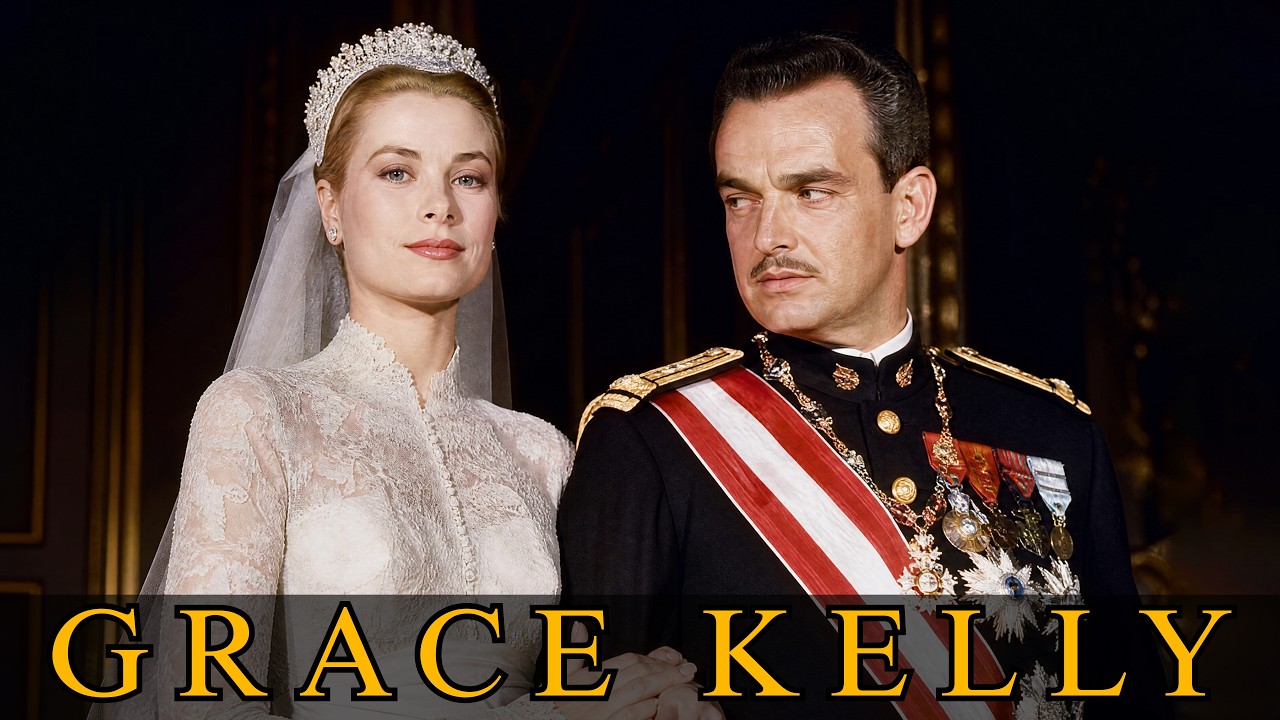
Nearly 30 million television viewers watched Grace Kelly become a real-life princess in 1956, but behind the fairy tale was a transaction that would define the rest of her life. The Hollywood star who had just won an Academy Award entered a marriage contract that required a two-million-dollar dowry, a medical examination to prove she could bear children, and an agreement that would make it nearly impossible for her to ever leave. Grace Patricia Kelly was born on November 12, 1929, in Philadelphia, the third of four children in a family that prized strength above all else. Her father, John Brendan Kelly, known as Jack, had risen from poverty to build a fortune in construction and had won three Olympic gold medals in rowing.
He openly favored his older daughter and his son, while Grace was quiet, delicate, and prone to illness. She grew up believing that love had to be earned. Her father dismissed acting as an unworthy profession, but she left home for New York to prove herself. Within five years, she had become one of Hollywood’s most sought-after actresses.
She made eleven films between 1951 and 1956, working with stars like Gary Cooper, Clark Gable, James Stewart, and Cary Grant. Alfred Hitchcock directed her three times, and she won the Best Actress Oscar for “The Country Girl” in 1955, beating Judy Garland in one of the ceremony’s most talked-about upsets. She was at the absolute peak of her career when a photographer arranged a meeting that would end it. The meeting took place in 1955 at the Cannes Film Festival, where Grace was introduced to Prince Rainier III of Monaco.
Rainier ruled a tiny principality of less than one square mile, famous mainly for its Monte Carlo casino. His situation was urgent. A 1918 treaty with France stipulated that if the ruling prince died without an heir, Monaco would lose its independence and be absorbed by France. Rainier was unmarried and had no children.
He needed a wife, and he needed one quickly. Grace was Catholic, famous, young enough to have children, and carried herself with the bearing of royalty. She was, on paper, perfect. Newspapers called it a romance conducted through letters across the Atlantic, and Rainier did visit the Kelly family in Philadelphia by the end of the year.
But behind the courtship lay a carefully negotiated deal between two families. Before the wedding, Grace had to submit to a medical examination to confirm she could produce an heir. The agreed dowry was two million dollars, a sum her family helped provide. Reports indicate that part of that money came from Grace’s own earnings.
She also signed away something far more consequential: in the event of a divorce, her children would remain in Monaco with their father. She would have no claim over them. Once she became a mother, leaving would mean abandoning her children forever. The palace announced that Grace would return to acting in one film to be directed by Alfred Hitchcock.
She agreed to donate her reported 800,000-dollar salary entirely to Monacan charities to soften the criticism. Rainier initially supported the project. But the citizens of Monaco were outraged at the idea of their princess kissing another man on screen, particularly a rising star named Sean Connery. At the same time, Monaco was locked in a dangerous dispute with French President Charles de Gaulle, who threatened the principality’s existence over its status as a tax haven.
Rainier could not appear frivolous while his country’s future hung in the balance. In June 1962, Grace withdrew from “Marnie. ” Hitchcock replaced her with Tippi Hedren, whose turbulent experience with the director became one of Hollywood’s most notorious stories. Grace never attempted an acting comeback again.
She remained princess of Monaco for two more decades, raising her three children, patronizing the arts, and presiding over a country that grew wealthy and glamorous during her tenure. She founded the Princess Grace Foundation and performed poetry readings. Friends who knew her in her final years described a woman searching for meaning, worn down by a marriage described by different observers as both loving and cold, and by children who made their own troubled choices publicly. Her younger daughter, Stéphanie, was rebellious.
Her older daughter, Caroline, married against her parents’ wishes and divorced in 1980. On September 13, 1982, Grace was driving from the family’s country retreat at Roc Agel toward the palace in Monaco. Her 17-year-old daughter Stéphanie was in the car. The road was the Moyenne Corniche, a narrow and dangerous cliffside route she had driven countless times.
She was reportedly driving herself because the back seat was filled with clothing brought back from the estate, leaving no room for her chauffeur. The car plunged about 120 feet down the cliff and came to rest on the slope below. Stéphanie survived with minor injuries. Grace suffered severe head trauma, including a cerebral hemorrhage.
Her condition was hopeless, and the decision was made to turn off life support. She died on September 14, 1982, at age 52. The official explanation was that Grace suffered a stroke while driving, causing her to lose control of the car. But questions surfaced quickly.
Stéphanie said her mother cried out in fear before the crash, which witnesses said was inconsistent with a sudden debilitating stroke. Family members mentioned high blood pressure, which doctors denied. A persistent rumor emerged that Stéphanie, who was under the legal driving age, had actually been behind the wheel and that the official story was crafted to protect her. The palace and Stéphanie denied this, and no evidence has ever confirmed it.
The questions were never fully resolved. Grace’s funeral was held on September 18, 1982, at the same St. Nicholas Cathedral where she had married Rainier 26 years earlier. Among the roughly 400 mourners were Princess Diana of Wales, Cary Grant, and Nancy Reagan.
Rainier was devastated and never remarried. When he died in April 2005, he was buried beside her. Their son Albert succeeded him, and the Grimaldi dynasty was secured. Grace Kelly paid the full price of her crown, from the fairy-tale wedding to the funeral in the same cathedral.
She was the first modern fairy-tale princess, and her life became a warning about the cost of being chosen. The tragedy was not that she was unhappy every day, but that she performed her role so flawlessly that no one could see the woman beneath it.