In December 2007, a brigadier carried 10 private letters into a London courtroom and handed them to a coroner. They were the only surviving proof of what Prince Philip had written to Diana. The jury was shown only the opening and closing paragraphs of each one. The coroner sealed the rest and gave his reason in open court: there was nothing in those letters that was unpleasant, nasty, or insulting.
For five years, much of the country had believed those letters were cruel. The originals Philip posted to Kensington Palace, the pages Diana actually held in her hands, were never found.
Diana Frances Spencer was born on July 1, 1961, in a rented house standing on ground the Queen owned. The house was called Park House, on the Sandringham estate in Norfolk, a short walk across the grass from the big house itself. Her family rented it.
That arrangement explains more about what came afterwards than any amount of psychology. She did not arrive from outside the royal world. She was raised on the edge of it, close enough to see in.
As a child, she played with Prince Andrew and Prince Edward because the royal nursery was a few minutes away. The Spencers had been at the English court since the Tudors, which made them older in the country's life than the House of Windsor.
Her father was Viscount Althorp, later the eighth Earl Spencer. Her mother was Frances Roche. Her grandmother, Ruth, Lady Fermoy, was one of the Queen Mother's closest ladies-in-waiting, giving the family a permanent listening post inside the household Diana would eventually marry into.
By most accounts, Lady Fermoy steered her granddaughter toward the Prince of Wales with a good deal of purpose. The match did not arrive out of the air.
The marriage that produced Diana ended badly and in public. Her mother left. There was a custody battle, and in the course of it, Lady Fermoy gave evidence against her own daughter. Diana was small when it happened, and afterwards she was shuttled between parents.
While she was still a child, she watched a family close ranks around its own reputation and sacrifice one of its women to do it. She learned what that looks like from the Spencers, not from the Windsors.
School did not rescue her. She failed her ordinary level examinations twice. There was no career being assembled, no plan, no profession waiting. She was working as a nursery assistant in Pimlico when the engagement was announced.
She married Charles, Prince of Wales, at St. Paul's Cathedral on July 29, 1981. She was 20. He was 32. Roughly 750 million people watched it happen. From that morning until the end of her life, she was the most photographed woman on Earth.
What almost nobody understood watching that morning was how thin the preparation had been. There was no training program, no handbook, no course, no office that existed to explain the machinery to a young woman who had walked into the middle of it. The family assumed the rules were obvious because to them they were obvious.
Eleven years later, she would find that out in the hardest possible way. And the only person in that family who would sit down and try to write the handbook for her had been born nowhere near it either.
Prince Philip was born at Mon Repos on Corfu in June 1921 into a royal house that was about to lose its country. He was a prince of Greece and Denmark by birth and a refugee before he was two years old. His father, Prince Andrew of Greece, was court-martialed in the wreckage of the war with Turkey, and in 1922 the family was taken off the island aboard a British warship, Calypso.
The story that the baby was carried aboard in an orange crate has been told so often that it has hardened into fact. It is probably true in substance. What is not in doubt is what happened to that family afterwards, which was that it came apart entirely.
His mother, Princess Alice of Battenberg, was diagnosed with schizophrenia and taken away to a sanatorium in Switzerland when Philip was nine or ten. He did not choose it and he was not consulted. His father went to Monte Carlo and stayed there and died there in 1944, having not seen his son in years.
All four of his elder sisters married German noblemen, three of them with connections to the Nazi party. One of those sisters, Cecile, was killed in an air crash in 1937. By the age of 16, he had lost his country, his father to another city, his mother to a hospital, and one sister to a crash.
He went to Cheam, then to Salem in Germany, then to Gordonstoun in Scotland. He was raised in effect by his British relatives, the Mountbattens. He had no home in the ordinary sense of the word, only schools and a rotation of houses belonging to other people.
He married Princess Elizabeth on November 20, 1947. To do it, he gave up his Greek and Danish titles and became a naturalized British subject. He was a serving naval officer with a real career in front of him. In 1951 and 1952, as her father's illness closed in and then killed him, that career simply stopped. He never went back to the Navy.
He was 30 years old and the whole of the rest of his working life had just been decided by an illness in another man's chest. Then came the argument he lost, and it is the one that tells you what the position actually was. He wanted his own children to carry his name. He was overruled. He spent the following seven decades walking a step behind his wife.
There was no manual for the job he held. He had to invent it as he went, and he had to invent it in public, watched by a press that treated his family history as a liability. He learned the rules by breaking them. He learned that a career could be taken from you by an event nobody controlled, and that the compensation offered was a role with no job description and no way out of it short of leaving his wife.
Thirty-four years later, a girl of 20 from Norfolk walked into the same building through the same door. By 1992, she was drowning in it. He was the only member of that family who had ever done what she was doing. And in the summer of that year, he was the only one who picked up a pen.
On March 29, 1992, Diana was on a skiing holiday in Austria when word came that her father had died. The eighth Earl Spencer was gone. She was 30 years old. Her marriage was in ruins. And she had just buried her father.
Ten weeks later, the roof came off. On June 7, 1992, The Sunday Times published the first extract from Andrew Morton's book Diana, Her True Story. It named Camilla Parker Bowles as the Prince of Wales's lover. It set out Diana's bulimia in clinical detail. It described self-harm. It described suicide attempts, including one in which she had thrown herself down a staircase at Sandringham while pregnant with her first son.
Nothing like it had ever been printed about a living member of the royal family. Morton stated publicly that he had not interviewed her. In the narrowest sense, that was true. Diana had recorded a series of tapes talking freely and at length, and her friend James Colthurst had carried them to Morton. The book was her account delivered in a way that let her deny delivering it.
She had gone around the entire apparatus, the private secretaries, the press office, the lawyers, the family, and put her own version of her marriage into a national newspaper while retaining the ability to look her husband's family in the eye and say she had not.
The effect inside the household was total. There was no longer a private version of the marriage and a public version. There was one version, it was hers, and it was on the front page.
The response from the institution followed a pattern it had used for a hundred years, which was to say nothing at all and wait. Silence had worked on a great many things that never reached print. Silence was not a mood in that building. It was the machinery.
And then, within weeks of that first extract, one man inside the family broke the pattern. He did not brief a friendly newspaper. He did not summon her to a room with courtiers in it. He did not send a lawyer or a private secretary or a message through her office. He sat down at a typewriter in his own study and typed a letter to his daughter-in-law about her marriage. And he posted it to Kensington Palace.
He was 71 years old. He had been inside that family for 45 years. He had no standing in the matter beyond being the father of the man she was married to. And nothing in his public reputation suggested he would volunteer for a conversation about feelings.
The rest of 1992 would go on to earn its own name in Latin. There would be a fire, a speech, and an announcement in the House of Commons. But the letters started in June, within weeks of the most damaging book ever published about the Windsors reaching the newsstands, and they started because the Duke of Edinburgh decided that they would.
The first envelope reached Kensington Palace in June 1992. Diana's reaction to it was not gratitude. Rosa Monckton was one of her closest friends. Her daughter Domenica was Diana's goddaughter. Fifteen years later, under oath at the Royal Courts of Justice, Monckton described what happened when that letter arrived.
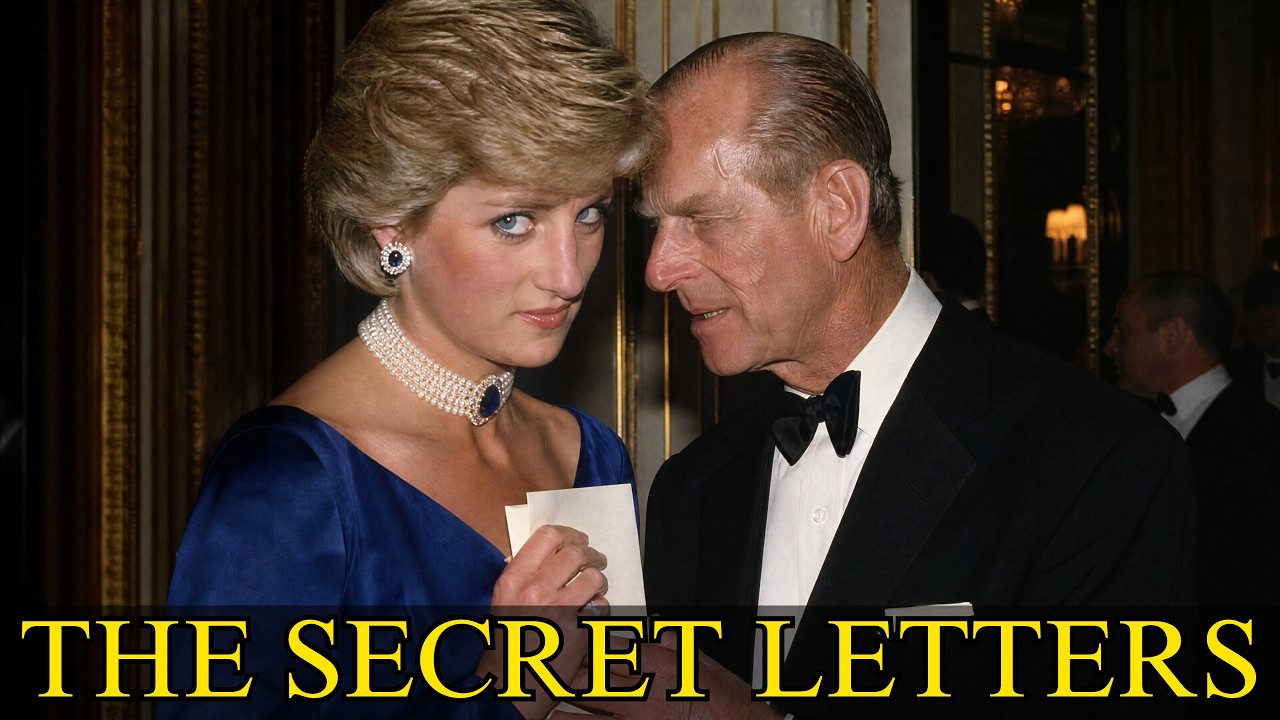
Diana was hysterical. Not annoyed, not wary. Hysterical. That was the word Monckton used to a coroner's court, about a woman who had spent a decade absorbing hostile front pages without visibly flinching. A letter from her father-in-law did something to her that the world's press could not.
Diana had no framework for the object in her hands. Nobody in that family wrote to her about her marriage. The Windsors dealt with difficulty by not naming it, and by making certain that nothing was ever committed to paper that could later be read out by somebody else. Her first assumption, opening the envelope, was that she was holding an attack.
Monckton talked her down. She read it with her. And she persuaded Diana of something that took a good deal of persuading, which was that this was a very genuine offer of help from her father-in-law.
Brigadier Sir Miles Hunt-Davis was Prince Philip's private secretary. In December 2007, he stood in a witness box and explained the process. Philip typed his own letters. He did not dictate them to a secretary. He did not write them out by hand. He sat at the machine himself. And he kept carbon copies of everything he sent. Diana replied in longhand. Philip kept her originals.
Between June and September 1992, there were 10 letters in all. The breakdown reported at the time was six from Diana and four from Philip, though contemporaneous accounts vary a little on the arithmetic. Ten letters, four months. That much is firm.
Ten letters across roughly 17 weeks is one every 12 days or so back and forth over the length of a summer. That is not a note dashed off in temper and answered in kind. That is a sustained correspondence maintained by two people who each had to sit down, think, and write 10 separate times while the newspapers screamed outside both their windows.
Neither of them was obliged to write a word of it. There was no protocol requiring it, no adviser recommending it, and no advantage to either of them if it leaked.
She addressed him as dearest Pa. Her own father had been dead for 10 weeks when the correspondence began. She wrote dearest Pa at the top of a letter to the Duke of Edinburgh in the summer of 1992, 10 weeks after Earl Spencer died.
He signed off with fondest love, Pa. She was the woman who had detonated their family in The Sunday Times, whether or not anybody could yet prove it. He was the man who, on the public understanding of him then and ever since, was the family's hard edge, the one who did not do sentiment, the sailor with the tongue on him. And they wrote to each other on paper, in type, and in longhand for four months while the newspapers guessed.
Monckton also gave the court her own verdict on Philip's letters: very thoughtful, kind, intelligent, and considered. That was the assessment of a friend who read them with the recipient crying beside her.
There is a version of this story in which none of it survives. A version in which the letters are read, felt, answered, and forgotten, and the whole exchange disappears quietly into two households. That version very nearly happened. It is what happens to almost all private correspondence in every family, everywhere.
It did not happen here for one reason, and the reason is the least romantic detail in the entire story. In a private office, a man in his 70s fed a sheet of carbon paper into a typewriter because that is what you did with correspondence you might one day have to account for. Everything that follows exists because of that habit.
What Philip wrote about, according to the woman who read the letters with her, was himself. Monckton told the inquest that in those letters he told Diana how difficult it had been for him to get used to royal life, having to give up a career, having to always be one step behind.
In 1947, a naval officer of 26 gave up his titles, his nationality of birth, and within five years his profession in order to marry a woman who would become queen. He arrived with a family history the British press treated as a liability. He was made to understand that his job was to support, to walk behind, and to keep his opinions inside the building.
In 1981, a nursery assistant of 20 married the heir to the same throne. She had no professional training, no experience of public life, no money of her own in that world's terms, and a family history the press treated as a fairy tale. She was made to understand that her job was to support, to be photographed, and to keep her difficulties inside the building.
Thirty-four years apart, the same door, the same instructions. He was the only person in that family who had ever stood where she was standing. Charles had been born to it. The Queen had been born to it. Andrew and Edward had been born to it. Every courtier in every corridor of every palace had spent a whole career learning its grammar. Philip alone had arrived from outside as a grown man with a life already half built and been required to take it apart.
What he offered her when he finally wrote was not instruction. It was a report from somebody who had made the same crossing and knew how cold the water was.
Then comes the line that survives, and it is the best thing in the released extracts because of how little it claims for itself. If invited, he wrote, he would always do his utmost to help her and Charles to the best of his ability. But he was quite ready to concede that he had no talents as a marriage counselor. He put exclamation marks after it. More than one.
A man exercising authority does not open by disclaiming his own competence. And he certainly does not decorate the disclaimer with punctuation like a schoolboy passing a note. That is somebody who knows he is out of his depth, knows the other person knows it too, and is going in regardless because there is nobody else who will.
So why did he write at all? There are two honest readings, and the truthful answer is that the evidence supports both and settles neither.
The first is personal. He liked her. He recognized something of his younger self in a person being slowly crushed by an institution that could not see what it was doing to her. And he wrote because no such letter had ever arrived for him. On this reading, the letters are the oldest gesture there is: an older man telling a younger one that the thing they are going through is survivable because he survived it.
The second reading is institutional. The Morton serialization began on June 7. His letters begin that same month. The monarchy was facing the worst public crisis of the reign, and the most experienced operator in the building moved to open a private channel to the person at the center of the fire. Read that way, the letters are damage control conducted with excellent manners and a good typewriter.
Both readings fit the same sheets of paper. A man can want to help his daughter-in-law and want to save the firm on the same afternoon. And there is no reason to believe he separated the two motives in his own head because people rarely do. Even the most cynical reading of his purpose still requires the letters themselves to have been decent, because a channel you are trying to keep open is not a channel you fill with abuse.
There was, however, a problem at the other end of the correspondence. Diana could not answer him on her own.
Diana did not answer the Duke of Edinburgh alone. Rosa Monckton told the inquest that she helped the princess draft her replies. And with Diana's consent, she brought in her own husband to help draft them as well. Her husband was Dominic Lawson, a journalist and newspaper editor.
In the summer of 1992, in the middle of the worst royal crisis since the abdication, the Princess of Wales sat down with a close friend and a national newspaper editor to work out how to reply to a letter from her father-in-law.
Monckton was clear on the point that matters most, and she said it under oath. Diana meant what she said in those letters. The help was with the shaping. The sentiment was her own. She was equally clear about something else. She showed Philip's letters to nobody else at all. Only her husband. Only with Diana's permission. Only for that purpose.
The circle around that correspondence was three people wide in a life where almost nothing else was. Diana's household was large. Her circle of friends, advisers, healers, and staff was larger still. And a great many of them would eventually write books, give interviews, or talk to police. The letters from the Duke of Edinburgh were shown to none of them.
What Diana wrote in the extracts eventually released to the jury reads as anything but drafted. She wrote that she was particularly touched by his most recent letter, which proved to her, if she did not already know it, that he really did care. She wrote that he was very modest about his marriage guidance skills and that she disagreed with him.
And she wrote a sentence that carries more weight than any of the others because it accepts in advance that the whole exercise was probably going to fail. Even if he were unable to succeed in this, she still wanted him to know how much she admired him for the marvelous way in which he had tried to come to terms with an intensely difficult family problem. She thanked him for words she called heartfelt and honest.
That is a woman writing to a man she has decided to trust and doing it carefully, and telling him plainly that she does not expect him to win.
There is a temptation to treat the drafting as a scandal and it is nothing of the kind. Plenty of people have help with a difficult letter. What the detail actually reveals is the pressure she was under. Here was a woman of 31 who could walk into a room full of photographers without visible strain and who needed two people at her elbow to answer a letter from a man of 71. The institution was more frightening to write to than the world's press was to face down.

The replies were the only part of the exchange she could control. Philip's letters arrived finished. Hers went back drafted, weighed, checked by a friend and an editor, because she had learned by 1992 exactly how a sentence of hers could be lifted, printed, and used against her. Even in a correspondence of three people, she was writing for a possible audience.
And through all four months, the man whose marriage was the entire subject of the exchange never appears in it as a voice. Charles is the subject of every letter and the author of none. His father is writing about him. His wife is writing about him. Two households, a close friend, and a newspaper editor are engaged in a careful, mannered effort to save his marriage. And it is happening around him rather than with him.
In September 1992, the letters stopped. There is no record of a final row, no dramatic rupture, nothing that reads as a door being closed. The correspondence simply reaches its end four months after it began, with the marriage exactly as broken as it had been in June.
Both parties had behaved well. Both had been honest. He had offered the only thing he had, which was the experience of having made the same crossing. She had answered warmly and had been touched and had said so in writing. It was the correct response, sent to the right person at a moment when nothing on earth would have worked.
The letters went into drawers. Diana's set went somewhere inside Kensington Palace. Philip's carbon copies went into a filing system in his own office, where they would sit undisturbed for 15 years. Three months after the last of them was written, the marriage was ended on the floor of the House of Commons.
The last letter was written in September. By December 9, the marriage was finished in the House of Commons. What happened in between is the reason 1992 acquired a name of its own.
In August, The Sun published the contents of a telephone conversation between Diana and a man called James Gilbey, recorded three years earlier. He called her Squidgey, and the tape took that name. A private call between the Princess of Wales and a male friend was now available to the general public as entertainment.
That same month, The Daily Mirror printed photographs of the Duchess of York with her financial adviser, John Bryan. Two royal marriages were now being conducted in public in the same news cycle, in competing tabloids, on the same breakfast tables.
On November 20, fire broke out at Windsor Castle. It burned through more than 100 rooms of the castle the family had taken its name from. The restoration would take five years and cost in the region of 36 and a half million pounds.
Four days later, at the Guildhall, the Queen stood up to mark the 40th anniversary of her accession, and she said the thing that fixed the year permanently in the language. 1992, she said, was not a year on which she would look back with undiluted pleasure. In the words of one of her more sympathetic correspondents, it had turned out to be an annus horribilis.
On December 9, the Prime Minister, John Major, rose in the House of Commons and read out a statement announcing the separation of the Prince and Princess of Wales. In January, the last tape arrived. A recording of a private telephone conversation between Charles and Camilla Parker Bowles, also made in 1989, also published. Whatever protection had ever existed around the private life of the heir to the throne was now gone and it was not coming back.
Line the year up and look at where the letters sit in it. A death in March. A book in June. A tape in August. A fire in November. A speech four days after the fire. A separation in December. A second tape in January. And running quietly underneath all of it from June to September, 10 letters that nobody outside three people knew existed.
They begin within weeks of Morton and they end weeks before Major stands up. They occupy the exact window in which somebody might still have stopped it. They are the only known private sustained good faith negotiation between Diana and a senior member of the royal family in the whole of that crisis. And they were conducted by the one person in the building nobody would have predicted, and they failed completely.
Ten letters, four months, two people trying honestly, and it made no measurable difference to anything at all. And nobody knew. That is the part that separates this from every other episode of the year. The tapes were public within days. The photographs were public within days. The fire was on the evening news while it was still burning, and the speech and the statement were designed to be heard. The letters were the only thing that happened in 1992 which stayed where it was put.
There is no shame in the failure. Some marriages cannot be saved by anybody, and this one had been past saving for years before the Duke of Edinburgh ever loaded a sheet into his typewriter. But it does mean the correspondence had no consequence in the world. It changed no policy, prevented no announcement, and altered no outcome. Its consequence was entirely archival.
Diana had five years left and she spent them making sure her version reached the public. In December 1993, she withdrew from most public duties. It did not hold and was never really going to. In 1994, Charles gave his own account sitting for a television documentary and a biography with Jonathan Dimbleby and admitting adultery on camera. The war of briefings was now open, formal and conducted through broadcasters rather than through friends.
Then, on November 20, 1995, Diana went on Panorama. Almost 23 million people in Britain watched it. She talked about the bulimia. She talked about the self-harm. And she said the sentence that has outlived every person involved in making it: there were three of us in this marriage.
Twenty-six years later, the broadcaster's own inquiry conducted by Lord Dyson and published in 2021 found that the interview had been obtained by deceit. Faked bank statements had been shown to her brother in order to gain access to her. The most famous interview in the history of British television was procured with forged documents. That finding came 26 years too late to matter to anybody in 1995.
In December of that year, the Queen wrote to both her son and her daughter-in-law and told them to divorce. The decree absolute came through on August 28, 1996. The terms have been reported consistently. A lump sum of around 17 million pounds. Roughly 350,000 pounds a year to run her private office. She kept her apartments at Kensington Palace and she kept the title Princess of Wales.
She gave up the style Her Royal Highness, which is a smaller phrase than it sounds and meant a good deal more. It removed her from the family in the only way the household actually recognized, which was formally in the order of precedence on paper. Custody of William and Harry was shared.
One year and three days after that decree, on August 31, 1997, she was killed in an underpass in Paris along with Dodi Fayed and the driver, Henri Paul. She was 36 years old.
What happened to Diana's private documents in the autumn of 1997 has never been established to anybody's satisfaction. Things left Kensington Palace. Some went to her family. Some were handed to members of her staff for safekeeping. Some have never been seen again by anybody willing to say so publicly.
A woman of 36 had died abroad without warning in the middle of a summer, leaving apartments full of 16 years of paper. There was a funeral being organized for the following week. Nobody was cataloging. Papers left those rooms in the hands of people who had loved her. And some of that paper was correspondence with the royal family.
By the time anybody thought to ask what had become of the letters from her father-in-law, years had gone by. And the only person who knew exactly what she had kept and where she had kept it was dead.
Five years later, that question arrived in a criminal court. Paul Burrell had been Diana's butler. In 2002, he stood trial for stealing her property. The trial collapsed on November 1 of that year after the Queen recalled a conversation in which Burrell had told her he was keeping items belonging to the princess for safekeeping. The case ended without a verdict, and Burrell walked out of court a free man with a great deal to say.
When he spoke to police, Burrell had told them about correspondence between Diana and Prince Philip. His account was that some of the Duke's letters had been warm and supportive, and that others had been, in his words, cutting and cruel. That was a former butler's recollection given to police of letters he had seen in the possession of a woman who was by then dead. Nothing about it was ever tested in a courtroom because the trial ended before anything was tested at all.
In November 2002, a Sunday newspaper printed the two words that would define Prince Philip's reputation for the next 20 years. The source was Simone Simmons, who had worked with Diana as her healer. She told the paper that Diana had shown her letters from the Duke of Edinburgh, and that in them he had called her a trollop and a harlot.
The timing was not accidental. Burrell's trial had collapsed at the start of the month. The palace was already reeling, and every newsdesk in Britain was hunting the next fragment. This one detonated on contact. It was vicious. It was specific, and it confirmed everything a large part of the public had already decided about the man.
Simmons described the letters in some detail. That detail is what destroys the claim. She said they were handwritten. She said they were on cream-colored A5-headed notepaper. She said they were short and to the point. And she said they were signed curtly, Philip.
Philip typed his personal correspondence. A source close to him told the Press Association exactly that at the time, in 2002, five years before the letters themselves were produced to anybody. His private secretary confirmed the same thing under oath in a witness box in 2011. The Duke sat at a machine, typed, and kept the carbons.
When a coroner eventually read the whole correspondence, he described the letters as lengthy. Long enough that releasing the opening and the closing paragraphs of each one would still leave a substantial private middle unread. And he signed with fondest love, Pa.
The coroner, having read every page, found nothing at all to support the suggestion that the letters contained anything unpleasant, nasty, or insulting. Four descriptions. Four contradictions. And the first of those contradictions was published in 2002, five years before anybody outside two households had seen a single sheet of the correspondence.

A household defending itself against an allegation has every incentive to say whatever is most convenient. But the detail the palace volunteered in 2002, that the Duke typed rather than wrote, was a small, checkable, boring fact about office practice, offered in the middle of a scandal about cruelty. It was the sort of thing nobody bothers to invent. And it happened to be the exact detail that a witness in a courtroom would confirm under oath half a decade later, when the file was finally opened.
None of that mattered in November 2002. A cream envelope and a curt signature made a better paragraph than a carbon copy and a typewriter ribbon, and the better paragraph won.
Philip responded, and by his private secretary's later account, he did so rather reluctantly. Answering a press story is a decision to feed it, and he made that decision in November 2002 anyway. The statement said that Prince Philip wished to make it clear that at no point did he ever use the insulting terms described in the media reports, nor that he was curt or unfeeling in what he wrote. It said he regarded the suggestion that he had used such derogatory terms as a gross misrepresentation of his relations with his daughter-in-law and hurtful to his grandsons.
That final clause is the human part of it and it is easy to skim past. His grandsons were young men by then. Their mother had been dead for five years and they were reading in a Sunday newspaper that their grandfather had called her a trollop and a harlot in writing.
The denial achieved almost nothing, which is what denials generally achieve. A man in his 80s insisting he had not written something is not evidence and the public had no particular reason to weigh his word above the word of a woman who said she had held the pages in her hands. By the end of that month, the story had set like concrete.
There was only one thing left in the world that could settle it and it was the last thing any royal household would ever willingly do. Somebody would have to open the letters in public under oath and let a court decide.
On December 13, 2007, Prince Philip did not come to the Royal Courts of Justice. The reason any of this reached a courtroom at all was Mohamed Al-Fayed. Dodi Fayed's father had alleged for a decade that his son and Diana had been murdered and that the order had come from Prince Philip.
The state had already answered it once. The Metropolitan Police inquiry, Operation Paget, conducted under Lord Stevens, published its report on December 14, 2006, and found no evidence of a conspiracy of any kind. It changed nothing. So the full jury inquest opened at the Royal Courts of Justice on October 2, 2007, and ran for six months.
The letters were produced as evidence against the murder allegation. That is the only reason they exist in the public record at all. No historian asked for them. No archive opened. A father-in-law had to demonstrate in a court of law that he had not wanted his daughter-in-law dead, and the only material he had was the correspondence.
Philip was not required to give evidence in person, and he did not attend. He sent Brigadier Sir Miles Hunt-Davis with the file. The optics of that decision were poor, and everybody in the building must have known it. The man accused did not appear. His private secretary took the stand in his place carrying a folder.
Michael Mansfield, appearing for Al-Fayed, went at the brigadier hard and repeatedly. He put it to him that Philip was the only person alive who could actually answer the central questions. He asked whether the duke would give evidence if he were asked, and Hunt-Davis said he had no idea. Mansfield asked him directly whether he had ever heard the allegation that Diana feared Prince Philip wanted her dead. The reply was flat. He had never heard it. And in view of the correspondence the court had seen that day, he was very surprised that it had even been suggested.
Mansfield put another line to him, that Philip had described Dodi Fayed as an oily bed hopper. Hunt-Davis said it sounded extremely unlikely. The phrase remains what it was that afternoon, an allegation put in cross-examination and rejected by the witness it was put to.
Then Mansfield put a longer proposition to him, that it had been of extreme concern to the royal family, to Her Majesty the Queen, and to His Royal Highness, that the Princess of Wales was cavorting on a yacht in the Mediterranean with the son of somebody who was regarded as undesirable. The brigadier's answer is the coldest thing in the entire transcript. The divorce was in August 1996. The lady concerned ceased to be a member of the royal family. That is all I'm going to say.
Lord Justice Scott Baker read the letters and then ruled that almost nobody else ever would. The jury was shown edited copies, the first few paragraphs of each letter and the last few paragraphs of each letter. The middles were withheld entirely.
His stated reason for withholding them is the most important thing in this story, and it runs backwards from what anybody expects. He confirmed that the letters contained nothing to support the suggestion that they held unpleasant, nasty, or insulting material. Having established that, he ruled that it would be inappropriate to release contents of such a private nature into the public domain.
The middles stayed sealed not because they were cruel, but because they were kind. Had Philip written what Simone Simmons said he wrote, every word of it would have been read aloud in open court. Because cruelty relevant to an allegation of murder is evidence and evidence is public. The material was protected precisely to the degree that it was innocent. The kinder those letters were, the less of them the country was permitted to see.
For five years, Prince Philip had been the man who called his daughter-in-law a harlot. The only way to disprove it was to produce the letters. The letters were produced. They disproved it completely. And the reward for disproving it was that the country was told the contents were too kind to publish. A verdict of innocence delivered in a sealed envelope.
Hunt-Davis put the household's position on the record in one flat sentence. There is not a single derogatory term in the correspondence. And he gave the court his summary of what the whole file amounted to. The general feeling throughout, he said, was of a father-in-law doing his very best to help his daughter-in-law resolve the problems that she and the Prince of Wales were having with their marriage.
Rosa Monckton, who had actually sat beside Diana while she read them, had already told the same court that the letters were very thoughtful, kind, intelligent, and considered. And then Monckton said the thing that resolves the entire contradiction and does it without calling one single person a liar.
Diana's first reaction on receiving the letters, she said, was generally tearful and not really understanding. And if she was like that with Monckton, who was helping her with them, then Monckton could very easily see how she might have expressed similar sentiments to other people in her circle.
The letters were kind. And Diana cried when they came. And both of those things are true at the same moment. A woman under more pressure than any private citizen in Britain opened an envelope from the institution that was crushing her and wept and told the people who loved her how much the letters had upset her. Those people did what people who love someone do. They concluded that the letters must have been cruel because they had watched the crying with their own eyes.
Nobody had to lie for the story to be born. It needed one distressed woman and a circle of loyal friends and the rest assembled itself over 15 years. Burrell told police that some of the letters were warm and some were cutting and cruel, and he was describing what he had gathered in a household where the princess was distraught. Simmons described pages she said she had been shown. Neither of them had access to the file that a coroner eventually read. They had access to Diana and Diana was in pieces.
On April 7, 2008, after six months of evidence, the jury returned its verdict. Unlawful killing caused by the grossly negligent driving of the following vehicles and of the Mercedes. Mohamed Al-Fayed rejected it and went on rejecting it.
Everything the world knows about those 10 letters survives because a man in an office made a carbon copy. On one side, a private secretariat, a typewriter, carbon paper, a filing system, and the ordinary bureaucratic habit of keeping the record. Philip's copies of his own letters and Diana's original replies in her own hand, held intact and undisturbed for 15 years until a brigadier walked them into a courtroom.
On the other side, nothing that anybody can now produce. The palace said as much in its statement of November 2002. The original letters sent by Prince Philip to the princess have apparently been lost. He kept copies of his letters to her, and he also has the original replies from the princess, apparently lost.
The actual sheets of paper Diana held in her hands, the ones she cried over at a table in the summer of 1992, are gone. Where they went is contested. A detective investigating Burrell said that Lady Sarah McCorquodale, Diana's elder sister, had told him letters were kept in a mahogany box in Diana's study, and that she had opened that box and given it to Burrell. The box was later returned to Lady Sarah. It was empty.
There was also said to be a separate cache of tapes and cassettes Diana was said to have recorded herself, which vanished from Kensington Palace after her death and has never been recovered. At the inquest, Lady Sarah denied absolutely that she had destroyed it, saying she had given the material to Burrell for safekeeping, and adding four words that carry their own weather: I trusted him then.
Burrell's own account is that the papers went to the Spencer family seat at Althorp. Those two accounts have never been reconciled.
On September 6, 1997, the Duke of Edinburgh walked behind Diana's coffin beside her sons. By several second-hand accounts, he had told a hesitant William that he would walk if William walked. Nobody has produced his exact words.
On April 17, 2021, William and Harry walked behind his. He had died at Windsor Castle eight days earlier at the age of 99, two months short of a hundred.
In the end, the letters achieved nothing in either direction. They did not save the marriage in 1992, and they did not save his name in 2007. The allegation they were produced to kill has comfortably outlived the man who wrote them, because a story about a cruel old prince is easier to carry than a story about a careful one at a typewriter.
Diana spent the last five years of her life fighting an institution for possession of her own story, and by any measure that counts, she won it. Her version is the one the world absorbed. Her version is the one still being filmed. But the one exchange she never performed, the four months in which she was not briefing anybody and was not being recorded, is the one she did not keep. The institution kept it.
And when the institution finally opened the file under oath in a public courtroom, and every word of it turned out to be decent, the country did not move an inch. A brigadier carried 10 letters into a room in December 2007, handed them up, and the coroner closed them again. They are still closed.
All that ever reached the public was the top of the page and the bottom of it. Dearest Pa at the beginning. With fondest love, Pa at the end. And a private middle that stayed private for the only reason the law allowed, which was that there was nothing in it worth exposing anybody for.