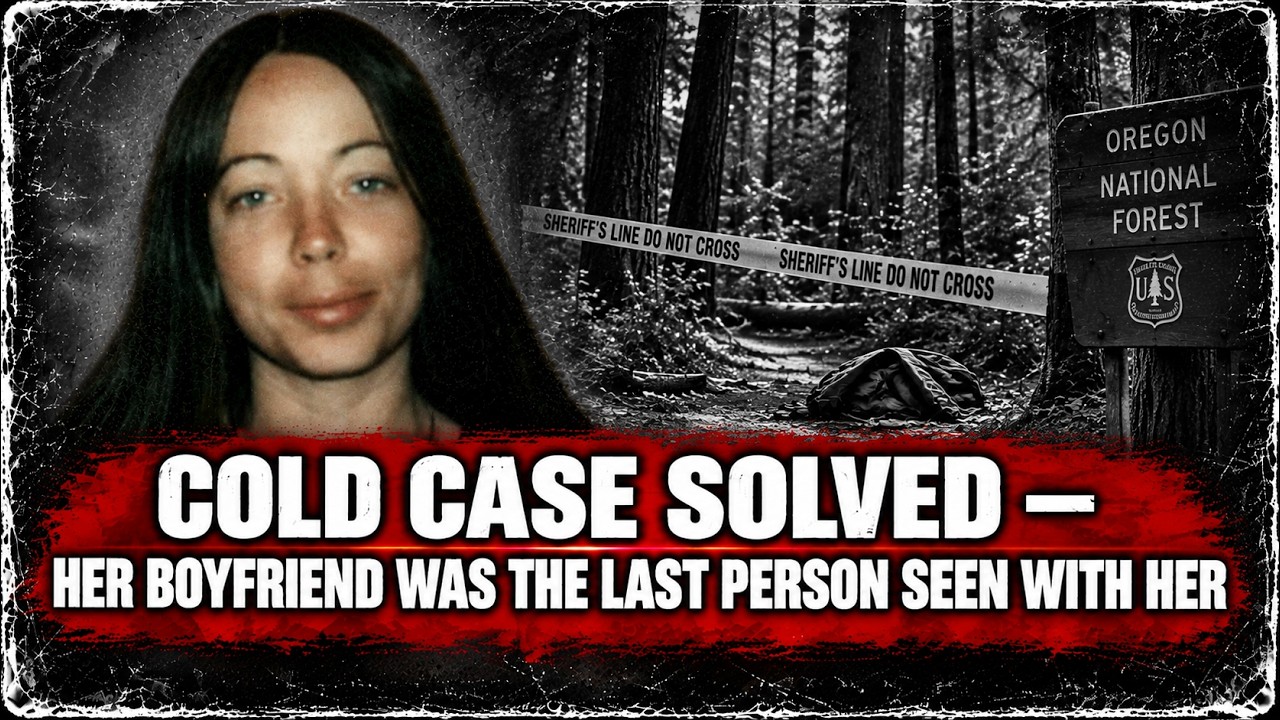
On July 4, 1983, a 27-year-old woman named Teresa Joanne Peroni went to a party in the woods of Southern Oregon. Friends saw her walk into the trees with her boyfriend. Nobody saw her walk out.
Deputies called her disappearance suspicious. They asked questions and searched for her, but they had no body and no proof. No one was charged, and the case went quiet.
Then, in 1997, a landowner found a human skull near those same woods. Nobody knew whose it was. It took new science and a few people who refused to quit to find out.
Teresa stood about 5'4" with blue eyes and long dark hair. Friends described her as a free spirit, a phrase for someone who lives a little outside the lines.
She was from the Grants Pass area in Josephine County, in the southwestern corner of Oregon. It is a part of the state known for thick forest, cold rivers, and small communities where many people know each other.
Grants Pass sits on the Rogue River. About 20 miles to the southwest, the land opens into the Illinois Valley. Along the Illinois River in that valley is a small community called Selma.
By the summer of 1983, Teresa had recently moved back to Oregon after a divorce. A marriage had ended, and she had come home to family, familiar roads, and friends who knew her before.
Her family was in the Grants Pass area. They would later tell the sheriff she was gone.
Teresa had epilepsy. According to a local podcast that later dug through records on her case, she got her medicine regularly from the county health clinic. She had a routine, and she kept up with it.
The public record does not hold many of the stories a family would tell. It does not say her favorite song or what she hoped for. Reports from the sheriff's office, the state Department of Justice, and the news focus on the case and mostly leave the person out.
What remains are the pieces that were saved: a national missing person's profile, a photo taken about a year before she vanished, a description from friends, and the words of the state's attorney general, who later said what happened to Teresa left her family with decades of uncertainty and grief.
In the summer of 1983, none of that had happened yet. Teresa was 27. She had a boyfriend, friends, and a holiday weekend ahead of her.
July 4, 1983, fell on a Monday, making it a long holiday weekend. In the hills near Selma, on Illinois River Road, one of those gatherings was underway.
There is no guest list and no photo of the party. Even the exact night is a little fuzzy after all this time. Official records say on or around July 4.
Teresa was there. So was Mark Sanfartello, who also goes by Marcus. He was 29, two years older than she was, and he was her boyfriend.
The missing persons profile gives a short, plain version of what came next. It says there was an argument over Teresa having another lover. Then Teresa and her boyfriend went into the woods. The profile ends the story in three words: Peroni never returns.
A local podcast added detail from people who knew the couple. It reported that their relationship was stormy. Friends described the arguments as heated and said Sanfartello had the more controlling personality.
It also reported that the two had been fighting earlier that same day. Even so, the podcast said, the pair was seen walking into the forest together to sleep for the night.
That is the last anyone reported seeing of Teresa Peroni. Not a scene at a door, not a car pulling away. Just two people at the edge of the trees, and then nothing.
The record gets thin after that. When did her family realize something was wrong? Who called whom? Those answers are not available.
One account says her family in Grants Pass reported her missing about a month later. The sheriff's office simply says that after her family reported her missing, an investigation began.
Either way, the deputies who took that report were looking at a cold trail. Weeks had gone by. People had gone home from the party and back to work. The one person who could say exactly what happened in the woods was the person she had been seen walking beside.
Selma is only about 20 miles from Grants Pass. On a map, that is a short drive. Yet that is how far Teresa's family stood from the last place she was seen.
The sheriff's office looked at what they had: witnesses who saw her walk into the woods, a boyfriend, and a woman who never came home. It was enough to make them uneasy, but was it enough to prove anything?
For a while, there was nothing. No call, no sighting, no word. Then, according to records the local podcast later obtained, something odd happened in July 1984, about a year after Teresa vanished.
Someone, and nobody has ever said who, brought a brown purse to the Josephine County Sheriff's Office. Inside were papers with her name on them, including her Oregon ID, and her epilepsy medicine.
Whatever the purse meant, somebody knew where a piece of Teresa's life had ended up. The public record does not say who carried it in.
A search team went out to the land on Illinois River Road with a cadaver dog, but nothing was found. The podcast reported that it is not clear how thoroughly that 20-acre property was covered.
The search ended the way the earlier ones had, with nothing. Then the years began to pile up. Teresa's name faded from the news the way names do. People who had been at that party moved away or changed or passed on. Her family did not forget.
Then came 1997. Fourteen years after Teresa walked into those woods, a landowner found a human skull on private property near where she was last seen.
Investigators searched the area with a cadaver dog. They looked for anything else, but no other remains were found that day, and according to every report, not in the years since.
One skull and nothing else. A skull cannot tell you its own name. To a detective in 1997, it was a question with no answer attached.
But someone remembered Teresa. According to the podcast records, investigators gathered DNA from her sister to compare against it. The sheriff's office says the skull was sent to the University of North Texas for examination.
For the first time in 14 years, it looked like the case might finally move. It did not, not right away, because the science of that era had a problem, and so did the paperwork.
In 1983, the Josephine County Sheriff's Office and the District Attorney's Office did investigate. They found Teresa's disappearance suspicious. They talked to people, and then they made a call: there was not enough probable cause to charge anyone.
Probable cause is a simple idea with a high bar. Prosecutors need enough evidence to show a crime happened and that a specific person likely did it. Without a body, they had no way to show how Teresa died, or even in a legal sense, that she had been harmed at all.
They had witnesses who saw her walk into the woods with her boyfriend. That is important, but it is not proof of a crime.
Then there was a false lead. The podcast reported that one witness told investigators they had seen Teresa drunk at a nearby bar later in July. It was wrong.
But wrong information can be powerful. If a missing woman is spotted at a bar, she is not in danger. She is just away for a while. A sighting like that can slow a case for weeks, and in a small county, weeks can turn into years.
The District Attorney's Office let the case go dormant. Sanfartello was called a person of interest. That is a real term, but a soft one. It does not mean charged or arrested. It means investigators would like to know more.
The tool that could have changed everything did not exist yet. DNA fingerprinting was discovered in 1984 by a scientist in England named Alec Jeffreys, about a year after Teresa disappeared. It took years more to reach American courtrooms, and the FBI's national DNA database did not go nationwide until the late 1990s.
The science that could someday name Teresa was invented about a year after she vanished. It would take about four decades to reach her case.
When the skull turned up in 1997, the system tried. According to the podcast's records, investigators sent a sample to the FBI, but it turned out to be a tooth filling. A filling does not hold usable DNA. The test could not be done, and the case went cold again.
Then in 2004, a new detective named Ken Selig picked the case back up. He wanted to send the FBI a better sample from the skull. There was just one problem: nobody could find it.
The most important piece of physical evidence in the case was lost, not stolen, misplaced. Years later, the podcast reported, the skull turned up at a genetic lab at the University of North Texas. Josephine County had sent it there for safekeeping, and then it slipped out of memory.
In 2020, the podcast said, tests were finally done and a new DNA sample matched Teresa's sister. Officials have not publicly laid out that timeline. They say the skull went to Texas and that new DNA evidence gathered later let the lab confirm it was Teresa's.
Either way, for decades this case sat between two bad answers: not enough evidence to charge, and no easy way to get more. The case went quiet. Not dead, just waiting.
While the file gathered dust, one man was living his life. In July 1983, Mark Sanfartello was 29 years old and Teresa's boyfriend. According to friends quoted by the podcast, the relationship was stormy. Some described him as more controlling than she was. That is how friends remembered it, not a finding by any court.
At the time, he was not charged. He was a person of interest, and that was all. About a year later, he left Oregon and moved to Northern California.
According to reporting that drew on the podcast's research, he ended up in serious legal trouble there in the 1980s in a case that had nothing to do with Teresa. He was convicted of attempted murder and sentenced to more than 15 years in prison. He was released in the late 1990s.

After his release, he settled in Butte County, California. He lived for a time in Gridley and later in Chico, a college town in the Northern Sacramento Valley, roughly 300 miles from Selma.
People in Chico told a local newspaper he went to karaoke on Tuesdays and Thursdays at a bar on Park Avenue. He wore a leather jacket and sang heavy metal and rock songs. One person called him a capable guitar player. Another called him quiet.
That is the thing about cold cases. The person at the center of them does not always vanish. Sometimes he is right there in a bar on a Tuesday night singing along to a song, ordinary, unnoticed, getting older. All that time, a family in Oregon was still waiting to find out what happened to Teresa.
The people who kept this case alive were not only detectives. A journalist named Gwen Baringer, who runs a nonprofit called the Josephine County Missing Persons Project, spent years asking for information. She researched and wrote a podcast episode about Teresa, and a host named John Lordan narrated it.
In 2024, something changed, and it started with a list. The Josephine County Sheriff's Office reopened the case. The officer credited with getting it moving again was Detective Sergeant Kyle Heinrich, and he did not start with a hunch.
The sheriff's office described the first step this way: they looked for anyone still alive who had some involvement with the case and knew details of the original 1983 investigation. In a case this old, the people who remember are aging, moving away, or passing on. Every year you wait, you lose a witness.
Then the office got help. The Oregon Department of Justice came in with prosecutors and investigators. The Josephine County District Attorney's Office joined. Oregon State Police forensic anthropologist Dr. Niesha Vance, an expert who works with human remains, was part of the effort too.
Investigators re-interviewed witnesses. They reviewed the evidence collected in 1983. They collected new DNA from people connected to Teresa. Those samples went to the University of North Texas Center for Human Identification, a lab that specializes in identifying human remains and linking them to families.
Every person inherits DNA from their parents. That means relatives share pieces of the same genetic code, like two halves of a torn photograph. A lab can pull DNA from an old bone or tooth and build a profile, then compare that profile to samples from living relatives. If the pieces line up, you know who the remains belong to.
Officials have not said exactly which tests were used here, but that is the general approach. And the answer came back. The skull found in 1997 was Teresa Peroni's.
The sheriff's office has not said exactly when the lab confirmed it. What the public knows is that after nearly three decades, a piece of a missing woman had finally been given her name. The same skull went from a question mark in a landowner's field to proof that Teresa was gone.
Meanwhile, something else was happening in the background. In July 2024, the podcast episode came out. It was titled "Is Teresa Peroni 1997 Jane Doe?" and it laid out records most people had never seen.
The podcast team did not know the case had just been reopened. Later, Detective Sergeant Heinrich contacted Baringer and asked her to keep her reporting quiet. He was close to an indictment and did not want anything to get in the way.
Baringer has said she had been hoping for an identification since 2019. She thinks the podcast was at least part of the chain of events that moved the case forward, but she was modest about it. "I'm pleased to have been a small part of it," she said.
Cold cases do not crack because of one hero or one test. They crack because a bunch of people keep showing up long after they are supposed to stop. With a name on the skull, investigators finally had something they had been missing for four decades: a place to start building.
Identification is not an arrest, and that is the part people forget. Knowing whose remains they are does not tell you who is responsible. That takes a case.
The Oregon Department of Justice's Criminal Division took it on. The lead prosecutors were Senior Assistant Attorneys General John Castellino and Brad Calbow. They worked with Oregon DOJ Special Agent Brendan McGuire.
Together, the state says, they spent time meticulously organizing more than 40 years of evidence. Forty years of paper, interviews, and lab work from different decades and different offices. Somebody had to make sense of all of it.
Investigators re-interviewed witnesses. They collected new DNA evidence. They applied modern forensic techniques. They went back to the original 1983 investigation and looked at it with fresh eyes.
Then came the grand jury. A grand jury is a group of citizens who hear the evidence in private and decide whether there is enough to bring formal charges.
On June 27, 2025, prosecutors presented the case to a Josephine County grand jury, and that grand jury indicted Mark Sanfartello for murder in the second degree.
The next day, June 28, police in Chico, California, arrested him. Chico police worked with the Josephine County Sheriff's Office and the Oregon Department of Justice. The Grants Pass Tribune reported that he was taken into custody without incident. He was 72 years old.
He was questioned about his involvement in Teresa's disappearance and death. The public record does not include what he said. There is no dramatic confrontation in the reports, no quote of a denial, just a man in custody in Butte County waiting to be sent to Oregon.
He was extradited, and in July 2025 he was arraigned in Josephine County Circuit Court. Attorney General Dan Rayfield said it was important not to prejudge the outcome, but he also said the arrest showed what is possible when law enforcement persists and adapts to new tools. He said, "Time doesn't erase the need for answers."
After 42 years, a man was facing a murder charge for something that happened in the summer of 1983. He had been 29 when it happened. Now he was in his 70s. A case that had sat in filing cabinets and in a lab in Texas and in the memories of a few determined people was finally moving.

Most people would expect this story to end with a trial, a jury, a verdict, a dramatic moment on a witness stand. It did not go that way.
On Tuesday, April 21, 2026, in Josephine County Circuit Court, the case ended. Not with a verdict, but with a plea. Mark Sanfartello pleaded guilty to manslaughter in the first degree.
That is a lower charge than the second-degree murder count he had been indicted on. The difference matters. In plain terms, murder is generally a killing done on purpose without a legal excuse. Manslaughter is a killing the law treats as less severe for reasons the law spells out.
In Oregon, one of those reasons is a killing committed under extreme emotional disturbance. According to KOIN, that is the phrase in his plea petition: he was under the influence of an extreme emotional disturbance at the time of Teresa's death.
The plea petition uses legal language. It does not tell a story. Because there was no trial, there was never a moment when a witness stood up and described what happened in those woods.
The state has not given a detailed public explanation for why it accepted a plea. But any prosecutor weighs certain factors in a case this old. Memories fade. Some witnesses have died. Evidence has aged. A trial carries risk, and a plea locks in a conviction.
Sanfartello's attorney, Elizabeth Baker, told the Associated Press her client had, in her words, strong motivation to resolve the matter. The reason, she said, was a diagnosis of a complex health issue. She added that the resolution gave the family closure and gave him the treatment he urgently needs, which he will receive while serving his sentence.
That is a legitimate thing for a defense lawyer to say. But there is another side. When there is a plea, the story stops where the paperwork stops. There is no cross-examination. There is no witness who says, "Here is what I saw." There is no public account of how a 27-year-old woman ended up in the woods near Selma or what happened after the two of them walked into the trees.
For a family, that could feel like a relief. Forty-two years is a long time to wait, and a trial can drag on for months. Or it could feel like a door that closed too soon. The public record does not say which.
What it does say is this: the state chose a guilty plea to a serious felony over the uncertainty of a courtroom battle. And the man who was last seen walking into the woods with Teresa admitted in court that he was responsible for her death. For the first time in more than four decades, the question of who was responsible had an answer in writing in a court file.
On that same day, April 21, 2026, Sanfartello was sentenced to 20 years in prison. He was 73 years old. Under the plea agreement, he must serve at least 10 years. Depending on how the sentence is carried out, he could spend between 10 and 20 years in custody.
Teresa vanished in 1983. The sentence came down in 2026. That is 43 years. Attorney General Rayfield put it plainly, calling it a 43-year wait for an answer that Teresa's family never should have had to wait for.
Some people will hear those numbers and feel the gap. Others will say a conviction at all after this long is remarkable. Both reactions are fair.
There is another complication worth naming. Because the plea was to manslaughter, the record now shows a lower charge than the one the grand jury returned. The state called it a conviction, and it closed the case. But it is not the same as a murder verdict. Headlines online may call it murder. The court record says manslaughter.
The public releases and news reports do not include a victim impact statement from Teresa's family, and it would not be right to guess at what they felt. What is on the record is that the state acknowledged decades of uncertainty and grief.
The state also named the people who did the work: Detective Sergeant Heinrich, the District Attorney's Office, Dr. Niesha Vance, the scientists at the University of North Texas, and the Chico Police Department. Some worked on this case for months. Others carried a piece of it for decades.
There are people the state did not name, like the podcast team that put the case in front of the public when nobody else was. John Lordan thanked the officials involved for giving Teresa's family a chance at justice that was long overdue.
One more fact needs to be said out loud. According to every report, no other remains were ever recovered. The skull found in 1997 is the only part of Teresa that has been found. For a family, that is a heavy thing. They received an answer, but not the whole one.
That is why this case, for all its progress, does not feel tidy. It closed, but it closed with a plea instead of a trial, a lower charge instead of a murder verdict, and one piece of remains instead of a full farewell.
Even so, something did change. For 42 years, Teresa Peroni was a name in a missing person's file. Now she had a court record and a finding of what happened to her. Not everything, but something.
Teresa was not a cold case, a skull in a lab, a DNA profile, or a line in a press release. She was a 27-year-old woman with blue eyes and long dark hair who had moved back to Oregon after a divorce.
She had a family in Grants Pass and friends who called her a free spirit. She kept up with her medicine. She kept a routine. She was a person building a next chapter.
She went to a party on the 4th of July weekend, the way thousands of people do every year, and she never came home. Her voice is not preserved in the public record, and the stories her family could tell are not there either. It would not be right to invent them.
But we do know what she was: someone who had a life, who was loved, and who was missed for 43 years.
Think about what it took to get here. A landowner who noticed something in a field in 1997. A detective who tried to send a sample to the FBI and a lab that could not use it. Another detective who went looking for a skull and could not find it. A sister who gave her DNA. A journalist who kept asking questions. A podcast that put the records in front of the public. A detective sergeant who made a list of people who were still alive and started knocking on doors. And a lab in Texas that finally gave the answer.
None of them were there when Teresa walked into the woods. All of them are the reason she is not forgotten.
Teresa Joanne Peroni, 27 years old, last seen on or around July 4, 1983, in the woods near Selma, Oregon. Remembered here.