The winter of 1944 arrived in Europe not just as a change in weather, but as a punishing adversary in its own right. General George S. Patton's Third Army had spent the summer tearing across France, pushing shattered German forces back toward their homeland. American morale was high, and many soldiers believed the war would end before the holidays.
Then December brought the coldest temperatures the Ardennes forest had seen in more than half a century. That bright momentum disappeared into a blinding whiteout. It was in this frozen landscape that Germany launched its desperate counteroffensive, the Battle of the Bulge.
The attack brought more than a sudden darkness to the front. It also shattered the gentlemanly rules of engagement the Allied High Command had tried to maintain across Europe.
On the morning of December 17, at a wind-swept intersection known as the Bois de Jacques crossroads near Malmedy, a lightly armed American artillery observation battery was intercepted and overwhelmed by a German vanguard. What followed became one of the darkest tragedies of the European conflict.
Dozens of disarmed, surrendered American troops were deliberately killed while standing defenseless in the snow. It was not merely an act of war. It was a calculated erasure of humanity, and it sent shockwaves of outrage through the entire Allied chain of command.
The American GI now faced an adversary that recognized no moral boundaries. The nature of the conflict had changed.
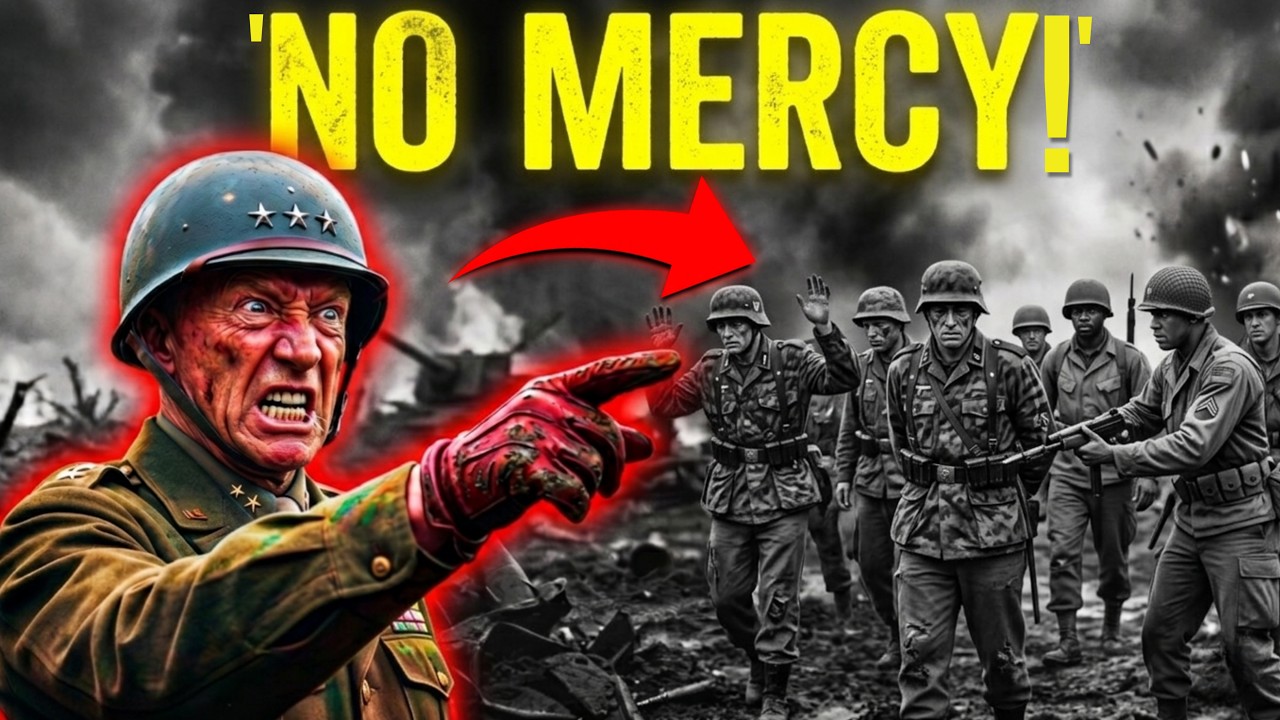
When radio transmissions describing the scale of the tragedy reached Third Army headquarters, Patton's reaction was not the fiery outburst his public persona might have suggested. According to the private diary entries of his staff officers and the Third Army's command logs, he descended into a state of cold resolve.
He stood over the operational maps with a darkened expression. His legendary temper was replaced by a quiet, analytical realization that the war had crossed an unforgivable line in the snow.
In that silent war room, Patton vowed that his men would no longer be bound by the polite conventions of a gentleman's war when facing these specific formations. To defeat an enemy that had abandoned its humanity, he believed he had to unleash a machine of pure consequence.
That psychological shift soon translated into one of the most astonishing logistical maneuvers in modern warfare. In a tense emergency meeting with Supreme Allied Commander Dwight D. Eisenhower and other top generals in a freezing bunker in Verdun, Patton announced he could disengage his forces from their offensive in the Saar region and counterattack the German flank in the Ardennes within 48 hours.
The room fell silent. Turning an army of hundreds of thousands of men, heavy tanks, and artillery pieces 90 degrees in the middle of a winter blizzard was compared to turning a massive cargo ship on a dime in a hurricane.
Yet the Third Army moved. Mechanics worked through the freezing night, risking frostbite to keep diesel engines running. Quartermasters rerouted thousands of supply trucks on icy roads without headlights to avoid enemy bombers. Exhausted infantry marched through knee-deep snow, fueled by outrage that radiated from the top of the command structure down to the lowest private.

As Sherman tanks ground north through the blizzards and pine forests of the Ardennes, a classified briefing took place on December 21 that cemented the new reality of the front lines. Standing before his exhausted division and regimental commanders, Patton issued directives as harsh as the subzero weather.
According to historical accounts, declassified dispatches, and the testimony of officers present, Patton made it clear that the elite enemy units in the Bulge, specifically the feared First SS Panzer Division, were to be met with overwhelming and unforgiving force. The understanding that rippled down to the frozen infantrymen was that the standard leniency afforded to surrendering combatants would not automatically be extended to those wearing the insignia of the units responsible for the crossroads tragedy.
The shift in the American GI was dramatic. Men who had once fought simply to survive and return home were now infused with a dark, unifying purpose. A new battle cry echoed through the shattered forests: Remember Malmedy.
This was no longer a campaign for territory or bridges. It was a personal crusade for retribution. The soldiers hardened their hearts, knowing the men across the frozen fields had shown no mercy to their captive brothers-in-arms just days before.
The pursuit that followed was a masterclass in high-speed tactical pressure aimed at the heart of the enemy vanguard, known as Kampfgruppe Peiper. Its commander, Joachim Peiper, found his winter blitzkrieg bogged down by fierce American resistance and the closing jaws of Patton's armored spearheads.
Patton used his tanks as instruments of psychological terror, pushing them through snow-choked valleys and mined roads at terrifying speed. The relentless pressure severed Peiper's supply lines, starving his fuel-thirsty Tiger and Panther tanks.

By destroying bridges and seizing fuel depots in front of the German column, American forces reduced the once-proud armored spearhead to a trapped, freezing pocket of exhausted combatants holding out near the village of Le Gleize. The net closed with mechanical efficiency, leaving no avenue of escape.
During this violent phase, the dark echoes of the crossroads tragedy surfaced near the ruined Belgian village of Chenogne. Days after the initial massacre, American forces fought a bloody house-to-house battle to clear the village of entrenched enemy troops.
What happened in the aftermath remains highly controversial and deeply scrutinized. While official records are often sanitized, it is widely acknowledged by military historians that American forces, affected by the battle cry and the images of their fallen comrades, enacted harsh and immediate consequences on the defeated units.
The event demonstrated the tragic, cyclical nature of a war where the rules of engagement had been permanently erased by the initial violation. Patton's forces had held up a dark mirror to their adversaries, proving they could match ruthlessness with an unstoppable force of their own.
As winter broke and the shattered remnants of the German war machine retreated, the legacy of Patton's pursuit and the shadow of the crossroads tragedy loomed over the war's conclusion. His philosophy, that swift and overwhelming aggression was the only path to victory and to minimizing American casualties, had been validated in the snows of the Ardennes.
His quest for justice did not end when the guns fell silent. After the German surrender, an international legal effort was launched to track down and try those responsible for the tragedy at the Baugnez crossroads. According to the archives of the war crimes trials held at Dachau, documentation and eyewitness testimony gathered by American forces played a crucial role in holding individuals accountable.
Patton, often criticized for his raw aggression, viewed the saga as a brutal equation. When an enemy abandons the laws of humanity and resorts to atrocity, he believed, they must be met with a force that permanently removes their ability to inflict harm again. True justice, in his view, was found not in diplomatic protests but in total physical defeat.
Looking back at this dark chapter forces us to grapple with the realities of command, survival, and the crushing psychological burdens placed on young men pushed to their limits in the blood-stained snow. History remembers the victors, but it debates the methods.