The British 11th Armored Division liberated the Bergen-Belsen concentration camp on April 15, 1945, southwest of Bergen in Nazi Germany. The camp would come to epitomize the true bestiality and horrors of the Nazi regime and its death camps.
When British forces entered the camp, they found 13,000 unburied dead bodies and almost 60,000 prisoners who were sick and starved. More than 13,000 former prisoners were too ill to recover and would die of diseases such as typhus and tuberculosis in the months following the camp's liberation.
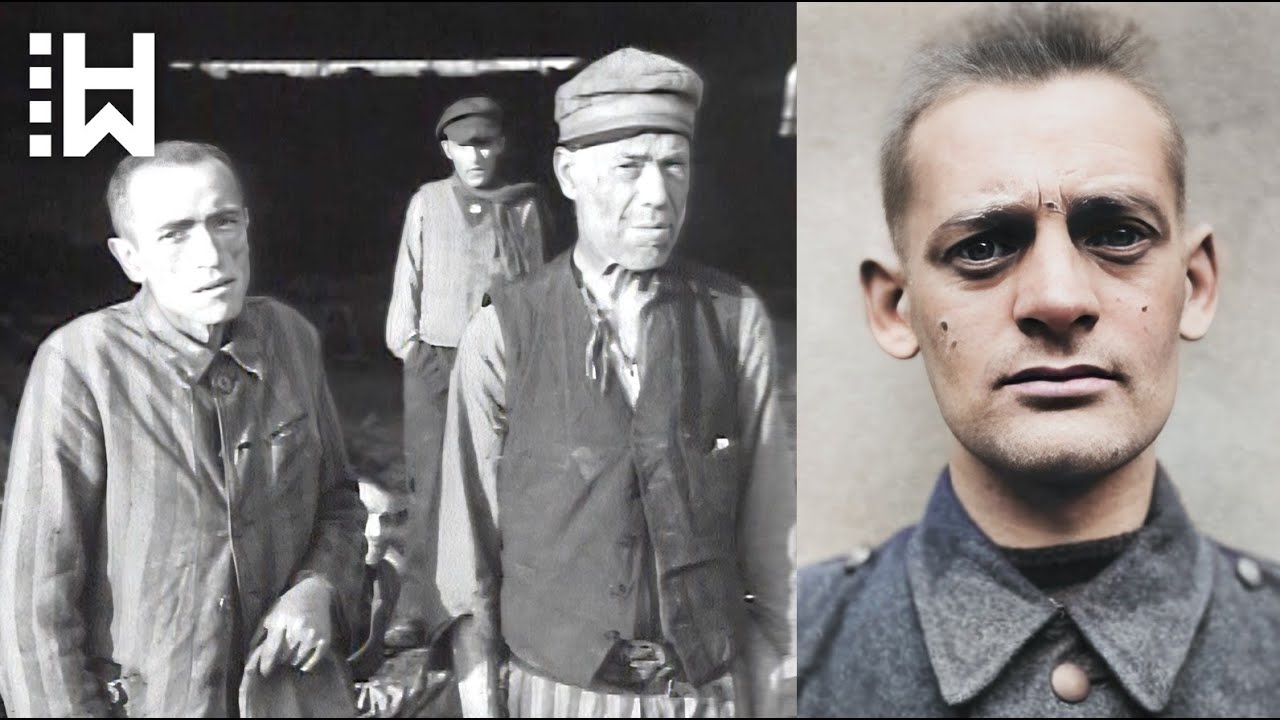
The British captured male and female Nazi personnel responsible for these horrors and forced them to help bury the dead in mass graves. One of those captured was Franz Stofel.
Stofel was born on October 5, 1915, in Hamburg, then part of the German Empire. Following World War One, a number of right-wing extremist political groups emerged in Germany, including the Nazi Party, which rose rapidly from obscurity to political prominence with the onset of the Great Depression and became the largest party in the German parliament in 1932.
On January 30, 1933, Adolf Hitler and his Nazi Party came to power in Germany. Stofel, a clerk by profession, decided to join the German Army, serving from October 1934 to 1935. In April 1936 he volunteered for the SS because he wanted to become a professional soldier.
He was assigned to the SS Totenkopfverbände, or Death's Head units, at Dachau concentration camp. The Death's Head units were an independent unit within the SS responsible for administering the Nazi concentration and extermination camps throughout Germany and later occupied Europe.
The units were trained to conduct themselves with strict discipline and cruelty and to view the prisoners under their guard as enemies of the state who should be destroyed if possible. They were responsible for facilitating what the Nazis called the Final Solution, known since the war as the Holocaust, the genocide of Jews in Europe.
In 1938 Hitler announced that the units were to become military units, and some groups were discharged from guarding the camps for combat duty, serving in Poland and the Soviet Union. As the units were trained to be barbaric in their treatment of camp prisoners, so too did they act on the field of combat.
Death's Head units were known to be cruel and ferocious warriors. At the beginning of World War II they had some 24,000 members, including reservists. By January 1945 that number had increased to 40,000.
The Second World War began on September 1, 1939, when Germany invaded Poland. From March 1939 to January 19, 1944, Stofel headed small work details in the warehouse area of Dachau.
Established in March 1933, Dachau was the first regular concentration camp built by the Nazi government. In October 1933 Dachau's commandant, Theodor Eicke, introduced a system of regulations which inflicted brutal punishments on prisoners for the slightest offenses.
Eicke was known as "Papa Eicke" and his guards as "Papa Eicke's boys." Under the slogan "tolerance means weakness," he advised his men that any SS man with a soft heart should retire at once to a monastery.
Eicke ensured that the Dachau camp served as a model for all later concentration camps. It also became a training center for SS guards who were deployed throughout the concentration camp system.
One such guard was Franz Stofel, who in mid-January 1944 was transferred to the Mittelbau-Dora concentration camp complex. From August 1944 he served as a commando leader for the construction of a satellite camp in Kleinbodungen.
From October 3, 1944, to early April 1945, he was commander of the Kleinbodungen subcamp. Mittelbau-Dora served as a subcamp of the Buchenwald concentration camp until it became independent in 1944.
Slave laborers from Mittelbau-Dora were used not only to produce V weapons such as the V1 flying bomb and V2 rockets, aimed primarily at London, but also to extend the nearby tunnels in Kohnstein, a hill that served as natural protection against Allied bombing. The underground factory named Mittelwerk, where the V weapons were produced, housed the construction and storage of these so-called weapons of retaliation in bombproof shafts.
The inmates at Mittelbau-Dora were treated in a brutal and inhumane manner, working 14-hour days and being denied access to basic hygiene, beds, and adequate rations. Prisoners too weak or ill to work were sent to Auschwitz and Mauthausen to be killed.
The inmates were subjected to extreme cruelty and as a result often suffered injuries including permanent disability, disfigurement, and death. Severe beatings were routine, as were deliberate starvation, torture, and summary executions.
In many cases the prisoners were compelled to hang other prisoners under penalty of execution if they failed to cooperate. The death toll at Mittelbau-Dora was high, with estimates suggesting that around 20,000 prisoners died because of the camp's conditions, including malnutrition, exhaustion, and disease.
Near the end of the war, when Germany's military force was collapsing, the Allied forces closed in on the Nazi concentration camps. The Soviets approached from the east and the British, French, and Americans from the west.

The Germans began frantically to move prisoners out of the camps near the front and take them to be used as forced laborers in camps inside Germany. Prisoners were first taken by train and then by foot on death marches.
Prisoners were forced to march long distances in bitter cold with little or no food, water, or rest. Those who could not keep up were shot.
When US troops appeared poised to capture Mittelbau-Dora and its surrounding areas in April 1945, the evacuation of the camp was ordered. Stofel was one of 45 SS men who led a brutal death march of hundreds of Kleinbodungen inmates to Bergen-Belsen concentration camp in Lower Saxony.
The march started on April 5, 1945, when 610 prisoners were forced to march in wooden shoes for days until they reached Bergen-Belsen on April 11. During the journey the SS conducted numerous summary executions of prisoners who attempted to escape or otherwise slow the progress of the march.
One group of prisoners was forced to march toward the town of Gardelegen, located in northeastern Germany, where a large barn and several nearby buildings were prepared as a makeshift prison. On April 13, 1945, there were some 4,000 prisoners in the Gardelegen area who had arrived a few days earlier from Mittelbau-Dora, its satellite camps, and from the Hannover-Stöcken subcamp.
There they had to disembark from freight cars because the trains could not advance any further due to damage to the rail lines. More than a thousand prisoners, many of them sick and too weak to march any further, were taken from the town of Gardelegen into a large barn on one of the local estates and forced inside the building.
They were locked inside the barn, which was then doused with gasoline and set on fire. Some 1,016 inmates were burned alive, suffocated, or shot by the SS as they tried in desperation to escape by digging under the barn's walls.
When the US Army entered Gardelegen the following day, they were horrified. Dead bodies were everywhere while the barn was still smoldering.
Although Stofel did not participate in the executions during the death march directly, he delegated this task to his deputy, Wilhelm Dörr. Dörr was one of the 610 prisoners forced to march from Mittelbau-Dora to Bergen-Belsen.
According to his testimony, the first day they marched from 7:00 a.m. until dusk and covered 51 kilometers. They received no food from the SS, and most inmates had only clogs.

On the first day of the march two men collapsed, and some fellow prisoners put them on a handcart which they then pulled along. The prisoners and SS guards took a break overnight in a field next to a barn about 3 kilometers from the town of Osterode.
On the following day, April 6, 1945, Wilhelm Dörr took the two men who had collapsed the previous day and another man who had also been in a distressed condition into the barn. He made these three men kneel down and shot two of them in the back of the head, firing two shots at each of them.
The third prisoner tried to escape, but Dörr shot him as well. He then ordered some prisoners to dig a shallow grave near the barn and bury the inmates he had just shot.
On April 15, 1945, four days after Stofel and his group arrived at Bergen-Belsen, the camp was liberated by British troops. The British found around 60,000 starving prisoners in the camp, most of them seriously ill.
Shortly after the liberation, Franz Stofel was captured by British forces together with fellow Nazi criminals such as Josef Kramer, the commandant of Auschwitz-Birkenau and the last commandant of Bergen-Belsen. After evacuating Bergen-Belsen, the British burned down the whole camp to prevent the spread of typhus.
During its existence approximately 50,000 people died in Bergen-Belsen, and more than 13,000 former prisoners too ill to recover died after liberation.
Justice finally caught up with Stofel when he was tried at the Belsen trial, which began on September 17, 1945. He was indicted for the atrocities which had occurred during the death march from Mittelbau-Dora.
At the trial Stofel refused to confess to any of the charges brought against him and claimed that neither at the concentration camps where he served nor during the death march did he kill anyone. Stofel claimed that the prisoners who had bare feet were allowed to sit on the handcart, however he did not mention that they were shot the next morning.
Stofel also added that during the death march the prisoners had good sleep at night as well as enough food. According to Stofel, their food consisted of coffee in the morning and 500 grams of bread and 40 grams either of sausage or cheese during the day.
However, those who were lucky enough to survive had different recollections of how much food they received, and the hot meal in the evening which Stofel also mentioned was never the case.
On November 17, 1945, the British Military Tribunal sentenced Franz Stofel to death by hanging. He was 30 years old when the British executioner Albert Pierrepoint carried out the sentence on December 13, 1945. There were no tears shed for Franz Stofel.