The year was 1968. Robert F. Kennedy was running for president and was the favorite to win the Democratic nomination. He had survived the loss of his brother, years of political conflict with Lyndon Johnson, and the chaos of the antiwar movement that was tearing the Democratic Party apart. By the spring of that year, he may have been the only figure in American politics capable of uniting enough of the country to win in November.
Then a private conversation with his brother's widow, Jacqueline Kennedy, suddenly and quietly threatened to become a political disaster. Jacqueline Kennedy wanted to marry Aristotle Onassis. Bobby Kennedy had just asked her to wait. She agreed to wait until after the election. If the story leaked before then, and if it became public that the widow of President Kennedy was planning to marry a controversial Greek shipping magnate while her brother-in-law was running for president, the political damage could be severe and irreparable.
This is the story, reconstructed from biographies, contemporary reporting, oral history, and later recollections, of what Robert Kennedy said and did about Jackie's relationship with Aristotle Onassis, why he opposed the marriage so strongly, what Jackie told him, and how the timeline of events in the spring and summer of 1968 intersected in ways that make it one of the most significant private dramas in Kennedy family history.
To understand Robert Kennedy's position on the Onassis question, you have to start well before 1968. The relationship between Jacqueline Kennedy and Aristotle Onassis predated the assassination of her husband by years. According to multiple biographies, the two first met at social occasions during the Kennedy presidency. Jackie, still grieving the death of her infant son Patrick in August 1963, accepted an invitation for a cruise aboard Onassis's yacht in October of that year. President Kennedy was concerned enough about the public image that he insisted Undersecretary of Commerce Franklin D. Roosevelt Jr. accompany the trip as a kind of chaperone. Kennedy was sensitive to how his wife would appear as a guest on the yacht of a man who, at the time, was under scrutiny by American authorities. Roosevelt later stated publicly that nothing improper happened during that cruise.
Six weeks after that cruise, John Kennedy was assassinated in Dallas. In the months and years that followed, Robert Kennedy became a central figure in Jackie's life. He served as a surrogate protector for her and her two children, John and Caroline. He helped manage the practical and emotional aftermath of the assassination. He oversaw the oral history project Jackie conducted with Arthur Schlesinger Jr., which produced recorded conversations of Jackie talking about her life with John Kennedy, interviews deposited at the Kennedy Library with restrictions on their release. He was present with her during what biographer Barbara Leaming, in her 2014 book "Jacqueline Bouvier Kennedy Onassis: The Untold Story," described as a period of acute and untreated post-traumatic stress caused by what Jackie witnessed in Dallas.
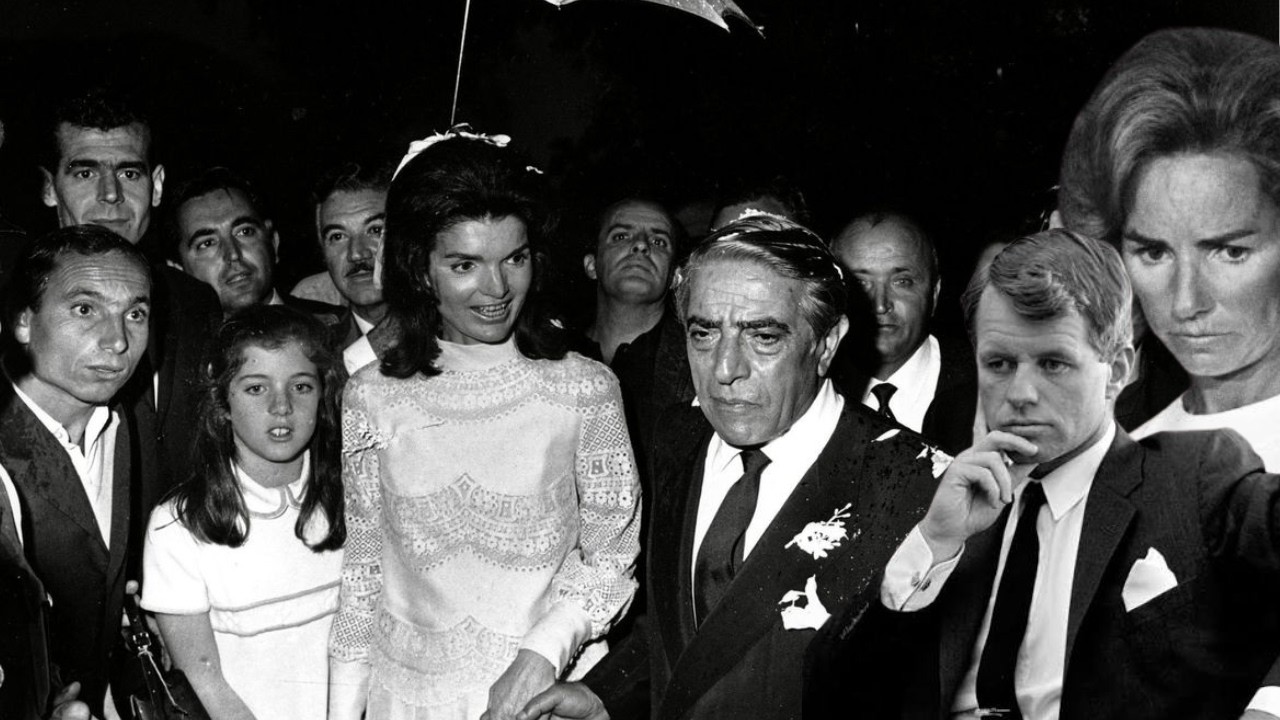
According to biographical accounts, Robert Kennedy and Jackie were very close in the years after the assassination. Biographer Evan Thomas, in his 2000 book "Robert Kennedy: His Life," drawing on Robert Kennedy's private papers and extensive interviews with his closest aides, described the depth of that relationship as one of the most important personal relationships of Robert Kennedy's final years. As reported in multiple sources, including journalist Peter Evans's 2004 book "Nemesis: The True Story of Aristotle Onassis, Jackie O, and the Love Triangle That Brought Down the Kennedys," a book that contains valuable but sometimes controversial recollections rather than archival documents, Robert Kennedy and Aristotle Onassis had a deeply hostile relationship. They had known each other since the early 1950s, and according to multiple accounts, each disliked the other from the start. Their antipathy was personal and political, and both sides felt it keenly. Robert Kennedy, as attorney general under his brother, was aware of Onassis's legal problems with the American government. Onassis, according to Evans's account, viewed Bobby Kennedy as an enemy and an obstacle.
When it became clear to Robert Kennedy that Jackie's relationship with Onassis was becoming serious, and that she was genuinely considering marrying him, his opposition, as biographers later recounted it, was strong. According to several biographical accounts, Robert Kennedy argued with Jackie about Onassis directly. He urged her to end the relationship entirely. According to accounts in numerous Jackie biographies, including J. Randy Taraborrelli's 2023 book "Jackie: Public, Private, Secret," and the account preserved in Peter Evans's reporting, Robert Kennedy made clear that marrying Onassis would be damaging not only to the image of the Kennedy family but to his political prospects and, more broadly, to what he considered the Kennedy legacy.
The most important conversation between Robert Kennedy and Jackie on the subject is said to have taken place in 1968, during the period when Robert Kennedy was actively campaigning for the Democratic presidential nomination. According to later recollections reported in multiple sources, and relying on memory and retrospective interviews rather than contemporary records, Bobby Kennedy strongly urged Jackie to postpone any decision about marrying Onassis until after the November presidential election. The political logic was clear. If Jackie married Onassis while Bobby was running for president, the headlines would be devastating. The contrast between the martyred John Kennedy and the enormously wealthy, twice-divorced, non-American Onassis would be inevitable. The story would dominate the news at the very moment Bobby Kennedy needed the public focused on his campaign.
According to these accounts, Jackie agreed to wait. She told Robert Kennedy she would not move forward with any marriage plans until after the November election. That was the agreement they reached, as it was later described. It was a private understanding between two people who had been through enormous shared grief and who, despite the tensions between them over Onassis, retained a deep bond formed through the assassination and its aftermath.
Then, on June 5, 1968, moments after winning the California Democratic primary and delivering a victory speech at the Ambassador Hotel in Los Angeles, Robert Kennedy was shot. He died the next day, June 6, 1968. The gunman was Sirhan Sirhan. Bobby Kennedy was 42 years old.

Jackie was at her home in New York that night, and she came to Los Angeles to be at his side in the hours that followed. Published accounts differ somewhat on the exact circumstances of what happened next. Several sources indicate that Jackie was the one who made or stated the decision to remove Robert Kennedy from life support after two days. Sarah Bradford's account, for example, attributes this decision to Jackie based on Richard Goodwin's recollection. Although the precise details of who made or stated that medical decision have been described differently across various sources, this is best understood as secondhand testimony rather than established fact.
In the immediate aftermath of Robert Kennedy's assassination, Jackie's psychological state, as documented by multiple published sources, reflected horror and despair. The account she gave to journalist Pierre Salinger, who had served as White House press secretary under her husband and remained a trusted friend, was striking in its directness. As Salinger documented and numerous biographies have reported, Jackie told him she hated America and no longer wanted her children to live there. She said that if people were killing Kennedys, her children were the prime targets. She said she had to leave the country. This account, preserved in Salinger's later reporting and reproduced in multiple biographical sources, captures the depth of what the second Kennedy assassination did to her.
The agreement she was said to have made with Bobby to wait until after the election was now void. The election Bobby had asked her to wait for was now an election Bobby would never contest. And the reason she had given for choosing to wait, her respect for Bobby's wishes and the political consequences for his campaign, no longer existed. Bobby was gone.
Within four months of Robert Kennedy's assassination, on October 20, 1968, Jackie married Aristotle Onassis in a small private ceremony on Skorpios, Onassis's private island in Greece. She was 39 years old. Onassis was 62. Public reaction was immediate and overwhelming. The New York Times reported that reaction in the United States and abroad ranged from disapproval to a kind of stunned disbelief. The Washington Post carried reports of widespread public sorrow and anger. European newspapers were more direct. One headline described the marriage as America losing a saint. Another declared that John Kennedy had died a second time. The Catholic Church raised the question of excommunication, given that Onassis had been married before and his former wife was still alive.
Peter Evans, in "Nemesis," relayed a remark from journalist and author Harold Evans: "Not one friend thought Jackie should marry Onassis." Evans then added the observation, widely cited since, that now that Bobby was gone, there was no one left to stop her. That line captures something real about the situation, though it should be noted it came from a book built largely on recollection rather than contemporary records.

Bobby Kennedy, in the years after John Kennedy's death, was the one person in Jackie's life who had both the closeness and the standing to challenge her on the Onassis question. He did so, according to the accounts we have. She listened to him, at least to the extent of agreeing to wait. Now he was gone and the waiting was over.
The Kennedy family's reaction to the marriage, according to multiple documented accounts, was almost uniformly negative with one important exception. Rose Kennedy, the family matriarch, gave Jackie her blessing. She was, according to multiple sources, the only Kennedy to do so without reservation. Ethel Kennedy, Bobby's wife, was reported in several accounts to be strongly opposed. Ted Kennedy, the surviving Kennedy brother, had his own doubts but attended the wedding on Skorpios as a representative of the family. The wider family, according to reporting from numerous journalists and biographers who covered the Kennedys during that period, viewed the marriage with a mixture of disapproval and helplessness.
What makes this story historically significant is not just the drama of the individuals involved. It is what the surviving records, assembled from letters, oral history, contemporary reporting, and later recollections, reveal about the private structure of the Kennedy family in the years after John Kennedy's assassination, and specifically about the role Robert Kennedy played in that structure. Robert Kennedy, in the five years between Dallas and his own death, became more than Jackie's brother-in-law. He became her closest protector, the person who managed the relationship between her and the family, and the person who served as the connective thread between the Kennedy who had been president and the two children that president had left behind.
His influence on Jackie's major decisions was real, according to every account we have. And his opposition to her relationship with Onassis is well documented as well. The fact that she agreed to his request to wait, and then moved toward marriage almost immediately after his death, suggests something about the nature of that influence. It also raises a question that no historical document can answer with certainty, though many biographers have wrestled with it. What would have happened if Robert Kennedy had survived June 1968? What would the agreement Jackie was said to have accepted after November, when the election was over, have looked like? Would she have married Onassis anyway? Would Bobby's opposition have continued? Would his proximity to the presidency, had he won, have created new pressures that changed the calculations entirely?
These questions remain open precisely because the event that would have answered them never occurred. Bobby died before the election. The private understanding he and Jackie were said to have reached became irrelevant almost immediately. And four months later, Jackie Kennedy became Jackie Onassis.
What Robert Kennedy said about Jackie's relationship with Onassis, as far as we can determine from the surviving accounts, was this. He opposed it. He argued against it directly. He acknowledged he could not stop her, but he asked Jackie to give him time. Specifically, the time between their conversation and the election of November 1968. She gave him that time, according to these accounts, not because he could force her, but because she chose to. That choice, if it happened as later described and was then rendered meaningless by the gunshots in Los Angeles, is one of the most painful and least discussed details in the long history of what the Kennedy family endured between 1963 and 1968.
The marriage on Skorpios lasted six years legally. Aristotle Onassis died in March 1975 at the age of 69. Jackie Kennedy Onassis lived nearly 20 years after him, dying in May 1994 at the age of 64. She is buried at Arlington National Cemetery beside John F. Kennedy. The three of them rest there together: John Kennedy, Patrick, and the stillborn daughter the family named Arabella. Robert Kennedy was buried separately, also at Arlington, in a more modest site chosen to reflect his wish not to be buried near his brother's official memorial. He was buried in June 1968, four months before the wedding on Skorpios that he was said to have asked his brother's widow not to hold until after the election. The election he was killed before he could contest.