For the three Gibb brothers, the magic of the Bee Gees lay in their ability to become one voice. Barry, Robin, and Maurice stood around a single microphone for decades, selling more than 200 million records and building one of the most celebrated family legacies in pop history. But behind the records and the harmonies, another story was quietly unfolding: the story of their children. Between the three brothers, the public knew of eleven sons and daughters.
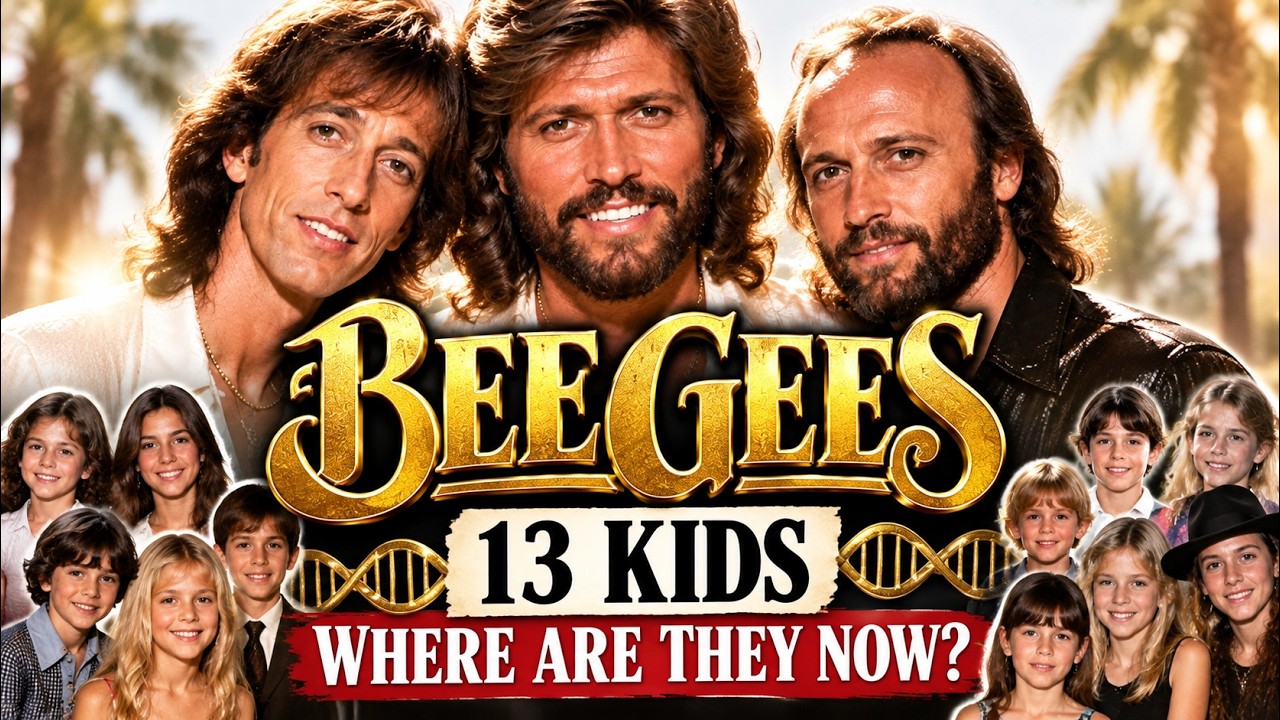
Some inherited the family’s musical gift. Others deliberately built lives far from the stage. One became a heavy metal guitarist. Another worked in real estate.
One composed a final, extraordinary work with his father while time was running out. And one was only three years old when she lost her father. Years after Maurice and Robin passed away, a surprising development made the Gibb family tree appear incomplete. A man who had been adopted as an infant took a DNA test.
The result connected him to the Gibb family and raised an extraordinary possibility: that the Bee Gees may have had a twelfth child—possibly the eldest of them all. But before untangling that mystery, it’s necessary to understand the lives of the eleven children the world actually knew. Barry Gibb, born in 1946, was the oldest brother. Twins Robin and Maurice followed in 1949.
Their father Hugh was a drummer, but it was the brothers’ natural vocal blend that set them apart. They seemed to understand instinctively where each other’s voices would go. That ability carried them from Britain to Australia and back again, and by the late 1960s, the Bee Gees were international stars with hits like “Massachusetts” and “I Started a Joke. ”
Then came the 1970s.
“Saturday Night Fever,” “Stayin’ Alive,” “Night Fever,” “How Deep Is Your Love. ” The Bee Gees became inescapable. For their children, that fame created a strange reality. Their fathers belonged to them, but they also belonged to millions of strangers.
Barry’s eldest son later recalled how unnerving it could be: fans saw a beloved star, while the children simply saw their dad. Barry was the patriarch of the largest immediate family. In 1970, he married Linda Gray, and their marriage survived decades of extraordinary fame. Together they had five children: Stephen, Ashley, Travis, Michael, and Alexandra.
Over time, Barry made it clear that his priorities had shifted. The man who spent his youth chasing musical success found deep satisfaction in ordinary family life—even taking his daughter to school. “My whole life is the music and my children,” he once said. Stephen, born December 1, 1973, quickly showed a pattern that would repeat among the Gibb children: having a father in the Bee Gees did not mean following in his footsteps.
Stephen went in the complete opposite direction, embracing heavy metal and loud rock guitar. He would later perform with bands like Black Label Society and Crowbar. Barry described his son simply as “very heavy metal. ” It’s hard to imagine a greater musical contrast: the father known for pure harmonies and one of pop’s most distinctive falsettos, the son drawn to distorted guitars.
Stephen’s childhood also revealed something about growing up with that level of fame. He remembered watching fans swarm toward his father, pulling at him, trying to get close. For a small child, it was frightening. Later, Stephen faced his own struggles, but music remained part of his life.
Eventually, something happened that neither father nor son could have fully grasped when Stephen was a child: they ended up standing on stage together. Most of Barry’s life, when he turned to his side on stage, he saw one of his brothers—Robin or Maurice, sometimes both. But after both brothers were gone, when Barry returned to touring, Stephen stood beside him. Barry later said, “It’s a pleasure to have Steve standing next to me.
” The Gibb beside Barry was no longer his brother—it was his son. Ashley Gibb, born in 1977, initially showed interest in tennis more than music. But music was never far from the Gibb household. Eventually, Ashley began working in studios and developing as a songwriter.
Years before, Maurice had mentioned Ashley’s studio work in an interview, saying the family wanted to give him opportunities. In time, Ashley and Stephen began writing with Barry. That collaboration produced something deeply meaningful: Barry’s 2016 album “In the Now,” on which every song was co-written with Stephen and Ashley. Think about that shift.
For decades, Barry’s creative partners were his brothers. The famous Gibb songwriting machine was built around siblings who knew each other’s instincts before anything was said. Now, Maurice was gone, Robin was gone, and Barry was in a room writing songs with his sons. He later explained that Stephen and Ashley brought different qualities: Stephen had deeper musical instincts, while Ashley was more analytical and detail-focused.
Barry loved working with both. When CBS asked him if music was still the family business, his answer was revealing: “It’s still a family that loves music and shares music. What I miss is my brothers. But I’m not alone.
”
Barry’s third son, Travis, born in 1981, took a different path. He didn’t become a famous singer, and he didn’t spend his adult life trying to prove he had his father’s voice. Instead, he built a career in real estate. When your father is Barry Gibb, choosing an ordinary professional life can be almost the most rebellious choice possible.
Barry’s fourth child, Michael, arrived in 1984, named after his godfather: Michael Jackson. Barry and Jackson knew each other, and the friendship between two of the world’s most famous musical families briefly became part of the Gibb family itself. Michael Gibb later moved into entertainment, but unlike his father and older brothers, his main interest was acting. The youngest of Barry and Linda’s children, Alexandra, was born in 1991.
She grew up during a different phase of her father’s life, when the Bee Gees were already legends, and she largely avoided building a public career around the Gibb name. But she was responsible for a remarkable human moment. “Saturday Night Live” had created a parody called “The Barry Gibb Talk Show,” with Jimmy Fallon playing Barry and Justin Timberlake playing Robin. Barry was initially unenthusiastic, but Alexandra helped persuade him to embrace it.
The real Barry Gibb eventually appeared in the comedy sketch. His daughter convinced him to laugh at himself—one of the most successful songwriters alive. The story reveals something important: the children didn’t just accessorize Barry’s fame; they changed him. Maurice Gibb was different from his brothers.
Barry was often the natural frontman, and Robin had one of pop’s most distinctive voices. Maurice was the multi-instrumentalist—bass, guitar, keyboards, arranging, studio work. He was often the glue that held things together. With his second wife, Yvonne, Maurice had two children: Adam, born in 1976, and Samantha, born in 1980.
Unlike some celebrity children who remember a distant father consumed by work, Samantha’s memories of Maurice were deeply familial. She later described him as “a dad in every sense of the word. ” He was present, playful, and didn’t need every family moment to revolve around his career. But music inevitably entered the children’s lives.
Adam and Samantha began writing songs together, and Maurice not only embraced their ambitions—he got involved. In a 2001 interview, Maurice was asked about the music his children liked. His answer quickly turned into the proud-father talk anyone can recognize. He explained that Adam and Samantha wrote together and had recorded an album.
Maurice produced eight songs. Then he said, “My daughter really impressed me,” and “My son really impressed me. ” Forget the Bee Gees for a moment—just listen to the father. He was proud.
Maurice also spoke about the extended Gibb family, noting how close all the children were. At that moment, he had no reason to believe he wouldn’t have years ahead to watch those children build their own lives. He was 51. Less than two years later, he was gone.
In January 2003, Maurice was hospitalized in Miami. His condition became critical, and on January 12, he died at just 53 years old. For Bee Gees fans, it was the loss of a third of an iconic group. For Barry and Robin, it was losing their brother.
For Adam and Samantha, it was losing their father. Those proud words from 2001 suddenly sounded different. There would be no decades of future collaboration, no growing old together, no chance to see where their lives would lead. Shortly afterward came an extraordinary public moment.
The Bee Gees were honored with the Grammy Legend Award. Barry was there, Robin was there, but Maurice’s place was empty. Adam, Maurice’s son, stepped forward. Barry spoke about Maurice and the family, and Adam accepted the honor on his father’s behalf.
One generation physically replaced another. Samantha found another way to stay connected to Maurice: she kept making music. Years later, when Barry finally returned to touring after losing his brothers, Samantha joined him. So did Stephen.
The family configuration on stage had changed. Barry was still in the center, but instead of Maurice and Robin, he was now surrounded by the next generation. Barry described it simply: “We all want to play together. ” For Samantha, it was far more emotional.
Years later, she explained what touring with her uncle meant to her: she felt connected to her father, felt his presence around her. She described the experience as healing. She wasn’t trying to become Maurice; she was experiencing his world, standing on stage, playing those songs, looking at crowds who had loved her father for decades. The music became a bridge between father and daughter.
Robin Gibb had four children. Unlike Barry’s five, they came from different chapters of his personal life. His eldest son, Spencer, was born in 1972 during Robin’s marriage to Molly Hullis. Then came Melissa.
Later came Robin John, known as RJ. Finally, decades after his first children, came Snow. Spencer inherited the musical instinct, but he also inherited something harder: the Gibb name. For an aspiring musician, the name opened doors, but it also created impossible expectations.
Spencer once explained: “People know your heritage, so you can never just be yourself. Then people think it was so easy to be me. ” Most unknown musicians get a chance to fail without anyone noticing. Spencer didn’t have that.
People knew who his father was, what his uncles had achieved—the harmonies, the songwriting, the millions of records. Before Spencer played a single note, a standard already existed that he was expected to meet. Yet he continued, leading his band 54 Seconds and pursuing his own musical identity. Eventually, Spencer’s path crossed with another second-generation Gibb: Samantha.
The children of Robin and Maurice collaborated under the name the Ghost Twins. Even the name seemed to acknowledge the family history—their fathers were twins, and now the next generation was making music together. Melissa, Robin’s second child with Molly, chose a much quieter path, staying largely out of the spotlight. That in itself deserves respect.
Not every celebrity child owes the public a continuation of their parents’ lives. In 1983, Robin and his second wife Dwina welcomed a son, Robin John, known as RJ. Of all Robin’s children, RJ likely shared the most intense musical relationship with his father. They didn’t just perform together—they composed together.
The work they created became inseparable from Robin’s final months: “The Titanic Requiem. ”
Robin and RJ began work on an ambitious classical composition timed to coincide with the 100th anniversary of the Titanic disaster. For RJ, it was an opportunity not just because of the scale of the work, but because he was creating it with his father. He later described the experience: “To do that with my dad, it was a dream come true.
” But while father and son created music about tragedy and loss, another tragedy was unfolding in secret. Robin was seriously ill. As the premiere approached, Robin’s health deteriorated. “The Titanic Requiem” was performed in London in April 2012, but Robin was too ill to attend.
Imagine RJ in that moment: the work existed because of both of them, an orchestra playing music he had composed with his father, but his father’s seat was empty. Weeks later, Robin Gibb died at 62. RJ was just 29. For decades, audiences associated Robin with songs of sadness and loss.
Now those songs belonged to his children in a completely different way. “I Started a Joke,” one of Robin’s signature songs, took on new meaning for RJ after his father’s death. A record known by millions of strangers became something personal—a link to his father. Robin’s older children were devastated as well.
At the funeral, Melissa prepared a eulogy but was too overcome to read it herself. Spencer read it on her behalf. Forget the records, forget “Saturday Night Fever,” forget the fame—a son and daughter were saying goodbye to their father. But there was another daughter, and she was still very young.
In 2008, Robin became a father for the fourth time. His daughter Snow was born to Claire Yang while Robin was still married to Dwina. The circumstances inevitably became tabloid material—relationships, money, inheritance, family tensions. But there’s a danger in telling Snow’s story entirely through adult actions, because Snow was a child.
When Robin died in 2012, she was just three years old. She had barely begun forming memories of her father. One day she would grow old enough to realize that millions knew his voice, that people around the world cried to his songs, danced to them, married to them. But she only had a few years with the man himself.
At Robin’s funeral, Barry publicly acknowledged little Snow. Whatever the complications among the adults, Robin’s youngest daughter was part of the family story. And because she has remained largely private, there’s no reason to turn her childhood into speculation. What matters is simple: Robin left four children, and his youngest lost him before she was old enough to truly know him.
By 2012, Barry had lost almost every brother who defined his life. Andy died in 1988, Maurice in 2003, Robin in 2012. Barry was now the last surviving Bee Gee. Years later, when asked about grief, Barry said, “You never get over that.
” For a while, he withdrew. His wife Linda eventually encouraged him to return to the stage, to do something, to stop sitting at home with sorrow. When Barry returned, he didn’t try to replace his brothers. Instead, he surrounded himself with family—Stephen beside him, Samantha singing.
A new generation was occupying a stage once dominated by the old one. After Maurice’s death, Samantha continued recording. In 2016, she recorded her own version of “New York Mining Disaster 1941” with her partner Lazzaro. She loved what they created.
Then came an idea: what if the rest of the family did the same? Samantha began reaching out to her cousins, and they responded. The project became the Gibb Collective. The Gibb children began recording songs associated with their fathers and uncles.
The resulting album, “Please Don’t Turn Out the Lights,” was released in 2017, featuring representatives from Barry’s family, Maurice’s family, Robin’s family, and even their younger brother Andy’s family. Andy Gibb wasn’t an official member of the Bee Gees, but he became a major star in his own right before his tragic early death in 1988. He left behind one daughter, Peta, who joined the Gibb Collective as well. Suddenly, the children of all four Gibb brothers were connected through music.
Not because they were trying to resurrect the Bee Gees—no one could do that. Robin and Maurice’s magic came from a lifetime of shared instinct. Barry once described what happened when the brothers sang together around one microphone: they watched each other, breathed together, knew each other’s paths. But the children could do something different.
They could keep the songs alive while adding their own stamp. Samantha explained her philosophy about losing her father and uncles in remarkably simple words: “You can either grow through the experience or let it tear you apart. ” The Gibb Collective represented that growth—a family divided by death reconnecting through the very thing that made their fathers famous. For the first time, it seemed every branch of the Gibb musical family had finally come together.
There was just one problem: the family tree was wrong. Nick Endacott was born in April 1968. From birth, he was placed for adoption, and at around eighteen, he joined another family. But the question of where he came from never fully disappeared.
Who was his biological father? In 2003, Nick reconnected with his biological mother, but his father’s identity remained unresolved. Years passed. Then an ancestry DNA test offered another possibility.
Nick submitted his DNA to a commercial database. Eventually, a close genetic match appeared. At first, one detail was enough to stop him: the surname Gibb. Then came the first name: Adam.
Adam Gibb. If you’ve followed this story, you already know why that mattered. Adam was the known son of Maurice Gibb. According to Nick’s account, the DNA relationship identified Adam as his half-brother—a match consistent with the two men sharing one biological father.
Nick had spent decades searching for his father. Now, the evidence seemed to point to an extraordinary name: Maurice Gibb. Nick later explained in a television interview that the discovery was about identity and psychological relief, not fame. Nick didn’t grow up behind the scenes of theaters.
Maurice never produced music for him. He had no childhood memories with Barry or Robin. If the DNA connection was as reported, Nick had inherited a link to the Gibb family without knowing it. Then came another detail.
Look at the dates. Nick was born in April 1968. Spencer Gibb was born in 1972. Stephen Gibb was born in 1973.
Adam Gibb was born in 1976. The possible twelfth son wasn’t the youngest—he appeared to be the eldest of them all. For decades, the familiar count was simple: five for Barry, four for Robin, and two publicly acknowledged children for Maurice—eleven in total. The reported DNA match between Nick and Adam is why the story can’t be dismissed as baseless celebrity gossip.
But it’s also important to be accurate: the public evidence is a DNA relationship between Nick and Adam, not a direct paternity test conducted on Maurice. The extended family’s response remains complicated, and private family relationships shouldn’t be invented where none are known. For Nick, the result was an answer to the question he’d carried for almost his entire life. Where did he come from?
The answer seemed to lead directly to one of the most famous musical families in history. Today, the Bee Gees’ children live in entirely different worlds. Some still make music. Some work behind the scenes.
Others chose professions almost entirely unrelated to entertainment. Several have guarded their privacy closely. Many found ways to keep their fathers close through the songs they left behind. Perhaps the most striking thing about the Gibb second generation is that there was no single destiny waiting for them.
The family name connected them, but it didn’t define them. And at the heart of what remained stood Barry—the last Bee Gee. He began his life as one of five Gibb children, became the leader of three brothers whose voices changed popular music, then a husband, a father of five, a grandfather, and finally, the last surviving Bee Gee. His later career became inseparable from his family.
He wrote with Stephen and Ashley, performed with Stephen, shared the stage with Samantha, and watched another generation reinterpret songs he had created with his brothers decades earlier. Barry once described his life simply: “My whole life is the music and my children. ” Perhaps that’s the real story of the Gibb family. The Bee Gees spent decades pursuing immortality through music, but immortality doesn’t really work that way.
Recordings remain. Photographs remain. Performances remain. But people leave.
Andy went first. Then Maurice. Then Robin. Barry remained, carrying memories that once belonged to several brothers.
He has spoken about imagining Robin and Maurice beside him on stage, especially around the microphone—that famous image of three brothers, three faces almost touching, three voices becoming one. No one can reproduce that. Not Stephen, not Samantha, not Spencer, not RJ, not any of them. And they don’t need to, because the Bee Gees’ children didn’t inherit an obligation to become like their fathers.
They inherited the freedom to decide what the Gibb name means to them. For Stephen, it meant loud guitar music before he finally stood beside Barry. For Ashley, it meant writing songs with his father. For Travis, it meant choosing something completely different.
For Samantha, it became a way to stay connected to Maurice. For Spencer, it meant fighting to be recognized as his own person. For RJ, it meant the extraordinary privilege and the grief that came from composing beside Robin. For Snow, it means carrying the name of a father she never had the chance to know well.
And for Nick, it may finally mean understanding a part of himself that was missing for decades. Eleven publicly known children, and a DNA discovery that appears to reveal a twelfth. Different mothers, different childhoods, different relationships with fame and music—but all connected by three brothers whose voices seemed made to unite. Years after losing Robin and Maurice, Barry was asked about making music with his children.
His answer may be the best possible ending to this story. He acknowledged what was lost: “What I miss is my brothers. ” Then he acknowledged what remained: “But I’m not alone. ” And he isn’t.
Because the Bee Gees may have begun as three brothers around one microphone, but what they left behind is much bigger: children, grandchildren, songs, memories, and an extraordinary family story that, even decades later, still seems to reveal new chapters.