Newly declassified archival research has shattered the decades-old legend of Field Marshal Erwin Rommel, revealing that the Nazi commander celebrated as the “clean” general of a dirty regime presided over a theater of forced labor, mass persecution, and a planned genocide that would have murdered half a million Jews in Palestine.
The documents, examined by historians across German and Allied archives, paint a portrait of a commander whose battlefield victories were not merely tactical achievements but the functional key that could have unlocked a Middle Eastern Holocaust, stopped only by his defeat at El Alamein in November 1942.
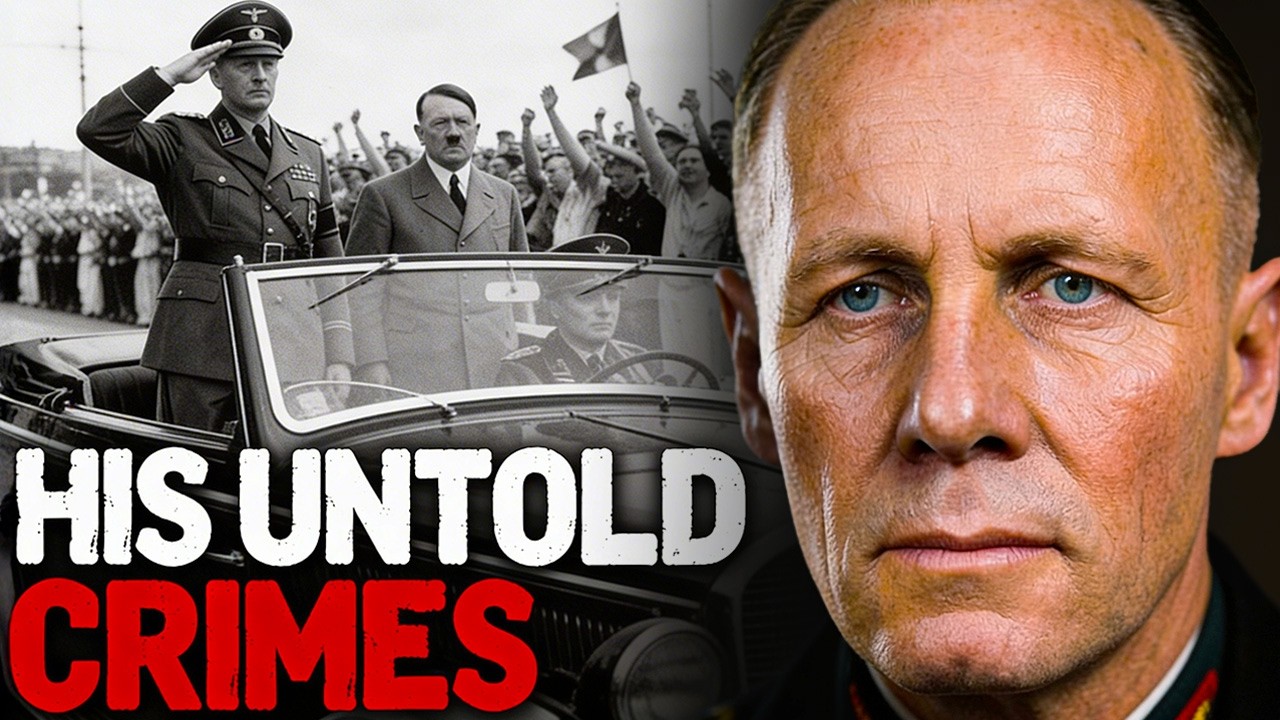 For generations, Rommel has been held up as proof that a soldier could serve Adolf Hitler and still fight with honor. Allied generals admired him. His North African campaign was romanticized as “the nearest thing to war without hate,” a phrase Rommel himself used and which became the bedrock of his myth.
That phrase, according to the newly surfaced evidence, was a lie built on a mission. As Rommel’s forces pushed across Libya and into Cyrenaica in early 1942, Italian colonial authorities moved to cleanse the region’s Jewish population. More than 2,600 Jews from Benghazi alone were rounded up and deported to the Giado concentration camp deep in the Libyan desert.
Conditions at Giado were catastrophic. Inmates received almost no food, no clean water, and no medical care. Families who had lived in Benghazi for generations, merchants, craftsmen, and teachers, were packed into desert barracks surrounded by nothing but sand and wire.
Typhus swept through the overcrowded camp within weeks.
Italian authorities made no meaningful effort to contain the disease. People died on the ground where they slept. Their bodies were sometimes left for hours before removal.
At least 526 people perished from starvation, disease, and sheer neglect, dying in a concentration camp located in the same theater, at the same time, under the same Axis command structure that Rommel operated within.
The war without hate was being fought over a landscape of camps. The man whose name became synonymous with desert honor never publicly acknowledged that the people dying behind his lines even existed, according to the archival record.
Rommel’s advance did not merely enable persecution from a comfortable distance. When Axis troops occupied Tunisia in late 1942, the persecution moved directly into his operational theater and became structural. SS officer Walter Rauff arrived in Tunisia and organized an Einsatzkommando that coordinated directly with the Wehrmacht.
Rauff was not a rogue agent operating in the shadows. His unit worked alongside military command, and his activities were logged in detail. Roughly 5,000 Tunisian Jews were forced into more than 20 labor camps scattered across the country.
They were not building roads for civilians. They were conscripted to dig the very fortifications that Rommel’s army would fight behind.
Trenches, bunkers, and defensive positions, the infrastructure of Rommel’s war, were built with forced Jewish labor. Rauff’s own diary records the arrangement with chilling bureaucratic precision. Three thousand Jews were drafted and marked with yellow stars.
Their community organizations were forced to fund their own imprisonment, to pay for the supplies that kept the camps running.
Non-compliance was met with severe reprisals. At least 2,500 Tunisian Jews died during just six months of German rule. That is the distance between Rommel’s arrival and the collapse of the Axis position in North Africa.
This was not persecution happening somewhere nearby while Rommel fought his honorable war in the other direction. This was persecution woven into the fabric of his military operations.
The labor that sustained his defensive lines came from camps run by an SS officer operating in his theater and coordinating with his army. The myth says Rommel fought a clean war. The archives say his war was built on the backs of Jewish forced laborers.
 What most Rommel admirers have never heard, and what changes everything about how historians understand the North African campaign, is that Rauff’s unit was not just running labor camps in Tunisia. Research by historians Klaus-Michael Mallmann and Martin Küppers, published after years of work in declassified German and Allied archives, reveals that Rauff’s Einsatzkommando was an advance team for something far worse.
Their intended target was not in Africa at all. It was Palestine. If Rommel had broken through the British lines at El Alamein and seized Egypt, the road to the Middle East would have been open.
Waiting to follow the advancing Wehrmacht into Palestine was Rauff’s unit, prepared to systematically murder roughly 500,000 Jews living in the region.
The operational model was identical to what the Einsatzgruppen had already carried out across Eastern Europe and the Soviet Union. Mobile killing squads following behind the front line army, liquidating Jewish communities town by town. The only thing that stopped it was Montgomery’s victory at El Alamein in October and November of 1942.
Every mile Rommel advanced toward Egypt brought Rauff’s genocide team one mile closer to half a million people. Rommel’s battlefield victories were not just tactical achievements. They were, functionally, the key that would have unlocked a Middle Eastern Holocaust.
El Alamein was not just a turning point in a military campaign. It was the line between survival and extermination for an entire population.
The general celebrated as the honorable warrior was the one trying to cross it. Rommel left something else behind in the Egyptian desert, something that is still killing people today. Under his command, German and Italian engineers laid vast minefields near El Alamein.
The Germans called them Teufelsgarten, devil’s gardens.
These were not scattered defensive positions. They were massive horseshoe-shaped belts containing millions of mines designed to channel attacking forces into 𝓀𝒾𝓁𝓁 zones. As a tactical decision, it was effective.
As a human legacy, it has been devastating. When the war moved on, the mines stayed. Nobody came back to clear them.
Decades later, they remain buried in the Egyptian sand, rusted but functional, their firing mechanisms preserved by the dry desert air. Estimates suggest millions of unexploded devices remain across a vast stretch of the Western Desert, covering land that holds significant oil and mineral resources.
Egyptian civilians, farmers, herders, Bedouin families, and children playing in the wrong patch of sand have been maimed and killed by these mines for generations. The Egyptian government has reported thousands of casualties since 1945, and large-scale clearance efforts have barely dented the total. The land cannot be developed.
Communities cannot expand. Infrastructure cannot be built.
The Devil’s Gardens are still doing exactly what they were designed to do, denying ground and inflicting casualties. Only now, the casualties are Egyptian families instead of British soldiers. Rommel’s tactical brilliance did not end when the war did.
 Its consequences are measured in limbs and lives lost every year, 80 years after the last shot was fired.
If North Africa were the only theater in question, defenders of Rommel might argue that the persecution was an Italian or SS matter, that Rommel’s hands were clean even if his surroundings were not. But then came Italy, and Rommel’s own words made that argument impossible.
After the North African campaign collapsed in May 1943, Rommel took command in northern Italy. When Italy switched sides in September 1943, abandoning the Axis and joining the Allies, Rommel issued what became known as the Geiselbefehl, the rabble order. His instructions were explicit.
Former Italian allies who resisted German authority had, in his words, lost every right to mercy. They were to be treated with the harshness due to rabble. That language was not vague.
It was not open to gentle interpretation. Historians have linked the Geiselbefehl directly to a wave of brutal reprisals, summary executions of Italian soldiers who refused to lay down their arms, mass deportations of prisoners of war, and violent crackdowns on civilian populations across northern Italy.
The wording mirrors the kind of exterminatory anti-partisan orders issued on the Eastern Front, where such language routinely translated into massacres of unarmed people. Under Rommel’s authority in northern Italy, roughly 600,000 Italian soldiers were disarmed and deported to German labor camps. These were men who, just days earlier, had been fighting alongside the Wehrmacht as allies.
Now they were classified as military internees, a designation deliberately chosen to deny them the protections of prisoner of war status under international law. Thousands died in transit or in the camps. Many never returned home.
This was not a bureaucratic oversight or a subordinate acting without orders. This was Rommel’s directive, issued in his name, carrying his authority.
The pattern was not theater specific. It was consistent. In Africa, persecution operated alongside his command.
In Italy, it operated under his direct orders. The geography changed, but the willingness to enable atrocity did not.
The strongest case against Rommel comes from the very evidence his defenders cite most often. The United States Holocaust Memorial Museum confirms that Rommel rejected certain blatantly criminal orders. He refused to execute captured black prisoners of war from Free French colonial units.
He refused to carry out the so-called Commando Order, which demanded the killing of captured Allied commandos.
These refusals are real, documented, and significant. They prove that Rommel understood the moral line between lawful combat and war crimes. He could see it clearly enough to refuse when it suited him.
But that is exactly what makes his other decisions so damning.
 He issued the Geiselbefehl with full knowledge of what such language would authorize. He operated in close proximity to Rauff’s genocidal SS operations in North Africa without raising a documented objection. He maintained the personal relationship with Hitler that made all of it possible: the promotions, the propaganda, the command authority that put him at the center of campaigns where atrocities were structurally embedded.
The few orders he refused do not exonerate him. They prove he had the capacity to resist and chose, deliberately, when to exercise it. He drew moral lines, just not where they would have cost him anything.
On October 14, 1944, Rommel was forced to swallow cyanide after being implicated in the July 20 plot to assassinate Hitler. The regime gave him a state funeral and told the public he died of his wounds. His death should have ended the story.
But the myth was too useful to die with him.
In the postwar years, former Wehrmacht generals needed a hero, someone whose reputation could rehabilitate the German military in the eyes of the Western Allies. Rommel was perfect: dead, unable to contradict anyone, and already famous. His name appeared in the Himmerod Memorandum, a secret document drafted by former German officers in 1950 that lobbied for West German rearmament and the early release of convicted war criminals.
The argument was simple. Germany’s soldiers had fought honorably, led by men like Rommel, and the new Cold War demanded their rehabilitation. The clean Wehrmacht myth spread from there.
It seeped into popular culture, into films, into the way an entire generation of Germans understood their own military history. And Rommel sat at the center of it.
The Desert Fox, the chivalrous warrior, the proof that not all of Hitler’s generals were monsters. In his hometown of Heidenheim, a monument still calls him chivalrous and labels him a victim of tyranny. But the archives eventually caught up with the legend.
Today, that monument sits beneath a counter-monument, a memorial to the victims of the mines his forces planted in the Egyptian desert.
Two truths, one on top of the other, neither able to erase the other entirely. The conclusion from the United States Holocaust Memorial Museum is careful but unambiguous. While Rommel refused some criminal orders, his close relationship with Hitler, his awareness of the Final Solution, and his command in areas where Jews were persecuted and Einsatzkommandos prepared mass murder mean he cannot be cleanly separated from Nazi crimes.
The good Nazi did not exist. What existed was a skilled general whose victories enabled persecution, whose theater housed genocide’s advance team, and whose legend was deliberately engineered to help a nation avoid accountability. The Rommel myth did not just distort one man’s legacy.
It delayed an entire society’s reckoning with what its army actually did.
Every year the clean Wehrmacht narrative survived, accountability weakened, trials stalled, perpetrators reintegrated, and history softened. The question was never whether Rommel personally signed a deportation order. The question is what his campaigns made possible and what the myth built around him helped an entire country forget.
Half a million people in Palestine survived not because of Rommel’s honor, but because Montgomery stopped him at El Alamein. That is the distance between the legend and the truth, and the archives have finally closed it.