On a warm Saturday afternoon in June 1986, Anthony Spilotro, 48, slipped on a light jacket he did not need and climbed into a car with his younger brother Michael. They were headed to a meeting in Bensenville, Illinois, a suburb near O’Hare Airport. Neither man ever came home. For eight days, no one knew where the brothers had gone.
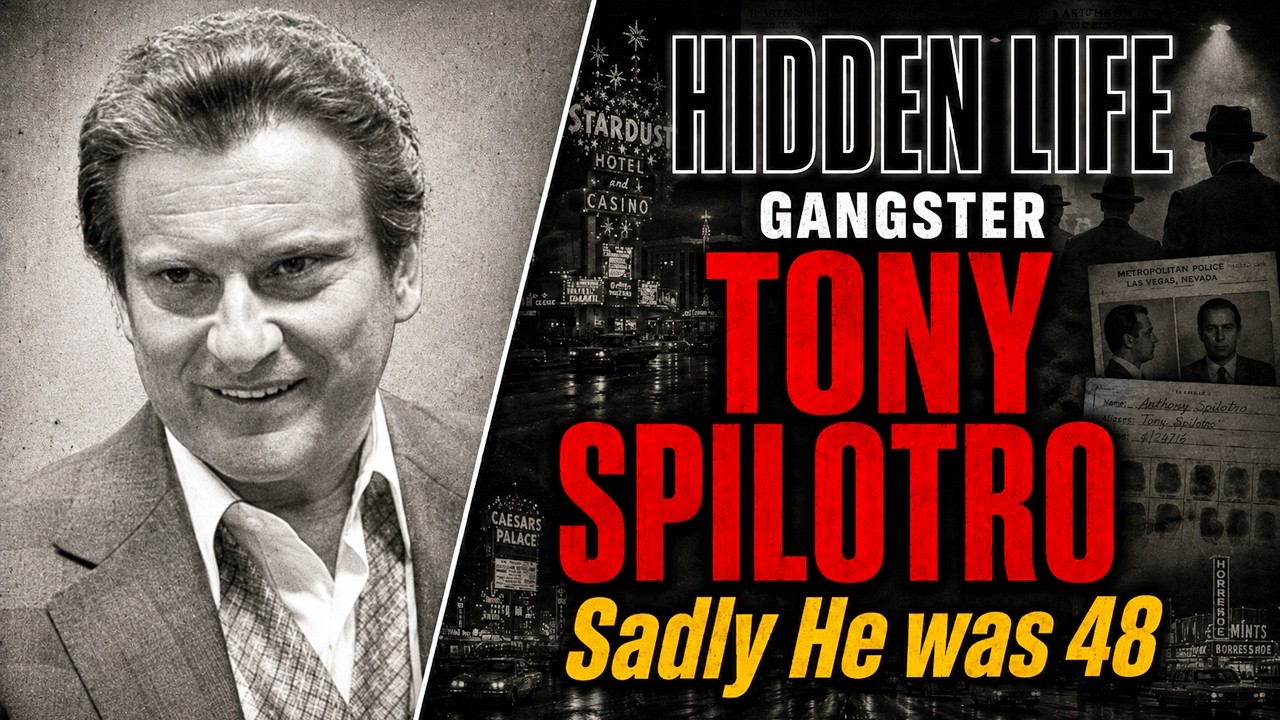
Their wives waited in silence. The FBI, which had tracked Tony for years, had no answers. Then their bodies were found in a shallow grave in a sandy Indiana cornfield, stripped to their underwear, one lying on top of the other. For decades, the world accepted a dramatic version of their deaths, one later immortalized in Martin Scorsese’s 1995 film *Casino*, in which Tony’s character is beaten with baseball bats and buried alive.
That version was fiction. The real story, established under oath in a Chicago federal courtroom more than two decades later, was quieter, colder, and more methodical. Tony Spilotro grew up on Chicago’s West Side in the 1940s, one of six brothers in an Italian immigrant family. His parents ran a small restaurant where local mob figures ate in the front while the children ate in the back.
Tony absorbed lessons at those tables. He dropped out of high school, drifted into petty crime, and by his early twenties was collecting street tax for Chicago loan sharks. The Chicago Outfit noticed his usefulness. They prized his willingness to do what others would not, including, by 1962, his suspected participation in a brutal murder that drew federal attention.
In 1971, the mob sent him to Las Vegas. Their mission: protect the massive skim of unreported cash flowing out of casino counting rooms, millions of dollars a month bound for the Midwest. Tony set up shop at a jewelry store called The Gold Rush and quickly became the most feared figure on the Strip. But his bosses had asked for a ghost.
They got a hurricane. Tony beat people in public, threatened police, and drew scrutiny his handlers in Chicago did not want. He also built his own crew, a burglary unit later dubbed the “Hole in the Wall Gang” for its habit of cutting through roofs and walls to reach safes. Over three years, they hit dozens of businesses, leaving trails of stolen goods and angry investigators that pointed straight back to Tony.
Federal wiretaps recorded Chicago bosses complaining years before his death that Tony was bringing heat on the entire organization. He was warned to cool down, sell the store, and return to Chicago. He refused. He had built an empire, and he would not walk backward.
In 1979, Nevada gaming regulators placed Tony in the Black Book, permanently barring him from entering any licensed casino in the state. For a man paid to protect mob interests inside those casinos, it was a professional death sentence. Tony reportedly waved it off, insisting he answered to no one. On July 4, 1981, the Hole in the Wall Gang attempted a jewelry heist during a fireworks display.
The FBI had been listening for months. Agents raided the store, arresting the crew in seconds. Tony was monitoring by phone from a distance. His empire collapsed.
The crew’s leader, Frank Cullotta, flipped and entered witness protection. He gave federal agents decades of information on Tony’s crimes. Weeks later, Tony’s casino partner, Frank “Lefty” Rosenthal, survived a car bombing outside a restaurant, thanks to a steel plate in his seat. Rosenthal soon retired to Florida.
By 1985, Chicago Outfit leadership was under federal indictment for its role in the skim. Facing prison, bosses did not want Tony’s antics complicating their cases. According to testimony later given at the 2007 Family Secrets trial, a decision came from the top: Tony had to go. And Michael had to go with him, because leaving a brother alive was seen as leaving behind a potential avenger.
The men chosen were senior figures, including Frank Calabrese Sr. , a loan shark with a reputation for hands-on violence, and James Marcello. Tony was told the bosses wanted a sit-down to clear the air. The sweetener: Michael would finally be formally inducted into the Outfit.
Michael, 41, a construction worker with a family in Arlington Heights, believed it. He reportedly told his wife he was finally being brought in. It was a lie. On June 14, 1986, the brothers arrived at a modest house in Bensenville.
Waiting inside were Calabrese, Marcello, and several soldiers. They exchanged pleasantries. Then someone suggested they continue the conversation in the basement. Tony had trusted no one for decades.
Yet he walked down those stairs, with his brother behind him. Historians believe he did it because he trusted the men and refused to show fear in front of Michael on the day of his induction. The attack began without warning. There were no bats and no guns.
According to trial testimony, the killers turned on Tony with fists, feet, and elbows. Guns leave evidence. A beating, in an isolated basement, does not. Michael tried to fight back.
Both brothers went down on the basement floor. The beating lasted several minutes. Forensic pathologist Dr. John Pless later testified that both men suffered multiple blunt-force injuries to the head, neck, and chest.
Their airways and lungs filled with blood. In practical terms, they drowned in their own blood as the blows continued. The brothers were stripped to their underwear to remove traces of fiber, hair, or DNA. Their bodies were wrapped and loaded into a car.
That evening, the killers drove roughly ninety minutes south on Interstate 65 into Newton County, Indiana. They chose the location because the soil was sandy and easy to dig. They dug one grave. They placed one brother on top of the other and covered them.
Then they drove back to Chicago. Michael’s car was left in a motel parking lot near O’Hare Airport, suggesting the brothers had fled by plane. For eight days, the public story was that the Spilotros had run. Their wives knew better.
On June 22, 1986, a farmer or local dogs discovered the grave. FBI agents arrived from Chicago. The bodies were identified by fingerprints by nightfall. The case sat open for twenty-one years.
Everyone in Chicago knew who did it, but no one would testify. That broke in the early 2000s when Nicholas Calabrese, Frank’s own brother, was arrested on an unrelated matter and decided to cooperate. Nicholas gave federal prosecutors an accounting of 18 murders, including the Spilotro killings. He named who was in the basement, who struck the blows, who drove the bodies, who dug the grave.
His testimony destroyed the code of silence. The resulting prosecution, Operation Family Secrets, became the largest federal mob trial in American history. In 2007, a Chicago jury convicted Frank Calabrese Sr. , James Marcello, and others of the Spilotro murders.
Frank Calabrese died in federal custody in 2012. Marcello received life in prison. The autopsy testimony corrected the record. There were no bats.
There was no cornfield beating. There was no live burial. The brothers died in a suburban basement on a Saturday afternoon, killed by men they knew, using only their hands and feet, in a killing designed to leave no trace. The house in Bensenville has never been publicly identified.
The cornfield has no marker. *Casino* remains the version most people remember, but the forensic record is clear. The killing was meant to protect the Chicago Outfit. Instead, it became the crime that finally broke it.
The men who ordered Tony dead to save the organization ended their lives in federal prison, convicted in part on the very killing they had hoped would protect them.