Shortly after 2 a. m. on a Tuesday in October 1952, 30 armed men closed in on Bumpy Johnson in a narrow alley off 126th Street in Harlem. The men had spent 11 days studying his habits, tracking his routes, and timing his nightly pauses.
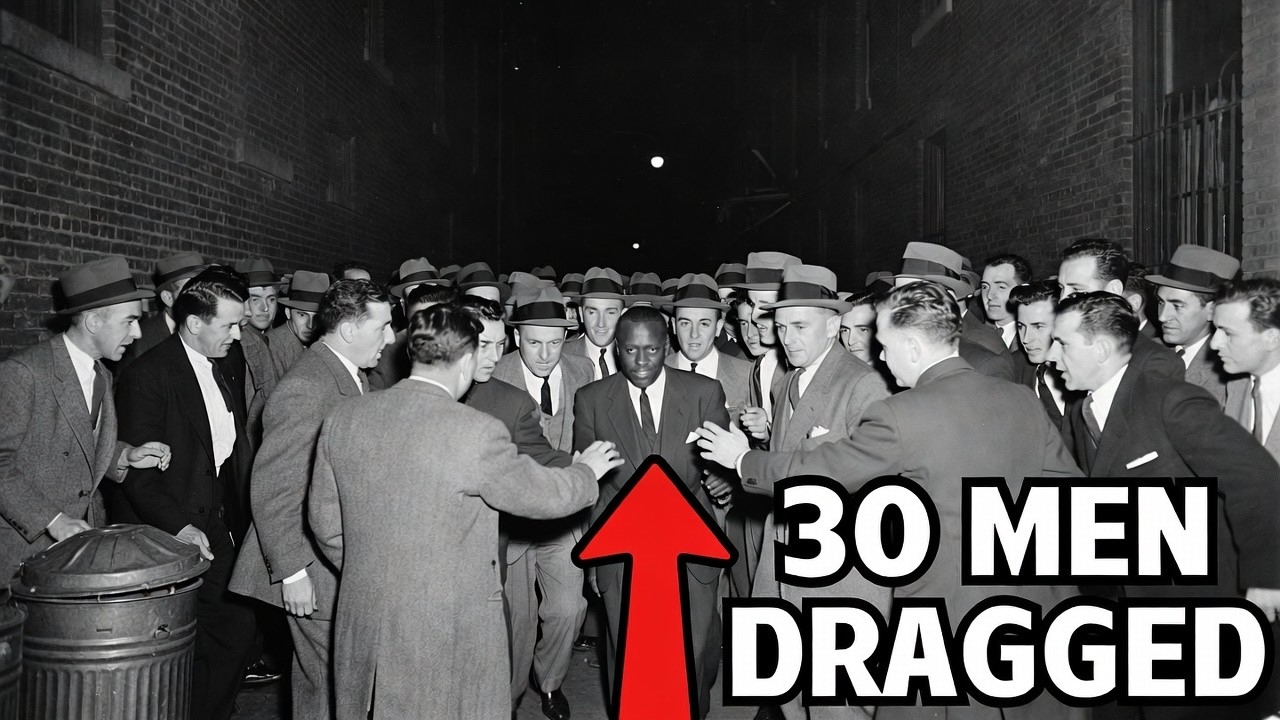
They had positioned themselves in doorways, parked cars, and behind a rusted fence. Every one of them was armed, and their orders were clear: this ended that night. Johnson walked into the alley voluntarily, stopped in the center, and finished his cigarette. He did not reach for a weapon.
He was not dragged. He stood calmly for three minutes, scanning the men, the gaps in their positioning, and the face of the man who had organized the ambush, standing at the far end. According to accounts passed down in Harlem, Johnson then said two words: “Count again. ” His own men, just three of them, came through the door behind him.
The arithmetic shifted not because three men could overpower 30, but because the men in the alley realized they had misread their target. The organizer left Harlem within the week. Johnson was not harmed. Ellsworth Raymond “Bumpy” Johnson was born in Charleston, South Carolina, on October 31, 1905, and arrived in Harlem as a teenager during the Great Migration.
He became a central figure in the neighborhood’s informal economy, particularly its numbers racket, a black-owned betting system that circulated money through a community largely shut out of legitimate finance. In the early 1930s, Dutch Schultz, a white gangster from the Bronx, attempted to seize Harlem’s numbers operations. Most operators capitulated. Madam Queen Stephanie St.
Clair refused, and she chose Johnson as her ally. The confrontation lasted years and involved violence on both sides before Schultz was murdered in 1935 in Newark by rival mob interests, a death unrelated to Harlem but one that ended the pressure campaign. Johnson’s reputation rested on more than violence. Residents described him as someone who answered when the community called: rent debts quietly settled, evictions forestalled, bail money materializing when needed.
He served multiple federal prison sentences and returned to Harlem each time to find the neighborhood reacting with a collective sense of relief. By 1951, federal pressure on organized crime was intensifying. The Kefauver Committee hearings put mob figures in front of television cameras, and authorities were building narcotics cases against Johnson. He also had personal disruptions: two of his most trusted men had been arrested in the months before the alley incident, leaving gaps in his early warning network.
Those gaps were observed. The man who planned the 1952 ambush was experienced and believed his timing was sound. He had the backing of a financier with territorial ambitions and the advice of an outside strategist who believed that sufficient force at the right moment would break any man. What the planners did not know was that Johnson had identified their surveillance by the third night.
He noticed a parked car that moved slightly closer each evening and a newspaper seller who did not handle his paper like a vendor. He did not react; he filed the information. Over eight days, he walked past the alley nightly, noting the unlocked door, the repositioned garbage cans, and the subtle preparations made by men who believed they were invisible. On the night of the ambush, the men in the alley expected a cornered man to run or beg.
Johnson gave them stillness instead. Witnesses later recounted that he stood in the center of the alley, read the positioning of all 30 men in seconds, identified the gap beneath a broken fire escape, and noted that the man holding the rear door had poor footing. When the heavy-set man nearest him announced, “You know why you’re here,” Johnson did not respond. He looked past him to the man at the far end who had given the order.
He then told the crowd, “Whoever told you this was a good idea didn’t tell you everything. ”
The man holding the rear door stepped away when Johnson told him to. The organizer told Johnson he was outnumbered. Johnson replied with the two words that became legend: “Count again.
”
Three of Johnson’s men entered through the unsealed rear door. No violence followed. The men in the alley began to reposition themselves, creating distance, finding reasons to be near the fence. Johnson walked the full 40 feet to face the organizer directly.
He told the man he had studied his route, counted his people, and done everything right, except understand what he was looking at. He lit a cigarette and explained that Harlem was not a place you take but a place you earn. He asked if the man heard him. The organizer’s eyes dropped.
Johnson left the alley unharmed. By dawn, the story had moved through Harlem’s informal networks. The version that circulated was unusually accurate. People repeated the line “Count again” as the defining moment.
The organizer left Harlem within the week and never returned. The financier made quiet inquiries, learned that Johnson treated danger as weather rather than interruption, and withdrew his interests. The outside strategist disappeared from the record entirely. Two years later, in 1954, the federal government succeeded where the 30 men had failed.
Johnson was convicted on narcotics charges and sentenced to Alcatraz. He was 49. He spent nine years in prison before returning to Harlem in 1963 at age 58. Residents said the neighborhood exhaled upon his return, the same way it had after his earlier stints.
His absence had been felt in rising pressures and tested boundaries. On July 7, 1968, Johnson died of heart failure at a table in Wells Restaurant on Seventh Avenue in Harlem. He was 62. He was not shot, not arrested, and not driven out.
His death prompted a grief that was personal and structural, the loss of a man who functioned as a load-bearing wall for a community that knew there was no replacement. The alley on 126th Street still exists. It looks like any other alley, but those who carry the story pass it with the knowledge of what happened there: 30 men entered to end something, and one man walked out with everything that mattered.