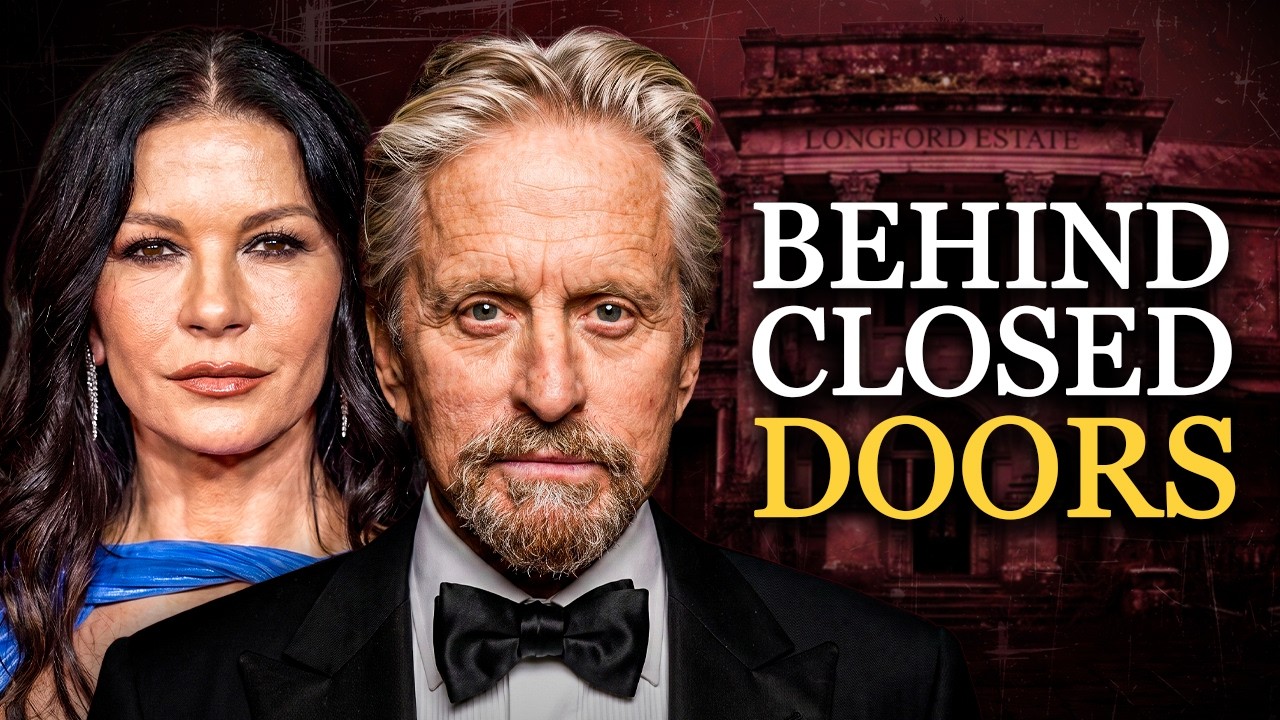
Michael Douglas walked the red carpet alone at the Deauville Film Festival on August 28th, 2013, promoting his acclaimed role in *Behind the Candelabra*. The absence of Catherine Zeta-Jones beside him was conspicuous: the couple had met at that same festival 15 years earlier, and their representatives had just confirmed they were taking time apart. Behind the composed public image lay a private reality that the cameras had circled for years—a son in federal prison, a cancer that nearly killed him, a wife who had twice sought treatment, and two young children growing up in the middle of it all. The story begins decades earlier, with the weight of a name.
Michael Kirk Douglas was born on September 25th, 1944, the eldest son of Kirk Douglas and actress Diana Dill. Growing up in the shadow of his legendary father, Michael inherited immense access—and an impossible comparison. When the film adaptation of *One Flew Over the Cuckoo’s Nest* finally came together, Kirk was deemed too old for the lead role he had long championed. Michael produced the film, which won the Academy Award for Best Picture in 1976.
It was a triumph and, unavoidably, a wound. He had succeeded at the exact thing his father wanted and could not have. Michael would later admit that his career once served as a place to hide from an unhappy first marriage and the difficult labor of raising a child. That pattern echoed into the next generation.
By his mid-50s, he was quietly determined to do fatherhood differently the second time around. Catherine Zeta-Jones came from a different world entirely. Born in Swansea, Wales, on September 25th, 1969—the same birthday as Michael, exactly 25 years apart—she came from a working-class family with no connections to fame. A family bingo win reportedly funded her early dance training.
She left school at 15 for London and the theater, working through discipline and repetition until she arrived in Hollywood with a career already in motion. As she would later admit, she carried insecurities beneath the confidence and disliked being reduced to her beauty rather than treated as a serious performer. Two ambitious people, both accustomed to performing composure in public, found each other. When they met in 1998, Michael told her—more confidently than the moment could support—that he intended to father her children.
Unimpressed, she ended the evening, and he apologized afterward with flowers. The line became part of their romantic mythology only because it eventually came true. There was a third person in the family from the beginning. Cameron Douglas, born in December 1978, was the only child of Michael’s first marriage to Diandra Luker.
He would become the older half-brother to a new set of children, and, in time, the family member whose private struggle became a public legal crisis no amount of money could contain. Cameron later described learning at age seven that his father had been unfaithful to his mother, with his mother placing an adult’s emotional burden on him far too young. He began using drugs at 13; by 20, he was using heroin. Michael later said his career had come before his family, but he did not accept that his absence caused his son’s addiction—and Cameron agreed, refusing to reduce his choices to parental blame.
Michael and Catherine became engaged during a New Year’s trip to Aspen at the end of 1999. Their son, Dylan Michael Douglas, was born in August 2000, three months before the wedding. They married on November 18th, 2000, at the Plaza Hotel in New York, a spectacle costing an estimated one to two million dollars. Cameron, 21, stood as best man.
Three-month-old Dylan was there. The guest list read like a roll call of stardom: Tom Hanks, Whoopi Goldberg, Anthony Hopkins, Brad Pitt, Goldie Hawn. The photographs showed a united family extending into another generation. They could not show the unfinished damage from the first family sitting silently underneath the evening.
The early years seemed to validate the second chance. Both appeared in *Traffic* (2000), and Catherine’s career accelerated through *Chicago*, *Intolerable Cruelty*, *The Terminal*, and *Ocean’s Twelve*. The clearest image of the marriage at its peak came on March 23rd, 2003, when Catherine, visibly pregnant, performed “I Move On” from *Chicago* at the Academy Awards and won Best Supporting Actress. Less than a month later, Carys was born on Easter Sunday, April 20th, 2003.
The family built a world to match the image. They lived for years in Bermuda, kept residences in New York and Canada, and spent time at S’Estaca, a historic estate on Mallorca that Michael and Diandra had purchased in 1990 for roughly $3. 5 million. For a period after the divorce, Michael and Diandra divided its use before he and Catherine gained exclusive use.
Catherine was building a household inside a space that carried the history of the one that came before. The past was never entirely gone; it was in the architecture. The first real crack was not in the marriage at all, but in the relationship between Michael and his oldest son, which had never healed. Cameron’s addiction eroded his career and reliability through the years.
In the 2003 film *It Runs in the Family*, three generations of Douglas men—Kirk, Michael, and Cameron—appeared together in a story about an emotionally troubled family. Off-screen, the real addiction continued unresolved. Michael would later say he reached a point where he believed his son would either kill someone or be killed. In July 2009, Cameron Douglas was arrested in Manhattan in connection with the distribution of methamphetamine and cocaine.
He pleaded guilty in January 2010. On April 20th, 2010—seven years to the day after his half-sister Carys was born—he was sentenced to five years in federal prison. Before the sentencing, Michael wrote a handwritten letter to Judge Richard Berman asking for mercy. He acknowledged his son’s responsibility and the repeated failed attempts at rehabilitation, but he also described his own failings as a father and the particular pressure of a child growing up inside a famous family.
The private history of the family had entered an official public document. Michael asked for compassion while admitting his son had ignored numerous chances at treatment. The judge described the sentence as Cameron’s last chance to change. In those same months, Michael had been noticing a soreness in his mouth that would not go away.
He had been told more than once it was nothing serious. On a visit to Montreal, a physician examined him closely and ordered a biopsy. The answer came a few days later by telephone: cancer. A tumor roughly the size of a walnut sat at the base of his tongue, advanced by the time it was found.
He was 65 years old. His eldest son was in federal custody. Treatment was brutal. For roughly seven to eight weeks, Michael underwent radiation and chemotherapy.
He resisted a feeding tube, survived largely on liquids, lost close to 40 pounds, and was profoundly weak by the end. In the middle of it, he went out to promote *Wall Street: Money Never Sleeps*, producing images of a working actor carrying on. Catherine became caregiver, parent, and public spokesperson at once, nursing Michael through radiation while raising two young children. In January 2011, Michael announced the tumor was gone.
But as his body cleared, something in Catherine was breaking down. In April 2011, she voluntarily checked into Silver Hill Hospital, a mental health facility in Connecticut, for approximately five days. She had bipolar 2 disorder, and she chose to say so publicly—a significant decision for a working actress in her early 40s whose livelihood depended on the appearance of control. She said she hoped disclosing the diagnosis might encourage others to seek help.
Michael said he was proud of her. The person who had been holding everyone else together admitted she needed to be held together, too. Meanwhile, the hope that prison would save Cameron was quietly falling apart. He continued to obtain and use substances while incarcerated.
In December 2011, Judge Berman added 54 months to his sentence for possession in prison. Years later, a group of addiction specialists filed an amicus brief on his behalf, detailing that he had entered custody with a severe untreated opioid dependence, used heroin five or six times a day before his arrest, and had received no professional treatment for his substance use disorder in prison. He had also been confined to his cell for 23 hours a day for roughly 11 months. To the court, repeated possession looked like defiance.
To addiction specialists, it looked like exactly what happens when you incarcerate a person with severe untreated addiction and provide no treatment. The family that had access to every form of protection money could buy could not reach him. Three members of one family were each isolated inside a different institution: Michael in a hospital, Catherine in a psychiatric facility, Cameron in a prison cell. Michael’s anger gradually shifted away from his son and toward the system holding him.
Both went back to work, and their work created a cruel optical illusion: every premiere and red carpet became evidence that the family was fine. Michael’s performance as Liberace in *Behind the Candelabra* (2012) was extraordinary and would earn him an Emmy. Catherine worked through *Rock of Ages*, *Playing for Keeps*, *Broken City*, and *Side Effects*. But productivity is not the same thing as health.
In late April 2013, Catherine again checked into a mental health facility. This time, her representative characterized it not as a crisis, but as proactive periodic care—managing an ongoing condition before it worsened. It was the healthiest possible way to understand it, and inescapably one more piece of the family’s private medical life turned into public information. Then came June 2013, and a single interview that made headlines globally.
Speaking to the *Guardian* while promoting *Behind the Candelabra*, Michael offered his own explanation for his cancer: HPV, a virus he said had been transmitted through oral sex. He then made a joke, medically unsupported, suggesting the same act could be a cure. Michael later expressed regret, specifically for the embarrassment it caused Catherine and her family. It would be wrong to say that interview caused what came next; there is no reliable evidence that it did.
It was one more weight arriving after three years of accumulated strain. By the middle of 2013, there was very little left in reserve. The marriage was the thing that finally gave. In late August, their representatives confirmed they were taking time apart to evaluate and work on the marriage.
Reports noted they had not been photographed together in roughly four months. No divorce petition was filed. This was not an ending announced; it was a fracture acknowledged. The chronology of that year tells the story: in April, Catherine went in for treatment; in May, Michael received rapturous acclaim at Cannes; in June came the cancer interview and its fallout; through the summer the couple appeared separately; in late August the separation became public.
His body had survived; his career had reached one of its highest points. By every ordinary logic of storytelling, this should have been the triumphant end of the family’s ordeal. Instead, the professional recovery and the marital collapse arrived in the same few months. In September 2013, Michael won the Emmy for *Behind the Candelabra*.
He arrived without Catherine. From the stage, he thanked his absent wife, then turned his attention to his son, saying he hoped he would be allowed to see Cameron. Speaking to the press afterward, he described a non-violent, drug-dependent young man held in extended isolation, and made clear his frustration with a system that had chosen punishment over treatment. Michael kept saying the marriage was being worked on.
Catherine said very little, and did not litigate the marriage in public. The public reached for easy explanations—the 25-year age gap, her diagnosis, his cancer, the pressures of fame—but the honest version refuses to choose a single reason. Within roughly three years, one member of this family was sentenced and then resentenced to prison, another was treated for stage four cancer, another entered mental health care twice, and two young children lived through every bit of it. Then the marriage paused.
It went slowly back toward each other. By April 2014, Michael and Catherine were seen together again at events in New York. By 2015, Michael was willing to talk about it, describing the couple as stronger than before, while making clear that a marriage cannot be repaired by one person. They gave each other room, kept working separately, and had two children who needed a functioning household.
The reconciliation was not a reset; nothing that had happened unhappened. The marriage survived by ceasing to demand that endurance look like perfection. Cameron Douglas was released in August 2016 after serving roughly seven years. He came out sober, and this time the sobriety held.
He stayed clean, became a father, and in 2019 published a memoir, *Long Way Home*, telling the story of his addiction, imprisonment, and childhood in his own voice. That same year, in the ABC special *The Douglas Dynasty: Fame, Addiction, Finding Home*, Michael and Cameron sat and talked publicly about the childhood, the addiction, and the years Michael had chosen work over home. Michael acknowledged his failures without accepting sole responsibility for his son’s choices—and Cameron did not ask him to. Love and damage could exist in the same room at the same time in the same two people.
Kirk Douglas died in February 2020 at age 103. With his death, the comparison that had driven Michael since childhood finally ended. Michael had become the oldest living center of the family himself. By then, the thing he seemed to want to be measured by was not the name at all, but whether the people who would carry it after him had come through the fire intact.
In 2025, Cameron appeared alongside Michael in a film called *Looking Through Water*—the first time the two had acted together on screen since *It Runs in the Family* in 2003. The story turned on estrangement and reconciliation; both of them were sober and present. Michael Douglas is now 81. He has said he stepped back from acting on purpose after filming *Franklin* in 2022, though he has not ruled out returning for an extraordinary project.
He has a memoir announced for publication in October 2026, described as reckoning with his father’s shadow, his personal struggles, the stage four cancer, and the marriage. Catherine Zeta-Jones is 56 and never stopped working. A new generation knows her as Morticia Addams in *Wednesday*. When she talks about the marriage now, she talks about humor, respect, imperfection, and shared pride in the two children she and Michael raised through the worst of it.
Cameron Douglas is 47: an actor, an author, and the father of two. The man his father once believed would end up dead or in a cell for the rest of his life is neither. He is home. Dylan Douglas graduated from Brown University in 2022, has worked in political organizing, and hosts a SiriusXM program called *Young American*.
Carys Douglas graduated from Brown in 2025 and made her professional stage debut in 2026 as Nina in a Brooklyn production of Chekhov’s *The Seagull*—a play about art, ambition, and the wreckage families leave in each other. On November 18th, 2025, Michael and Catherine marked their 25th wedding anniversary. Catherine looked back on the day it began—the flowers, the candlelight, the Welsh choir—not as evidence that the hard years had never happened, but as evidence of something more durable: that after the imprisonment, the cancer, the diagnoses, and the separation, it was still, 25 years on, the same marriage. The story of Michael Douglas and Catherine Zeta-Jones does not resolve into a lesson.
Their wealth was real and bought them real things, but it did not buy distance from addiction, cancer, mental illness, or the near loss of the marriage itself. The photographs the public saw were not lies; they were only incomplete. Between two pictures—a 21-year-old son standing beside his father as best man, and the two of them standing together again a quarter-century later, both still here—is everything no camera ever captured.
A family learning the hard way that staying together was not a promise made once and kept forever, but a decision that sometimes had to be made all over again after everything had gone wrong.