The F4F Wildcat was pitifully inferior in climb, maneuverability, and speed. Lieutenant Commander Jimmy Thach put that blunt assessment in his report on the Battle of Midway, describing the fighter his own squadron had just flown into combat. Yet the loss records from 1942 tell a more complicated story than the performance charts suggested. Historian John Lundstrom later matched American losses against Japanese ones plane by plane.
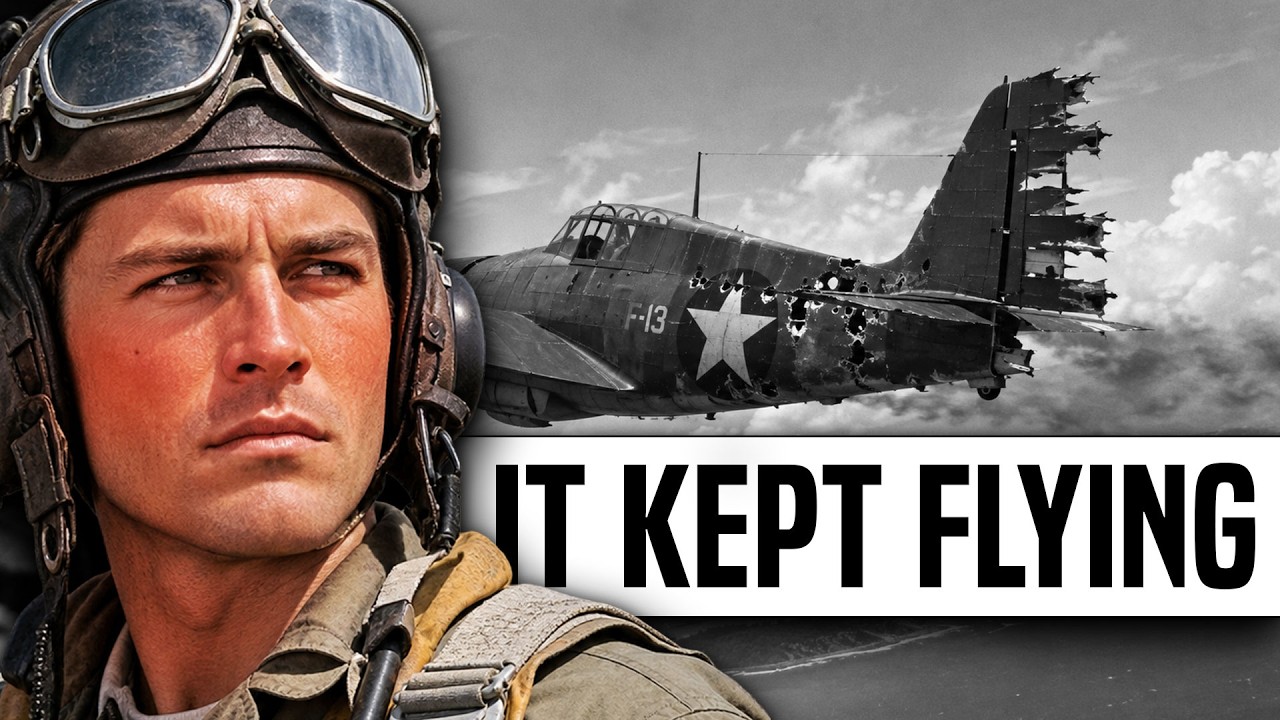
Where the Wildcat met the Zero head-on, 15 Zeros went down and 10 Wildcats were lost. Seven of those ten American pilots died, but three survived being shot down in a fight their airplane was supposed to lose. A month earlier, at the Coral Sea, the older Wildcat model had done almost the same thing: 14 Zeros destroyed against 10 Wildcats lost. Thach’s complaints about climb and speed were accurate.
But laid against Japanese records, his fighter traded with the best fighter in the Pacific at roughly even terms for the entire year of 1942. The reason sits inside the two airplanes, and it has almost nothing to do with the qualities that made the Zero famous. Mitsubishi built the Zero to be light. The Japanese Navy demanded a carrier fighter that could climb fast, turn inside anything, and fly absurd distances.
The designers achieved all three by stripping weight wherever they found it. The wing spar used a new, stronger aluminum alloy from Sumitomo. There was no armor plate behind the pilot. The wing tanks were not self-sealing, and as fuel burned off, the empty space above it filled with vapor.
The Wildcat went the other way. Behind the pilot’s seat sat a plate of hardened steel meant to stop a . 50 caliber round. The main fuel tank rode in the fuselage inside a rubberized bladder built to swell shut around a bullet hole.
The carburetor kept feeding fuel whether the airplane was right side up or upside down. Then there were the guns. The Zero carried two 20 mm cannon with 60 shells apiece, giving roughly 10 seconds of cannon fire, plus two light machine guns in the nose. The new Wildcat carried six .
50 caliber Brownings with 240 rounds each. Pilots hated the change because the older four-gun model had carried 34 seconds of ammunition, while the six-gun model ran dry in under 20 seconds. Thach had an answer for anyone who defended the extra guns: a pilot who cannot hit with four guns will miss with eight. On paper, the six-gun Wildcat was a slug.
Grumman advertised a climb of almost 2,000 feet per minute, but squadron pilots in combat found they were getting somewhere between 500 and 1,000. The famous kill ratio is a problem. For 1942, Navy and Marine Wildcat pilots were credited with shooting down Japanese aircraft at 5. 9 to 1, a figure that still turns up in books and documentaries.
It comes from plane claims, which were wildly inflated on both sides. Plenty of the credited kills were bombers and float planes that could not turn inside anything. When Lundstrom matched fighter claims against surviving Japanese unit records, the 5. 9 shrank to about 1 to 1.
A draw against the Zero in the year of the Zero. The squadron that showed how was Thach’s own. In 1941, working from intelligence reports on the new Japanese fighter, he designed a formation for a slower airplane. Two pairs of Wildcats flew abreast.
When a Zero dropped onto one pair, both pairs turned in and crossed paths, swinging the attackers straight into the guns of the other pair. Thach tested it against Butch O’Hare, who flew the attacker at full power while Thach’s defenders flew with their throttles wired back. O’Hare landed and told him it had worked every time. On the morning of June 4, 1942, Thach took six Wildcats off the carrier Yorktown to escort 12 torpedo bombers toward the Japanese carriers.
Between 15 and 20 Zeros came down on them. One Wildcat caught fire almost at once, and another pilot lost his radio, so Thach could not talk anyone through something new. He started the weave anyway, with a young, untested ensign named Robert Dibb as his partner. A Zero followed Dibb through one of his turns and ran into Thach’s guns.
Thach shot down three Zeros in that fight, and Dibb got another. One Wildcat was lost. The torpedo bombers they were guarding did far worse, and that fight is part of the 15 to 10 tally. Two months later, on the first day of the Guadalcanal landings, a planter named Paul Mason sat in the hills of southern Bougainville with a radio.
People had laughed at the idea of him in uniform. He was overage, undersized, a little deaf, and a bit short-sighted. On August 7, 1942, he sent a signal down the island chain: 24 bombers headed yours. Zeros of the Tainan Air Group were escorting them.
The Tainan Group was the most experienced fighter unit in the Japanese Navy, and the flight from Rabaul ran 556 miles each way, the longest fighter mission of the war up to that date. On the carrier Saratoga, Lieutenant James Sutherland, called Pug since his boxing days at the Naval Academy, scrambled into the nearest airplane, a Wildcat painted 5-F-12 that belonged to Ensign Mortimer J. Kliemann. The ensign had lettered a small name under the cockpit in black paint.
The airplane was called Junior. Pug took off at 3 minutes past noon. At about a quarter past one, he shot down a twin-engine bomber, the first Japanese aircraft lost in the Guadalcanal campaign, and then a second one. After that, he lined up on a Zero, pressed the trigger, and heard nothing.
The guns may have jammed, a known fault in early Wildcat wing installations, or he may have emptied them on the bombers. Neither he nor the men who watched him ever settled it. What followed was a Wildcat with silent guns against three Zeros. Sutherland worked out that two were making runs from opposite sides while the third waited its turn, so he kept turning into whichever came first.
Then a fourth Zero joined in, flown by Saburo Sakai, the Tainan Air Group’s best-known pilot. By Sakai’s own account, he switched off his cannon expecting a quick kill with his light machine guns and put 500 or 600 rounds into the Grumman. It kept flying. He pulled alongside and saw the rudder and tail shredded like old cloth.
A Zero that had taken that much, he wrote, would have been a ball of fire by now. Sutherland’s report of the same minute reads like an inventory of damage. His flaps and radio were gone, oil was running down his right leg, and fuel had pooled in the bottom of the cockpit from a tank that had been punctured many times and still held. The after part of my fuselage was like a sieve.
The engine was still pulling at full throttle when a 20 mm shell burst under the left wing root, and Junior exploded with Sutherland already going over the side. The day’s ledger is the part that gets left out of the Wildcat legend. The Tainan pilots claimed 43 American aircraft destroyed on that mission. The Americans lost 10, nine of them Wildcats out of the 18 fighters that met the raid.
The Tainan Air Group lost two Zeros. On August 7, the Zero won by a wide margin. Later that afternoon, Sakai dived on a formation of Dauntless dive bombers he took for fighters, and their rear gunners put rounds into a cockpit with no armor around it. He was out of the war for two years.
Sutherland, meanwhile, was walking. A Solomon Islander named Bruno Nana found him on the coast and got him past the Japanese to American lines. On August 20, he left Guadalcanal on the first flying boat to land at Henderson Field. His condition on landing depends on which source is open.
A New York Times story in March 1943 gave him injuries when he jumped. The Pacific Wrecks database says he came down under his parachute unharmed. Over the next three months, the pattern of that first day turned around. Marine and Navy fighters moved ashore to Henderson Field, the airstrip the Japanese had been building when the Marines took it.
Coast watchers like Mason gave warning. Radar gave more. The Grummans climbed high and waited, and when the Zeros arrived after 556 miles in a cramped cockpit, the Americans came down on them in one diving pass and kept going. One Grumman against one Zero was not a fair fight, a pilot on the island said, but with mutual support, two Grummans are worth four or five Zeros.
Between August 7 and November 15, Wildcat pilots shot down 72 Zeros and lost 70 of their own. In the two carrier battles of that stretch, the Eastern Solomons and Santa Cruz, 43 Zeros went down against 31 Wildcats. Counting every cause, including accidents and airplanes wrecked on the ground, the Americans lost 115 Wildcats from the start of August to the middle of November, and Japan lost 106 Zeros. The fighter that was supposed to outclass the Wildcat never pulled ahead across the hardest months of 1942.
The aircraft count hides the half of the ledger that decided the war. A Wildcat shot down over Henderson Field often meant a pilot in a parachute above his own airfield. Sometimes he was in the water, a short boat ride from friendly troops. A Zero shot down there meant a pilot 500 miles from base over enemy ground in an airplane with no armor and wing tanks full of vapor.
The Tainan Air Group, the unit that claimed 43 aircraft on the first day, lost 32 pilots killed in action between August and November 1942. One of them was Lieutenant Junichi Sasai, Sakai’s own division leader, shot down on August 26. Rabaul picked up a nickname among its pilots, the fighter pilot graveyard, and malaria took more of them out of the cockpit on top of the combat losses. The two navies handled what was left in opposite ways.
After Midway, the United States Navy pulled Thach out of combat and sent him back to the States to teach his formation to pilots who had never seen a Zero. The Japanese Navy kept its veterans at the front until they were killed or too hurt to fly. A new actor had turned up in July far from the Solomons. A Navy flying boat crew under Lieutenant William Thies spotted a Zero lying upside down in a bog on Akutan Island in the Aleutians.
Its pilot, a 19-year-old petty officer named Tadayoshi Koga, had tried an emergency landing on what looked like a flat grassy field after the June raid on Dutch Harbor. The wheels dug in, the fighter flipped, and he was killed. The airplane was almost undamaged. It went to Naval Air Station North Island in San Diego under guard.
The factory serial number was 4593. Lieutenant Commander Eddie Sanders took it up for the first time on September 20, 1942, and flew it 24 times in 25 days. Above 200 knots, he found, the Zero’s big ailerons grew so heavy that rolling it took real force on the stick. It rolled left far more willingly than right.
Its float carburetor cut the engine out when the pilot shoved the nose down hard. The advice that went out to the fleet was plain: push over into a steep power dive, let the Zero’s engine choke, and at about 200 knots, roll hard right. The Japanese historian Masatake Okumiya later wrote that losing Koga’s Zero was no less serious for Japan than losing at Midway. Lundstrom’s verdict runs the other way, and the calendar backs him.
Sanders first flew the captured Zero on September 20. The draw at the Coral Sea came in May. The 15 to 10 at Midway came in June. The first six weeks over Guadalcanal were already fought.
The pilots who got the Wildcat to even terms did it without the test report, working from after-action notes from Thach’s formation and from what the Zero had done to them. The report confirmed what they had already paid to learn. None of this made the Wildcat safe. On October 2, 1942, a Japanese raid reached Guadalcanal before anyone picked it up, and the Zeros caught the intercepting Wildcats by surprise.
Six Wildcats went down for one Zero. When the warning failed and the Americans had to fight from below, the old numbers came right back. Pug Sutherland went back to war. By 1945, he was a commander flying the Hellcat, the fighter that replaced the Wildcat, in the fighting of Okinawa.
In April, he shot down a Zero and became an ace. After the war, he taught flying at the Naval Academy. He was killed in 1949 in a jet accident on takeoff from a carrier off Florida. Even that date is unsettled.
The Pacific Wrecks database gives January 12. The most widely circulated biography gives October 12. His Wildcat stayed where it fell for more than 50 years. On February 14, a Solomon Islander led the researcher Michael Claringbould into a ravine inland from the north coast of Guadalcanal.
The fin still carried the stenciled Navy number 5192. The engine lay there with two cylinders shot away and bullet holes through the propeller. Claringbould called it arguably the most historic US Navy aircraft wreck of World War II. Three of the .
50 caliber guns have since turned up in the ravine. When a later expedition climbed in to learn why Sutherland’s guns went silent at the moment a Zero slid across his sights, a landslide had buried the rest of the wing, and the team could not dig down to the gun bays inside it. In the published accounts, the airplane that took 500 or 600 rounds and kept flying still has not answered why its own guns never fired back.