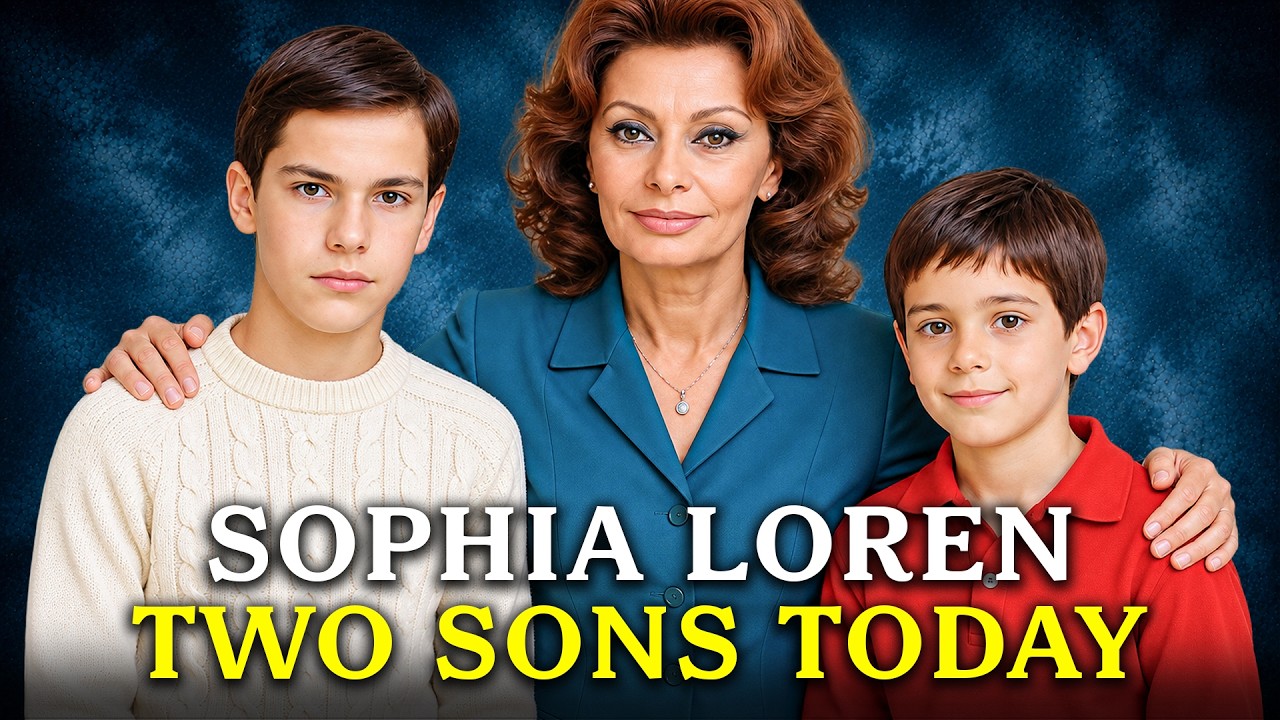
In the winter of 1968, one of the most famous women on earth checked into a hospital in Geneva, having spent most of the previous nine months confined almost entirely to a single hotel room. This is the story of Sophia Loren’s two sons and what became of them. To understand why Sophia Loren spent nine months of a pregnancy essentially hiding in a Swiss hotel, you have to understand what had happened to her in the decade before it. The war years in Pozzuoli were genuinely dangerous.
It was in this period at one of these contests that she was noticed by a film producer named Carlo Ponti, 22 years her senior and already one of the most powerful figures in Italian cinema. Ponti was already married to a woman named Giuliana Fiastri, and Italy in the 1950s did not permit divorce, not for anyone at any price, under any circumstances. She received hostile mail, some of it from strangers who had never met her, condemning her personally in religious terms. Warrants were a genuine possibility for a couple whose entire professional lives were built inside the Italian film industry.
By 1962, they had the Mexican marriage annulled simply to end the legal exposure. That same year, 1962, Loren won the Academy Award for best actress for “Two Women,” becoming the first performer ever to win the award for a role in a non-English language film. On April 9th, 1966, Sophia Loren and Carlo Ponti were married in France legally and permanently nine years after their first attempt. Both losses were devastating and both were compounded by the particular circumstances of her life at the time, in which a woman internationally famous for her physical presence was privately dealing with something her own body seemed unable to do.
She has written that she did not know at that point whether it would ever be possible for her at all, and that the fear of a third failure was almost worse than the losses themselves. Loren would remain effectively immobile for the duration. The most famous woman in Italian cinema spent the better part of a year in a single room waiting. She has described the period as simultaneously the longest and the most hopeful of her life.
She also wrote that she had not slept at all the night before, and that her real fear was not the surgery, but the ending of the pregnancy itself, a state she had wanted so badly and waited so long for that she was reluctant to see it end. Loren had achieved at 38 the thing she had spent her entire adult life wanting, and she responded by doing something almost nobody at her level of fame does. She walked away from the screen to care for her sons, the first performance in a non-English language film ever to win best actress. The family lived in Switzerland for practical and legal reasons as much as personal ones, given how thoroughly Italy had complicated their marriage, and the boys were raised Swiss in their daily lives while remaining entirely Italian in their culture.
They ate Italian food, much of it cooked by their mother, who has written two cookbooks, and who has been consistent across decades of interviews in treating cooking as a genuine part of her identity rather than a celebrity affectation. The result was an upbringing that both sons have described in remarkably similar terms across the decades since. Both have said they cannot identify any single moment when they understood what their mother actually was to the world. Both went into the arts.
Neither went into acting, and the paths they chose took them in two entirely different directions. One of them almost as far from film as it is possible to get while still working creatively. For a family with the Ponti fortune and the Loren name, based partly in Italy with two small boys, this was not an abstract concern. Switzerland offered political stability, banking privacy, geographic distance from the Italian situation, and a legal environment that had never had any opinion about the validity of their marriage.
Whatever pressure came with that, it does not appear to have come in the form of anyone pushing them toward the family business. Both have described the household as one where the arts were simply present rather than imposed. There is one more chapter in the family’s history with the Italian state, and it happened while both sons were still young. The case ground on for years through the notoriously slow Italian court system.
In May of 1982, Sophia Loren returned to Italy and reported to a prison in Caserta near Naples to serve a sentence. She has spoken about it since without much bitterness, describing it as something she chose to face directly rather than continue avoiding, and the decision to simply return and serve the time rather than continue fighting or remain abroad. Italy denounced her marriage in the 1950s, refused to recognize it into the 1960s, drove the family to French citizenship, and then jailed her in the 1980s. Decades later, the same country would award her its highest honors and treat her as a national treasure.
Both of her sons were old enough to understand what was happening. Edoardo Ponti is in his early 50s and continues to direct based in California with Sasha Alexander and their two children. The two sons are four and a half years apart, and by all available accounts, they have remained close throughout their adult lives, despite working in entirely different disciplines on different continents for long stretches. They appear together publicly with some regularity, most often flanking their mother at tributes and award ceremonies.
Carlo Jr. , working in music, has taken essentially no role in managing or extending her legacy, which has left him free to be simply her son rather than any part of her professional apparatus. Both have also spoken about their mother in strikingly similar terms across the years, emphasizing her ordinariness at home over her stature outside it. It is the same observation made independently by two people who grew up in the same house four and a half years apart, which gives it more weight than either account would carry alone.
What is genuinely unusual about the Loren-Ponti family is what did not happen. Two sons were born to a woman who was at the time of their births among the most recognizable human beings on the planet and to a father who controlled one of the most powerful production operations in European cinema. Compare that to almost any other family of comparable stature in 20th-century entertainment, and the difference is stark. There was a nine-year legal battle to be married at all, the surrender of Italian citizenship, two lost pregnancies, and a 17-day prison sentence.
The one moment of genuine public attention any of them has received came when Edoardo’s daughter appeared at a debutante ball in Paris, an event that attracted photographers primarily because of who her grandmother is rather than because of anything she had done. A woman who grew up hungry in a bombed town near Naples without a father in the house, spent nine years fighting a legal system for the right to be married, lost two pregnancies, and then, having finally got what she wanted, walked away from the screen to raise her sons. Nearly six decades after that woman spent nine months in a Swiss hotel room, refusing to move, her two sons are in their 50s, working in music and film, raising four children between them, and carrying a surname that has never once required explanation.