The actor was twenty-seven years old, standing at the very peak of a career most performers only dream of, when the news reached him from three thousand miles away. He was on location in Ireland, deep in the middle of shooting David Lean’s epic *Ryan’s Daughter*, when he learned that the woman he claimed to have loved more than anything—actress Sharon Tate—had been brutally murdered in Los Angeles. For Christopher Jones, the man who had been poised to become the next James Dean, the news did not just break his heart; it broke his entire life. He walked off the set of his own life and never came back.
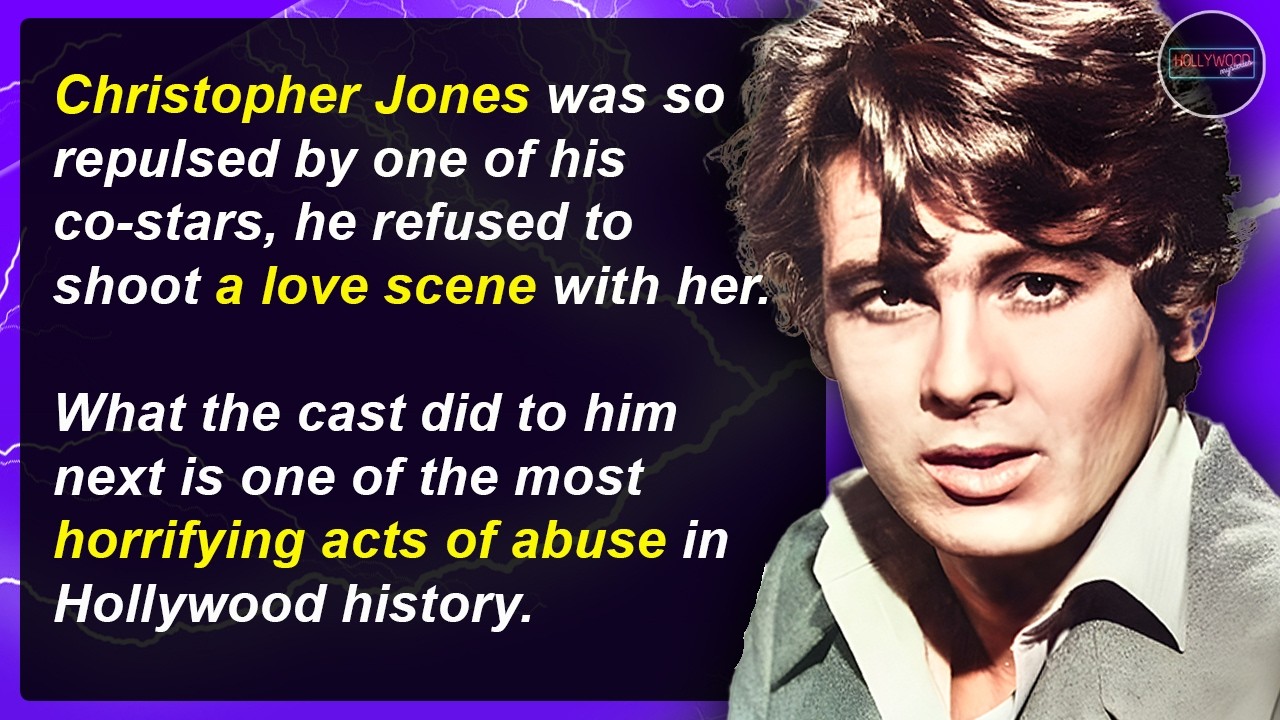
Born William Franklin Jones on August 18, 1941, in Jackson, Tennessee, his early life was defined by loss and institutionalization. His mother, unable to cope after his father’s death, left him at an orphanage, a place that was not cruel but was undeniably institutional. The gap between the fantasy world he watched on screen and the reality of the orphanage felt like a canyon. The movies, he would later say, kept him going for a long time.
It was an escape that became a pattern: the sudden departure, the violent recoil from reality, and then the vanishing. Each escape was total, and the aftermath was always silence. His youth was a whirlwind of trouble. He ran away repeatedly, was returned, and spent time in juvenile detention.
By the time he could legally vote, he had already accumulated a police record for car theft and served six months in a military prison on Governor’s Island after turning himself in. Released with no plan and no prospects, he drifted to New York City, where he studied visual art and fell in with a loose confederacy of actors, writers, and drifters. It was there that his striking good looks—so reminiscent of the late James Dean that people often had to be told Dean was really dead—opened doors. His Broadway debut in *The Night of the Iguana* alongside Bette Davis and Margaret Leighton brought him to the attention of the industry.
It was during this run that he formed a friendship with Shelley Winters and began a relationship with actress Susan Strasberg, the daughter of famed acting teacher Lee Strasberg. Their marriage lasted barely three years, ending, according to Strasberg, because of Jones’ mental instability and his struggles with drugs. When the television series *Jesse James* was canceled, Jones leapt to film. His first lead was in *Tabasco* (1967), a melodrama about a hot-headed drifter forced into hard labor on a tuna boat.
He made three films in a single year, each turning a profit. During this period, shuttling between London and Rome, his personal life became entangled with the doomed archetype of the late ’60s: the beautiful, self-destructive young man running on charisma and narcotics. He was frequently compared to Jim Morrison, with whom he shared overlapping circles and a similar public image. It was during this chaotic time that he met and fell for Sharon Tate.
The claim of their love affair rests almost entirely on Jones’ own late-life testimony, as there is no independent contemporaneous documentation to confirm it. Yet the observable record of his career after her death lends it the weight of something real. In 1968, he married the love of his life, but it was a decision that proved fateful. While on set for *Ryan’s Daughter*, Jones was reportedly struggling.
He could not master a convincing English accent for the role, and his co-star, Sarah Miles, later noted that he seemed distinctly disturbed about something, so much so that he could hardly perform. Director David Lean, dissatisfied with Jones’ vocal performance and emotional hollowness—which may have been grief, sedation, or both—made the decision to have all of Jones’ dialogue re-recorded in post-production by another actor. When audiences watched *Ryan’s Daughter*, they saw Jones’ face but heard someone else’s voice. It was a public humiliation on a massive scale.
Despite the professional disaster, Jones was still a star. The most famous refusal of his career came when Quentin Tarantino, decades later, courted him for a role. It was the most famous “no” in a career made almost entirely of refusals. Jones simply walked away from it all: six feature films, one television series, and a voice erased from his most prestigious role.
He returned to California and, for nearly 25 years, disappeared from public view. He gave no interviews, made no films, and did not engage with the industry in any observable way. He simply stopped. When he resurfaced, the explanations were fragmented.
In a rare interview with the Chicago Tribune in 2000, he said simply, “I am happy. ” He added, with disarming openness, “The death of Jim Morrison really [messed] me up more than anything else. ” He did not grant confessional interviews or construct a narrative of Hollywood betrayal. He simply withdrew, first into the Sunset Strip drug scene, and then into a quieter life.
He formed a long-term partnership with Paula McKenna, the mother of five of his seven children, who acted as a gatekeeper between Jones and the world he had left behind. The contradictions in his story, however, extend beyond his career. His relationship with Sharon Tate is the hinge on which his career story turns, but his connection to actress Olivia Hussey pivots on something much darker. In her memoir, Hussey alleged that Jones sexually assaulted her in 1969.
She stated the assault took place in the house on Cielo Drive, the same address where Sharon Tate had been murdered only weeks earlier. She described the attack in stark terms, saying she did not know if he was going to kill her, and that the relationship had been abusive, a pattern of violence rather than an isolated event. She ended the relationship and soon after married Dean Paul Martin. It is critical to note that this allegation, though made publicly and on the record, was never followed by criminal proceedings or legal adjudication.
The claim was made decades later, and while it collapses the symbolic geography of Jones’ story into a single, unbearable point, it remains an unproven allegation. The public memory of Christopher Jones can no longer be assembled without reckoning with both events: the tragedy he suffered and the tragedy he was publicly accused of inflicting. Whether his total withdrawal from the world was an act of self-preservation, repentance, or self-destruction—whether it was courage or collapse—is a question that remains unanswered. He was a man who had absorbed and given more damage than any 29-year-old should have to.
And then, he simply vanished.