In May 1960, Prince Aly Khan was killed in an automobile accident near Paris. He was 48 years old. When Rita Hayworth received the news, she wept. The marriage that had once been one of the most glamorous in the world was long over by then.
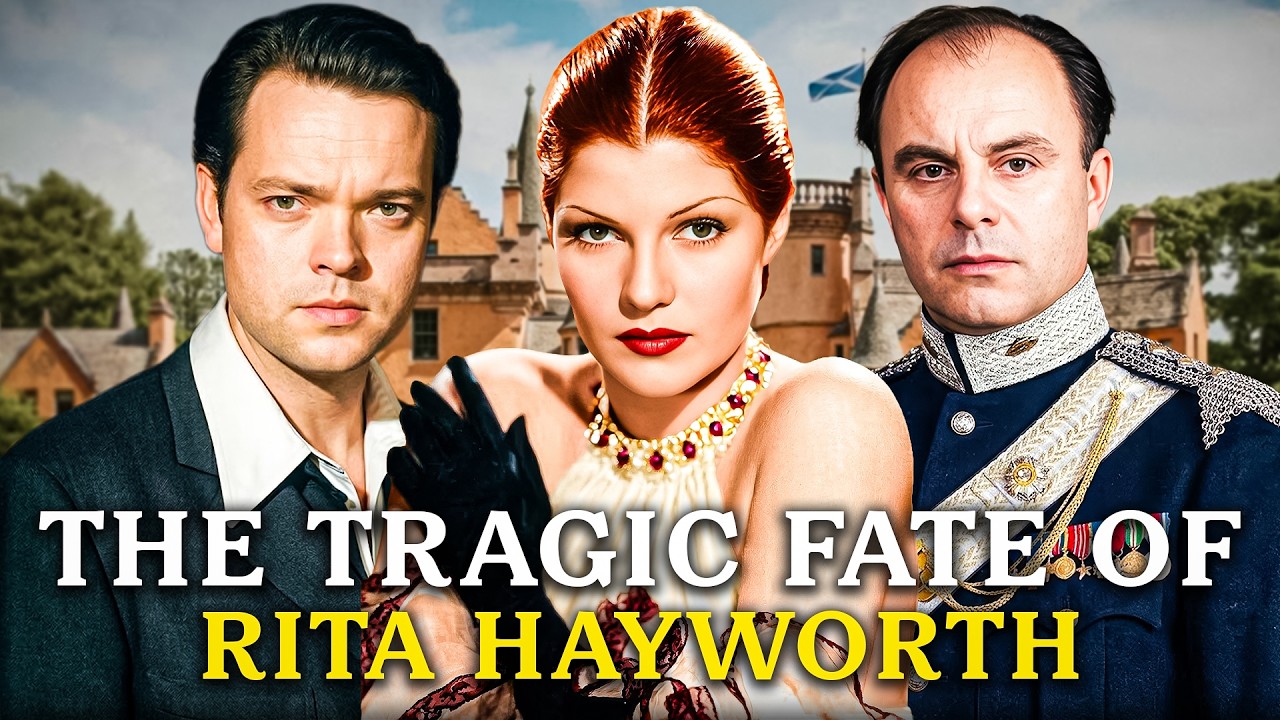
But the bond was never entirely broken. Rita Hayworth was born Margarita Carmen Cansino on October 17th, 1918, in Brooklyn, New York. Her father, Eduardo Cansino, was a Spanish-born flamenco dancer. Her mother, Volga Hayworth, was a former Ziegfeld Follies showgirl.
She was performing professionally by age 12, and in her mid-teens she was dancing in Mexican nightclubs in Tijuana with her father. Accounts during her lifetime suggested the relationship with her father crossed boundaries that no father-daughter relationship should. Rita rarely spoke about it directly, but those closest to her understood the early years left marks that never fully healed. A Fox Film Corporation executive discovered her in 1935.
She was 16. In 1937, she married Edward Judson, a businessman 30 years her senior. Judson recognized her star potential and set about remaking her. Her dark hair was dyed auburn and then red.
Electrolysis altered her hairline. Her name changed to Rita Hayworth. The transformation worked professionally. Columbia Pictures signed her, and by the early 1940s she became one of the biggest stars in Hollywood.
Her role in Gilda in 1946 made her synonymous with desire itself. But Judson was controlling, and by accounts that emerged over the years, emotionally abusive. The marriage ended in 1943, when Rita was 24. Her second marriage, in 1943, was to director and writer Orson Welles.
They had a daughter, Rebecca, born in 1944. But Welles was perpetually distracted and perpetually broke. The marriage unraveled, and by 1947 Rita was single again at 29. In the spring of 1948, she went to Europe.
She met Ali Khan. Prince Ali Khan was the son of Sultan Mohammed Shah, the Aga Khan III, the Imam of the Nizari Ismaili Muslims, a community of millions. The Aga Khan was one of the wealthiest men in the world. Ali was his heir in the worldly sense.
Ali Khan had grown up across continents, educated in England and fluent in several languages. He was a serious horseman, and his racing stables were among the most celebrated in Europe. During World War II, he served with distinction in the British and French armies, earning decorations for his work in intelligence and combat operations in Syria, North Africa, and Italy. He was also, by widespread reputation, extraordinarily attentive to women.
He had been married before to Joan Yarde-Buller, a British socialite with whom he had two sons, Karim and Amyn. That marriage ended in 1949, just as things between Ali and Rita were reaching their most intense. When Ali Khan met Rita Hayworth in Cannes in May 1948, he had reportedly arranged the introduction deliberately. Rita was in Europe partly to recover from the end of her marriage to Orson Welles and from the exhausting demands of Columbia Pictures head Harry Cohn.
The summer of 1948 along the French Riviera was one of the more glittering social seasons on record. Ali Khan, who had rented a sprawling estate near Cannes called the Chateau de l’Horizon, pursued Rita with concentration that was focused to the point of being overwhelming. He gave her his full attention, in a way she had rarely experienced from a man. People who knew her during this period said he made her feel genuinely seen, not as a studio commodity but as a person.
By the late summer and fall of 1948, they were inseparable. The coverage was enormous, partly because Rita was still technically married to Orson Welles as divorce proceedings moved through the courts. Harry Cohn back in Hollywood was furious. In December 1948, Rita discovered she was pregnant.
Neither she nor Aly was yet free to marry. The situation was, by the standards of the time, genuinely scandalous. The Vatican weighed in. Aly accelerated his divorce proceedings.
Rita’s divorce from Welles was finalized in November 1948. On May 27th, 1949, at the Chateau de l’Horizon, Rita Hayworth and Prince Aly Khan were married. Nearly 70 guests attended, including the Duke and Duchess of Windsor. The village below the chateau was overwhelmed by crowds who had come to watch.
Their daughter, Yasmin, was born on December 28th, 1949. On the surface, everything looked like a fairy tale. But something had already begun to go wrong. By most accounts, Aly Khan was not a bad man.
He was generous, warm, and genuinely loved Rita. But he had never organized his life around any one person. His social demands were relentless. He was expected at race meetings across England, France, and Ireland, at dinners, at hostings, at the events that constituted the rhythm of his life.
And then there were the women. Aly Khan’s reputation before the marriage was well known. But awareness in the abstract is different from the daily reality of being married to a man whose charm did not turn off because he had acquired a wife. Rita had also discovered that the life of a prince’s wife was not the same as the life of a movie star.
In Aly’s world, she was expected to be available for his schedule. She was expected to appear at race meetings even though she had no interest in horse racing. She was frequently, by accounts of those who were there, exhausted and out of place. Rita, despite her fame, was a deeply shy and introverted woman in private life.
The screen persona was a performance. Off camera, she was uncertain, prone to anxiety, and desperately in need of emotional security. By 1951, the marriage had deteriorated to the point where separation was inevitable. Rita took Yasmin and returned to the United States.
What followed was a public, prolonged, and at times humiliating battle that dragged on for years. Harry Cohn moved quickly to collect on the films Rita owed Columbia Pictures. She was put back to work in 1952 in Affair in Trinidad, designed to capitalize on the Gilda image. It performed well at the box office.
It did not particularly satisfy Rita. The divorce was formally completed in January 1953. The negotiations over Yasmin were among the most difficult parts. They reached an arrangement, but it was never entirely comfortable.
Aly Khan was reportedly devastated by the end of the marriage. He had genuinely loved Rita in the ways he was capable of. People who knew him well said the loss marked him. After the divorce, Rita married twice more.
Her fourth marriage in 1953 was to singer Dick Haymes. It was worse than the marriage to Ali Khan. Haymes was controlling and at times psychologically cruel. He went through her money at an alarming rate and isolated her from people who cared about her.
Rita filed for divorce in 1955. She made more films, Pal Joey in 1957 and Separate Tables in 1958. The talent had not dimmed, but the context had changed. In 1958, she married for the fifth and final time to producer James Hill.
It was relatively quiet by comparison. They divorced in 1961. For much of the 1960s and into the 1970s, murmurs grew about Rita’s behavior. She would forget whole conversations and lines she had rehearsed.
She would seem confused in situations where confusion didn’t make sense. For a long time, this was attributed to drinking. In 1980, Rita Hayworth was diagnosed with Alzheimer’s disease. She was 61 years old.
The erratic behavior and disorientation were not failures of willpower. They were symptoms of a disease that was dismantling the architecture of her mind. Her daughter Yasmin became her primary caregiver. Yasmin became one of the earliest and most prominent public advocates for Alzheimer’s awareness in the United States.
She worked with advocacy organizations and used her mother’s story to draw attention to a disease the public was only beginning to understand. Rita Hayworth spent her final years in New York, cared for by Yasmin. She died on May 14th, 1987. She was 68.
In the late 1970s, before the Alzheimer’s had taken too strong a hold, Rita gave interviews in which she was more candid than at almost any other point in her adult life. She spoke about the gap between who she actually was and who the world had decided she was. She said, in essence, that men fell in love with Gilda, the character, the image, and then were confused and frustrated when they woke up next to her. Ali Khan had been, in some ways, the most dramatic version of this.
He had pursued her with extraordinary intensity and genuinely loved her, or the version of her he could see. The actual Rita, the introverted, anxious woman needing consistency and emotional stability, was harder to accommodate within the life Ali had built. It wasn’t malice. It was the ordinary, grinding failure of two people drawn to images of each other that didn’t fully correspond to the people underneath.
Yasmin Khan chaired the Alzheimer’s Association for many years. Her work helped shape national and international awareness of the disease. Ali Khan is buried in a mausoleum in Salamieh, Syria. Rita Hayworth is buried at Holy Cross Cemetery in Culver City, California, not far from the Columbia Pictures lot.
Rita Hayworth wanted something very simple. She wanted to be known, not as the image, not as the love goddess, not as any of the other things other people needed her to be. She wanted someone to look past the image and find her underneath.
It is not clear she ever fully got that.