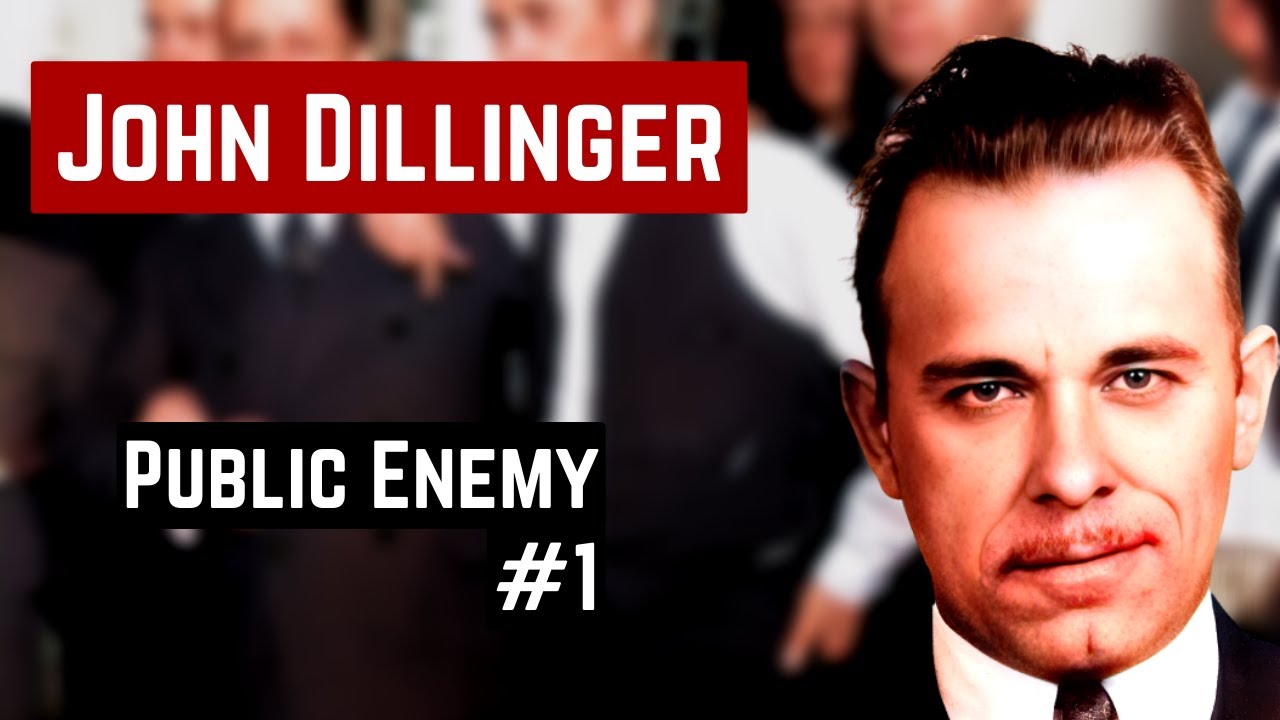
John Dillinger, the man the FBI once called Public Enemy Number One, was gunned down by federal agents outside the Biograph Theater in Chicago on July 22, 1934. The confrontation ended a nearly year-long manhunt and a crime spree that had terrorized the Midwest during the Great Depression. For years, Dillinger’s gang was accused of robbing 24 banks and four police stations, and his violent escapes from jail only cemented his reputation as one of the most dangerous outlaws of the era. Dillinger was born on June 22, 1903, in Indianapolis, Indiana, the younger of two children to John Wilson Dillinger and Mary Ellen Lancaster Dillinger.
He was frequently in trouble as a teenager for fighting and petty theft. His wild and rebellious behavior remained unchanged despite his new rural life, and he was arrested for auto theft in 1922, which soured his relationship with his father. In 1923, Dillinger enlisted in the United States Navy, where he was assigned as a petty officer third class machinery repairman aboard the battleship USS Utah. He deserted a few months later while his ship was docked in Boston and was eventually dishonorably discharged.
Back in Mooresville, Dillinger met Beryl Ethel Hovious, and the two married on April 12, 1924. He tried to settle down but was unable to find work, so he began plotting a robbery with his ex-convict friend Ed Singleton. The two robbed a grocery store, but the heist went wrong when Singleton, who was carrying a gun wrapped in a cloth, discharged it during the crime. No one was hit, but the two men were arrested the following day.
Singleton pleaded not guilty, but after discussing the case with the Morgan County prosecutor, Dillinger’s father persuaded him to confess and plead guilty without retaining a defense attorney. Dillinger expected a lenient probation sentence, but instead, he was sentenced to 10 to 20 years in prison. His father, who regretted giving the advice and was shocked by the sentence, begged the judge to reduce it, but he was unsuccessful. Dillinger became involved in a criminal lifestyle while imprisoned at the Indiana Reformatory and Indiana State Prison from 1924 to 1933.
Upon his admission, he was quoted as saying, “I will be the meanest bastard you ever saw when I get out of here. ” Because of his long sentence, he became resentful of society and befriended other criminals, including seasoned bank robbers Harry Pierpont, Charles Makley, Russell Clark, and Homer Van Meter, who taught him how to be a successful criminal. Dillinger also studied and used Herman Lamm’s meticulous bank robbing system throughout his criminal career. Dillinger’s father organized a campaign to have him released, collecting 188 signatures on a petition.
Dillinger was paroled on May 10, 1933, after serving nine and a half years. With little chance of finding work after his release at the height of the Great Depression, Dillinger immediately returned to crime. He is known to have participated with the Dillinger gang in 12 separate bank robberies between June 21, 1933, and June 30, 1934. Evelyn “Billy” Frechette, known as Billy, first met John Dillinger in October 1933, and the couple began a relationship the following month.
After a dramatic escape from the Lake County Jail, Dillinger reunited with Frechette just hours later. The two traveled to the Twin Cities and stayed at the Santa Monica Apartments in Minneapolis, Minnesota, for 15 days. After meeting John “Red” Hamilton, Dillinger formed a new gang with Baby Face Nelson’s gang, which included Nelson, Homer Van Meter, Tommy Carroll, and Eddie Green. The second gang robbed a bank in Sioux Falls, South Dakota, and the First National Bank in Mason City, Iowa, a week later.
Dillinger and Frechette moved into the Lincoln Court Apartments in Saint Paul, Minnesota, on Tuesday, March 20, 1934, using the aliases Mr. and Mrs. Carl T. Hellman.
The landlord, Daisy Coffey, went to the FBI’s Saint Paul field office to file a report, including information about the couple’s New Hudson sedan parked in the garage behind the apartments. The building was placed under surveillance by two agents, Rufus Coulter and Rusty Knowles, as a result of Coffey’s tip. Coulter and Cummings knocked on apartment 303’s door. Frechette responded by opening the door two to three inches and telling them to wait because she was not dressed.
While the agents waited, Van Meter went to the third floor landing and Coulter followed. Van Meter opened fire on Coulter as he approached the lobby on the ground floor. Dillinger opened fire through the door with a Thompson submachine gun after hearing Van Meter firing at Coulter, sending Cummings fleeing for cover. Dillinger then took a step forward and fired another burst at Cummings.
Cummings retaliated with a revolver, but he quickly ran out of ammunition; one of his five shots struck Dillinger in the left leg. Dillinger and Frechette dashed down the stairs, exited through the back door, and drove away in the Hudson. After Cummings retreated, Dillinger and Billy visited Dillinger’s father in Mooresville. On April 7, Dillinger and his brother Hubert rear-ended a couple on the road.
Within hours, swarms of police arrived at the accident scene only to find an empty car on the side of the road. Dillinger had a meeting at a tavern at 416 North State Street on Monday, April 9. Billy went in first, sensing trouble, and was quickly apprehended by agents. She refused to reveal Dillinger’s location.
Dillinger waited in his car outside the tavern before driving away unnoticed. She would never see him again. In charge of the Chicago field office was Special Agent Melvin Purvis. Several agents approached the theater on the evening of July 22.
Agents yelled for the car to come to a halt, but the driver did not hear them. Agents opened fire, killing the driver. Dillinger and his gang were upstairs in the lodge when they began shooting out the windows while the agents ducked for cover. Dillinger and his men escaped through the back door.
Dillinger then relocated to Michigan’s Upper Peninsula and then to Chicago, where he assumed the alias Jimmy Lawrence. The FBI had formed a Dillinger task force and dubbed him Public Enemy Number One. By this point, they had found his abandoned car in the city. The FBI was aware he was in town, but the team was unable to find any leads for several months.
In another attempt to elude law enforcement, Dillinger paid a plastic surgeon five thousand dollars to change his appearance near the end of May. His moles and scars were removed, his famous chin cleft was filled in, and his fingerprints were burned away. “I don’t look any different than I did before,” he allegedly said while looking in the mirror. Rita Hamilton fled Fargo, North Dakota, and made other companies in Gary, Indiana.
She worked as a prostitute in Anna’s brothel on the side. In agreement, she told the FBI everything she knew about Dillinger’s whereabouts. This enabled them to set up surveillance in the area where he was staying. The FBI task force surrounded the theater on the evening of July 22nd while Dillinger and Hamilton were watching the show.
Purvis stood by the front door, lighting a cigar to signal Dillinger’s departure. Dillinger turned his head and looked directly at the agent as he walked by, then glanced across the street. He moved ahead of his female companions and reached into his pocket. According to both him and the other agents, three men pursued Dillinger into the alley and fired.
Clarence Hurt shot twice, Charles Winstead did three times, and Herman Hollis once. Dillinger was hit from behind and fell face first to the ground. According to a New York Times report the next day, Dillinger was shot and killed by special agents on July 22, 1934, around 10:40 pm.
Dillinger died only two months after fellow notorious outlaws Bonnie and Clyde were killed, marking a definitive end to the public enemy era of the Great Depression.