In the final weeks of 1944, inside a stone barracks in Verdun, American commanders gathered to confront a collapsing front. The German offensive through the Ardennes had torn a gap 60 miles wide, the weather was closing in, and no one in the room was certain where their own lines still ran.
Eisenhower looked at the tense faces around him and said something that sounded almost ridiculous in the moment: the situation should be treated as an opportunity, not a disaster. Then he turned to Patton and asked how fast he could relieve Bastogne.
Patton had been waiting three days for exactly that question. His answer came without a second's pause: 48 hours.
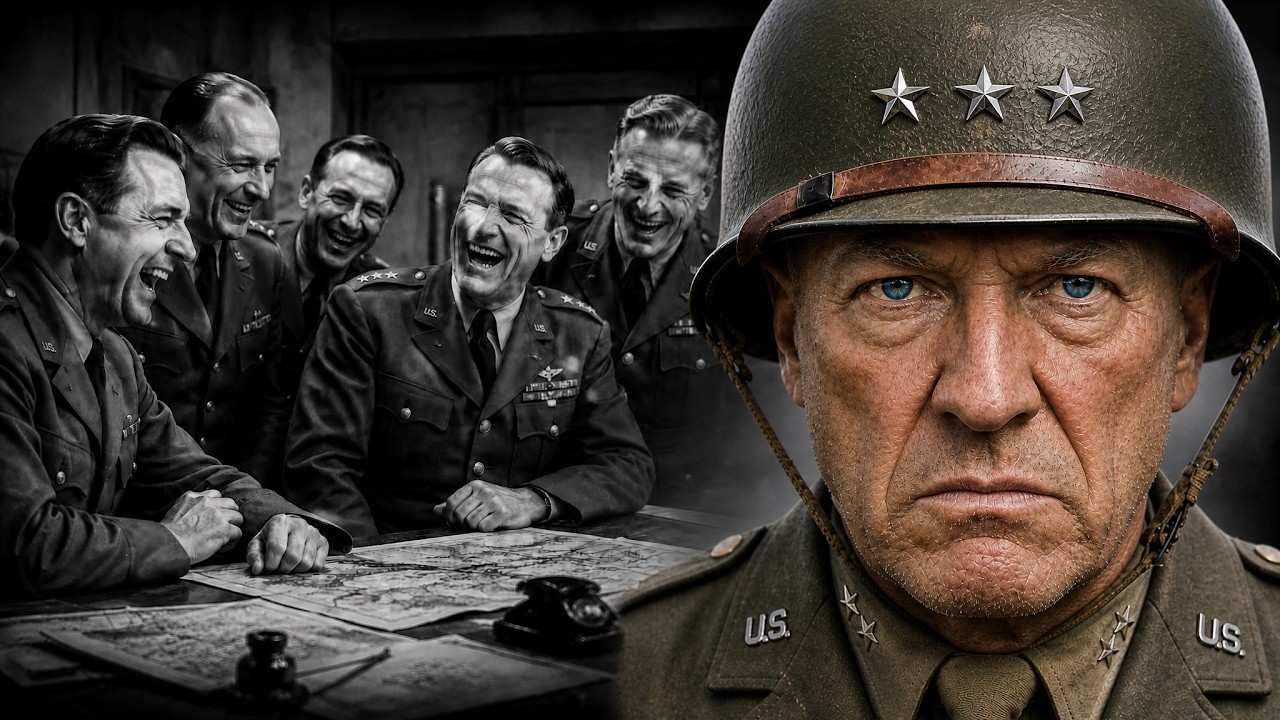
Some of the men in the room laughed. Turning an entire army 90 degrees in the dead of winter, on icy roads, in total darkness, in 48 hours sounded absurd to most of them. A week later, nobody was laughing.
The German attack had begun on December 16, when Manteuffel's tanks rolled west through thick fog. The weather was chosen on purpose. It was too bad for flying, which meant no Allied bombers could stop the columns from above. Surprise was total. The Americans had considered this stretch of front quiet, almost forgotten.
Manteuffel's scouts used the fog to slip past the strongest American positions and push through the gaps. In the middle sat an American division barely a week on the front line, green and untested. Within a day, two of its three regiments were surrounded. Nearly 9,000 American soldiers were cut off from supply, out of ammunition, with no way back.
So far, everything was going to plan for the Germans. But while Manteuffel watched the west, something was happening in the south that did not show up on any of his maps.
The Americans had no air support of their own. The same weather protecting the German columns kept their bombers grounded. Along the supposedly quiet stretch, American positions collapsed. Whole companies retreated or surrendered. Radios went dead. In Allied command posts, fear grew of a breakthrough all the way to Paris, with the memory of 1940 still fresh.
The German push, however, ran on something that never arrived. Hitler's promised reserves did not show. The Luftwaffe did not show. And the captured American fuel depots the whole plan depended on never fell into German hands in the quantities needed. Every kilometer further west only widened the gap to Germany's own supply depots, and Manteuffel saw it more clearly in the fuel reports every single day.
Right in the middle of that gap sat Bastogne. Seven roads met there, and whoever held them controlled movement for 50 kilometers in every direction. Manteuffel's order was to bypass it, surround it, and keep moving without wasting time.

The American 101st Airborne reached the town only hours before the last roads closed. That left 11,000 American paratroopers with no winter gear, ammunition running lower by the hour, and wounded men lying on frozen ground with no morphine.
On December 22, four German soldiers approached the American line under a white flag. They carried a written ultimatum: surrender the town or face annihilation by German artillery. The demand climbed the chain of command until it reached Commander McAuliffe. His answer was exactly one word: "Nuts."
To the Germans, it was pure provocation. In the frozen foxholes, that one word ran through the men like an electric current. Surrounded, outnumbered, almost out of ammunition, their commander had just told the entire German army to go to hell. Men who had not seen a hot meal in days passed the word from hole to hole until the whole line knew it. It was enough to get through the night.
For Manteuffel, Bastogne was just an obstacle. For Patton, the same town became a deadline. Three hundred kilometers to the south, he was already preparing the next move.
While other generals were still laughing at him, Patton was already giving orders. He reached for the phone while Eisenhower was still nodding. The movement was underway before the meeting was even over.

Some 200,000 men, their vehicles, and their entire supply chain were turned around in under 72 hours, in the dead of winter, on icy roads, in total darkness. Drivers navigated by the breath of the man ahead of them. Engines that had sat cold for days had to be cranked back to life by hand.
While the columns rolled north, Manteuffel was bent over his fuel report. The danger that would end his entire campaign did not appear on a single one of those lists. Maps were redrawn on the move because the old routes were already blocked by German columns. Men slept standing up, leaning against their own guns, and woke the moment the column started rolling again.
A German scout reported dust on the southern horizon and took it for his own supply column at first. Then the first shells hit.
On December 26, Patton's lead tanks reached the southern edge of Bastogne. Ten days after the German offensive began, the ring was broken. That exact report was soon sitting on Manteuffel's desk.
He knew Patton's reputation. He had factored in his risk-taking. What he had not accounted for was something colder: Patton was already fighting the next battle while everyone else was still fighting this one.
In those very days, Manteuffel himself studied every fuel report, every weather pattern, every gap on his own map. Hidden inside all that careful attention was the one threat he never saw coming. Historians still rank him among the most capable German commanders of the entire Ardennes offensive. Yet he was the one who got the only question wrong that ended up mattering, not whether Patton was coming, but how fast.
Operation Autumn Mist ended in January 1945. Every objective went unmet. Manteuffel survived the war, later served in the West German Parliament, and spoke of his old opponent with respect for decades to come.
Patton died six months after the war ended in a car accident in Germany. He is buried among his own soldiers in Luxembourg, less than 50 miles from the road his tanks took into Bastogne. The distance Manteuffel could not explain, Patton had already closed before anyone on the German side even knew there was a race.