The death of Ellsworth “Bumpy” Johnson in July 1968 marked the end of an era in Harlem, but the silence that followed his passing spoke louder than any legend. Before the funeral, before the flowers and the crowds, there was an empty chair at Wells restaurant—a place where the notorious figure had once sat, a detail that stripped away the myth and left only the man. His life had been surrounded by danger for so long that his death, which came without drama or warning, felt like a sudden stop in a story that had always been in motion. It was not the result of a grand shootout but a quiet moment that turned into a permanent absence.
To understand why his death mattered, one has to understand the Harlem that existed before that night—a world of contradictions. Bumpy was a man who could read philosophy and operate inside an illegal economy, a man who spoke politely while living inside a violent world. He was a bridge between Black Harlem and Italian organized crime, two communities that rarely trusted each other, and he moved between them with a skill that made him both powerful and dangerous. That arrangement lasted because both sides benefited, but it also meant that every bridge has people standing on both sides, and Bumpy stood at the intersection of it all.
His legal troubles were constant. He had already served a long federal sentence for drug conspiracy, much of it at Alcatraz, and the pressure on him was not just about money. The people around him wanted results, not discipline, not patience, not waiting. A famous criminal is never surrounded only by friends, and Bumpy knew that the most dangerous person in a room was not always the man with the gun.
He understood that if you showed fear, someone could use it, and that was how death usually enters a life—without permission, without drama, without warning. When the news spread through Harlem, it moved from the hospital to the telephone calls to the streets. At first, people could not believe it. Then they began to understand.
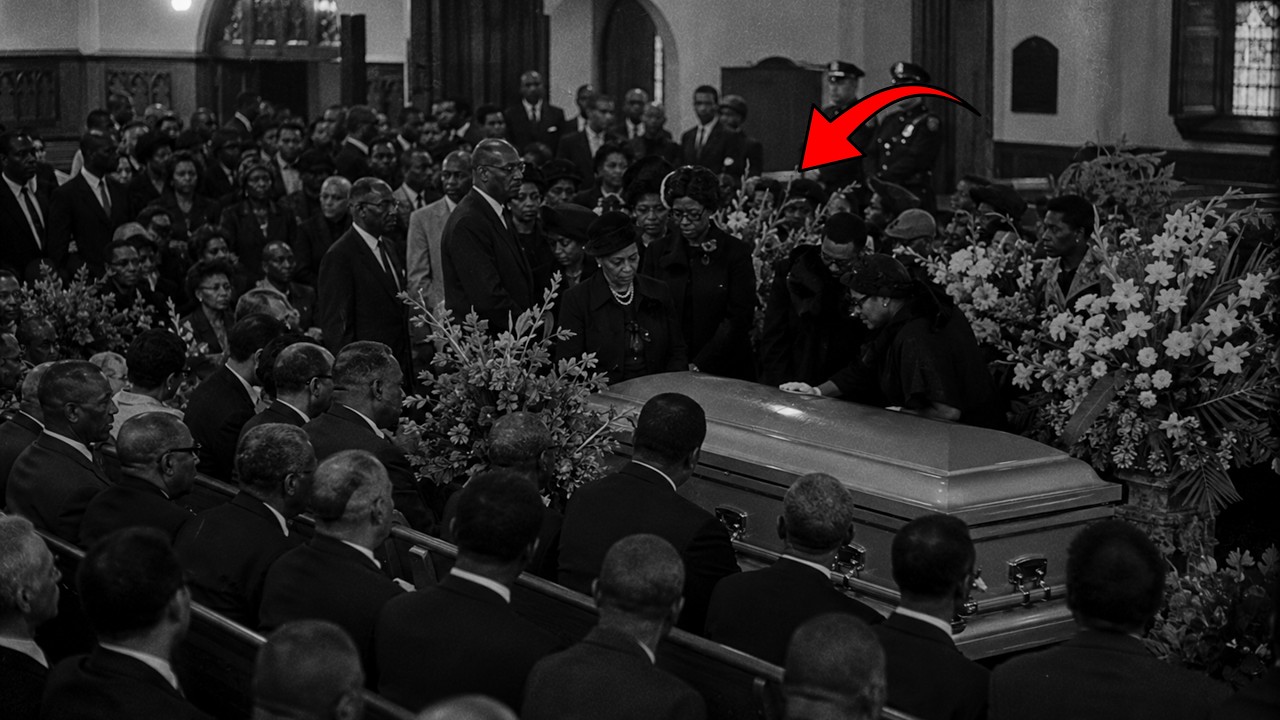
The funeral became a public event, with people coming quietly at first, then more, then more. Some looked for only a few seconds before turning away, and the question of who Bumpy Johnson really was hung in the air. The crowd was real, but so was the tension between the man and the legend. Some remembered his violence, others his generosity, and all of them could be talking about the same person.
That contradiction was the real story. If everybody had agreed about Bumpy, the story would have ended at the cemetery, but the disagreement kept it alive. He had been there before the television cameras, before the movies, before the legends became entertainment. Now he was lying inside a coffin, and the room belonged to everyone else.
For a moment, the criminal record disappeared—not because it had been erased, but because a funeral is not a courtroom, and nobody was there to determine guilt. Inside, his life was being measured by relationships, not by a rap sheet. Bumpy’s life had always existed between those two realities. He was not the most powerful man in New York, but he was one of the most recognizable, and his death left a vacuum in the neighborhood’s underworld.
People would say “back when Bumpy was around,” a phrase that divided Harlem into before and after. That observation was more important than it sounded because it meant his real power had never been the empire people imagined. It was the respect and fear he commanded, and that could not be inherited. The public gained a story, but the private man remained a mystery.
Books would be written, and the legend would grow, but the real Bumpy was somewhere underneath all of it. He had survived returning to Harlem after more than a decade away, but the world had changed. Television, film, and popular culture would eventually turn him into a character, but the man himself could not be reduced to a single label. The truth lived somewhere between the hero and the villain, and holding both sides at once was perhaps the most responsible way to remember him.
In the end, the most important image was not the coffin or the crowd but the chair at Wells restaurant—an ordinary chair on an ordinary day, now empty forever. A death like that becomes a dividing line between two eras, and the memory of Bumpy Johnson would only grow as the world that created him changed. The contradictions never resolved, and that kept the story alive. He was a man who lived inside a violent system and became exceptionally skilled at surviving it, but the real man was more complicated than any legend.
After death, everyone else gets to explain him, but the stories are becoming harder to separate from the myths. The historical record would always contain an unfinished sentence, but the memory of a man who could not be reduced to one thing endures. The funeral revealed the distance between a criminal record and a human relationship, and the name survived long after the world that created it had changed. As long as someone asks what really happened in that Harlem restaurant in July 1968, the story is not finished.
Bumpy Johnson’s story is not simply about crime or glamour; it is about a man who lived between worlds and became a symbol of an era. The real man did not die in the spotlight but in an ordinary moment, and that is perhaps the most honest ending the story can have. The crowd, the flowers, and the newspapers were temporary, but the memory of a man who could not be replaced remains.
And as long as the story is told, Bumpy Johnson lives on—not as a hero or a villain, but as a complex figure who shaped Harlem in ways that still echo today.