On April 14, 1945, the war in Europe had perhaps three weeks left to run. No one standing in the rubble of central Germany knew that with certainty.
What they knew was this: the roads were clogged with retreating Wehrmacht columns, with SS rearguard units burning documents and shooting deserters, and with American armored columns pushing forward so fast that supply lines strained to follow.
General George S. Patton Jr., age 59, commanded the United States Third Army. He had driven it from the beaches of Normandy through the Lorraine, through the Bulge, across the Rhine, and now deep into the German interior.
He slept perhaps four hours a night. He read battlefield maps the way other men read novels, with complete absorption and with instinct sharpened by 40 years of professional soldiering.
He was not a gentleman. He was not a patient man. But he was, in the precise and documented sense of the word, a particular man — particular about discipline, about conduct, about what soldiers under his command did and did not do in the presence of unarmed civilians.
That particularity was about to be tested in a small German town southeast of Weimar, in the Thuringian Hills, where a unit of the Fourth Armored Division encountered something that did not fit neatly into the rhythm of pursuit warfare.
The Fourth Armored Division had been Patton's favorite instrument since the breakout from Saint-Lô the previous summer. Its commander, Major General William Hoge, was an engineer turned armored commander whose instinct for rapid movement matched Patton's own.
The division had liberated Bastogne's relief corridor in December. It had crossed the Rhine in March. By April, it was operating in the kind of fluid, fast-moving environment that armor doctrine had always promised but rarely delivered.
Deep penetrations, bypassing pockets of resistance, securing road junctions before German commanders could organize coherent defense — this was the work of the spring of 1945.
The terrain in Thuringia that April was a mixture of forested ridgelines, small river valleys, and agricultural villages spaced roughly 5 to 12 kilometers apart along secondary roads. The forests still held snow in the shadows.
German resistance in this zone was inconsistent. Here a roadblock held by teenagers in Volkssturm armbands surrendered after one burst of machine gun fire. There a dug-in Tiger tank cost an afternoon and two Shermans to reduce.
The pace of advance created inevitable gaps — not gaps in the line, because there was no line in the traditional sense, but gaps in knowledge. What lay in the next village was unknown until the lead vehicle turned the corner.
On the morning of April 14, a reconnaissance platoon from Combat Command B of the Fourth Armored entered a village. The name is rendered variously in after-action reports, but the incident itself is documented through Third Army records, Fourth Armored Division logs, and subsequent tribunal proceedings.
What the platoon found stopped them.
The bodies were arranged along a low stone wall at the edge of the village square. Twelve of them. Civilian dress. Men ranging in age from what appeared to be late middle age to elderly. No weapons near them.
Shell casings lay on the cobblestone, still bright in the morning light, not yet tarnished by weather. The platoon leader, a first lieutenant whose report survives in the Third Army G-2 file, noted in his initial radio transmission a single phrase that would travel up the chain of command with uncommon speed: "Civilians recent execution style."
The German unit responsible had not entirely left. Two SS enlisted men were found in a barn at the edge of the village, apparently waiting for transport that had not come. They were detained without incident.
The officer who had commanded the action, a Hauptsturmführer — the SS rank equivalent to an Army captain — was found at a farmhouse 300 meters from the square, along with a driver and a radio operator. He offered no resistance.
By midday, the situation had been reported through channels to Combat Command B Headquarters. By early afternoon it had reached the desk of the Third Army G-3. By 1600 hours, General Patton had been informed.
What Patton knew in the spring of 1945 about the conduct of SS units was not theoretical. He had been present at the liberation of Ohrdruf, the Buchenwald subcamp, on April 4, ten days earlier. He had walked through it with Eisenhower and Bradley.
The photographs from that day show him standing at the edge of a pit, jaw set, eyes level, hat square. He said nothing publicly in that moment that was recorded. What he said privately was preserved in his diary and in letters to his wife, Beatrice — a controlled fury expressed in the clipped declarative sentences of a man who had decided that restraint in public was a professional discipline, not an emotional one.
He had also received and reviewed multiple after-action and intelligence reports documenting SS executions of Allied prisoners of war. Most infamously, the Malmedy massacre of the previous December, in which soldiers of the First SS Panzer Division had shot 84 American prisoners in a field near the Baugnez crossroads.
Patton had read the First Army investigation. He had been briefed on the details. He had filed them.
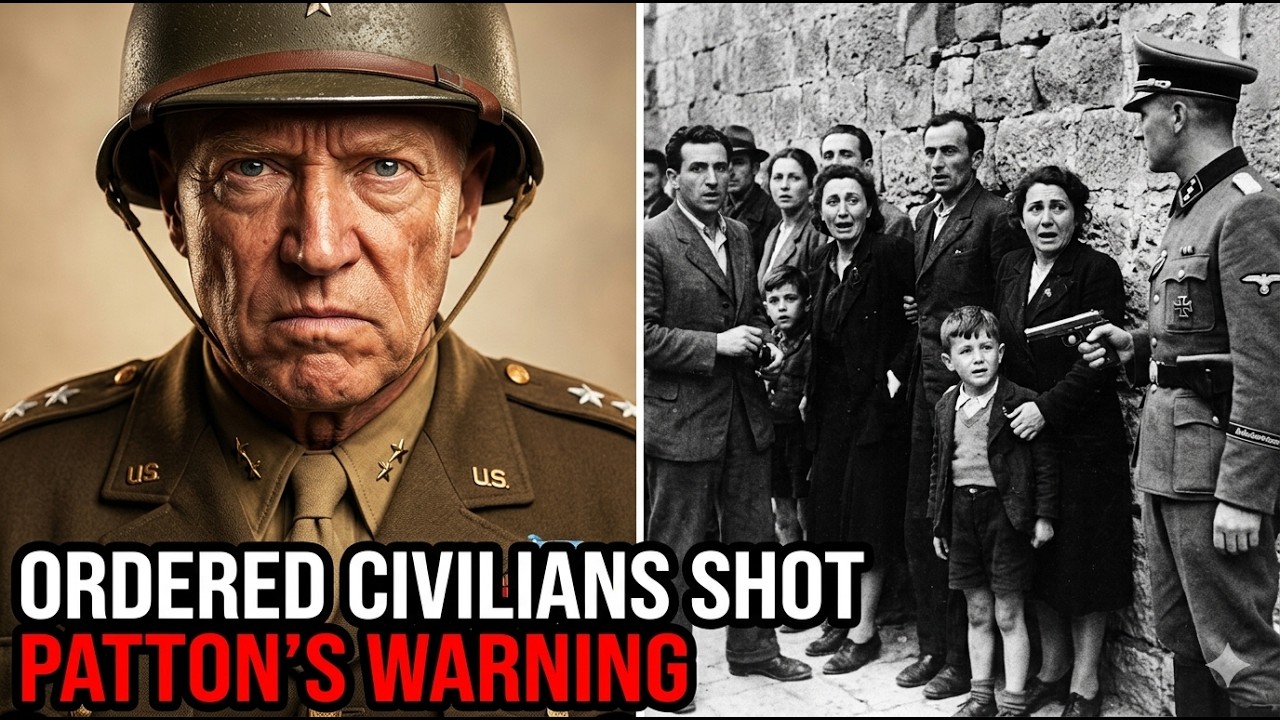
So when the report from the Thuringian village reached him on April 14, he was not encountering this category of event for the first time. What made this instance different — what prompted his decision to go forward personally — was a combination of factors that are individually documented and collectively significant.
First, his proximity. Third Army headquarters had advanced to Hersfeld, and the incident location was within reasonable driving distance.
Second, the prisoner was in hand. This was not a case of documented atrocity with perpetrators unknown or fled. The officer who gave the order was sitting in American custody, and there was a real, immediate command-level question about what to do with him in the next 48 hours before the formal prisoner of war processing system absorbed him into its bureaucracy.
Third, the mayor of the village had been brought to the Combat Command B command post and was asking, through an interpreter, what would happen. Real people, real faces, real requests for something that translated roughly as acknowledgement — that what had been done to their neighbors had been witnessed and would not pass without consequence.
Patton drove forward on the morning of April 15. The convoy was small by his standards: his command car, a Jeep with a security detail, and a follow vehicle. He preferred to travel light when traveling fast, and on this kind of visit — not an inspection, not a press event — he wanted no entourage.
His aide, Major Charles Codman, rode with him. An interpreter, an Army captain of German Jewish origin who had immigrated to the United States before the war, and whose name appears in Codman's memoir as simply Captain Maller, accompanied them.
The road from Hersfeld into the Thuringian hills took approximately 90 minutes at the speeds permitted by road condition and security protocols. Patton used the time to read the written report prepared for him — two pages of close-typed text covering the physical evidence, the prisoner interviews to date, and the identity documents taken from the detained SS officer.
He annotated it in the margin with a pencil in the compressed shorthand he used for battlefield notes.
The SS Hauptsturmführer had served in the 3rd SS Panzer Division Totenkopf, the Death's Head — one of the original concentration camp guard formations before its conversion to a combat unit.
His service record, reconstructed from the documents on his person and from the division's partial records, showed action on the Eastern Front from 1941 through 1943, reassignment to France in 1944, and movement to the German interior in the final months of the war as part of rear area security operations.
He was 31 years old. He held the Iron Cross second class and a wound badge from the Eastern Front. As of the morning of April 15, he had said very little to his American captors beyond confirming his name, rank, and service number.
The 12 men in the village square had been accused, according to documents found on the Hauptsturmführer, of harboring deserters. The documentation was formal in its structure — a field order signed by the SS officer himself, citing the authority of a standing order regarding the treatment of civilians who assisted Wehrmacht personnel in unauthorized absence from their units.
The order had been carried out at approximately 0530 on the morning of April 14, in the predawn dark before the American advance reached the village. The 12 men had been lined up. They had been shot.
The SS unit had moved on. The Combat Command B forward command post was established at approximately 10:45. Patton went directly to the briefing room, a requisitioned farmhouse with a large table and maps pinned to the walls, and received a 10-minute briefing from the Combat Command B commander.
He asked two questions. The first was about the physical evidence: Had it been photographed, cataloged, preserved in the form required for subsequent legal proceedings? The answer was yes.
The second question was about the prisoner: Was he in condition to speak? The answer was also yes.
The Hauptsturmführer was brought to a room that had been used as a storeroom, now empty except for two chairs and a table. He was in the field uniform he had been wearing when detained, minus his sidearm and his belt. He was uninjured. He sat upright.
Patton entered without ceremony.
What follows is drawn from two sources: Major Codman's memoir, published in 1957, and a letter from Captain Maller — whose full name was later identified as Captain David Maller — written to a colleague in 1962 and preserved in a private collection later donated to the United States Army Military History Institute at Carlisle Barracks, Pennsylvania.
Both accounts agree in their essential content, though they differ in small details of phrasing, as eyewitness accounts invariably do.
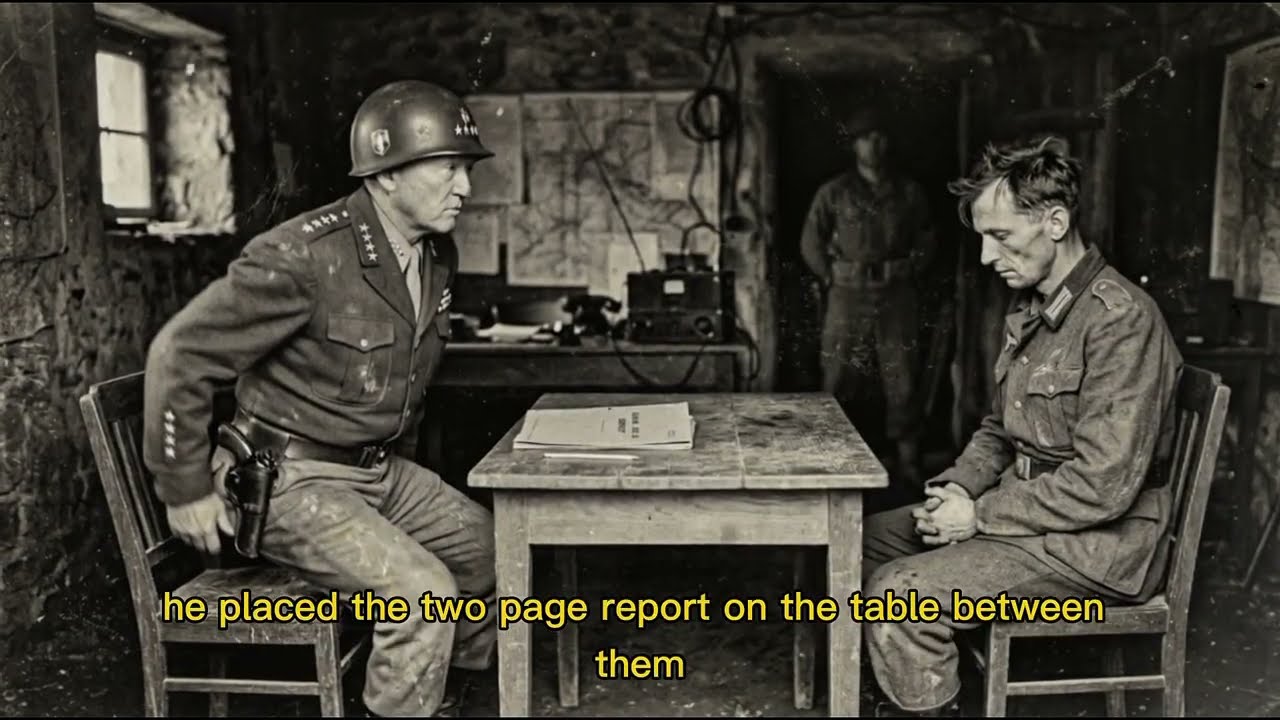
Patton sat down across the table from the SS officer. He placed the two-page report on the table between them, face down. He said nothing for approximately 30 seconds.
This was not theater. Those who knew Patton understood that his silences before speaking were the intervals in which he organized his thoughts into the precise form he wanted them to take.
Then he spoke in English, which the interpreter rendered into German. He said, "You signed an order. 12 men are dead in that square. I've read your order. I want to know one thing. Did you believe, at the moment you signed it, that those men were guilty of what you accused them of, or did you sign it because you were ordered to produce a number?"

The Hauptsturmführer answered in German that he had acted on information received from a local informant and that the order was consistent with standing directives.
Patton listened to the translation. He did not move. He said, "That is not an answer to the question I asked."
There was another silence. The SS officer looked at the table. He said, in German, that he had not independently verified the information.
Patton said, still in the same level tone, "So, you shot 12 men in the dark based on something somebody told you without verification, and you wrote an order to give it the appearance of legality."
The interpreter translated. The Hauptsturmführer did not respond.
What Patton said next is the moment that Codman and Maller both record with particular care, because it was neither an outburst nor a condemnation in the theatrical sense. It was, both men noted independently, a statement delivered in an almost clinical voice — flat, without emphasis, without the parade ground bark that Patton was known for when addressing troops.
He said, "I've seen what men like you leave behind. I've walked through it. I've made my general officers walk through it so they can never say they didn't know. You killed those men because it was easier than protecting them, and you wrote a paper to call it law. That paper doesn't make it law. It makes it murder, and the difference matters because men like you keep telling yourselves it doesn't."
He said, "You will be processed according to the Geneva Convention and held for formal proceedings. I am recommending to my staff judge advocate that the documentation in this case be forwarded immediately to the war crimes investigation unit. What happens to you after that is not in my hands, but I want you to know that someone who walked through Ohrdruf 10 days ago looked at your order and looked at those men in that square, and he saw exactly what it was."
He picked up the report from the table and walked out.
The encounter lasted less than eight minutes.
Codman, who waited in the corridor, wrote that Patton came out of the room without speaking, walked to the external door of the farmhouse, stood in the morning air for approximately two minutes, and then turned to the Combat Command B commander who had followed him and asked, in a completely business-like tone, about the status of fuel resupply on the division's right flank.
The war did not pause. It never paused. That was the reality of command at that level in that phase of the campaign — the capacity to hold a moral accounting in one hand and a logistics problem in the other, and to put each down only when the other demanded attention.
The SS Hauptsturmführer was transported to the rear prisoner of war processing center the following day. The documentation from his case — the field order, the witness statements from village survivors, the physical evidence photographs, and Patton's written endorsement forwarding the materials to the theater judge advocate's office — traveled with him, attached to his processing file by order of the Third Army G-2.
The village itself deserves a paragraph, because it is the kind of place that history mentions only when something is done to it.
Approximately 400 people had lived there before the war. By April 1945, the population had contracted. Men drafted, some killed, some prisoners elsewhere in Europe, some simply gone in the uncertain way that war erodes communities.
The 12 men who died in the square represented a significant fraction of the adult male population that remained. Among them were a school teacher who had taught in the village for 30 years, two farmers whose families had worked the same land since the 18th century, a retired railway worker, and several others whose identities are preserved in a memorial book compiled by the village council in 1952.
The widows and families of those 12 men were present in the village when Patton arrived. They did not meet with him. There is no record that he requested to meet with them, and in the context of April 1945, when American forces were administering occupied German territory under military government procedures that deliberately limited fraternization, such a meeting would have required deliberate arrangement.
What the villagers knew, through the local German-speaking interpreter attached to Combat Command B, was that the American commanding general had come personally, had spoken with the prisoner, and had ensured that the documentation of the crime was preserved.
Whether that constituted justice or merely the precondition for justice is a question the villagers answered differently depending on when they were asked.
The broader context of April 1945 requires brief examination, because the incident in Thuringia did not occur in isolation. It was one instance within a documented pattern.
As the Wehrmacht collapsed and American forces overran central Germany, SS rear area security units committed a series of atrocities against German civilians — their own countrymen — in the final weeks of the war. The victims were typically men accused of desertion, defeatism, or white flag activities.
The legal authority cited was the March 1945 Führer order designating unauthorized withdrawal or capitulation as capital offenses. SS and SS-affiliated units enforced this order with varying degrees of documentation and varying degrees of actual procedure, but the underlying dynamic was consistent.
The apparatus of ideological discipline, which had been directed outward at occupied populations for five years, was now turning inward on the German civilian and military population as the system collapsed.
Patton had been briefed on this pattern by his G-2, Brigadier General Oscar Koch, one of the most capable intelligence officers in the European theater. Koch had been tracking SS rear area activity since the Rhine crossing and had included a section on anticipated civilian atrocities in the March intelligence summary.
His assessment was that the pattern would intensify as German territorial control contracted, and that SS units facing certain defeat would accelerate enforcement actions both to maintain the fiction of continued resistance and in some cases to destroy evidence of their own earlier crimes by eliminating witnesses. That assessment proved accurate.
The American military government and war crimes investigation units in the final weeks of the European war processed hundreds of incidents fitting this pattern. The documentation rates varied widely depending on the speed of the American advance and the presence of trained investigation personnel.
Patton's role in the broader war crimes documentation effort is not always prominent in the popular historical memory of the man, which tends to focus on his operational conduct, his public statements, and the incidents of temperament.
The hospital slapping incidents of 1943, the speech in England before D-Day, the postwar statements about Germans and Soviets that ended his operational command — these are real and documented episodes. They do not erase the other record.
The Third Army war crimes documentation procedures developed under Patton's command authority in 1944 and refined through the campaign were among the most systematic in the theater.
When Ohrdruf was liberated on April 4 and Patton walked through it with Eisenhower and Bradley, the subsequent order directing all nearby American commanders to visit the camp and see it personally was issued by Eisenhower. But Patton's own staff had already been sending personnel from Third Army units to document conditions at liberated camps since February 1945.
The Third Army G-5 section, responsible for civil affairs and military government, had a standing instruction to preserve physical evidence and witness testimony at any site of mass atrocity. The instruction did not originate in a single dramatic moment. It originated in the professional military culture of a headquarters that reflected, in its documentary and procedural standards, the habits of mind of its commanding general.
Patton was not a humanitarian in the modern sense of the word. He was a soldier of the early 20th century whose framework for human life was shaped by his profession and his era. But within that framework, he held certain things as absolute.
And the murder of unarmed civilians by soldiers using official documentation as cover was one of them. Not because it was sentimental to hold it as absolute, but because it was a violation of the military code he had spent 40 years living inside — and because it was, in the most precise sense available to him, wrong.
The Hauptsturmführer from the Thuringian village was formally charged by the theater judge advocate's office in June 1945, two months after the German surrender. The case was consolidated with several similar cases from the same operational area under the war crimes group established in the European theater under the authority of the Dachau military tribunal.
He was convicted in 1947 on charges of murder of civilians in violation of the laws of war. He was sentenced to life imprisonment. His sentence was subsequently reviewed, as were most such sentences, and he was released in the early 1950s under the general commutation program that affected a significant number of war crimes convicts as the occupation period transitioned to the Federal Republic.
Whether this was just is a question on which reasonable people have disagreed for 70 years.
The documentation from the Third Army file, including Patton's endorsement, was entered as evidence in the proceedings. The photographs of the 12 men in the square were shown to the tribunal. The signatures on the field order were authenticated. The procedure worked in its imperfect way because someone in the confusion of April 1945 had ensured that the paperwork was preserved.
Patton himself did not live to see the conviction. He died on December 21, 1945, in Heidelberg, Germany, 12 days after a traffic accident in which his staff car collided with an Army truck on a country road near Mannheim. He was 60 years old.
He had survived the entire war — Torch, Sicily, the drive across France, the Bulge, the Rhine crossing, the march into Germany — and he died in peacetime, on occupation duty, on a Sunday afternoon.
He was buried at Luxembourg American Cemetery, in the country whose population he had helped relieve during the Bulge, among the men of the Third Army. His grave is at the front of the military section, facing the soldiers he commanded, as he had requested.
He never wrote at length about what he said to the SS officer in Thuringia. The entry in his diary for April 15, 1945, is brief and operational: road conditions, fuel status, enemy order of battle assessments, a note about a conversation with Bradley by telephone. The encounter with the prisoner is not mentioned.
This is consistent with the diary as a whole. It is a commander's working document, not a confessional.
What Codman wrote about it in 1957, 12 years after the event, is worth the full passage. He wrote: "I have seen Patton in a great many circumstances, in a great many moods, and I have learned to read which Patton you are dealing with from the way he carries himself in a room. In that farmhouse in Thuringia, after he came back from speaking with the German, I saw something I had not seen before and did not see again. He was perfectly still — angry still, the way he could be before a speech, still the way a man is when he has said something that will not be unsaid and knows it."
The 12 men in the square have names. The memorial book compiled in 1952 lists them all with brief biographical notes.
The schoolteacher's name was Friedrich Becher. He had taught mathematics and geography for 31 years. The eldest of the farmers was named Karl Heinz Moller, 67 years old. The youngest was a 22-year-old named Anton Gruber, who had been rejected for military service two years earlier because of a heart condition.
They were not soldiers. They were not combatants. They were men who had survived five and a half years of war in a small village in Thuringia and died in the dark on the morning of April 14, 1945, because a 31-year-old SS officer signed a document.
They are remembered now primarily because a general drove to a farmhouse and sat across the table from the man who signed that document and said what he said — which was not eloquent, not performed, and not designed for any audience except the man sitting across the table.
That is sometimes how memory is preserved. Not through monuments, but through the specific, unrepeatable insistence that what happened be seen for what it was.
This is their record. This is what happened. This is why the documentation matters.