The Japanese army captain who refused to surrender on Saipan for 512 days was not brought down by American firepower, but by a document from an army that no longer existed. Sakae Oba, a former school teacher from Gamagori in Aichi Prefecture, was born in 1914. He joined the 18th Infantry Regiment in 1934 after working as a teacher, served in Manchuria, and went to Shanghai when the war with China opened in 1937. He was promoted to captain in March 1943.
In early 1944, his regiment was sent to the Pacific and Oba was placed in charge of its medical company. The troopship carrying the unit, the Sakito Maru, was torpedoed by the American submarine Trout on February 29, 1944. The ship went down in the afternoon with more than half the regiment aboard. Warships traveling with the convoy rescued about 1,800 men and brought them to Saipan.
Most survivors were re-equipped and shipped on to Guam, but about 600 stayed on the island, Oba among them. What he was given to command was not a medical company in any meaningful sense. It was 225 men assembled from survivors of the sinking: tank crews without tanks, engineers without tools, orderlies who had lost their equipment. They had an aid station running by the middle of May.
Four weeks later, the Americans landed. Saipan is about 13 miles long and never more than six miles wide. Almost everything on the island can be seen from Mount Tapochau, the highest point, which sits in the middle. The beaches, the harbor, and the airstrip in the south are all visible from its summit.
The Americans landed on June 15, 1944. On July 7, the surviving Japanese command launched the largest mass attack of the Pacific War down the coastal plain in the north. When it was over, American forces counted more than 4,300 Japanese bodies in that area alone. Admiral Turner declared the island secure two days later.
Known Japanese dead on Saipan came to just under 24,000. There were 736 prisoners in American hands on the day the island was declared secure, and mopping up operations more than doubled that figure within three weeks. Oba went through the mass attack and lived. Five of his original unit survived the battle, and two of those died in the months afterwards.
What eventually brought Oba down was not force. On November 27, 1945, a Japanese major general named Umaji Amō, who had commanded the ninth independent mixed brigade on Saipan and was by then in American custody, walked up into the hills and handed Oba documents from Imperial General Headquarters ordering him to surrender. Through the second half of 1944, the American garrison had a persistent problem: supplies kept going missing and dumps kept getting raided at night, chiefly for food and small amounts of ammunition. The island had been declared secure in the summer, but several thousand Japanese soldiers and civilians remained somewhere in a landscape of limestone caves, sugarcane, and jungle ravines.
In September, the Marines began running patrols into the interior. Those patrols picked up stragglers and took them to camps for questioning. Out of the interrogations came a name: there was a captain up there who had gathered survivors from a dozen shattered units and organized them. The Marines started calling him the fox.
Almost everything vivid about those 16 months comes from a single book written in the 1980s by Don Jones, a former Marine who had served on Saipan and tracked Oba down decades later. The book was published as a novel in Japanese first. Its detail rests on what one man remembered 40 years after the fact. The stories in it are memorable: Oba taking bread off a window sill at an American bakery, Oba using a shower belonging to the men hunting him and shooting at soldiers on his way out, Oba sitting in the back row of a film screening laid on for the garrison, a raiding party getting onto the airfield and destroying a bomber on the ground.
No American operational report has ever been produced that confirms any of them, but garrison paperwork from that period is thin. What is established is that men were living on the mountain, they were raiding, and the garrison knew who was leading them but could not capture him. Accounts differ on the size of the group. Some say Oba was sheltering more than 200 Japanese civilians.
Others put the total of soldiers and civilians combined at more than 350. Both figures come from the same narrow channel of testimony. What is agreed is that a substantial number of civilians who had fled into the hills during the battle ended up alive because a group of soldiers organized food, water, and shelter for them, and kept moving them between camps. The Americans eventually tried to solve the problem with a large-scale sweep.
Marines were spread in a line from one coast to the other with gaps of about two meters between men, and the line advanced from the south end of the island northward. The reasoning was that a body of men could not slip through a line with no gaps. The elderly and sick came down and surrendered rather than be marched over. The rest went up.
The main group climbed to a hidden clearing on the mountain, and some of the men spent the day standing on narrow ledges on the cliff face with nothing below them. The line came through. Huts were pulled apart and gardens dug up. In one place, the Japanese on the ledges stood less than 20 feet above the heads of the Marines walking underneath.
The sweep captured a handful of prisoners, most of them people who had already decided to be taken, and it did not find Oba. The officer who planned the operation was reassigned. On September 30, 1944, while Oba was still on the mountain, the Japanese army in Tokyo presumed dead every man on Saipan whose fate was unknown. They were recorded as killed in action.
Oba was among them. With the presumption came the customary posthumous step in rank: he was promoted to major. He would not learn about either for more than a year. Meanwhile, the American air base on the island was being built up at enormous speed.
The Japanese airfield in the south, Aslito, fell to the Americans on June 18, 1944, three days after the landing. Naval construction battalions immediately began filling shell craters with coral fill and salvaged Japanese equipment. A temporary strip 4,500 feet long was taking aircraft three days later. Work on turning it into a heavy bomber base started on June 24.
The Americans renamed it Isely Field for a Navy commander killed on June 13 while leading a low-level attack on the strip. A misspelling of his name on the paperwork went onto the signs and was never corrected. The first runway reached 8,500 feet by mid-October, and a second was finished on December 15. The first Superfortress of the 73rd Bombardment Wing arrived on October 12.
By the third week of November, more than a hundred B-29s were parked on the island. On November 24, at about 6:15 in the morning, a bomber called Dauntless Dotty rolled down that runway with the wing commander flying it and the former pilot of the Memphis Belle in the right-hand seat. Another 110 aircraft followed. It was the first attack on Tokyo from the Marianas and the first since the Doolittle Raid two and a half years earlier.
Up on the summit ridge, there were men with a better view of that takeoff than anyone standing on the airfield. The raids from Saipan and its neighboring islands went on for nine months. They burned out the centers of Japan’s cities and helped end the war. Not one of them was affected in any measurable way by the presence of an intact Japanese infantry company on the same island.
By the second half of 1945, the group on the mountain was starving. Raiding had become harder as the garrison tightened its security. The civilians were weak, and Oba made a decision every account agrees was the hardest one he made: he ordered the civilians under his protection to go down and surrender to the Americans. What remained was 46 men.
Japan surrendered formally on September 2, 1945. Word reached Saipan immediately, but the men on the mountain did not accept it. Holdout groups all over the Pacific dismissed surrender leaflets as enemy trickery, and some continued resisting for years. A soldier who had been taught that capture was the one disgrace he must not survive would not accept the enemy’s word that his country had quit.
What he would accept was an order. On November 27, 1945, Major General Umaji Amō came up the hill. Amō had commanded a brigade on Saipan during the battle and had been in American custody since. Accounts say he drew the first men out of hiding by singing the anthem of the Japanese infantry, which no American would have known and no Japanese soldier could have mistaken.
Oba did not take the documents on trust. He went through them page by page and checked the seals, because a forged order was the sort of thing he had spent 16 months expecting. The papers were genuine. They came from Imperial General Headquarters, an institution that no longer existed.
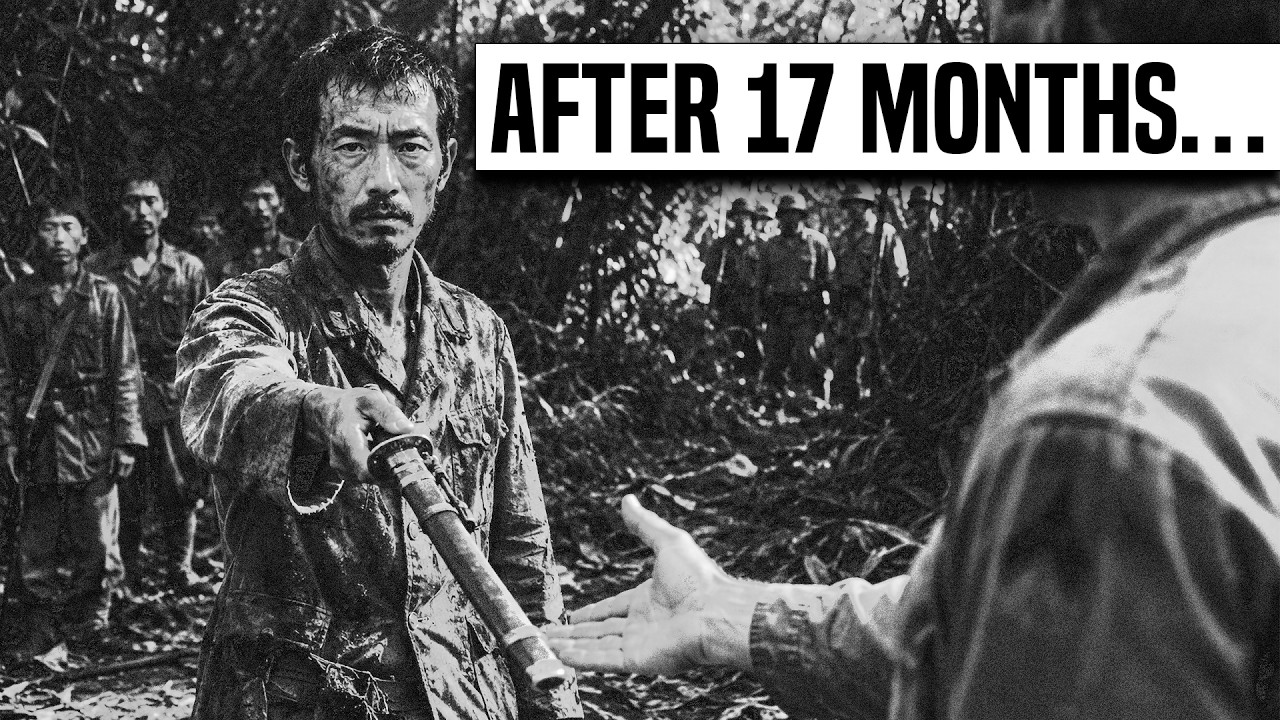
They told him the war was over and instructed him to surrender himself and his men. On the morning of December 1, 1945, the 46 men gathered on Mount Tapochau one last time and sang a farewell to those who had died there. Then they came down the mountain in two columns. They walked into the position of the 18th Anti-Aircraft Artillery Company of the Marines.
Nobody fired. Oba was in front, carrying his sword, in a uniform that had been kept in caves for a year and a half. Behind him, his men marched in step and carried their weapons to hand over. Lieutenant Colonel Howard Kurgis of the Marine Corps was waiting.
Oba gave him the sword, and his men gave up their arms and their unit colors. A Navy photographer recorded the scene, and the picture went out to the American press three days later. The group was the last organized Japanese force on Saipan, 17 months after the island had been declared secure. What the Americans did next surprised everyone.
They fed the men. Then the Marine officers on the island, including men who had spent a year and a half looking for Oba, invited him to their club and lined up to shake his hand before he was sent home. The colonel who accepted his surrender later called him a soldier any country would be proud of. Oba returned to Japan, and his posthumous promotion was canceled once Tokyo established that he was alive, leaving him a captain again.
He was reunited with his wife and met his son for the first time, a boy born in 1937 and eight years old when they met. Oba died in his birthplace in 1992, at the age of 78. The sword did not go home with him. The colonel kept it, and it sat in an American house for the next 40 years.
Years later, Don Jones, the former Marine who had once been part of a group ambushed by Oba’s men on Saipan and who had since become his friend, asked whether the sword could be returned. Oba agreed, and Jones carried it to Japan himself and handed it to the family. The same generation of American veterans said two things about Sakae Oba, and both were true at the same time. One was the colonel’s praise on that parade ground in December 1945.
The other was a line from a man who had hunted him: “If we had found him, we would have killed him. ” A Chicago newspaper ran that line as the headline over a feature about the book. For 16 months, two wars shared one small island. One was fought by 46 men who never lost an engagement and never had a target that mattered.
The other was fought by mechanics, loaders, and air crew who never saw an enemy soldier off the 8,500 feet of crushed coral laid down while the shooting was still going on. Only one of them reached Japan.