The story of the Second World War does not begin in 1939. It does not even begin in 1933, when Adolf Hitler came to power. To understand how the deadliest conflict in human history began, you have to go back to November 1918, to a railway carriage in the forest of Compiègne in northern France, where German representatives signed the armistice that ended the First World War.
The two conflicts are inseparable. The peace that followed the Great War was not a real peace at all. It was, as French Marshal Ferdinand Foch reportedly said when he first read its terms, not a peace but an armistice for twenty years. He was accurate to within a matter of months.
The documents signed at Versailles in June 1919 were, whether their authors knew it or not, the first chapter of the next catastrophe. Understanding why requires understanding what the First World War had done to Europe and what it left behind.
Four years of industrialized slaughter had consumed roughly 17 million lives, military and civilian. Empires that had stood for centuries collapsed within months. The Austro-Hungarian Empire simply ceased to exist, replaced by a patchwork of small and often quarrelsome successor states. The Ottoman Empire broke apart and withered into the rump of what became modern Turkey. The Russian Empire was swept away by revolution and replaced by the Soviet Union, a communist state that most of the capitalist world regarded with deep suspicion and outright hostility.
Even the victors had been bled nearly white. Britain lost close to a million men killed, with the toll rising considerably when the dead from Australia, Canada, India, New Zealand, South Africa, and the rest of the empire were counted. France, which had suffered the brunt of the fighting on the Western Front, lost over one and a half million of its sons.
Germany had suffered too. Nearly 2 million German soldiers died in the fighting, and hundreds of thousands more were permanently disabled. By the autumn of 1918 the situation was becoming untenable. The Hindenburg Line, Germany's final fortified defensive position on the Western Front, had been broken by the Allies in the Hundred Days Offensive. American troops were arriving in France at the rate of approximately 10,000 men per day, an endless flood of fresh reinforcements that Germany could not match.
The naval blockade had been strangling Germany's economy since 1914. By 1918, ordinary German civilians were genuinely starving. Official statistics indicate that perhaps 300,000 Germans died from malnutrition and related diseases caused by the blockade during the war years.
Revolution was not merely possible but underway. In late October 1918, sailors mutinied at the German naval bases of Kiel and Wilhelmshaven, refusing to put to sea for what they correctly understood would be a suicidal last battle. Workers' councils seized power in Munich, Hamburg, Berlin, and other major cities. Kaiser Wilhelm II abdicated on November 9 and fled to the Netherlands, where he would live until 1941.
Two days later, the armistice was signed and the guns fell silent. Here is the crucial detail that would poison German politics for the next fifteen years. When the armistice was signed, the German army had not been defeated on German soil. German troops still occupied large swathes of France and Belgium. No Allied army was marching through the Brandenburg Gate. There was no enemy soldier standing on the Rhine.
From the perspective of millions of ordinary German soldiers and civilians, many of whom had endured four years of extraordinary hardship and had been told right up until the last weeks that Germany was fighting honorably and not losing, the surrender made no sense. The conclusion that suggested itself to those unwilling to accept the reality of military defeat was that Germany had been betrayed from within, stabbed in the back by traitors at home.
This was a lie. The German army had been beaten. Erich Ludendorff, the quartermaster general who had effectively commanded the German war effort for two years, had personally told the Kaiser in late September 1918 that the military situation was hopeless and that an armistice must be sought immediately. He then had the audacity to place the blame on the civilian government for following his own advice.
The stab-in-the-back myth, the Dolchstoßlegende as it became known in German, was born almost immediately after the armistice. Ludendorff promoted it aggressively. Right-wing newspapers and political parties embraced it. It spread through the German right like a virus, infecting an entire political culture with a foundational lie that no amount of evidence could dislodge. And it became the cornerstone of Adolf Hitler's political appeal.
The new German Republic, remembered as the Weimar Republic after the Thuringian city where its constitution was drafted in 1919, came into existence under the worst possible circumstances imaginable for a democratic experiment. It was born in defeat, in revolution, and in economic crisis. Its founders were men of genuine principle, moderate social democrats and liberals who believed in parliamentary democracy and wanted to build a decent, humane German state on the ruins of the empire.
But they were immediately burdened with the consequences of a war they had not started and a defeat they had not caused. Their enemies on both the far right and the far left were merciless in exploiting this. In the minds of German nationalists, they would forever be the "November criminals," the men who had surrendered, the traitors who had sold out the fatherland.
The peace conference that assembled in Paris in early 1919 was unlike anything the world had seen before. Representatives from 32 nations gathered to settle the most destructive war in history, remake the maps of three continents, and build an international order that would prevent such a catastrophe from ever happening again.
The dominant figures were the so-called Big Four: President Woodrow Wilson of the United States, Prime Minister David Lloyd George of Britain, Prime Minister Georges Clemenceau of France, and Prime Minister Vittorio Orlando of Italy. Each man came to Paris with a different vision, different domestic pressures, and irreconcilable priorities. The compromises between them would ultimately satisfy nobody and store up grievances that would prove lethal.
Wilson arrived in Paris in December 1918 to a reception that was nothing short of extraordinary. Crowds lined the streets of Paris, London, and Rome to greet him. People wept with joy. He was hailed as the savior of civilization, the prophet of a new world order.
Wilson's vision was idealistic and genuinely inspiring. He called for the self-determination of peoples, open diplomacy, freedom of the seas, equal trading rights, arms reductions, and a League of Nations that would resolve disputes through law and arbitration rather than war. The exhausted peoples of Europe wanted desperately to believe it was possible.
But Wilson's idealism ran immediately into the hard walls of political reality. Georges Clemenceau, the French prime minister known as "the Tiger," was 78 years old when the conference began and had lived through two German invasions of France in 1870 and 1914. He was not interested in idealism. When someone told him that God himself had needed only ten commandments, Clemenceau reportedly replied that Wilson had come to Paris with fourteen points and let us see how that works out.
Clemenceau wanted Germany broken, permanently weakened, stripped of the capacity to wage offensive war, and made to pay for the devastation it had inflicted. France's northern industrial regions had been fought over for four years and left in a state of utter ruin. The coal mines of the Nord had been deliberately flooded by retreating German forces. Over a million and a half French soldiers were dead. Clemenceau's entire political mandate was to ensure that this never happened again.
Lloyd George of Britain occupied an uncomfortable middle ground. He was privately more sympathetic to Germany than Clemenceau and more realistic about the long-term consequences of a punitive peace. He once wrote a memorandum arguing that an unduly harsh settlement would produce a dangerous reaction in Germany and plant the seeds of future conflict. But he was also a prisoner of British public opinion, which had been inflamed by years of wartime propaganda and had just returned a government on promises of hanging the Kaiser and making Germany pay.
Vittorio Orlando of Italy was in a particularly bitter position. Italy had entered the war in 1915 on the Allied side in exchange for a package of territorial promises made in the secret Treaty of London. At Paris, Wilson insisted that the principle of self-determination must override these pre-war promises in the case of the Dalmatian coast. Orlando walked out of the conference in protest. He returned to Rome empty-handed to face a political crisis that would within a few years help bring Benito Mussolini to power.
The Treaty of Versailles, finally signed on June 28, 1919, in the Hall of Mirrors at the Palace of Versailles, was received in Germany with shock, fury, and humiliation. The date was chosen deliberately. It was exactly five years to the day after the assassination of Archduke Franz Ferdinand in Sarajevo, the event that had set the First World War in motion.
The German peace delegation, which had gone to Paris expecting to negotiate a treaty based on Wilson's Fourteen Points, had instead been presented with a document and told to sign it or face renewed war. The terms were severe on almost every front.
Germany lost approximately 13 percent of its pre-war territory and 10 percent of its population. Alsace-Lorraine was returned to France. The Rhineland was to be occupied by Allied troops for fifteen years and permanently demilitarized thereafter. The Saar region was placed under League of Nations administration for fifteen years, with coal revenues going to France.
Poland, which had been partitioned out of existence in the 1790s, was reconstituted as a sovereign state. To give Poland access to the sea, a strip of territory called the Polish Corridor was created, separating the German province of East Prussia from the rest of Germany. The predominantly German-speaking port city of Danzig was made a free city under League of Nations protection.
Germany also lost all of its overseas colonies, which were distributed among the Allied powers as mandates under the League of Nations. The military terms were designed to ensure Germany's permanent second-class status. The German army was limited to 100,000 long-service volunteers. There was to be no German air force whatsoever. The Navy was reduced to six battleships, six cruisers, twelve destroyers, and twelve torpedo boats, with an explicit prohibition on submarines.
But the provision that proved most politically explosive of all was Article 231 of the treaty, the so-called war guilt clause. This single paragraph required Germany to accept sole responsibility for causing all the loss and damage to which the Allied and associated governments had been subjected as a consequence of the war imposed upon them by the aggression of Germany and her allies.
The reaction in Germany was one of unified outrage that crossed every political line. The Social Democrats who ran the government, the nationalists on the far right, the communists on the far left, the Catholics, the liberals, almost everyone agreed that the war guilt clause was both a factual lie and a moral obscenity.
The reparations bill took two years to calculate. When the final figure was announced in May 1921, it stood at 132 billion gold marks, a number so large that it defied comprehension. The most famous critique came from John Maynard Keynes, a young Cambridge economist who had been part of the British Treasury delegation at Paris and had resigned in protest. His 1919 book, "The Economic Consequences of the Peace," argued that the reparations demands were economically unrealistic and would produce exactly the political backlash that rational statesmen should fear.
The book became an international bestseller and shaped educated opinion in Britain and the United States for the entire interwar period. It fed a growing conviction in both countries that Germany had been treated unjustly at Versailles and that some revision of the treaty terms was both fair and necessary. This sympathy for Germany's position would have enormous consequences in the 1930s, when revision was no longer a matter of diplomatic negotiation but of responding to Hitler's demands at gunpoint.
The Weimar Republic staggered into existence carrying all these burdens, and faced enemies from every direction almost immediately. In January 1919, even before the peace treaty was signed, a communist uprising in Berlin led by Rosa Luxemburg and Karl Liebknecht was suppressed by the government using irregular right-wing paramilitary units called the Freikorps. Luxemburg and Liebknecht were both murdered by their captives, their bodies dumped in a Berlin canal.
The episode established a grim precedent: the democratic government relying on right-wing militias to maintain order, creating a debt that the right would use to justify its contempt for the republic. In March 1920, a right-wing coup known as the Kapp Putsch seized Berlin for four days, forcing the legitimate government to flee. The coup collapsed not because of military counteraction but because of a general strike called by the trade unions, which paralyzed the country.
A series of political assassinations followed. Matthias Erzberger, the Center Party politician who had signed the armistice, was shot dead by right-wing extremists in August 1921. Walther Rathenau, the Jewish foreign minister whose Rapallo Treaty with Soviet Russia had been a rare diplomatic success, was assassinated in June 1922, again by right-wing killers. The message was unmistakable: democratic politicians in the Weimar Republic served their country at personal risk.
But the greatest immediate threat to the republic's survival came not from bullets but from the printing press. The German government's response to its fiscal problems was to print money, and by 1921 this had produced significant inflation. The French occupation of the Ruhr in January 1923 triggered an economic crisis that turned severe inflation into hyperinflation of genuinely catastrophic proportions.
By November 1923, the exchange rate had reached 4.2 trillion marks to one US dollar. Workers were paid twice a day and given time off to spend their wages before they lost their value entirely. A wheelbarrow full of banknotes might not buy a loaf of bread. People burned banknotes in their stoves because the paper had more value as fuel than as currency.
The savings of the German middle class, built over lifetimes of thrift and careful financial planning, were wiped out completely. The psychological and political impact of this catastrophe, particularly on the middle classes, was profound and lasting. People who had played by the rules of the economic system had been utterly ruined, not once but effectively twice. First by the war and then by the inflation. And they were desperately looking for someone to blame.
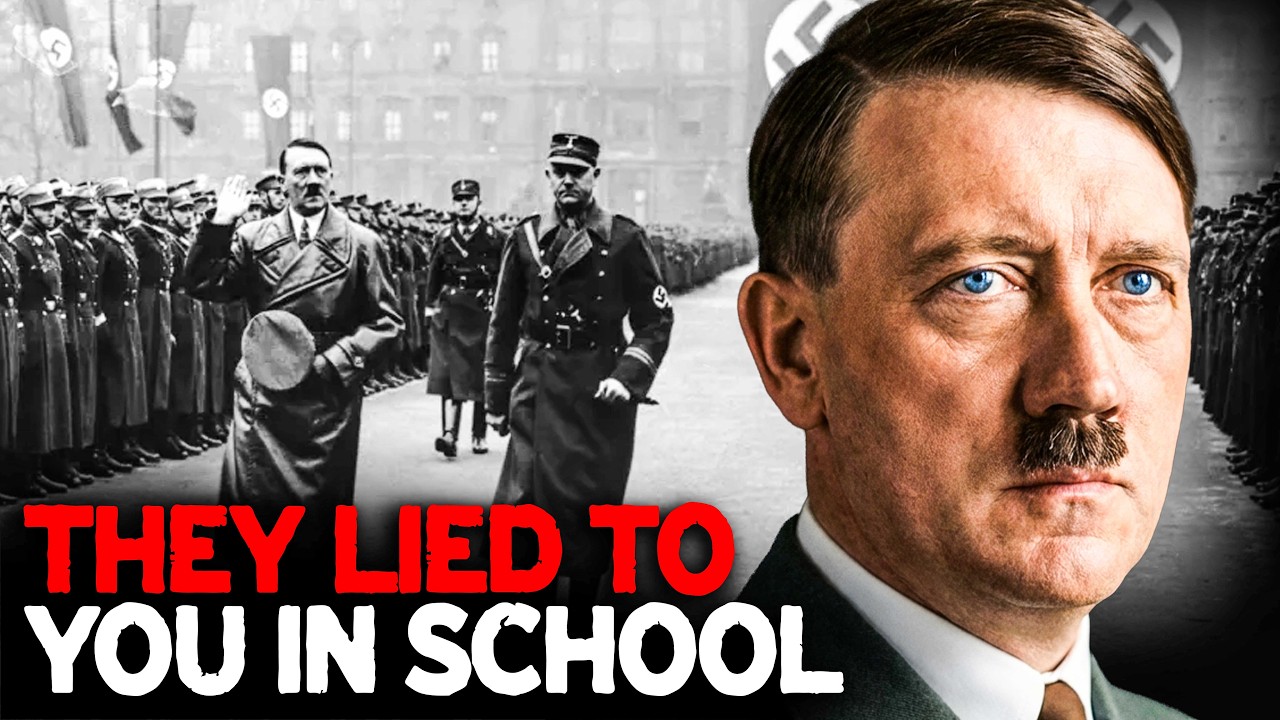
It was in this toxic atmosphere of defeat, humiliation, economic chaos, and political violence that Adolf Hitler made his first serious bid for national attention. Born on April 20, 1889, in Braunau am Inn, a small Austrian town on the border with Bavaria, Hitler had led an undistinguished early life. He was rejected twice by the Vienna Academy of Fine Arts, a failure that left a deep wound and perhaps fed the grudge against the educated establishment that he would nurse his entire life.
He spent several years drifting in Vienna, absorbing the turbulent political culture of a city where radical German nationalism and virulent anti-Semitism were not fringe positions but mainstream political forces. When the First World War broke out in August 1914, Hitler enlisted in the Bavarian army with what appears to have been genuine, even joyful enthusiasm. The war gave his directionless life a structure and purpose it had never had before.
He served as a regimental dispatch runner, a dangerous job that exposed him repeatedly to the worst of the fighting on the Western Front. He was wounded twice and was awarded the Iron Cross Second Class in December 1914 and, more unusually for an enlisted man, the Iron Cross First Class in August 1918. He genuinely appears to have loved army life, the camaraderie, the structure, the sense of shared purpose.
When the armistice came in November 1918, Hitler was in a military hospital at Pasewalk north of Berlin, temporarily blinded by a mustard gas attack. He later claimed that when a pastor visited the ward to inform the patients of Germany's surrender, he was so overcome with grief and rage that his sight temporarily returned. Whether or not this account is entirely accurate, there is no question that the experience of Germany's defeat was transformative for Hitler. It confirmed and intensified all his existing hatreds and gave them a political focus.
After the war, Hitler stayed in the Bavarian army, which used him initially as an informer and political educator. In September 1919, he was sent to observe a meeting of a tiny group called the German Workers' Party. He ended up in an argument with another attendee and in the process discovered something that appears to have genuinely surprised him: he had a remarkable talent for political oratory. He joined the party, became its most important speaker, and within months was effectively its leader.
By July 1921, he was the undisputed chief of what had been renamed the National Socialist German Workers' Party, the NSDAP, which would come to be known to the world as the Nazi Party. His rhetorical style was unlike anything German politics had seen before, a raw, visceral, emotionally overwhelming performance that built from quiet beginnings through gathering intensity to thundering climaxes.
The Beer Hall Putsch of November 8 and 9, 1923, was Hitler's first attempt to seize power. Taking inspiration from Mussolini's March on Rome the previous year, Hitler attempted to launch a revolution from Munich that he hoped would spread across Germany and bring down the Weimar Republic. The plan collapsed almost immediately when the Bavarian state government and military withdrew their support.
On the morning of November 9, a column of about 2,000 Nazi demonstrators attempted to march through Munich and was met by police who opened fire. Sixteen Nazis and four policemen were killed. Hitler was arrested two days later and put on trial for treason. The trial was his first major national platform, and he used it brilliantly, turning the proceedings into an indictment of the government and the Weimar Republic. The sympathetic judges gave him only the minimum sentence for high treason, five years, and he was released after serving only nine months at Landsberg prison.
Those nine months were not wasted. In the relative comfort of his cell, dictating to his deputy Rudolf Hess, Hitler produced the first volume of "Mein Kampf," his combined autobiography and political manifesto, published in 1925. The book laid out with remarkable clarity the goals Hitler intended to pursue: the destruction of Marxism, the acquisition of Lebensraum or living space for the German people in Eastern Europe, the racial restructuring of Europe through the persecution and elimination of the Jewish population, and the establishment of a German empire that would dominate the continent.
Any person who read "Mein Kampf" with careful attention in 1925 or 1926 would have known exactly what Hitler intended to do if he ever came to power. The tragedy is that most people did not read it carefully. Those who did often did not believe it, and those who believed it frequently did not think he could ever actually come to power.
The mid-1920s were in retrospect the Weimar Republic's best years. The hyperinflation was brought under control by a currency reform in November 1923. The Dawes Plan of 1924 reorganized Germany's reparations payments and opened the door to a flood of American investment and loans. The Locarno Treaties of October 1925 appeared to normalize Germany's position in Europe, and Germany was admitted to the League of Nations in September 1926.
The foreign minister who negotiated these achievements, Gustav Stresemann, received the Nobel Peace Prize in 1926. The cultural life of the Weimar Republic during this period was genuinely extraordinary. Berlin became one of the cultural capitals of the world, a city of remarkable creative energy and social freedom. But beneath the gleaming surface, the wounds of defeat and economic crisis had not healed. They had merely been covered over, and not very thick.
The Wall Street crash of October 1929 ripped that cover away. The collapse of the American stock market triggered the Great Depression, and its effects spread across the Atlantic with terrifying speed. American banks and investors called in their loans to Germany and stopped making new ones. German banks collapsed. German industry contracted violently.
Unemployment, which had been about 1.3 million in 1929, climbed to 3 million by 1930, to 4.4 million by early 1931, and to over 6 million by the beginning of 1932. Even those horrifying numbers do not capture the full extent of the suffering. Germany's national income fell by nearly a third between 1929 and 1932.
In this catastrophe, the Nazi Party found its moment. In the Reichstag elections of May 1928, before the depression had hit, the Nazis won only 2.6 percent of the vote and twelve seats. A year after the crash, in September 1930, they won 18.3 percent and 107 seats, becoming overnight the second largest party in the Reichstag. By July 1932, they won 37.4 percent, the highest share they would ever achieve in a genuinely free election, and became by far the largest party in Parliament.
What was Hitler actually offering that proved so attractive to so many? First and most importantly, he was offering emotional release and a clear narrative of blame. The depression had happened because of the Jews, the Marxists, the foreign powers, the November criminals who had betrayed Germany. This was not true, but it was emotionally satisfying in a way that the moderate parties' complicated explanations could not match.
Second, he was offering spectacle and belonging. The Nazi movement was not just a political party but a total community with its own symbols, rituals, uniforms, songs, and mass events. Third, he was offering specific promises: tear up Versailles, rearm Germany, smash the communists, put Germany back to work. And fourth, for many members of the German middle class and business community, Hitler represented the lesser evil compared to the communists. "Better Hitler than Stalin" was a calculation that many Germans made disastrously.
The path from electoral dominance to actual power ran through the backrooms of the German establishment. By late 1932, Germany was in a genuine constitutional crisis. No stable coalition government was possible in the Reichstag. Chancellor after chancellor governed by emergency decree under Article 48 of the Weimar constitution.
Paul von Hindenburg, the 84-year-old field marshal who had been elected president in 1925, was the crucial figure. He detested Hitler and had refused twice in 1932 to appoint him chancellor, reportedly calling him a Bohemian corporal. But in November and December 1932, a group of conservative advisers around Hindenburg, most notably the former Chancellor Franz von Papen, convinced the old man that the situation was desperate enough to warrant bringing Hitler into government on conservative terms.
Their argument was that Hitler's popular support could be harnessed while his radicalism was constrained by surrounding him with conservative ministers in key positions. Papen famously told a colleague that within two months they would have pushed Hitler so far into a corner that he would squeak. On January 30, 1933, Paul von Hindenburg appointed Adolf Hitler Chancellor of Germany. The conservatives believed they had domesticated a dangerous but useful force. They were catastrophically wrong.
Within weeks, the conservatives learned what they had done. The Reichstag fire of February 27, 1933, gave Hitler the pretext he needed to move against his opponents. The Reichstag Fire Decree of the following day suspended virtually all civil liberties, abolished freedom of the press, and authorized the arrest of political opponents without charge. Thousands of communists, social democrats, and trade union leaders were arrested in the days that followed.
The Reichstag elections of March 5, held in an atmosphere of intimidation and violence, gave the Nazis 43.9 percent of the vote. Still not an absolute majority, but enough combined with the German nationalists and the exclusion of the arrested communist deputies to push through the Enabling Act on March 23, 1933. This law gave Hitler the power to rule by decree for four years without consulting the Reichstag.
German democracy ended not with a bang but with a parliamentary vote. The months that followed saw the systematic dismantling of every institution that might have served as a check on Nazi power. Trade unions were dissolved in May 1933. Political parties were banned or dissolved themselves under pressure. By July 14, 1933, the Nazi Party was formally declared the only legal political party in Germany.

The process known as Gleichschaltung, the coordination of all German institutions, proceeded at blinding speed. State governments were dissolved and replaced by Nazi-appointed Reich governors. The civil service was purged of Jews and political opponents. The press was brought under the control of Joseph Goebbels's new Reich Ministry of Public Enlightenment and Propaganda. The universities were purged of Jewish professors and political dissidents, driving out of Germany in a single year much of the finest academic talent in the world, including Albert Einstein.
How did the outside world respond? The reactions were mixed, often poorly informed, and frequently shaped by wishful thinking. In Britain, the dominant initial response was a combination of anxiety and a determination not to overreact. There was a widespread feeling that Germany had legitimate grievances rooted in the injustice of Versailles, and that a German government which addressed those grievances might actually contribute to European stability.
Some conservative politicians and journalists were initially quite favorably impressed by Hitler, seeing him as a strong nationalist leader who was rescuing Germany from economic chaos and communist subversion. Lord Halifax, who would later become foreign secretary, visited Hitler at Berchtesgaden in November 1937 and came away with a largely positive impression.
This sympathy for Germany was not entirely irrational in the early 1930s. The argument that the peace of 1919 had been too harsh and that some of its provisions should be revised was genuinely reasonable. The problem was that this analysis completely misread the nature of Hitler's ambitions. He was not interested in addressing Versailles. He intended to conquer Europe.
In France, the response was a mixture of deep anxiety and political paralysis. The French had fewer illusions about Hitler's intentions than the British, partly because France was more immediately threatened and partly because French military intelligence was better informed about German rearmament. But France was deeply divided internally. The slogan on the French right, "Better Hitler than Léon Blum," captured a political pathology that crippled French strategic decision-making throughout the decade.
The United States under Franklin Roosevelt was constrained by powerful isolationist currents in public opinion and in Congress. Congressional investigations in the mid-1930s promoted the narrative that American entry into the First World War had been engineered by arms manufacturers and bankers. This produced a series of Neutrality Acts between 1935 and 1937 that prohibited arms sales to belligerents and attempted to keep the United States from being drawn into another European conflict.
The Soviet Union under Stalin was focused primarily on internal transformation and the terror of the early Five-Year Plans. Stalin recognized earlier than many Western statesmen that Hitler represented a mortal danger. In the mid-1930s, the Soviet Union made genuine overtures toward collective security, joining the League of Nations in 1934 and entering mutual assistance treaties with France and Czechoslovakia in 1935. But Soviet overtures were met with consistent suspicion and ambivalence in London and Paris.
Japan's descent into militarist imperialism provided an early and crucial demonstration of how the international community would respond to aggression. In September 1931, the Japanese Kwantung Army in Manchuria staged an incident at Mukden, blowing up a section of the South Manchurian Railway and blaming it on Chinese saboteurs. This manufactured pretext was used to justify the occupation of the entire province of Manchuria.
The League commissioned an investigation under Lord Lytton, which eventually produced a report condemning Japan's actions. Japan resigned from the League, kept Manchuria, and renamed it Manchukuo. Nothing happened. No military action was taken or seriously contemplated. The lesson was unmistakable and was not lost on Hitler or Mussolini. The great democracies would talk, investigate, and condemn. They would not fight.
Italy under Benito Mussolini had been the original template for European fascism. By the mid-1930s, Mussolini's imperial ambitions centered on the conquest of Ethiopia, one of the last remaining independent African states and a country that had famously defeated an Italian army at the Battle of Adwa in 1896. In October 1935, Italian forces invaded Ethiopia with a modern army of approximately 300,000 men equipped with artillery, aircraft, and chemical weapons.
The Ethiopians, led by Emperor Haile Selassie, fought back with extraordinary courage, but their rifles and traditional weapons were no match for Italian tanks and mustard gas. Haile Selassie addressed the League of Nations in June 1936 in a speech of great dignity and eloquence, appealing to the world's conscience and warning that if Ethiopia fell, other states would follow. He was right. But his appeal produced only moral sympathy and limited practical action.
The League imposed economic sanctions on Italy, but Britain and France, both fearing that too-severe sanctions would push Mussolini into Hitler's arms, deliberately excluded oil from the list. Ethiopia was conquered by May 1936. The League of Nations had failed its second major test after Manchuria. Its authority was effectively destroyed.
The Ethiopian crisis was also a pivotal moment in the alignment of the fascist powers. In October 1936, Hitler and Mussolini announced the Rome-Berlin Axis. The same month, Germany and Japan signed the Anti-Comintern Pact. Italy would join the pact in November 1937, completing the triangle that was known as the Axis powers.
German rearmament had been proceeding secretly since the early years of the Nazi regime, violating the Treaty of Versailles. In March 1935, Hitler openly announced the existence of a new German air force, the Luftwaffe, and the reintroduction of compulsory military service with a target of building the German army to 36 divisions and half a million men. These were direct, open, unambiguous violations of the Treaty of Versailles.
Britain, France, and Italy met at Stresa in April 1935 and issued a joint condemnation of German unilateral treaty violations, the so-called Stresa Front. And then in June 1935, Britain unilaterally signed the Anglo-German Naval Agreement, which formally accepted German naval rearmament in exchange for a German promise to limit its fleet to 35 percent of British naval strength. The French, who had not been consulted, were furious. The Stresa Front had lasted exactly two months.
The Anglo-German Naval Agreement was one of the most short-sighted acts of interwar British diplomacy. It sent an unmistakable signal to Hitler and to the world: Britain would accommodate German violations of Versailles rather than resist them. It confirmed that the Treaty of Versailles was a dead letter and that Britain would cut bilateral deals that undermined Allied solidarity rather than enforce the collective security provisions of the treaty.
The remilitarization of the Rhineland on March 7, 1936, was the most dangerous gamble of Hitler's entire pre-war career and the moment when the Second World War might most easily have been prevented. Under the Treaty of Versailles and the Locarno Treaties, the Rhineland was permanently demilitarized. This was France's essential security guarantee.
In the early hours of March 7, 1936, approximately 22,000 German troops entered the demilitarized zone and occupied it. Hitler had given his military commanders secret orders: if French forces moved to resist, the German troops were to retreat immediately. The generals were terrified. They later told him that if the French had marched, the operation would have had to be abandoned and the political consequences for the regime might have been fatal.
But the French did not march. The French government was in the middle of a political crisis. The military was cautious and overestimated German strength. And Britain made absolutely clear that it would not support military action. The British foreign secretary, Anthony Eden, told the French privately that Britain would not go to war over what he described as Hitler marching into his own backyard.
Hitler had gambled everything on a bluff and won. His contempt for the Western democracies deepened into something like certainty. Germany was now free to build fortifications on the Rhine and to plan the expansionist program that "Mein Kampf" had laid out a decade earlier.
The Spanish Civil War added another dimension to the gathering catastrophe. In July 1936, General Francisco Franco launched a military revolt against the elected Spanish Republic, triggering a three-year civil war that drew in all the major European powers. Germany and Italy intervened on Franco's side, recognizing the war as an opportunity to test new weapons and tactics.
The German Condor Legion learned the techniques of tactical air support, ground attack, and strategic bombing that it would employ so devastatingly in the years ahead. The most notorious single episode was the bombing of the Basque town of Guernica on April 26, 1937, when Condor Legion aircraft attacked the town on a busy market day, killing several hundred civilians. Pablo Picasso responded with a massive painting that bears the town's name and became one of the defining images of the 20th century.
The Soviet Union intervened on the Republican side, but Stalin's assistance came tangled with requirements for political loyalty to the Communist Party that poisoned the Republican war effort. Britain and France adopted a policy of non-intervention. The Spanish Civil War ended in April 1939 with Franco's victory.
Its importance for the origins of the Second World War lies in several directions. It provided Germany and Italy with invaluable operational experience. It deepened the polarization between fascism and communism across Europe. And it demonstrated again and again the pattern that was becoming the decade's defining feature: the fascist powers would act, take risks, and back them with force, while the democracies hesitated, deliberated, and ultimately accommodated.
By 1937 and into 1938, the pace of events was accelerating toward a crisis that thinking people could see coming but few could see how to prevent. The Nazi state had constructed a system of racial persecution through a series of legal measures, of which the Nuremberg Laws of September 1935 were the most significant, stripping Jews of German citizenship and prohibiting marriage between Jews and non-Jews.
In November 1938, Kristallnacht, the Night of Broken Glass, saw Nazi paramilitaries attack Jewish businesses, synagogues, and homes across Germany and Austria, killing at least 91 people, arresting 30,000 Jewish men, and destroying synagogues on a massive scale. This was no longer persecution conducted through bureaucratic legal mechanisms. It was open, violent public terror, and the world saw it. Some governments protested. No government acted.
In February 1938, Hitler moved to remove the last significant institutional check on his military adventurism. He dismissed Field Marshal Werner von Blomberg as defense minister and removed General Werner von Fritsch as Army Commander-in-Chief, both on trumped-up charges. He then reorganized the command structure, creating the Oberkommando der Wehrmacht with himself as supreme commander of all German armed forces.
Austria was the first item on Hitler's territorial agenda. On February 12, 1938, Hitler summoned Austrian Chancellor Kurt Schuschnigg to his mountain retreat at Berchtesgaden and subjected him to a lengthy humiliation, making demands backed by implicit threats of military action. Schuschnigg returned to Vienna and in a last desperate gamble announced a plebiscite on Austrian independence.
Hitler could not allow a genuine plebiscite to take place. He demanded that it be canceled and that Schuschnigg resign in favor of the Austrian Nazi Arthur Seyss-Inquart. Abandoned by Britain and France and without any credible means of military resistance, Schuschnigg resigned with quiet dignity, saying he did not wish to spill German blood.
On the morning of March 12, 1938, German forces crossed the Austrian border in Operation Otto. They met no resistance. On March 13, the Anschluss was formally proclaimed and Austria ceased to exist as an independent state. Germany had been increased in area by 17 percent and in population by over 6 million people. The Western powers protested and did nothing.

Czechoslovakia in 1938 was in many ways the brightest example of what the post-Versailles order had been trying to create: a genuine democracy with an independent judiciary, a free press, and a genuinely pluralistic political culture. It was also a modern industrial state with important arms industries. Its army, while smaller than Germany's, was well trained and had prepared extensive fortifications in the Sudetenland mountains. It had mutual assistance treaties with both France and the Soviet Union.
In practice, it was about to be sacrificed by those allies on the altar of appeasement. The Sudetenland contained approximately 3 million German-speaking people. Their political leader, Konrad Henlein, was receiving detailed instructions and substantial funding from Berlin. His real goal was the dissolution of Czechoslovakia, and no concession was ever enough.
Through the summer of 1938, Hitler made a series of violently threatening speeches about the suffering of Sudeten Germans, and German military preparations for an attack on Czechoslovakia, codenamed Fall Grün or Case Green, were accelerated. By September, Europe seemed to be sliding toward war.
Neville Chamberlain decided to fly personally to Germany. The three flights he made to Germany in September 1938, the first time the 69-year-old prime minister had ever flown, became the defining acts of his premiership. On September 15, Chamberlain flew to Berchtesgaden, where Hitler told him bluntly that he demanded the Sudetenland and was prepared to risk world war to get it.
Chamberlain flew home and worked with the French to produce a proposal demanding that all areas of Czechoslovakia with more than 50 percent German population be ceded to Germany. On September 19, this demand was presented to the Czechoslovak government. President Edvard Beneš resisted, then capitulated when Britain and France made clear that if Czechoslovakia rejected the proposal and went to war with Germany, it would do so without Allied support.
When Chamberlain flew back to Germany on September 22, meeting Hitler at Bad Godesberg, he found that the stakes had been raised. Hitler now demanded immediate military occupation of the Sudetenland by October 1, with no orderly transfer process and no protection for the evacuating population. For a few days in late September 1938, war seemed genuinely imminent. The British Navy was mobilized. Air raid trenches were dug in London's parks. 38 million gas masks were distributed to British civilians.
And then at the last moment, Mussolini intervened at British urging to propose a four-power conference. The Munich Conference of September 29 to 30, 1938, was the low point of European democracy in the entire interwar period. Four leaders sat around a table—Chamberlain, Daladier of France, Hitler, and Mussolini—and decided the fate of a country that had no representative in the room.
The terms gave Germany the Sudetenland and its fortifications, its industrial plants, and the mountain passes that formed Czechoslovakia's natural defensive line. Chamberlain returned to London holding a document he described as the symbol of the desire of our two peoples never to go to war with one another again. Later that evening at 10 Downing Street, he leaned from a window and told the cheering crowd that he believed it was "peace for our time."
Hitler himself expressed contempt for the ease of it. He had expected a fight. He had wanted a military campaign against Czechoslovakia that would demonstrate Germany's power. He reportedly told his military commanders that he had been robbed by that damned umbrella-carrying old fellow. Munich did not satisfy Hitler. It taught him that the democracies would retreat further under pressure.
Within six months, Munich was exposed as the illusion it had always been. On March 15, 1939, German forces entered what remained of Czechoslovakia and occupied it without resistance. The Czech provinces of Bohemia and Moravia became a German protectorate. Slovakia declared nominal independence as a German puppet state. Czechoslovakia had ceased to exist.
This was fundamentally different from everything that had gone before. The annexation of Austria could be justified, however strained the reasoning, by the principle of self-determination. The Sudetenland could be similarly justified. But the Czech lands had no German-speaking population to speak of. This was raw conquest, the absorption of a non-German people against their will. It shattered the central premise of Chamberlain's policy.
Chamberlain was publicly humiliated and genuinely furious. In a speech in Birmingham on March 17, 1939, he asked rhetorically whether this German move was the last attack upon a small state or whether it was to be followed by others. The answer to his question was obvious.
The reversal of British policy came with remarkable speed. On March 31, 1939, Britain gave Poland a unilateral guarantee. If Poland were attacked by Germany, Britain would come to its assistance. France followed with a similar commitment. After years of refusing to make binding commitments to Eastern European states, the democracies had now committed themselves to defending a country they had no practical ability to help directly.
The Polish guarantee was a moral statement as much as a strategic calculation. It was Britain and France saying that they had gone as far as they would go, that the next act of German aggression would mean war. But the strategic problem was gaping. Poland had a long border with Germany. British and French forces had no route to Poland. The only power that could actually place troops on Germany's eastern flank was the Soviet Union, and the Soviet Union had not been consulted about the Polish guarantee and was not included in it.
The Anglo-French negotiations with the Soviet Union for a collective security arrangement that began in April 1939 and continued desultorily through the summer were a dismal failure of diplomacy. The Soviets wanted a comprehensive security arrangement that would allow Soviet forces to enter the Baltic states and Poland automatically in the event of German aggression. Poland refused categorically to allow Soviet troops on Polish soil, and the Baltic states were equally resistant.
Stalin, watching the negotiations stall, reached his own conclusions. If Britain and France would not conclude a genuine military alliance with the Soviet Union, then the Soviet Union would have to seek its own security by other means. And the most immediate and certain means available was a deal with Germany itself.
In the summer of 1939, secret contacts were established between Berlin and Moscow. Ribbentrop flew to Moscow on August 23 and signed with Molotov, in the presence of a visibly pleased Stalin, the German-Soviet Non-Aggression Treaty. The public terms committed both countries to neutrality if either was attacked by a third party. The secret protocol divided Eastern Europe into spheres of influence with chilling precision.
Finland, Estonia, Latvia, Lithuania, and Eastern Poland fell to the Soviet sphere. Western Poland fell to Germany. It was a partition of Eastern Europe between two totalitarian powers executed with the bureaucratic precision of a real estate transaction.
The news of the pact, announced on the morning of August 24, fell on European capitals like a thunderbolt. It meant that Germany could attack Poland without fear of Soviet intervention. It meant that war, which had seemed like a possibility, had become a near certainty.
Britain and France scrambled to signal their resolve, confirming the Polish guarantee and warning Germany that they would honor their commitments. Hitler dismissed these warnings, telling his generals that they were worms and would not fight. The final preparations for war were made in the last days of August 1939.
On the night of August 31, SS troops dressed in Polish uniforms staged a faked attack on the German radio station at Gleiwitz near the Polish border. The pretext, transparent to any objective observer, was in place. At 4:45 in the morning on September 1, 1939, German forces crossed the Polish border on multiple fronts.
The Wehrmacht's armored and motorized divisions, applying in full measure the operational concepts of deep, fast combined-arms warfare that would be called Blitzkrieg, drove into Polish territory from the north, west, and south. The Luftwaffe bombed Polish airfields, communications networks, and cities. The old battleship Schleswig-Holstein, anchored in Danzig Harbor, opened fire on the small Polish military garrison at the Westerplatte. The Second World War had begun.
Britain delivered its ultimatum to Germany at 9 in the morning on September 3, demanding that Germany withdraw its forces from Poland. No reply came. At 11:15 in the morning, in a BBC radio broadcast, Neville Chamberlain told the British people that no such undertaking had been received and that consequently this country is at war with Germany. His voice was tired, sad, and strained. France declared war a few hours later.
Poland was conquered quickly. Soviet forces invaded from the east on September 17 in accordance with the secret protocol. Warsaw surrendered on September 27. The last Polish resistance ended on October 6. In five weeks, a nation of 35 million people had been overrun by two great powers acting in coordination.
What really started the Second World War? The honest answer is that there was no single cause. The war was the product of a chain of causes stretching back at least to 1919, with each link in the chain reinforcing and enabling the next.
The Treaty of Versailles created the conditions: the humiliation, the economic devastation, the war guilt clause that assigned exclusive blame without basis. These conditions made radical nationalism not just possible but politically powerful in a democracy under severe strain. The Great Depression provided the crisis that turned political possibility into electoral reality, driving millions of desperate Germans toward the most extreme solution on offer.
The failures of the Weimar Republic created the institutional vacuum that Hitler exploited. The mistakes of conservative German politicians who thought they could contain Hitler allowed him into the machinery of the state. And then the failures of the international community allowed him to use that machinery without effective challenge for six years.
The failures of Britain and France were real and consequential. The policy of appeasement, however understandable in its origins, ultimately enabled Hitler by teaching him that the democracies would not resist. Each concession, each unanswered violation of Versailles, each retreat in the face of escalating demands made the next step easier and bolder.
The inability of the League of Nations to enforce collective security, demonstrated in Manchuria and confirmed in Ethiopia and Spain, eliminated the institutional framework within which aggressive states might have been checked. But in the end, the war happened because one man willed it.
Adolf Hitler did not stumble into the Second World War. He had been planning for it since the early 1920s, had outlined its ideological foundations in "Mein Kampf," and had spent the years of his power systematically building toward it. He was not an impersonal force of historical circumstance. He was a specific individual who made specific choices at specific moments, and without him it is genuinely difficult to imagine how a second world war breaks out in 1939 from the conditions then prevailing.
The story of 1918 to 1939 is ultimately a story of how free societies can fail. How economic desperation can open the door to demagogy. How the desire to avoid conflict can create the conditions that make conflict inevitable. And how the international community's failure to act on shared principles of justice and collective security can produce consequences infinitely worse than the costs of action would have been.
The guns of September 1939 did not fire from nowhere. They were fired by a man who had learned step by step and lesson by lesson over six years that the world would not stop him. And they were enabled by a generation of choices—from the conference tables of Paris in 1919 to the cheering crowds outside 10 Downing Street in September 1938—that added up, taken together, to one of the greatest failures of political judgment in modern history.