In the summer of 1921, two 17-year-old identical twins moved into a New York apartment with a famous name and little else behind it. Their father was an American consul on a government salary, and their pedigree came from their mother’s side—a Union cavalry general who died in Chile and a Chilean grandmother. The newspapers called them “the magnificent Morgans. ” Within two years, one twin married a Vanderbilt; within five, the other married a British viscount.
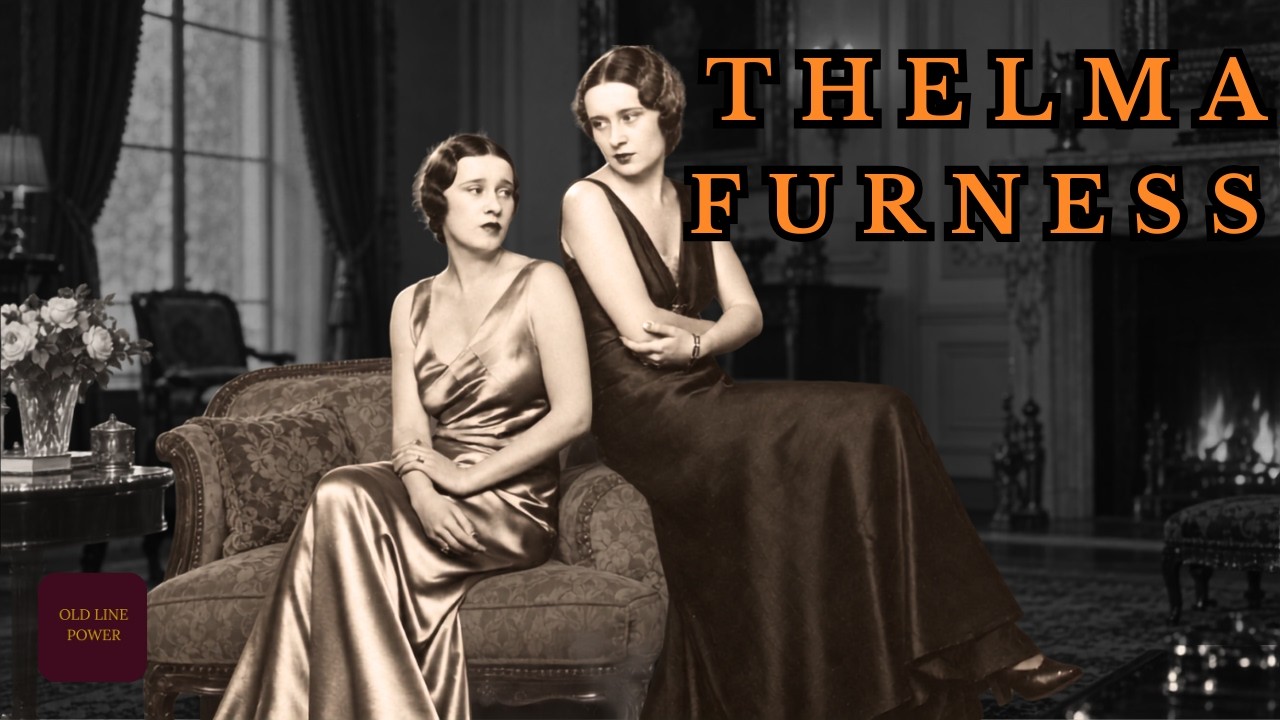
But by the end of 1934, one had lost her daughter in open court, and a Manhattan lawyer had proven that neither woman was the age their mother had always claimed. Thelma Furness is usually remembered as a single line in other people’s books: the woman who introduced Wallis Simpson to the Prince of Wales. That is true, and it is about one percent of her story. Everything Thelma ever held—a title that came with a husband, a house that came with a prince, a living that came from a child’s trust fund, a birth year that came from her mother and was taken away by a court—she held on somebody else’s terms.
On January 25, 1934, Thelma boarded a liner for New York. She had a real reason to go: her twin sister, Gloria Morgan Vanderbilt, was about to be dragged through the American courts over custody of a 10-year-old girl and a great deal of money. The part everybody remembers, however, is a lunch. Somewhere before she sailed, Thelma and Wallis Simpson sat down and talked about the Prince of Wales.
Both women wrote about it decades later in books meant to sell, and their accounts do not match. In the Duchess of Windsor’s 1956 version, Thelma raises it, saying she fears the prince will be lonely and asking Wallis to look after him. In Thelma’s version, published two years later, Wallis speaks first: “The little man is going to be so lonely. ” Thelma answers, “Well, you look after him for me while I am away.
” Same substance, different hand on the trigger. Some version of that exchange almost certainly happened. Thelma had held her position for close to four years, and it had never required her to stay in England. She had sailed to America before, and the prince had always been there when she returned.
She had no reason to think this crossing was different. Five days after she sailed, the prince dined with the Simpsons. Wallis later wrote that she sensed a deep loneliness in him that few people around him were aware of. Thelma, meanwhile, was having a good time in America.
On the crossing home in March, she spent much of it with Prince Ali Khan, 22-year-old son of the Aga Khan, spectacularly rich and already famous for exactly this sort of thing. The society press noticed, and so did London. Word got back quickly. She landed on March 22.
The prince was polite—that was all. There was no scene, no letter, no conversation in which anybody explained anything. He simply became a man she was not seeing very much of. In her own account, he made one dry remark about how attentive Ali Khan had been to her, then let the subject go.
She read that as proof somebody had been talking to him. In her book, she places the moment she finally understood at a weekend at Fort Belvedere over Easter. The prince picked up a piece of salad with his fingers. Wallis reached across and tapped his hand in the manner of a woman whose business his habits now were—and, while she did it, she looked at Thelma.
That is Thelma’s telling, and only Thelma’s. It is too small and too domestic a thing to have been invented; nobody constructing a betrayal scene reaches for lettuce. She wrote afterwards that she knew then Wallis had looked after him exceedingly well. She was not dismissed, because there was nothing to be dismissed from.
No position, no salary, no notice period. The invitations simply stopped arriving. That same year, the prince disposed of Freda Dudley Ward, the central woman in his life for 16 years, by instructing the palace switchboard to stop putting her through. He could remove a person from his life the way you cancel a standing order.
Two years and eleven months after that salad moment, that man was King of England. Eleven months after that, he gave up the throne rather than give up the woman Thelma had asked to keep an eye on him. Thelma and Gloria Morgan were born in a hotel in Lucerne on August 23, 1904. Their father, Harry Hays Morgan, was an American consul, and consuls move.
The family surfaced over the years in Switzerland, Spain, France, Germany, Brussels, and Buenos Aires. They came to the United States in 1916. Consuls in that era drew a fixed salary from the State Department—it was a living, and it was not a fortune. No source describes this family as rich, and everything the children did afterwards is the behavior of people who were not.
There were four surviving children: Consuelo, the eldest; the twins; and a brother, Harry, who entered the foreign service and later went to Hollywood, appearing in 27 films. The pedigree was the asset, and it came from the mother’s side. Laura Deline Kilpatrick was the daughter of Hugh Judson Kilpatrick, a Union cavalry general nicknamed “Kill Cavalry” by his own troopers. He rode at Gettysburg and with Sherman, went into politics after the war, lost, and was sent out to Chile as American minister as a consolation prize.
He died in Santiago on December 4, 1881, within months of arriving. His body stayed there until 1887, when it was finally brought back and buried at West Point. His wife was Louisa Fernandez de Valdivieso, from a Chilean family with Spanish colonial roots and, by every account, money. Whatever survived of that money, none of it reached two girls in a New York apartment in 1921.
There is one more thing their mother arranged. She declared that the twins had been born in 1905. That single adjustment sat quietly in the family paperwork for 30 years before a lawyer went looking for it. Education finished at 17, which for girls of that class on that budget meant it was time to go to work.
The work was marriage. Gloria got there first and spectacularly. On March 6, 1923, she married Reginald Claypoole Vanderbilt in a friend’s townhouse in New York. She was 18.
He was 42, divorced, and had already gambled away most of what his family had given him. Their daughter, Gloria Laura Vanderbilt, was born on February 20, 1924. Eighteen months later, Reginald Vanderbilt died on September 4, 1925, aged 45, of cirrhosis. The family line at the time was a throat condition and a hemorrhage in the night, and that is how the newspapers ran it.
Then the will was read, and the shape of the next 10 years fell into place. The New York Times headline: “Vanderbilt left children $6,250,000 residue to widow. ” The widow’s residue was capped at $1,125,000, along with a townhouse on East 77th Street and a farm in Rhode Island. The reality, once debts were settled, was that the widow came away with something around $130,000.
The money for the children was split between the baby and her half-sister from the first marriage. The baby’s own trust came to roughly $2. 5 million. That was not generosity.
It was a man who had run through his own inheritance making very sure his daughters could not run through theirs. By the autumn of 1925, a 21-year-old widow, a toddler, and a fortune that belonged entirely to the toddler. From that moment, every adult in that household had an interest in who controlled the child. The $2.
5 million trust was what the fight was about. The court had approved the mother’s allowance out of it: $4,000 a month, $48,000 a year. In the middle of the 1930s, a great many American families were living on under $1,500 a year. Gloria Morgan Vanderbilt was drawing more than that in a fortnight, and she was drawing it from her daughter.
The case opened on October 1, 1934, before Justice John Francis Carew of the New York Supreme Court. Gertrude Vanderbilt Whitney, the child’s aunt—a sculptor who had founded her own museum and possessed the sort of money that never has to be mentioned out loud—sought custody. Nearly 100 reporters and photographers came on the first morning. The complaint had been made by the twins’ own mother, Laura Kilpatrick Morgan, who had effectively raised the little girl along with a nurse and had come to believe her daughter unfit.
She produced postcards the child had sent her from Europe. “My mother is so bad to me,” one of them said. “I wish I could run away. ”
A grandmother went into a public courtroom and testified against her own daughter at length under cross-examination for weeks.
There was a chauffeur who talked about the mother’s lovers. There was the nurse who talked about the books beside her bed. There was a German prince who had been a constant companion. And then there was the French maid, who testified that she had walked in and seen Lady Milford Haven at Gloria’s bedside with an arm around her neck, kissing her “just like a lover.
” Nadejda Mountbatten, Marchioness of Milford Haven, called the maid’s evidence a set of malicious and terrible lies, came to New York, and denied it on oath. Justice Carew cleared the courtroom, press and public out. It made no difference to the coverage; the reporters printed what had already been said and speculated freely about the rest. Seventy years later, the child at the center of it wrote in her own memoir that the relationship had been real.
In 2022, Nadejda’s own grandson said publicly that his grandmother had been a lesbian. The thing denied on oath in 1934 was eventually confirmed by both families, long after everybody it could have damaged was dead. The judge talked to the little girl alone in his chambers, asking whether she could ever want to live with her mother. She said, “No, never.
She always wanted to live with her aunt. ” On November 21, he gave custody to Gertrude Whitney. The mother got Saturday morning to Sunday evening each week, eight hours on Christmas Day, and the month of July. Her allowance from the trust fell from $48,000 a year to $9,000.
Thelma crossed the Atlantic for this and stayed for the whole of it. She is named in one newspaper preview as a witness her sister’s side expected to call and quoted thinly calling the other camp mudslingers. The transcript does not put her in the box. There is one more thing the investigators turned up while digging.
They went through the twins’ childhood passports and birth certificates, hunting for something usable. What they found was that both women had been born in 1904, not 1905. Gloria had gone through her whole adult life believing she was a year younger than she was, on her own mother’s authority. The little girl the case was fought over grew up, put her own name on a pair of jeans, and outlived every single adult in that courtroom.
Thelma Morgan was 17 when she married for the first time and 20 when she got out of it. The wedding was on February 16, 1922, in Washington. The groom was James Vale Converse, 12 years older, a New Yorker with a stockbroker’s manner, a private income, and a small son from a previous marriage. Every reference book describes him as a grandson of Theodore Vail, the man who built the American Telephone and Telegraph Company into a monopoly.
The connection cannot be found in the genealogy; Theodore Vail married once and had one child, a son who died young, and there is no documented daughter through whom a grandson could descend. The claim does not survive an hour with the records. It shows how these stories get assembled: a young woman marries a man with money, the money requires a story, and the story attaches itself to the largest available name, and nobody checks it for a hundred years. What the marriage was actually like comes from one place only: the book the twins published in 1958.
In their account, Converse drank and was violent. There is a pregnancy and a miscarriage after a fall. There are detectives hired to track him down when he would not agree to a divorce. None of that is corroborated by anything written at the time.
The decree came through in Los Angeles on April 10, 1925. Thelma was 20 years and 8 months old. She was in Los Angeles because she had gone into pictures. Two of those films are real and verifiable: “So This Is Marriage” (1924), where she played a character named Therese, and a Gloria Swanson vehicle the same year, in which she played a society wife with a scandal attached.
In the reference books, you will read that in 1923 she founded her own production company with $100,000 of capital, that she announced she would make “big sane and sound specials,” and that she took the lead in a 1923 film called “Aphrodite. ” Both of those claims rest on a single citation: a column that ran in an American news magazine in July 1923, called “Imaginary Interviews. ” That is the title—invented conversations put into the mouths of real people for a joke. No film called “Aphrodite” from that year appears in any index.
The evidence offered is a satirical column, and a century later it is being cited as biography. By the age of 21, Thelma had one marriage ended, two small screen credits, an invented film career, and a divorce reported in the American papers. In the same period, her twin had married a Vanderbilt, buried him, and become the administrator of a $2. 5 million trust for an infant.
Christopher Furness bought his first ship in 1876 because he was tired of paying other people to carry his food. By 1882 he had split off from the family business with seven vessels and a company of his own. In 1891, he merged with Edward Withy’s shipbuilding yard, and the result was Furness Withy. The firm built the ships as well as sailing them.
Then he began buying whole fleets, and by the turn of the century he was among the larger shipowners in the country. He also went sideways into steel, iron, and coal—if you are building hulls, you may as well own the plate, the fuel, and the men who dig it out. He was knighted in 1895, sat as a Liberal in Parliament for the Hartlepools, was created Baron Furness in 1910, and died the following year, leaving an estate reported at £1,800,000. His son, Marmaduke, was 29 and inherited the whole apparatus two years before the First World War.
War is terrible for ships and wonderful for shipowners. Furness Withy lost vessels to enemy action by the score, but freight rates went to levels nobody had ever seen because there were never enough hulls left afloat to carry anything. By the end of it, the firm had a commanding position in North Atlantic cargo and had bought up the Prince Line. Marmaduke Furness was made a viscount on January 16, 1918.
Then, in 1919, he did the thing that defines him. He fell out with his managing director over strategy, and the family sold its interest in Furness Withy to the management. The figure reported was £10,200,000. He was 35 years old.
He never worked again. Everything the world later knew about Marmaduke Furness—the deer forest, the yacht, the racehorses, the lions in Kenya, the three wives—was paid for out of a business he had stopped running before he was 40. The deer forest was Glen Affric, 22,000 acres in the Highlands. The townhouse was in Grosvenor Square.
The yacht was the steam yacht Sapphire, 251 feet long, built on the Clyde, certified to carry 52 crew. By 1921, he owned a Highland mountain, a steam yacht, a hunting box in Leicestershire, and no occupation whatever. His first wife was Adah Hogg, called Daisy, from Seaton Carew. She married Marmaduke on November 1, 1904, before either of them had a title.
During the First World War, she set up and equipped a hospital for officers at Hartlepool with 206 beds and ran the administration herself. In February 1921, she was aboard the Sapphire off the Iberian coast recovering from an operation. She had a sudden relapse and died, and was buried at sea the following day. The accounts disagree about nearly every detail—some put the yacht off Cádiz, others off the Portuguese coast, the date shifts by three days.
That is what happens when the only clock and the only chart belong to a private yacht. She was about 40, and there is nothing sinister anywhere in the record about how she died. Four months later, her widower was engaged to an American named Julie Thompson, who had already turned down two Russian Grand Dukes. That came to nothing.
He met Thelma Morgan Converse at a dinner in Paris given by her sister. They married on June 27, 1926, at St. George’s Register Office in London. He was 42.
She was 21 and had been divorced for 14 months. A register office for one of Britain’s richest men marrying a second time is a decision rather than an accident. What she acquired was substantial. Burrough Court near Melton Mowbray in Leicestershire was an Arts and Crafts hunting box built in 1905 and bought by Furness in 1919.
Melton in the hunting season was the most fashionable few square miles in England. A hunting box there was less a house than a permanent party with horses attached. He kept giraffes and zebras on the estate, brought back from Africa. Their son, William Anthony Furness, was born at Melton Mowbray on March 31, 1929.
There has been a rumor ever since that the boy was not his father’s. Anthony Furness denied it all his life. No evidence for it has ever been produced, and the dates do not sit comfortably with it either. It is the sort of thing said about the child of a woman who later slept with a prince.
Thelma kept her own house in London on Ellsworthy Road in Primrose Hill, quite separate from her husband’s address in Mayfair. The stepdaughter is the warning. Avril Furness was born in 1908 and went out to East Africa with her parents every year. She fell in love with the man who ran the safaris, Andrew Rattray, a Scot from Perth and a Boer War veteran, a professional hunter since 1913, once badly mauled by a leopard, locally famous for having broken zebras to harness and driven them through the streets of Nairobi.
They married secretly in Nairobi on January 29, 1932. He was 56. She was 24. Her father disowned her and put out a public notice withdrawing the man’s employment—not a private letter to the family solicitor, but a notice.
Rattray died in November of the following year. Avril died in Nairobi on January 6, 1936, aged 27. What she died of is genuinely disputed: one colonial database says she drank herself to death after her husband; another account says heart failure. Neither cites a certificate.
Thelma watched all of that from inside the household. She had four years of warning about what that family did to a woman who chose the wrong man. Fort Belvedere came to the Prince of Wales in 1929. It was a battlemented folly on the edge of Windsor Great Park, half a ruin.
He spent the next few years turning it into the only place on earth he seems to have genuinely liked. There were bathrooms, showers, a steam room, central heating, a swimming pool, a tennis court, and fashionable decorators, at a reported cost of some £21,000 for the redecoration alone. He gardened seriously, working alongside designer Norah Lindsay. Roses and irises went in along the battlement walls; there was a rock garden with a water cascade.
Weekend guests were handed tools and expected to clear laurel, and his brother, the future George VI, dug with them. He also did needlepoint, which he knew was funny. “This is my secret vice,” he told Wallis Simpson later. In those same years, the Prince of Wales was the most photographed human being in the British Empire.
He toured coalfields and shipyards and shook hands with unemployed men. He was the modern face of a monarchy that badly needed one. At weekends, he did embroidery in a folly while somebody else managed the guests. From April of 1930, that somebody was Thelma Furness.
The word mistress does a great deal of work and explains almost nothing about the job. She decided who was invited. She handled the arrivals, the meals, the sleeping arrangements, the drink, and the temper of a man with a very low tolerance for being bored. She was expected to be present when he wanted a weekend and absent when he did not.
She had no wage, no title in the house, no legal standing, and no notice period. She had also, throughout the whole of it, been married to somebody else. They had met properly the summer before: a ball at Londonderry House in 1926 where they were introduced and nothing came of it. Then, on June 14, 1929, the prince presided at the Leicester Agricultural Show and handed out the prizes.
Thelma was there, and he asked her to dinner that evening. In the early months of 1930, they were in East Africa. The prince made two African expeditions, one in the autumn of 1928 and one from January to April 1930, both properly documented. Thelma’s presence on the second is attested by Thelma alone.
It is plausible. It is not confirmed anywhere else. She was not sentimental about it either: “Why did I have to be the big white hunter? ” she asks, before totalling what she shot—an elephant, a lion, a rhinoceros, and a water buffalo.
Her husband was elsewhere on the same continent running his own safari. A married woman could run the heir’s household at weekends for four years, and the only rule that genuinely mattered was that nothing appear in a British newspaper. Nothing did, not a word, for four years. The American papers were under no such restraint and printed what they liked.
So the British public went through the whole of it believing they had a charming bachelor prince, while anybody who read a New York gossip column knew rather more. Somebody had to fill two empty places at a house party, and the 20th century took a different shape. The house was Burrough Court. The date most historians now use is January 10, 1931, though some places give November 1930.
The guests who dropped out were Thelma’s sister Consuelo and her husband. Consuelo Morgan is the forgotten Morgan. Her first marriage was to a French count and had already ended in divorce when, in 1923, she married Benjamin Thaw in Brussels. He was a Pittsburgh Thaw out of the coal and railway fortune, a working diplomat, and the half-nephew of Harry Kendall Thaw—the man who shot architect Stanford White dead on a New York rooftop in 1906.
By the early 1930s, Benjamin Thaw was first secretary at the American Embassy in London. That is the whole mechanism: the Morgans had no money, but through a sister’s marriage they had access to every American of consequence in London. When the Thaws had to cancel, Consuelo asked another American couple to go in their place: Ernest Simpson, a shipping broker with an English education and an American passport, and his wife Wallis. Wallis was 34, from Baltimore, divorced once already from a naval officer, and living on her second husband’s modest income.
She arrived at Burrough Court with a heavy cold, at a cold English country house, to be presented to the heir to the throne. Her own account has the talk at lunch turning to central heating, which Americans had and the English did not. That story comes from her book written a quarter of a century later; there is no other witness to the dialogue. Also in the house that weekend, by most accounts, were the prince’s brother George and Thelma’s stepdaughter Avril.
It was a hunting weekend in hunting country, and the prince arrived late and left early, as he generally did. There is no suggestion from anybody, including Wallis, that anything happened. Now watch what Thelma does over the next three years. In May 1931, she gave a cocktail party to welcome the prince back from South America and invited the Simpsons.
In June, Wallis was presented at court; the feathers and the train she wore that day were lent to her by Thelma. By early 1932, the prince was calling at the Simpsons’ flat at Bryanston Court and staying until four in the morning. At the end of that January, Wallis was invited to Fort Belvedere for the first time as Thelma’s guest. In January 1933, the two women went ice skating with the prince and with the Duke and Duchess of York.
Thelma’s own written verdict on Wallis is worth having: “Not beautiful, not even pretty. But she had charm and a sharp sense of humor. ” She was appraising a colleague and did not know it. The Simpsons were not rich.
Ernest was a broker with a good address and an ordinary income. Wallis ran their flat on a budget while entertaining people who had never in their lives had to think about one. Every English account of her from those years mentions the same two things: she was funny and she was extremely well organized. Those are also the qualifications for Thelma’s job.
Thelma needed people at those weekends who could hold a table for three days without irritating the host. The entire value of her own position was that she could produce a room the prince enjoyed being in. She produced one rather too well. The divorce was staged, and everybody involved knew their part.
Thelma Furness petitioned on December 21, 1932. The grounds were her husband’s adultery with a woman employed by a shipping concern he chaired. The decree came through the following month. American papers ran it in a few lines: “Windsor divorce” said one.
“British peer is divorced” said another. English divorce law at that date required a guilty party and an innocent one. The innocent one had to be genuinely innocent, or the King’s Proctor could intervene and have the decree set aside. So the arrangement was that the richest man involved supplied the adultery, the wife supplied the outrage, and the heir to the throne was never mentioned in a courtroom by anyone.
That is not a conspiracy; it is simply how the English upper classes conducted divorce for the better part of a century. Thelma got custody of Anthony. There is no settlement figure in any accessible record. But her behavior afterwards is not the behavior of a woman who had come away with a shipping fortune.
On one side, she had a viscountess’s title with a hunting estate in the smartest county in England, a house in Mayfair, a yacht in the Mediterranean, and a husband too busy in Kenya to be much of a nuisance. On the other side, a standing invitation to a house in Windsor Great Park. She was 28, and she had swapped a contract for a courtesy. In 1933, the Prince of Wales was 38 and unmarried, and a great many sensible people expected him to stay that way.
The position she held was the best one available to a woman in her situation. It simply came with no paper. Her father died in her London house on March 19, 1933, a week after falling ill. He had spent his working life on a government salary, and he died in a house his daughter lived in because of a prince.
That August, Marmaduke Furness married for the third time. Enid Lindeman was Australian and twice widowed already. This time the ceremony was at St. George’s, Hanover Square, in a church with everything on display.
The contrast with the register office seven years before is not subtle. After 1934, the record thins out. A woman who had been photographed constantly for a decade becomes, in her thirties, almost undocumented. She never remarried.
After Ali Khan, there is no recorded relationship of any kind. That does not mean there was nothing; it means nobody considered it worth writing down, which is a different fact and a colder one. In December 1936, the man she had been with for four years gave up the throne on the radio, for a woman she had introduced to him in her own house at her own table. It was the biggest story in the world.
Every newspaper in America would have paid handsomely for Thelma’s opinion. She said nothing whatever and went on saying nothing for 22 years. Her sister did not give up. In 1936, Gloria Morgan Vanderbilt went back to court, appealed, and was refused a hearing by the Supreme Court of the United States.
She came away with a little more time with her daughter and nothing else. Two years of litigation to buy a few extra afternoons. Then the war came. Her stepson Christopher, Marmaduke’s elder son and Thelma’s stepson, was killed near Arras on May 24, 1940, covering the withdrawal of more than 40 transport vehicles towards Douai.
He was 28, a lieutenant in the Welsh Guards, and his light tanks and carriers were knocked out and their crews became casualties. He went on fighting the enemy at close quarters until he was killed. The vehicles and the survivors got away. He was awarded the Victoria Cross after his death.
He has no known grave; his name is on the Dunkirk Memorial, and his Cross is at the Welsh Guards’ headquarters in London. His father lasted four and a half more months. Marmaduke Furness died on October 6, 1940, aged 56, after a long illness of the liver. Accounts differ on whether it was cancer or cirrhosis, and nobody has produced a certificate.
He was cremated at Marseilles, and his ashes came home to a Yorkshire churchyard. Thelma’s son inherited at 11. The newspapers called him “the richest little boy in England,” a phrase that follows a child for the rest of his life. The money was in trust, and he could not touch it.
One account of that trust says it made no provision whatever for a wife. He grew up decent and slightly bewildered by all of it. Downside School, his seat in the House of Lords at 21, a job at American Express, then another with a wine merchant, then committees and the Inter-Parliamentary Union. In the late 1950s, he became a backer of plays.
Both lost money. Then the tax arrived: at one point, he was paying 98% of his income to the Inland Revenue. An Edwardian shipping fortune could survive two world wars; it could not survive the British 1960s. He asked one woman to marry him.
She said no. He then took a vow of celibacy and gave everything he had left to the Sovereign Military Order of Malta, becoming one of the first two English professed knights of that order since the Reformation. He moved to Martigny in Switzerland as a tax exile and kept an office in Geneva. He died on May 1, 1995, in the order’s hospice in London, aged 66.
No wife, no children. The viscountcy and the barony went extinct with him. Burrough Court had burned down around 1944. The story is that soldiers billeted there used explosives to break into a sealed wine cellar.
The stable yard survived. The estate was auctioned in 1952. By the mid-1970s, part of it was being used to store crisps. Since 2001, it has been a business park with more than 50 companies on it.
The room where Wallis Simpson met the Prince of Wales is now under a car park in Leicestershire. The yacht went too. The Sapphire was requisitioned in the Second World War and put to work leading convoys, then serving submarines at a Scottish loch. In February 1944, she collided with one of them and sank.
Enid Lindeman, the third wife, came out of it best of anybody. She got out of occupied France and married an Irish earl in 1943, who died within the year. She kept a villa on the Riviera for the rest of her life. Somerset Maugham played bridge there; so, in time, did Greta Garbo.
Furness Withy outlived every one of them. Sold out from under the family in 1919, it went on carrying cargo across the Atlantic for another 70 years under other people’s ownership. The name on the funnels was the only part of the whole enterprise that lasted. There was a miniature teddy bear in Thelma’s handbag, worn down to the nub.
She was walking to a doctor’s appointment on the Upper East Side of Manhattan on January 29, 1970. She got as far as the corner of Lexington Avenue and 73rd Street. She was 65. Her heart stopped, and she died there on the pavement.
The bear had been a present from the Prince of Wales. Her niece is the source for that. Whether the dating holds up at 50 years’ distance cannot be said, but the object was real enough that a woman carried it about with her for 36 years. She was buried at Holy Cross Cemetery in Culver City, beside Gloria, who had died of cancer in 1965 at the age of 60.
Thelma did not die alone, and she was not unfound for some time. She died on a busy corner of Manhattan in daylight, on the way to a doctor. People came at once. The papers had it the next day.
That is not a lonely death; it is simply an ordinary one. The Duke of Windsor outlived her by two years. The women here were punished for different things, and the punishments rhyme. Avril Furness married a hunter and was disowned by public notice.
Gloria Morgan Vanderbilt spent her daughter’s money and lost the daughter. Daisy Hogg died on her husband’s yacht and went over the side the next morning. Thelma held a position with no contract and lost it in 11 weeks. In every case, the property in question belonged to a man, living or dead.
In every case, the men kept it. And the single act that put Thelma in every history of the abdication was not seduction and it was not intrigue. It was hospitality. Two guests cancelled, and she filled the gap the way any competent hostess would, with a couple who were amusing and married and therefore no threat to anybody.
If those two chairs had stayed empty, Edward VIII would in all likelihood still have found some way to be impossible, because he was that sort of man. But it would not have been this way, and it would not have been in 1936, and the woman who arranged the seating would not have spent the next 36 years as a footnote in somebody else’s book. There is a version of this in which she is a fool who gave away a king. That is not what happened.
She did a difficult job well, inside an arrangement that offered her no protection whatever, and then the arrangement was quietly closed. Everybody involved had always been free to close it. That was the entire nature of the thing. Nobody wrote to tell her.
That was rather the style of the age.